
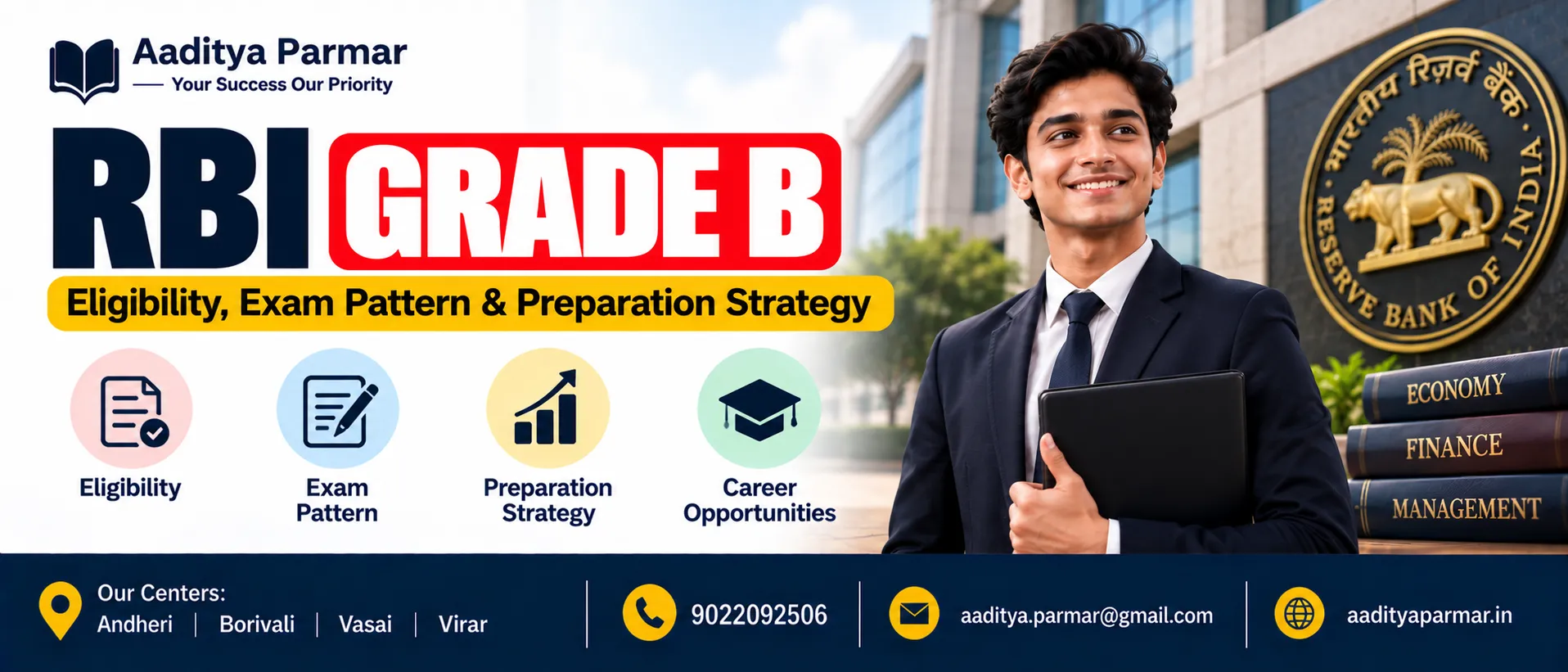
RBI Grade B is one of India’s most sought-after officer-level recruitment examinations for candidates interested in central banking, financial regulation, economics, finance, management and public policy.
For aspirants preparing from Vasai, Virar, Nalasopara, Mumbai, Andheri, Borivali and other parts of the Mumbai Metropolitan Region, RBI Grade B preparation requires a carefully planned approach because the examination is substantially different from a conventional banking recruitment test.
It is not enough to prepare only Quantitative Aptitude, Reasoning and English.
A serious RBI Grade B aspirant needs to build knowledge across:
The latest official RBI Grade B General Cadre Panel Year 2026 recruitment notice provides the current reference point for eligibility, recruitment stages, vacancies, examination dates, application rules and service conditions. RBI notified 40 vacancies for Grade B General in 2026 and scheduled Phase I for June 13, 2026 and Phase II for July 25, 2026.
Because RBI can change dates, vacancies, eligibility requirements, examination structure or other conditions from one recruitment cycle to another, candidates should always verify the latest notification before applying.
This comprehensive guide explains the RBI Grade B examination, eligibility criteria, exam pattern, syllabus, preparation strategy, study plans, mock-test strategy, Phase II preparation, interview preparation and local preparation options for students searching for RBI Grade B coaching in Vasai and Mumbai.
The latest official RBI Grade B General recruitment notice for Panel Year 2026 provides the following reference information:
| Particular | Latest Official 2026 Reference |
|---|---|
| Examination | RBI Grade B (DR) General |
| Conducting Authority | Reserve Bank of India |
| Recruitment | Direct Recruitment |
| 2026 General vacancies | 40 |
| Phase I | Online Examination |
| Phase II | Online Examination |
| Interview | Final selection stage |
| 2026 Phase I date | June 13, 2026 |
| 2026 Phase II date | July 25, 2026 |
| Minimum age | 21 years |
| Maximum age | 30 years, subject to applicable relaxations |
| Graduation requirement | 60% for General; specified concessions for eligible reserved/PwBD candidates |
| Alternative qualification route | Post-graduation with 55%, subject to notification conditions |
| Attempt restriction | General/EWS candidates: maximum six Phase-I appearances under the stated conditions |
| Application mode | Online |
| Posting | Candidates can be posted/transferred anywhere in India |
The above is based on the 2026 official recruitment notice, not a guarantee of the next recruitment cycle.
The Reserve Bank of India Grade B examination is conducted for recruitment of Officers in Grade B.
RBI is India’s central bank and performs major functions associated with monetary policy, banking regulation, financial stability, currency management, payment systems, foreign exchange management and other central-banking responsibilities.
The Grade B General recruitment therefore requires candidates to understand much more than conventional aptitude questions.
The preparation involves:
Aptitude + Banking + Economy + Finance + Management + Current Affairs + Writing Skills
This combination makes RBI Grade B a specialised competitive examination.
A candidate preparing for RBI Grade B needs to think beyond simply “clearing an exam.”
The preparation should develop the ability to:
This is why a structured RBI Grade B preparation strategy is important.
The latest official RBI Grade B General recruitment notice available for Panel Year 2026 was issued on April 29, 2026.
For the General Cadre, RBI notified:
40 vacancies
The distribution listed in the notification was:
The total for Grade B General was 40.
The same recruitment notice scheduled:
Candidates preparing for the next cycle should not assume these dates will repeat.
Eligibility is one of the first things candidates should verify before starting serious preparation.
The latest official 2026 notification specifies eligibility based on:
The exact conditions can change with a future notification.
According to the 2026 official recruitment notice, candidates for Grade B General had to:
The notification states that candidates should have been born not earlier than April 2, 1996 and not later than April 1, 2005 for the 2026 cycle.
The notification provides relaxations for eligible categories and circumstances, including:
The exact relaxation should always be checked against the applicable recruitment notification.
For the General Cadre, the 2026 official notification provides two broad educational routes.
Candidates can qualify with:
Graduation in any discipline with at least 60% marks
or an equivalent technical/professional qualification, subject to the conditions specified by RBI.
For SC/ST/PwBD candidates where the post is reserved, the notification specifies 50% marks at graduation level.
Candidates with:
Post-Graduation in any discipline with at least 55% marks
or an equivalent qualification may be eligible.
The notification specifies pass marks for SC/ST/PwBD candidates where applicable.
For the General Cadre, the answer is broadly yes, subject to the minimum percentage and other eligibility requirements.
Eligible academic backgrounds can include:
The 2026 official notification explicitly permits graduation in any discipline, subject to the prescribed marks and other conditions.
This makes RBI Grade B General accessible to candidates from diverse academic backgrounds.
Candidates should check the specific notification for the relevant recruitment cycle.
The important principle is that educational qualification must be satisfied within the prescribed eligibility date and documentation requirements.
Do not assume that merely being enrolled in the final year automatically satisfies the eligibility requirement.
Before applying, check:
One important feature of RBI Grade B General recruitment is the attempt restriction.
The 2026 notification states that candidates belonging to General/EWS categories who have already appeared six times in Phase I for the relevant Grade B General recruitment are not eligible to apply again.
The notification states that there is no such restriction for SC/ST/OBC/PwBD candidates where the posts are reserved for them.
This means aspirants should not treat attempts casually.
Before applying, maintain a record of your previous Phase-I appearances.
The selection process for Grade B General broadly consists of:
Online objective examination.
Three papers covering:
Candidates who qualify according to the applicable Phase II criteria are called for the interview.
The 2026 official notification explicitly describes selection through Phase I, Phase II and Interview.
The latest 2026 Phase-I result confirms the following maximum marks:
| Section | Maximum Marks |
|---|---|
| General Awareness | 80 |
| English Language | 30 |
| Quantitative Aptitude | 30 |
| Reasoning | 60 |
| Total | 200 |
RBI’s official Phase-I result for the 2026 General examination reports these section-wise maximum marks and a total of 200 marks.
The 2026 Phase-I examination was held on June 13, 2026.
General Awareness is a particularly important part of RBI Grade B preparation because it carries the largest share of the Phase-I paper.
Candidates should prepare:
The key is to avoid treating General Awareness as random GK.
RBI Grade B GA should be prepared with a strong emphasis on:
Economy + Banking + Finance + RBI + Current Affairs
The Reasoning section carries 60 marks in the latest Phase-I structure.
Important preparation areas include:
Determine whether available information is sufficient to solve the question.
Quantitative Aptitude carries 30 marks in the latest Phase-I structure.
Important areas include:
For RBI Grade B, candidates should focus on both:
Accuracy + speed
English carries 30 marks in the latest Phase-I structure.
Important areas include:
However, English preparation should not stop at Phase I.
The Phase-II English paper is descriptive, so candidates must also learn:
Phase II is the stage where candidates need deeper conceptual understanding.
The current structure for Grade B General consists of three papers:
| Paper | Subject | Nature | Marks |
|---|---|---|---|
| Paper I | Economic & Social Issues | Objective + Descriptive | 100 |
| Paper II | English Writing Skills | Descriptive | 100 |
| Paper III | Finance & Management | Objective + Descriptive | 100 |
| Total | 300 |
The current 2026 pattern reported from the recruitment framework uses 30 objective questions in ESI and FM, followed by descriptive components; the English paper is descriptive.
Candidates should verify the exact format in the latest official notification applicable to their examination cycle.
ESI stands for:
Economic and Social Issues
This paper requires candidates to understand the Indian economy and social-development issues.
Important areas include:
Candidates should understand important government schemes and connect them to economic and social objectives.
Do not study ESI like a textbook-only subject.
Use this formula:
Concept → Current Affairs → Data → Government Policy → RBI Perspective → Answer Writing
For example:
Learn:
This creates a much stronger understanding than memorising a definition.
The Finance and Management paper requires candidates to understand the financial system and basic management principles.
Important Finance topics include:
Management topics can include:
Important management theories should be understood rather than memorised mechanically.
The Phase-II English paper evaluates writing ability and understanding.
Candidates should practise:
Learn to write:
A good precis should:
Focus on:
The official framework describes English Writing Skills as a descriptive paper assessing expression and understanding.
Descriptive writing is one of the areas where many otherwise strong candidates need additional practice.
A useful answer structure is:
Define the issue and establish context.
Explain the issue clearly.
Use relevant facts, data, examples or policy references.
Explain causes, effects and implications.
Discuss practical policy or institutional responses.
End with a balanced, forward-looking conclusion.
Suppose the topic is:
“Financial Inclusion and Digital Transformation in India”
Do not simply write a generic essay.
Build it around:
This produces an analytical answer.
Current affairs should be one of the central components of your preparation.
However, candidates should avoid trying to memorise every headline.
Focus on:
Do not create 100-page notebooks.
Use a compact system.
For each important news item, write:
Topic
What happened?
Why is it important?
Relevant data
RBI connection
Economic connection
Possible descriptive question
This method converts current affairs into Phase-II preparation material.
The preparation should be divided into phases.
Build:
Start:
Introduce:
Focus on:
If you are starting from zero, do not immediately start taking full mocks every day.
Start with fundamentals.
Focus on:
Add:
Start:
Increase:
Quantitative Aptitude
Reasoning
English
Basic Economics
Banking basics
ESI
Finance
Management
GA
Current Affairs
Topic tests
Sectional tests
Current affairs revision
Descriptive writing
Full Phase-I tests
Phase-II writing
Finance practice
ESI answer writing
Regular full mocks
Mock analysis
Weak-topic revision
Current affairs
If you have only 90 days, preparation must become highly focused.
Complete fundamentals.
Prioritise:
Increase:
Focus on:
A candidate with sufficient time can use a structure like:
| Activity | Time |
|---|---|
| Current Affairs | 60 minutes |
| Quantitative Aptitude | 60 minutes |
| Reasoning | 60 minutes |
| ESI | 60 minutes |
| Finance/Management | 60 minutes |
| English/Reading | 30 minutes |
| Descriptive Writing | 30 minutes |
| Revision | 30 minutes |
This is only a model.
College students and working professionals can adapt it.
The objective is to create a schedule that can actually be followed.
Working professionals often face one major challenge:
Limited preparation time.
Instead of studying randomly, use high-value blocks.
Current affairs + reading
Revision
Quant/Reasoning
Phase-II + mocks
A working professional should particularly focus on consistency.
Two focused hours every weekday can be more sustainable than creating an unrealistic eight-hour weekday timetable.
Mock tests are essential.
But the score itself is not the only thing that matters.
After every mock, analyse:
Create four categories:
You did not know the concept.
You knew the concept but could not apply it.
You used the correct method but made a numerical mistake.
You spent too much time on a low-value question.
This analysis can dramatically improve future performance.
The latest Phase-I structure gives candidates a limited amount of time for multiple sections, and the 2026 official result confirms the four-section marks distribution.
Do not develop time management for the first time in the actual exam.
Practise it during mocks.
For example:
Aim for quick decision-making.
Avoid getting trapped in a long puzzle.
Identify calculation-heavy questions quickly.
Use reading skills rather than rereading every passage repeatedly.
The 80-mark General Awareness component in the latest Phase-I structure makes GA preparation extremely important.
Build three layers.
Read daily.
Consolidate.
Focus on:
Important banking concepts include:
Candidates should understand how these concepts connect.
Focus on:
Important topics:
The Finance paper should be prepared through both theory and application.
Management preparation should include:
Understand major motivation theories and their practical application.
Study:
Candidates reaching the interview stage should understand that interview preparation is not simply memorising hundreds of facts.
Prepare:
Know:
Know major economic developments.
Be able to discuss important financial and economic news.
Potential areas include:
The RBI 2026 recruitment notice specifies a starting basic pay of ₹78,450 per month for Grade B officers and states that various allowances and benefits are applicable according to RBI rules. It also states that initial appointment is on probation for two years, subject to possible extension under the stated rules.
The notification lists benefits and facilities such as:
Candidates should always use the latest official recruitment notice for the current compensation structure.
The 2026 official notification states that selected candidates are liable to be posted and transferred anywhere in India.
Therefore, candidates should be prepared for a career that may involve working in different RBI offices.
The latest 2026 RBI notification lists Mumbai/Navi Mumbai/Thane/MMR among the Phase-II examination centre options.
This is relevant for candidates preparing from:
Candidates must select examination preferences according to the instructions in the relevant application form.
Students searching for RBI Grade B coaching in Vasai may prefer a structured preparation environment that combines banking awareness, current affairs, aptitude and specialised RBI subjects.
Aaditya Parmar’s current banking-coaching page specifically lists RBI Grade B / Assistant among its banking programmes and describes specialised preparation covering Economics, Finance and Management, alongside mock tests, current affairs and mentoring.
The same page states that the Vasai classroom is located near Vasai Railway Station and describes preparation support including:
Candidates should contact the institute directly to confirm current RBI Grade B batches, faculty, timings, fees and availability.
For candidates searching specifically for RBI Grade B classes in Vasai, useful factors to compare include:
Check whether the faculty can teach:
Ask whether the programme includes:
RBI Grade B preparation requires a continuous current-affairs system.
Specialised subjects can create conceptual doubts, particularly:
For students from Vasai, Virar and nearby areas, commute time can affect consistency.
Aaditya Parmar’s website currently lists its Vasai centre near Vasai Railway Station and provides banking exam preparation that includes RBI Grade B.
Mumbai is a major competitive-exam preparation market.
Students searching for RBI Grade B coaching in Mumbai should compare institutes on:
Aaditya Parmar currently lists banking coaching across Mumbai-area locations and specifically includes RBI Grade B in its banking programme.
For students searching for:
the important comparison criteria remain faculty, curriculum, mock tests and convenience.
Aaditya Parmar currently lists an Andheri branch as part of its Mumbai-area banking-coaching network.
Students from Borivali and nearby western Mumbai areas may search for:
Aaditya Parmar currently lists a Borivali branch among its Mumbai-area centres.
Candidates from Virar may also search for:
Aaditya Parmar’s current branch information includes Virar as part of its Mumbai-area coaching network.
Students living in Vasai-Virar can build a preparation plan around:
Local classes + daily self-study + online current affairs + mock tests + revision
A practical weekly structure can be:
Concept classes and daily practice.
Sectional tests.
Full mock + analysis.
The advantage of a local coaching centre is primarily consistency and access to structured preparation, but candidates should still devote substantial time to self-study.
Mumbai students often have busy college, work and travel schedules.
A practical approach is:
2–3 focused hours.
4–6 focused hours.
Use the weekend for:
College students can start with:
2 hours per day.
3–5 hours.
Increase preparation intensity.
Build the common foundation first.
This prevents the need to start the complete syllabus immediately before the recruitment cycle.
RBI Grade B preparation overlaps with:
Common areas include:
However, RBI Grade B requires much deeper preparation in:
Therefore, candidates should use a common foundation while maintaining RBI-specific preparation.
Avoid collecting too many books.
A practical resource system can include:
One strong aptitude source + practice tests.
One conceptual resource + extensive question practice.
Grammar + vocabulary + reading.
A strong Indian economy resource + RBI material + current affairs.
Banking/financial-system resources + RBI publications.
One comprehensive management resource.
Monthly current-affairs compilation + RBI updates + economic news.
A reliable Phase-I and Phase-II mock-test series.
Previous-year questions can reveal:
But do not assume that the next paper will repeat the same questions.
Use PYQs as:
Practice + Analysis + Pattern Familiarisation
not as a prediction tool.
Use separate notebooks or digital folders for:
Current Affairs
RBI & Banking
Economics
Finance & Management
Mistakes
The mistake notebook should contain:
Revision should happen in cycles.
Within one week.
Within one month.
Before mocks.
Before the examination.
For current affairs:
Daily → Weekly → Monthly → Final Compilation
Accuracy improves when you understand why you make mistakes.
Track:
Conceptual mistakes
Calculation mistakes
Reading mistakes
Guessing mistakes
Time-management mistakes
If the same error appears five times, it is no longer a small mistake.
It is a preparation problem that needs targeted revision.
The exams overlap, but RBI Grade B requires deeper economic, financial and descriptive preparation.
Candidates should not wait until after Phase I to begin learning ESI and Finance.
Reading once is not enough.
Writing is a skill.
It must be practised.
A score without analysis provides limited learning.
Too many books create fragmented preparation.
RBI-related material is particularly relevant to RBI-focused preparation.
Conceptual understanding makes current affairs easier to retain.
This is especially important given the RBI’s attempt restriction for General/EWS candidates under the applicable rules.
Starting after the notification may leave insufficient time for Phase-II preparation.
Revise:
Focus on:
Full-length testing.
Error revision.
Light revision and exam strategy.
RBI Grade B is an officer-level direct recruitment examination conducted by the Reserve Bank of India for eligible candidates in specified cadres.
For the 2026 General recruitment, candidates needed to satisfy the prescribed age and educational requirements, including 60% in graduation or 55% in post-graduation under the specified rules.
For the 2026 General recruitment, the age was 21–30 years as of April 1, 2026, subject to applicable relaxations.
For Grade B General, the 2026 notification permits graduation in any discipline subject to the required percentage and other eligibility conditions.
The selection process consists of Phase I, Phase II and Interview. The latest Phase-I structure contains General Awareness, Reasoning, English and Quantitative Aptitude. Phase II contains Economic and Social Issues, English Writing Skills, and Finance and Management.
The latest official Phase-I result confirms a total of 200 marks.
Phase II consists of three 100-mark papers, for an aggregate of 300 marks under the current structure.
The three papers are:
The examination requires a broad combination of aptitude, current affairs, economics, finance, management and descriptive writing. The difficulty therefore depends heavily on the candidate’s preparation depth and ability to manage time.
Beginners should start with the Phase-I foundation while simultaneously building basic knowledge of Economics, Finance, Banking and current affairs.
Yes. Self-study is possible with the right books, official material, current affairs resources, mock tests and disciplined revision.
Coaching can provide structure, faculty guidance, mock tests, current affairs support, doubt solving and descriptive preparation. Whether it is necessary depends on the candidate.
Aaditya Parmar currently lists RBI Grade B / Assistant preparation among its banking programmes and has a banking coaching centre in Vasai near Vasai Railway Station.
Its current banking programme includes RBI Grade B preparation, and the institute lists multiple Mumbai-area centres.
Preparation should cover current affairs, banking, RBI, economy, finance, government policies, financial institutions, reports, international developments and major national events.
ESI means Economic and Social Issues and forms one of the Phase-II papers.
FM means Finance and Management and forms another Phase-II paper.
Current affairs are highly relevant, especially for General Awareness and Phase-II subjects where contemporary economic, banking and financial developments can provide context.
For the 2026 General recruitment, General/EWS candidates who had already appeared six times in Phase I were not eligible to apply again under the stated rules.
The 2026 official notification states a starting basic pay of ₹78,450 per month, with applicable allowances and benefits.
Yes. Working professionals can use weekday study blocks and longer weekend sessions.
There is no universal number. The required time depends on your existing knowledge, preparation duration and target cycle. Consistent focused study is more important than copying someone else’s timetable.
Yes. Waiting until Phase I results can create unnecessary time pressure. Phase-II preparation should begin alongside Phase-I preparation.
Yes. Mock tests help develop speed, accuracy, question selection and exam temperament.
Practise essays, precis, comprehension and analytical writing under timed conditions.
A useful daily combination is:
A balanced strategy combines:
Concepts + Current Affairs + Practice + Mocks + Descriptive Writing + Revision
No. Grade B General allows graduates from different disciplines subject to the applicable educational requirements.
A B.Com graduate can apply for Grade B General if the candidate satisfies the applicable eligibility and percentage requirements.
Yes, engineering graduates can be eligible for Grade B General subject to the applicable qualification requirements.
Candidates who set an ambitious 95+ performance target should avoid focusing only on the number.
Instead, break the goal into skills:
Reduce avoidable errors.
Solve standard questions quickly.
Build strong current-affairs retention.
Understand concepts and applications.
Understand banking and financial systems.
Develop clear analytical answers.
Improve consistently over time.
A high target should therefore be used as a preparation benchmark, not as a guarantee of selection.
One useful approach is to divide current affairs into five folders:
At the end of each month, revise the five folders.
For a 15-mark analytical question, use:
Introduce the issue.
Explain the concept.
Add relevant contemporary information.
Explain positive effects.
Discuss limitations.
Suggest realistic solutions.
Give a balanced conclusion.
This structure can make answers easier to evaluate and easier to write under pressure.
After each mock, record:
| Metric | Result |
|---|---|
| Total score | |
| Attempts | |
| Accuracy | |
| GA score | |
| Reasoning score | |
| Quant score | |
| English score | |
| Questions left | |
| Calculation errors | |
| Concept errors | |
| Guessing errors | |
| Time-management issue | |
| Next revision topic |
Maintain this over several mocks.
You will begin to see patterns in your performance.
For students searching online for RBI Grade B coaching in Vasai, RBI Grade B classes in Vasai, RBI Grade B coaching in Mumbai, or RBI banking coaching near Mumbai, local accessibility can be an important factor.
Aspirants should compare:
Aaditya Parmar’s current banking programme specifically includes RBI Grade B / Assistant preparation and describes specialised Economics, Finance and Management preparation, mock tests, current affairs and mentoring.
The institute also lists Mumbai-area centres including Vasai, Andheri, Borivali and Virar.
Candidates in Vasai and surrounding areas can benefit from establishing a routine well before the examination notification.
A long preparation period allows time for:
Starting early also reduces the temptation to study everything in the final few weeks.
Mumbai offers a large competitive-examination ecosystem, but students also face:
A dedicated plan helps candidates decide what to study and when.
The most important principle is:
Do not confuse being busy with being prepared.
Preparation should produce measurable improvement.
If you are starting today, follow this sequence:
Check eligibility.
Understand the official notification.
Take a diagnostic Phase-I test.
Build Quant and Reasoning basics.
Build English fundamentals.
Start daily current affairs.
Study RBI and banking.
Begin ESI.
Begin Finance and Management.
Start descriptive writing.
Take sectional tests.
Start full-length mocks.
Analyse every mock.
Revise weak topics.
Prepare for Phase II well before Phase I.
Develop interview awareness.
RBI Grade B is a specialised officer-level competitive examination that requires much more than conventional banking aptitude preparation.
A successful preparation framework needs to combine:
General Awareness + Banking Awareness + Quantitative Aptitude + Reasoning + English + Economics + Finance + Management + Descriptive Writing + Current Affairs + Mock Tests
The latest RBI Grade B General recruitment information provides a clear example of the level of preparation required. For Panel Year 2026, RBI notified 40 Grade B General vacancies, required candidates to satisfy prescribed age and educational criteria, and followed a selection process involving Phase I, Phase II and Interview.
The latest Phase-I result confirms the 200-mark structure comprising:
For Phase II, candidates must develop deeper knowledge of:
The biggest mistake an aspirant can make is to treat RBI Grade B as just another banking examination.
It requires a more comprehensive approach.
Start with fundamentals.
Build daily current-affairs habits.
Understand RBI and the Indian financial system.
Develop economics and finance knowledge.
Practise descriptive writing.
Take mocks.
Analyse mistakes.
Revise repeatedly.
For students looking for RBI Grade B coaching in Vasai or Mumbai, choose a preparation system based on faculty quality, RBI-specific content, current-affairs support, mock tests, Phase-II preparation, descriptive practice and mentoring rather than relying only on promotional claims.
Aaditya Parmar currently lists RBI Grade B / Assistant preparation within its banking programme and provides banking coaching facilities in Vasai and other Mumbai-area locations.
The most important rule remains simple:
Start early. Study consistently. Understand the concepts. Practise under time pressure. Analyse your mistakes. Keep updating your preparation from the latest official RBI notification.
Phone: 9022092506
Email: aaditya.parmar@gmail.com
Website: https://aadityaparmar.in
Andheri | Borivali | Vasai | Virar | Chembur
For current RBI Grade B batches, timings, fees, faculty availability and course details, candidates should contact the institute directly. The current website lists RBI Grade B / Assistant preparation and the Vasai banking centre.