

Seating Arrangement is an important topic in the Reasoning Ability section of competitive examinations such as SBI PO, SBI Clerk, IBPS PO, IBPS Clerk, RBI Assistant, SSC CGL, SSC CHSL, RRB NTPC, and other Railway recruitment exams.
This topic evaluates a candidate’s ability to understand relationships, interpret conditions, and arrange information logically. Questions may involve people sitting in a row, around a circular table, or in different seating patterns.
With regular practice and a clear understanding of the basic rules, candidates can improve their speed, accuracy, and overall performance in the Reasoning section.
Seating Arrangement is a logical reasoning topic in which candidates are provided with a set of people and several conditions describing their seating positions.
The objective is to determine the correct arrangement by analyzing the given clues and answering the questions that follow.
For example, a question may state that five people are sitting in a row, A is to the left of B, C is sitting at one end, and D is not sitting next to E. Using these conditions, candidates must identify the possible seating order.
The main elements of seating arrangement questions include:
Relative positions of people
Left and right directions
Immediate neighbours
Positions at the ends or in the middle
Circular and linear seating patterns
Relationships between different positions
Multiple conditions and logical deductions
The most effective approach is to read every clue carefully and represent the available information through a diagram.
Seating Arrangement is a useful topic for candidates preparing for banking, SSC, and Railway examinations. It tests logical thinking, attention to detail, and the ability to solve problems systematically.
In banking examinations, these questions frequently appear as part of the Reasoning Ability section. In SSC and Railway examinations, they may be included under General Intelligence and Reasoning.
Learning this topic can help candidates develop skills that are also useful for solving puzzles, ordering problems, and other reasoning questions.
1. Improves Logical Reasoning
Candidates learn to connect different clues and identify relationships between people or objects.
2. Develops Analytical Skills
Questions require candidates to evaluate multiple conditions and determine which arrangements satisfy all the given statements.
3. Helps Improve Accuracy
Drawing a proper diagram reduces confusion and helps prevent mistakes while interpreting positions.
4. Builds Problem-Solving Speed
Regular practice helps candidates recognize familiar patterns and solve questions more efficiently.
5. Supports Preparation for Multiple Exams
The concepts of seating arrangement are useful across banking, SSC, and Railway recruitment examinations, although the question formats and difficulty levels may differ.
Candidates should become familiar with the following common patterns:
In a linear arrangement, people sit in a straight row. Questions may involve people facing north or south, and the direction in which they face affects the interpretation of left and right.
In a circular arrangement, people sit around a circular table. They may face the centre or face outward, which changes the meaning of their left and right positions.
In this type, people sit around a square or rectangular table. Some questions may include people sitting at corners and along the sides.
Two or more rows of people sit opposite one another. Candidates must consider both the seating positions and the directions in which the people face.
These questions contain several conditions that may require candidates to consider different possible arrangements before identifying the correct one.
Follow these steps to approach seating arrangement problems systematically:
Read the complete question: Identify the number of people, the seating pattern, and the direction in which they are facing.
Identify fixed information: Start with clues that specify an exact position or establish a definite relationship.
Draw a diagram: Represent the available seats using boxes for a row or a circle for a circular arrangement.
Apply each condition: Add the remaining information one clue at a time.
Check all possibilities: If the clues do not establish a unique arrangement immediately, consider the possible cases.
Verify the arrangement: Make sure every clue is satisfied before answering the questions.
Answer carefully: Read the question again to confirm whether it asks for an immediate neighbour, a relative position, or the person sitting at a particular place.
Learn the basic direction rules before attempting difficult questions.
Practise linear arrangements before moving to complex circular puzzles.
Avoid making assumptions that are not supported by the clues.
Use clear diagrams to track each person’s position.
Solve questions without looking at the solutions first.
Review incorrect answers to understand where the reasoning went wrong.
Practise with a timer once you are comfortable with the concepts.
Seating Arrangement is an important reasoning topic for aspirants preparing for banking, SSC, and Railway examinations. A strong understanding of directions, positions, and logical conditions makes these questions easier to approach.
Candidates should focus on understanding the concepts, practising different arrangement patterns, and checking every clue carefully. Consistent practice can help improve both accuracy and time management in competitive examinations.
Five persons A, B, C, D and E are sitting in a row, all facing North.
A sits immediately to the left of B.
C sits immediately to the right of B.
D sits to the left of A.
E sits to the right of C.
Question: Who sits in the middle?
Step 1: Draw the row
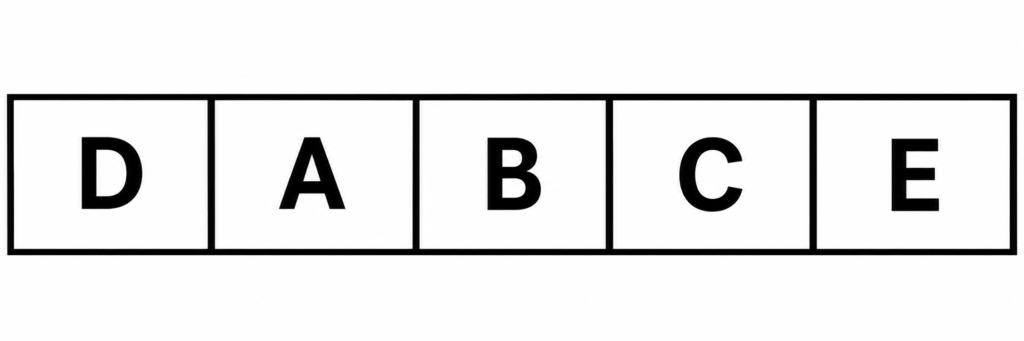
Step 2: Apply the clues
A sits immediately to the left of B.
C sits immediately to the right of B.
D sits to the left of A.
E sits to the right of C.
Final answer: B sits in the middle
Five persons P, Q, R, S and T sit in a row, all facing South.
P sits at the extreme left end of the row.
Q sits immediately to the right of P.
R sits immediately to the right of Q.
S sits immediately to the right of R.
T occupies the remaining seat.
Question: Who sits in the middle?
Solution:
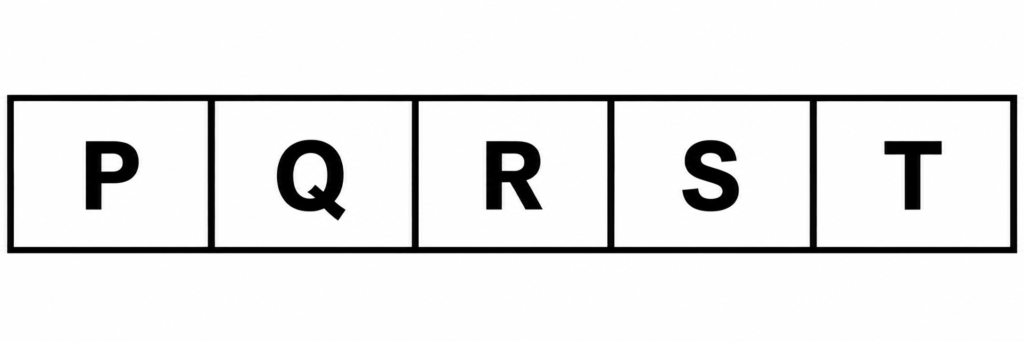
The arrangement is P – Q – R – S – T. The third position is occupied by R.
Answer: R
Four persons A, B, C and D sit around a circular table, all facing the centre.
B sits immediately to the right of A.
C sits opposite A.
D occupies the remaining seat.
Question: Who sits opposite B?
Solution:
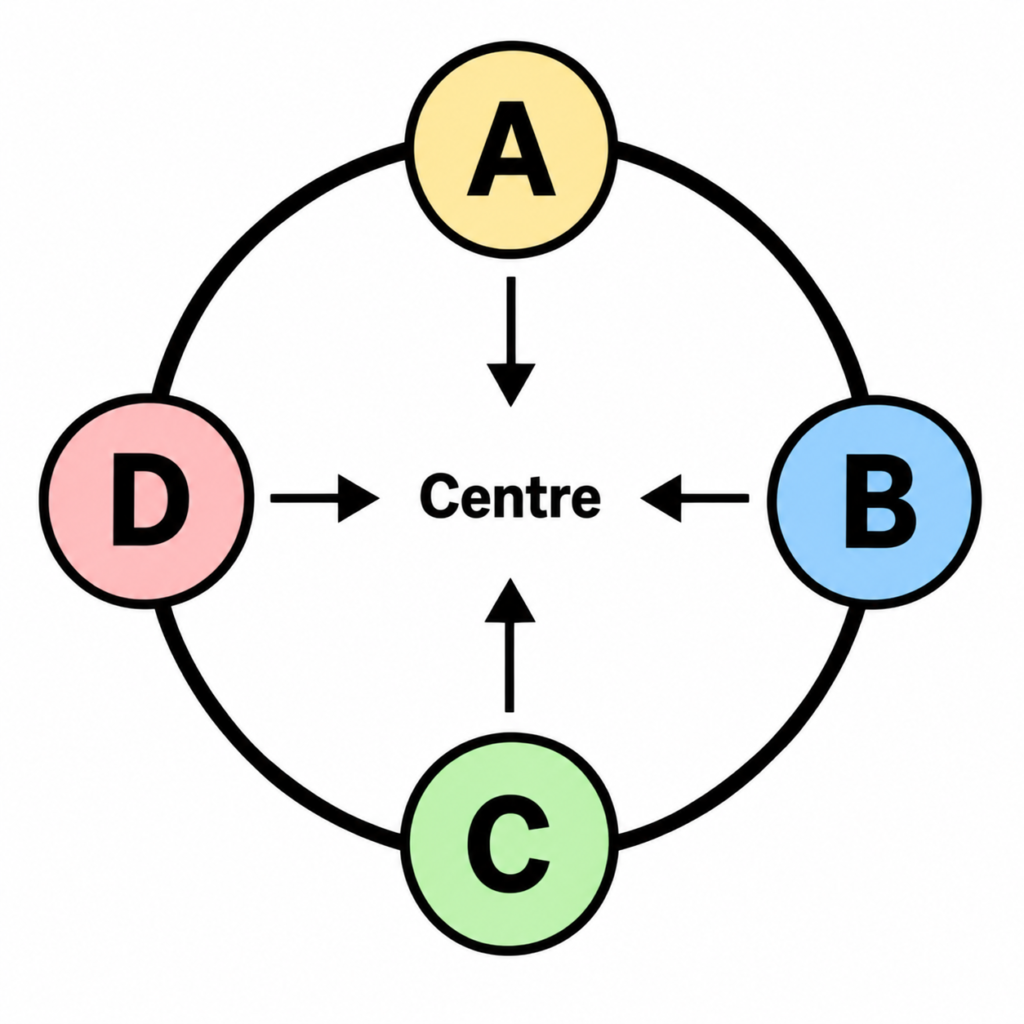
A and C are opposite each other. B and D occupy the remaining opposite positions.
Answer: D
Four persons A, B, C and D sit at the four corners of a square table, facing the centre.
A sits at the top-left corner.
B sits immediately clockwise from A.
C sits opposite A.
D occupies the remaining corner.
Question: Who sits opposite B?
Solution:
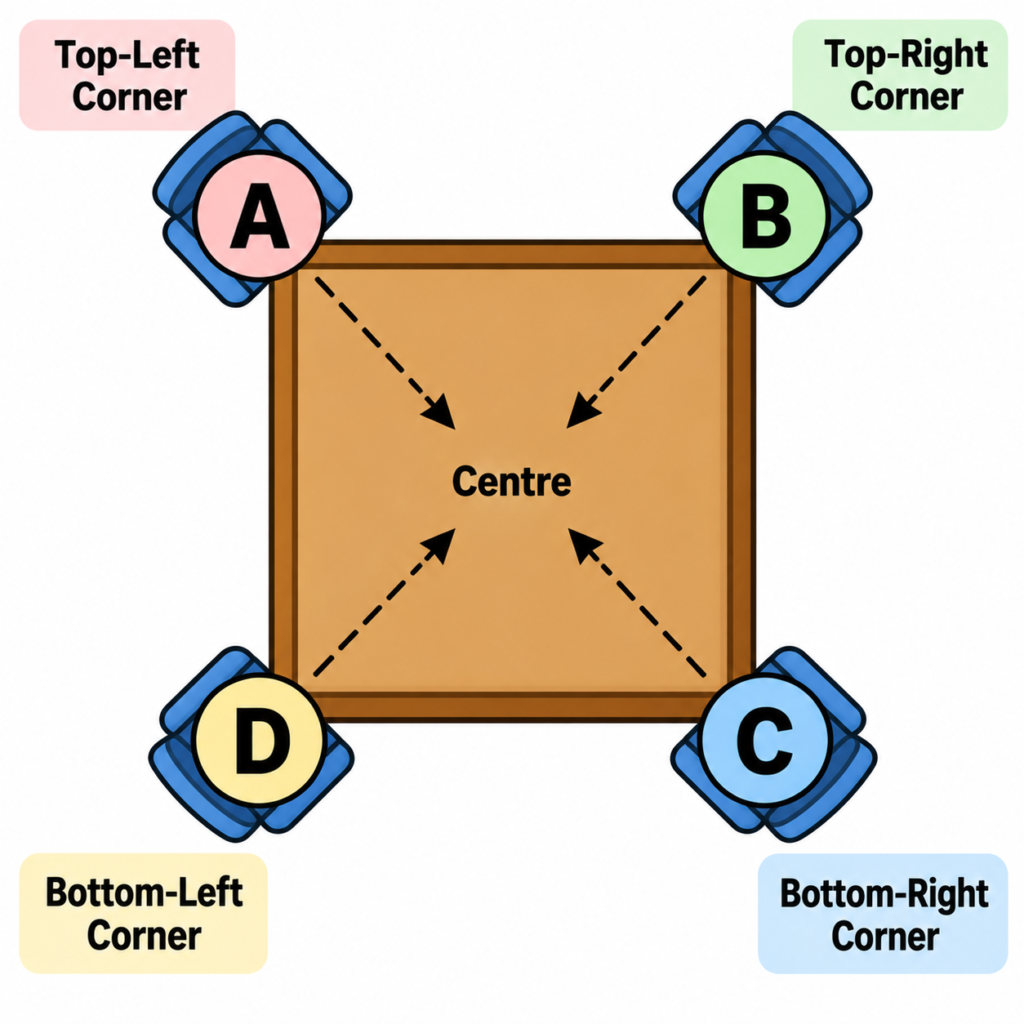
B and D occupy diagonally opposite corners.
Answer: D
Four persons A, B, C and D sit in the first row facing South. Four persons P, Q, R and S sit in the second row facing North. Each person faces exactly one person in the opposite row.
A faces P.
B faces Q.
C faces R.
D faces S.
Question: Who faces C?
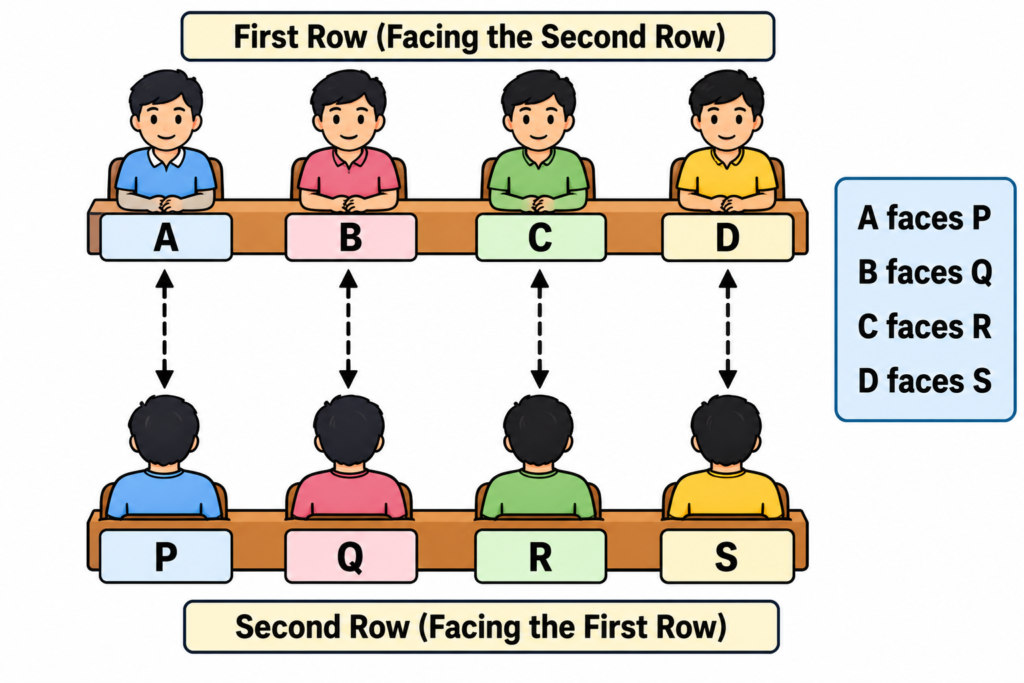
C faces R, so R is the required person.
Answer: R
Try these questions without checking the answers first.
Six persons P, Q, R, S, T and U sit in a row facing North.
P sits at the extreme left end.
Q sits immediately to the right of P.
R sits immediately to the right of Q.
S sits immediately to the right of R.
T sits immediately to the right of S.
Who sits at the extreme right end?
Six persons A, B, C, D, E and F sit around a circular table, facing the centre.
A sits opposite D.
B sits immediately to the right of A.
C sits immediately to the right of B.
E sits opposite B.
F occupies the remaining seat.
Who sits opposite C?
Five persons K, L, M, N and O sit in a row facing North.
K sits immediately to the left of L.
M sits immediately to the right of L.
N sits immediately to the right of M.
O occupies the remaining seat at the left end.
Who sits in the middle?
Four persons W, X, Y and Z sit at the four corners of a square table facing the centre.
W sits opposite Y.
X sits immediately clockwise from W.
Z occupies the remaining corner.
Who sits opposite X?
Three persons A, B and C sit in the first row facing South. Three persons P, Q and R sit in the second row facing North. Each person faces exactly one person in the opposite row.
A faces P.
B faces Q.
C faces R.
Who faces B?