
Puzzle is an important topic in the Reasoning Ability section of competitive examinations. It is commonly included in banking exams such as SBI PO, SBI Clerk, IBPS PO, IBPS Clerk and RBI Assistant. Puzzle-based reasoning may also appear in SSC and Railway recruitment examinations, depending on the exam pattern.
Puzzle questions test a candidate’s ability to understand information, identify relationships, apply logical conditions and reach a correct conclusion.
In these questions, candidates are given a set of statements or clues. Their task is to arrange the information systematically and answer the questions based on the given conditions.
Regular practice helps candidates improve their logical thinking, accuracy, analytical skills and time management.
A puzzle is a logical problem in which several pieces of information are provided, and candidates must use those clues to determine the correct arrangement or relationship.
The information may be related to people, floors, buildings, days, months, professions, cities, ages or other objects.
Example:
Five persons A, B, C, D and E live on five different floors of a building. The ground floor is numbered 1 and the top floor is numbered 5.
A lives above B.
C lives on the top floor.
D lives immediately below C.
B lives on the ground floor.
Using these clues, candidates must determine the floor occupied by each person.
Step 1: C lives on floor 5.
Step 2: D lives immediately below C, so D lives on floor 4.
Step 3: B lives on floor 1.
Step 4: A lives above B, but this clue alone does not establish A’s exact floor.
The remaining floors are 2 and 3, which must be occupied by A and E. Their exact positions cannot be determined from the given information.
Important lesson: Never assume information that is not provided in the question. If the clues do not establish a unique arrangement, acknowledge the possible alternatives.
Puzzle questions are useful for assessing several reasoning skills.
Candidates must understand how one clue relates to another and determine which conclusions are valid.
Many puzzles contain multiple conditions. Candidates need to combine these conditions without overlooking any detail.
A small mistake in interpreting a clue may affect the entire arrangement. Careful diagram-making helps reduce errors.
Competitive examinations have limited time. Learning systematic solving methods can help candidates solve questions more efficiently.
Puzzle practice develops the ability to divide a complex problem into smaller, manageable steps.
Candidates preparing for Banking, SSC and Railway exams should become familiar with the following common formats.
In a floor-based puzzle, people live on different floors of a building. The clues may describe who lives above or below another person, or whether someone lives immediately above or below another person.
Common clues include:
A lives above B.
C lives immediately below D.
E lives on the top floor.
F lives on an even-numbered floor.
In this type, people or objects are arranged in a straight line. The clues may describe their positions, neighbours or directions.
Example clues:
A sits to the left of B.
C sits between A and D.
E sits at the extreme right end.
People sit around a circular table. Some questions specify that everyone faces the centre, while others specify that everyone faces outward.
Candidates must understand the effect of facing direction on left and right.
These puzzles involve people assigned to different days, dates or months.
Example clues:
A attends a meeting in March.
B attends two months after A.
C attends in June.
Candidates use the clues to establish the correct schedule.
Different boxes are arranged vertically or horizontally. The clues describe which box is above, below or between other boxes.
People are assigned different activities, interviews, examinations or appointments at particular times or on particular days.
Candidates compare quantities or characteristics such as age, height, weight, salary or marks.
Example clues:
A is taller than B.
C is shorter than B.
D is taller than A.
These statements establish a relative order among the individuals.
Different people are associated with different cities, professions, colours, subjects or other attributes. Candidates must determine the correct combinations using the clues.
A mixed puzzle combines two or more formats, such as floor positions with professions, or seating arrangements with cities.
These questions may require candidates to maintain multiple sets of information simultaneously.
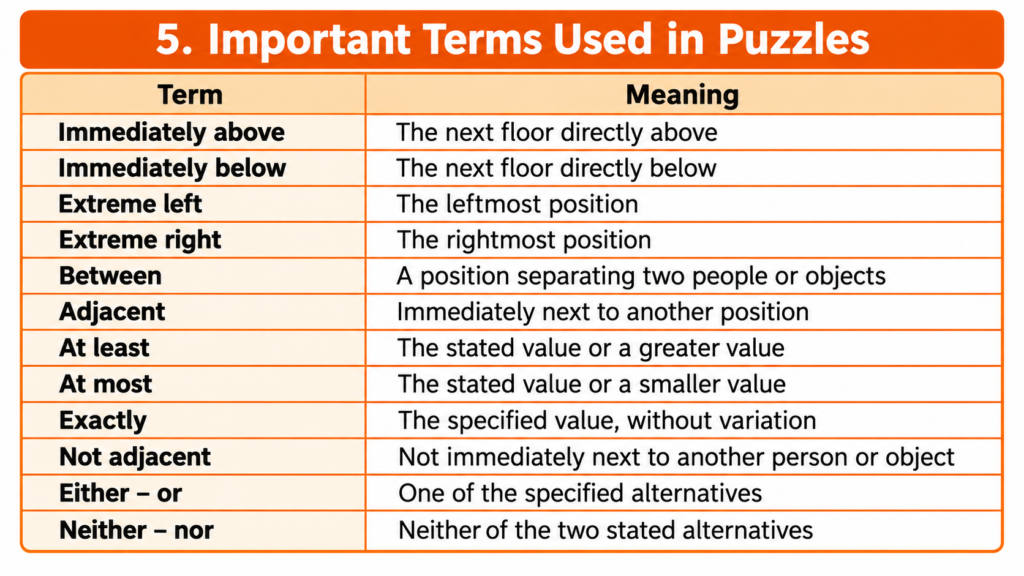
Read all the clues before finalising an arrangement. This gives you an overview of the problem.
Determine what needs to be arranged, such as people, floors, days, cities or professions.
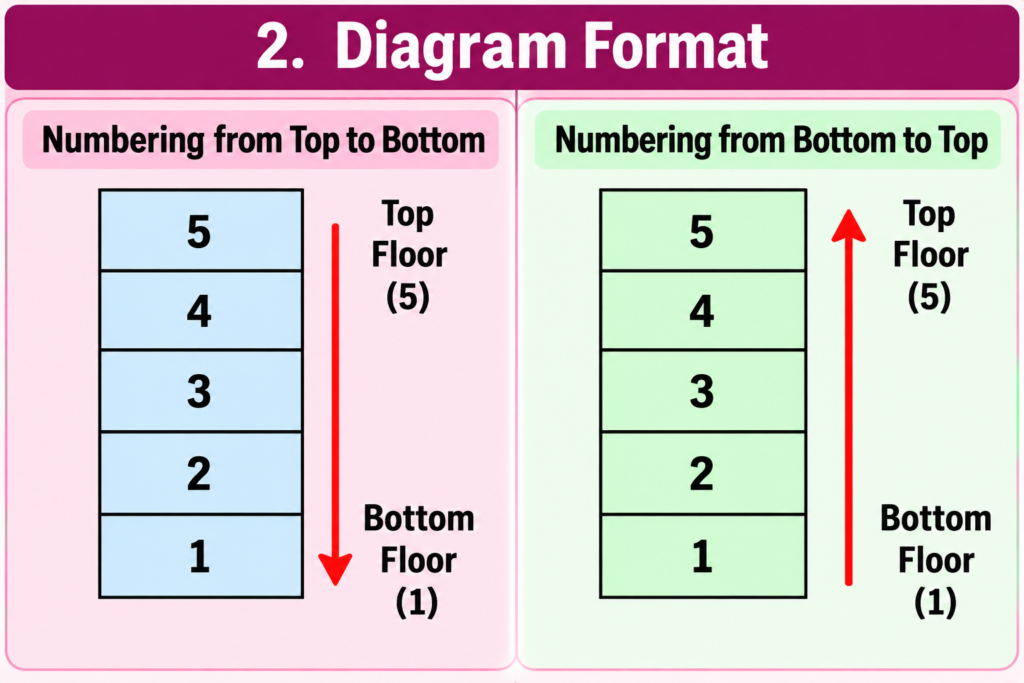
Choose a format that matches the puzzle.
For example, a floor puzzle with five floors can be represented as:
Start with statements that give an exact position or a definite relationship.
Examples include:
A lives on the fifth floor.
B sits at the extreme left.
C attends the meeting on Monday.
Use the fixed positions to interpret the other conditions. Update your diagram carefully.
If more than one arrangement is possible, create separate cases and eliminate those that violate a clue.
Check the complete arrangement against every statement in the question.
Once the arrangement is established, answer the questions carefully. Do not rely on an arrangement that has not been fully verified.
Question:
Five persons A, B, C, D and E live on five different floors numbered 1 to 5, where floor 1 is the ground floor and floor 5 is the top floor.
The following information is given:
A lives on the top floor.
B lives immediately below A.
C lives on the ground floor.
D lives immediately above C.
E occupies the remaining floor.
Determine the floor occupied by each person.
Step 1: A lives on floor 5.
Step 2: B lives immediately below A, so B lives on floor 4.
Step 3: C lives on floor 1.
Step 4: D lives immediately above C, so D lives on floor 2.
Step 5: E occupies the only remaining floor, which is floor 3.
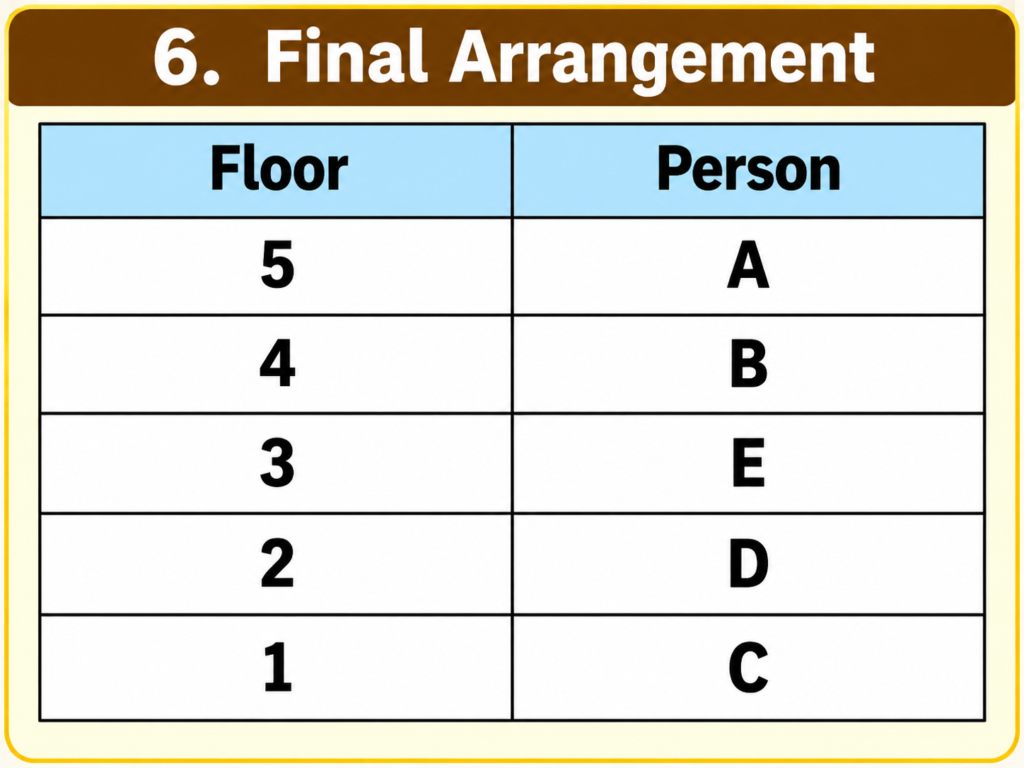
Answer: E lives on floor 3.
Reading only the first few clues before making assumptions.
Confusing immediately above with somewhere above.
Ignoring the direction in which people are facing.
Forgetting a condition while combining different clues.
Assuming that an arrangement is unique when several arrangements may satisfy the information.
Making unnecessary assumptions to fill empty positions.
Spending too much time on a single difficult puzzle without checking alternative cases.
Begin with basic floor-based and linear arrangement puzzles.
Practise one puzzle type at a time until the rules become familiar.
Use tables, boxes and simple diagrams instead of keeping every clue in memory.
Attempt the questions independently before reading their solutions.
Review mistakes and identify which clue was interpreted incorrectly.
Practise mixed puzzles after mastering the individual formats.
Use timed practice to improve speed while maintaining accuracy.
Check the official notification and syllabus for your target examination because the importance and format of reasoning questions can vary.
Puzzles are an important part of logical reasoning preparation for many competitive examinations. They require candidates to interpret clues, organise information and identify conclusions through systematic reasoning.
A strong foundation in the basic concepts makes it easier to approach more complicated problems. Candidates should focus on understanding the clues, drawing clear diagrams, checking every condition and practising regularly.
With consistent effort, puzzle-solving can become a more manageable and efficient part of competitive exam preparation.
Five persons A, B, C, D and E live on five different floors of a building. Floor 1 is the ground floor and floor 5 is the top floor.
Clues:
A lives on the top floor.
B lives immediately below A.
C lives on the ground floor.
D lives immediately above C.
E lives on the remaining floor.
Question: Who lives on the third floor?
Step-by-step solution
Step 1: A lives on floor 5.
Step 2: B lives immediately below A, so B lives on floor 4.
Step 3: C lives on floor 1.
Step 4: D lives immediately above C, so D lives on floor 2.
Step 5: E occupies the remaining floor, floor 3.
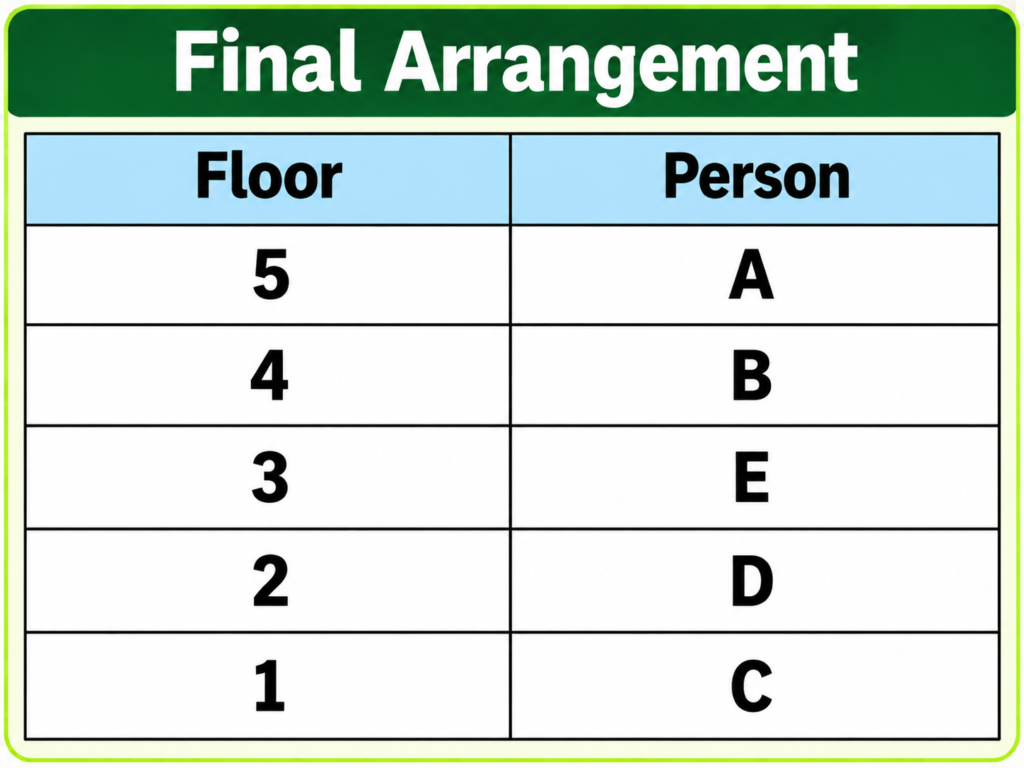
Answer: E lives on the third floor.
Six persons P, Q, R, S, T and U live on six different floors of a building. Floor 1 is the ground floor and floor 6 is the top floor.
Clues:
P lives on the top floor.
Q lives immediately below P.
R lives on the ground floor.
S lives immediately above R.
T lives above S but below Q.
U lives on the remaining floor.
Question: Who lives on the fourth floor?
Step-by-step solution
Step 1: P lives on floor 6.
Step 2: Q lives immediately below P, so Q lives on floor 5.
Step 3: R lives on floor 1.
Step 4: S lives immediately above R, so S lives on floor 2.
Step 5: T lives above S but below Q. The available floors are 3 and 4, so T could initially occupy either one.
Step 6: U occupies the other available floor.
The clues do not determine whether T or U lives on floor 4. Both arrangements satisfy all the conditions.
For a uniquely solvable question, add one more clue: T lives immediately above S.
Now T lives on floor 3 and U lives on floor 4.
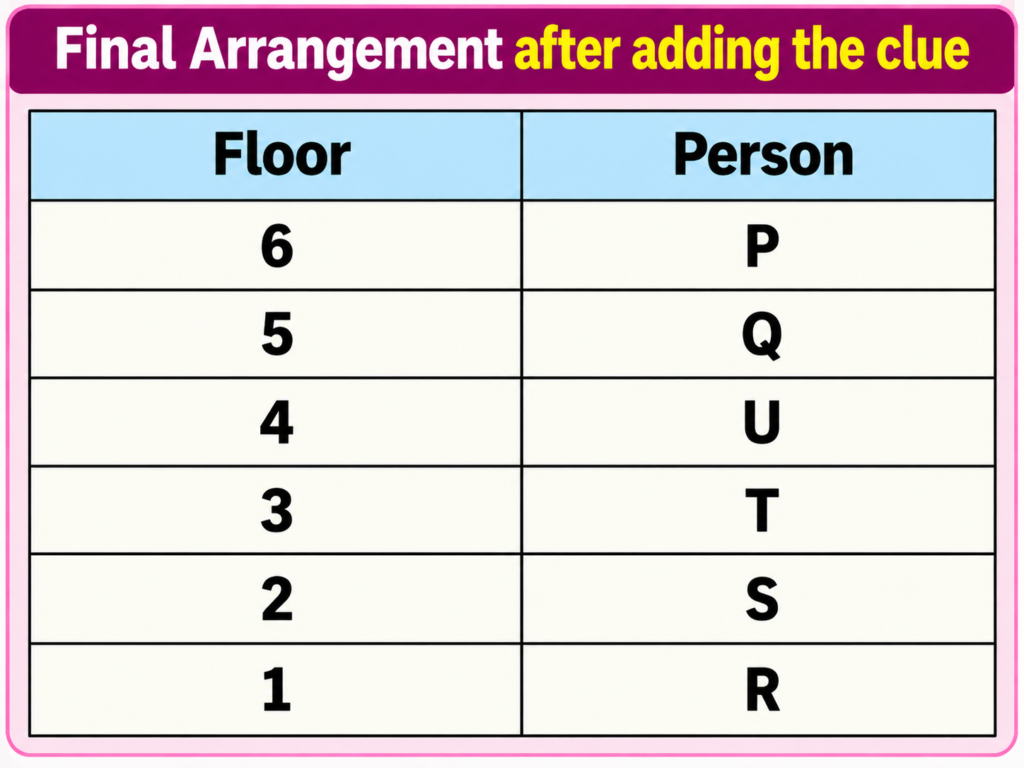
Answer: U lives on the fourth floor after the additional clue is applied.
Try to solve these questions independently before checking the answer key.
Five persons A, B, C, D and E live on five different floors of a building. Floor 1 is the ground floor and floor 5 is the top floor.
Clues:
M lives on the top floor.
N lives immediately below M.
O lives on the ground floor.
P lives immediately above O.
Q lives on the remaining floor.
Question: Who lives on the third floor?
Six persons A, B, C, D, E and F live on six different floors of a building. Floor 1 is the ground floor and floor 6 is the top floor.
Clues:
A lives on the top floor.
B lives immediately below A.
C lives on floor 2.
D lives immediately above C.
E lives below B but above D.
F lives on the remaining floor.
Question: Who lives on the fourth floor?