
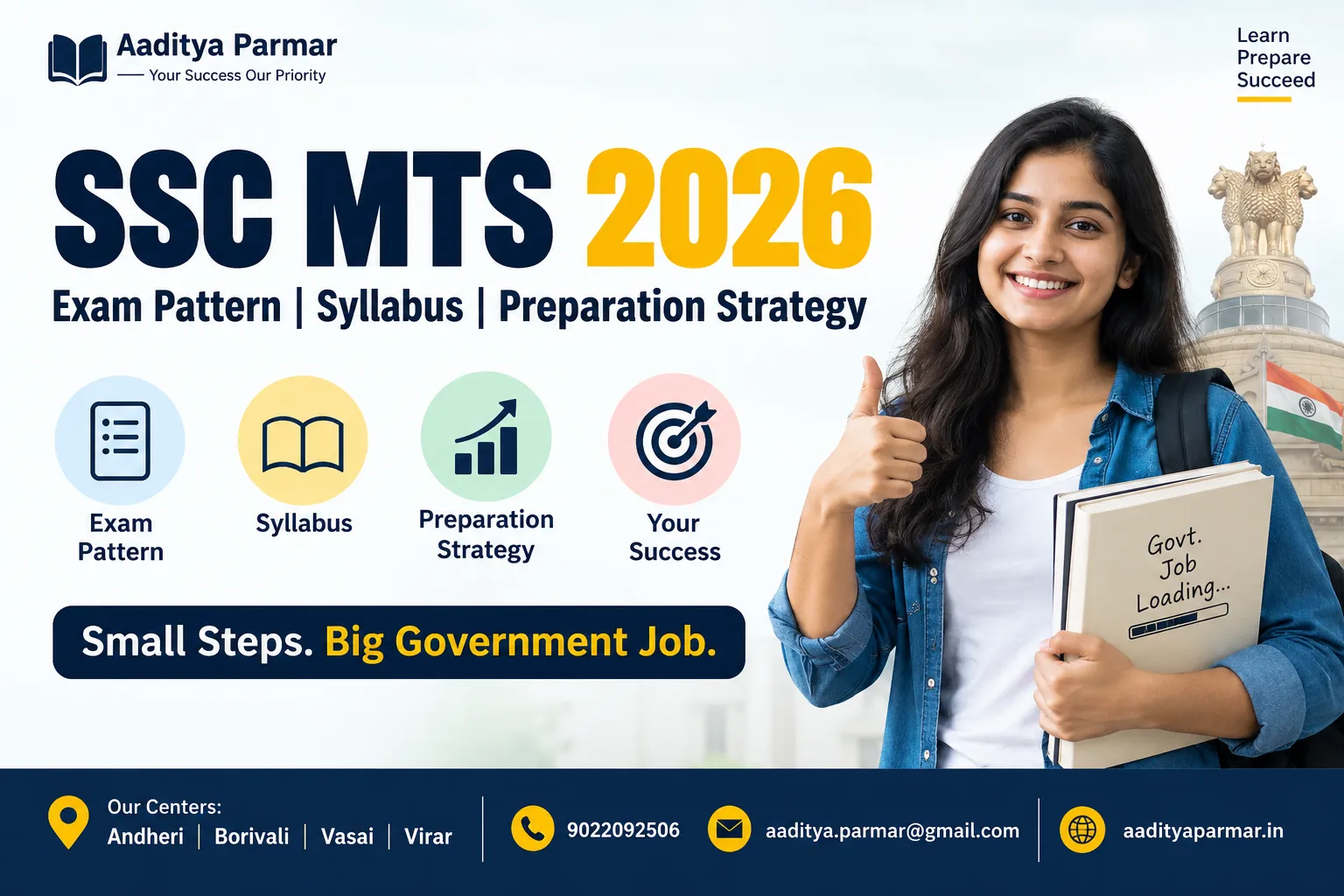
The SSC MTS 2026 examination is an important opportunity for candidates looking to secure a government job through the Staff Selection Commission (SSC). The Multi-Tasking (Non-Technical) Staff examination is designed to recruit candidates for various non-technical Group C positions in different departments and offices of the Government of India.
For aspirants preparing for SSC MTS 2026, understanding the exam pattern, syllabus, marking scheme, important topics, selection process and preparation strategy is essential. Rather than studying every topic randomly, candidates should create a structured plan that combines concept building, regular practice, previous-year questions and mock tests.
The SSC’s official website currently lists the Multi Tasking (Non-Technical) Staff Examination, 2026 in its examination calendar. Candidates should always verify the latest notification, application dates, vacancies, eligibility requirements and examination schedule directly from SSC before making final decisions.
This detailed guide explains everything an SSC MTS aspirant needs to know, including the SSC MTS 2026 exam pattern, syllabus, subject-wise preparation, time management, mock-test strategy, common mistakes and a practical study plan.
Government examinations continue to attract a large number of candidates because they provide opportunities for stable employment, structured career progression and the possibility of working in different government departments.
Among the examinations conducted by the Staff Selection Commission, SSC MTS is particularly relevant for candidates seeking recruitment to Multi-Tasking Staff positions.
However, competition means that simply appearing for the examination is not enough. Candidates need to understand exactly what is tested and develop speed and accuracy before the examination.
The most effective SSC MTS preparation strategy is based on four pillars:
The SSC MTS examination uses a Computer Based Examination (CBE) structure. In the latest available SSC MTS scheme, the CBE is divided into Session-I and Session-II. Session-I contains Numerical and Mathematical Ability and Reasoning Ability and Problem Solving, while Session-II contains General Awareness and English Language and Comprehension. The 2025 official notification specified 20 questions/60 marks for each Session-I subject and 25 questions/75 marks for each Session-II subject.
Because examination rules can be updated from one recruitment cycle to another, candidates should treat the latest 2026 notification issued by SSC as the final authority.
SSC MTS stands for Staff Selection Commission Multi-Tasking (Non-Technical) Staff.
The examination is conducted by the Staff Selection Commission for recruitment to Multi-Tasking Staff positions in various ministries, departments and offices of the Government of India.
The job is classified as a non-technical Group C position. Depending on the department and assigned responsibilities, MTS employees may perform a variety of supporting administrative and operational duties.
For candidates who have completed the required educational qualification and want to enter government service, SSC MTS can be an important competitive examination.
The SSC’s official website lists Multi Tasking (Non-Technical) Staff Examination, 2026 in its examination calendar. The current SSC calendar shows 30 June 2026 against the MTS examination entry. However, examination calendars and schedules can be revised, so candidates should rely on the latest official notice/admit-card instructions for the final examination schedule.
Before applying or appearing for SSC MTS 2026, candidates should check:
The official SSC website should remain the primary source for all final examination information.
Understanding the examination pattern is one of the first steps in preparation.
The latest official SSC MTS examination scheme available for reference divides the Computer Based Examination into two sessions.
| Session | Subject | Questions | Marks | Duration |
|---|---|---|---|---|
| Session-I | Numerical and Mathematical Ability | 20 | 60 | 45 minutes |
| Session-I | Reasoning Ability and Problem Solving | 20 | 60 | 45 minutes |
| Session-II | General Awareness | 25 | 75 | 45 minutes |
| Session-II | English Language and Comprehension | 25 | 75 | 45 minutes |
The 2025 SSC MTS notification specifies separate 45-minute sessions, with an extended duration for eligible candidates using a scribe.
Session-I and Session-II should not be treated as identical.
The official scheme states that Session-I is evaluated first, and Session-II is evaluated only if the candidate qualifies Session-I. The 2025 notification also specified minimum qualifying marks of 30% for UR candidates and 25% for OBC/EWS candidates in both sessions, with lower prescribed thresholds for certain other categories.
Candidates should therefore avoid completely ignoring any subject.
According to the latest available SSC MTS examination scheme:
Candidates should carefully check the 2026 notification for the final marking and negative-marking provisions before the examination.
A major mistake candidates make is attempting questions without considering accuracy. In competitive examinations, unnecessary guessing can negatively affect the final score when negative marking applies.
The SSC MTS syllabus can broadly be divided into four major areas:
Let’s examine each section in detail.
The Mathematics section tests basic numerical ability and mathematical concepts generally associated with school-level mathematics.
Important topics include:
Prepare:
Important areas include:
Candidates should understand:
Basic charts and tables may require candidates to interpret numerical information quickly.
Practise:
Do not start by solving the most difficult questions.
Begin with:
Concept → Formula → Basic Questions → Previous-Year Questions → Timed Practice
Create a formula notebook containing important formulas and revise it regularly.
Reasoning can become a high-scoring section when candidates practise consistently.
Important topics include:
The broader SSC reasoning syllabus includes verbal and non-verbal reasoning concepts such as analogy, classification, series, coding-decoding, Venn diagrams, space orientation, pattern folding and completion, embedded figures and problem solving.
Reasoning improves through exposure to different question patterns.
A useful routine is:
Speed matters considerably because candidates have limited examination time.
General Awareness can be unpredictable, so preparation should be systematic rather than random.
Important areas include:
Focus on:
Revise:
Important topics include:
Study:
Revise basic concepts of:
Focus on basic concepts such as:
The SSC syllabus generally tests general awareness of the environment and its application to society, including current events and areas such as History, Culture, Geography, Economic Scene, General Polity and Scientific Research.
English is an important part of SSC MTS preparation.
Candidates should work on both grammar and comprehension.
Important topics include:
These areas are consistent with the broader English-language topics specified in SSC examination syllabi.
Read English regularly rather than studying grammar only before the examination.
A simple daily routine can include:
Maintain a vocabulary notebook and revise old words instead of continuously adding new ones.
Candidates should understand the complete recruitment process instead of focusing only on the written examination.
For MTS recruitment, the key stage is the Computer Based Examination. The official SSC MTS scheme distinguishes MTS recruitment from Havaldar recruitment, where Havaldar candidates additionally undergo Physical Efficiency Test/Physical Standard Test requirements.
The broad process can involve:
Candidates should read the official 2026 notification carefully because selection procedures, vacancies and post-specific requirements can change.
Eligibility should always be checked against the official 2026 notification.
Candidates generally need to satisfy requirements relating to:
Do not assume that eligibility is identical to the previous year.
The SSC itself advises candidates to satisfy themselves about eligibility requirements because applications can initially be accepted provisionally and documents may be verified later.
A successful preparation strategy does not require studying for 12–14 hours every day.
What matters more is consistency.
A candidate studying for 4–6 focused hours daily with proper revision, question practice and mock tests can build a strong preparation routine.
Use this approach:
Print or save the syllabus.
Divide every subject into:
Start with high-frequency and foundational topics.
Do not immediately start taking full mock tests if your fundamentals are weak.
Learn:
Previous-year questions help identify:
Take short tests after completing individual topics.
For example:
Monday: Mathematics sectional test
Tuesday: Reasoning sectional test
Wednesday: English sectional test
Thursday: General Awareness test
Once the syllabus is reasonably complete, start full mocks.
After every mock, analyse:
The analysis after the mock is often more valuable than simply taking another mock.
Focus on concepts.
Complete:
Complete:
Work on:
Start:
Now increase question-solving volume.
Daily targets can include:
Start taking sectional tests.
The final phase should focus on:
Avoid starting large new topics during the final days unless absolutely necessary.
A practical daily timetable could look like this:
| Time | Activity |
|---|---|
| 7:00–8:00 AM | Current Affairs/GK |
| 9:00–10:30 AM | Mathematics |
| 11:00–12:00 PM | Reasoning |
| 2:00–3:00 PM | English |
| 4:00–5:00 PM | Previous-Year Questions |
| 7:00–8:00 PM | Revision |
| 9:00–9:30 PM | Formula/Vocabulary Revision |
Candidates can adjust this timetable according to their college, job or personal responsibilities.
Candidates should avoid collecting too many books.
Instead, select one reliable source for each subject and revise it multiple times.
A useful preparation resource combination is:
Use a reliable SSC mathematics book covering:
Choose a standard reasoning book with:
Use a grammar and vocabulary resource that includes:
Use:
Take online computer-based mock tests regularly to become comfortable with the actual examination environment.
Previous-year papers should be a central component of SSC MTS preparation.
They help candidates understand what the examination actually asks.
Instead of asking:
“What should I study?”
previous-year questions help you answer:
“What type of questions does SSC actually ask?”
Analyse at least several years of relevant papers where available.
Create a mistake notebook with three columns:
| Question | Mistake | Correct Concept |
|---|---|---|
| Percentage | Formula error | Revise percentage conversion |
| Reasoning | Pattern missed | Practise series |
| English | Grammar error | Revise rule |
Review this notebook every week.
Speed is developed through practice.
Do not try to solve every question as quickly as possible from the beginning.
First develop accuracy.
Then improve speed.
Use the following method:
Accuracy → Consistency → Speed
For Mathematics, learn shortcuts only after understanding the underlying concept.
For Reasoning, identify common patterns.
For English, strengthen vocabulary and grammar.
For General Awareness, avoid spending excessive examination time on a single uncertain question.
Accuracy can significantly improve your overall performance.
Follow these rules:
Do not rush through the question.
If you are unsure and the applicable marking scheme penalizes incorrect answers, calculate whether attempting the question is worthwhile.
Record repeated mistakes.
Never take a mock and immediately move to another one without analysing it.
Your weakest recurring topics should receive additional practice.
Random preparation creates gaps.
Create a weekly schedule.
GA can have a major impact on the overall score.
Theory alone is insufficient.
Computer-based examinations require familiarity with the interface and time pressure.
A candidate may perform well in Mathematics but lose marks because of weak English or GA.
More books do not automatically mean better preparation.
Mistakes repeated across multiple tests are warning signs.
Candidates preparing alongside a job can use a shorter but consistent timetable.
For example:
Use weekends for:
Consistency matters more than studying excessively for a few days and then stopping.
If you are starting from zero, do not worry about attempting difficult mocks immediately.
Use this sequence:
Build fundamentals.
Increase question practice.
Begin serious mock-test practice.
Focus heavily on revision, previous-year questions and full-length tests.
Beginners should measure progress based on improvement rather than comparing their first mock score with someone else’s final score.
Current affairs preparation should be selective.
Focus on important categories:
Do not attempt to memorise every piece of news.
Make short notes and revise them repeatedly.
Mock tests should be treated as a diagnostic tool.
After each test, classify questions into:
These are your strengths.
These require speed improvement.
These require concept revision.
These may indicate time-management problems or weak concepts.
This classification gives you a much clearer preparation strategy than looking only at your final score.
During the final two weeks:
Do not completely change your preparation strategy at the last moment.
On examination day:
The official SSC website remains the appropriate source for examination-day instructions and updates.
SSC examinations are competitive because a large number of candidates compete for a limited number of vacancies.
Therefore, preparation should not be based simply on the number of hours studied.
A candidate studying for five focused hours with:
may progress much more effectively than someone spending ten hours reading without practising questions.
The goal should be to convert knowledge into accurate answers within limited time.
Candidates preparing for SSC MTS 2026 in Mumbai can benefit from structured guidance, regular practice and an organised study environment.
Preparation support is available across four locations in Mumbai:
Students can use these locations for guidance and preparation support according to their convenience.
If you are looking for SSC MTS preparation in Mumbai, a structured approach involving syllabus coverage, practice tests, doubt solving, revision and mock-test analysis can make preparation more organised.
For further information, candidates can contact the preparation team using the details below.
Phone: 9022092506
Email: aaditya.parmar@gmail.com
Website: https://aadityaparmar.in
SSC MTS 2026 is the Staff Selection Commission’s recruitment examination for Multi-Tasking (Non-Technical) Staff positions in various government departments and offices.
The latest available SSC MTS scheme uses two Computer Based Examination sessions. Session-I covers Numerical and Mathematical Ability and Reasoning Ability and Problem Solving. Session-II covers General Awareness and English Language and Comprehension. Candidates should verify the final 2026 notification for any changes.
There are four broad subjects:
Yes. The examination is conducted as a Computer Based Examination.
Candidates should carefully check the latest 2026 notification for the exact negative-marking provisions applicable to each session. Do not assume that the previous year’s rules will remain unchanged.
The syllabus broadly covers basic mathematics, reasoning, general awareness, current affairs and English language/comprehension.
Start by understanding the syllabus and exam pattern. Then build basic concepts, solve previous-year questions, practise topic-wise tests and gradually introduce full-length mock tests.
There is no universal number of hours. Four to six focused hours per day can be productive when combined with proper planning, revision and practice. Students with less time should focus on consistency and high-quality practice.
Yes. Previous-year questions help candidates understand question patterns, difficulty levels, frequently tested concepts and time requirements.
Build fundamentals first, learn important formulas, practise arithmetic regularly and solve previous-year questions under timed conditions.
Combine static GK with current affairs. Focus on History, Geography, Polity, Science, Economy, important events, awards, sports, government schemes and other relevant current topics.
Practise grammar, vocabulary, error detection, fill-in-the-blanks, sentence improvement, cloze tests and comprehension passages regularly.
Mock tests are highly useful because they help improve speed, accuracy, time management and familiarity with computer-based examination conditions.
Yes. Beginners can prepare effectively by first building basic concepts and then progressively increasing question practice and mock-test frequency.
Preparation support is available across four locations: Andheri, Borivali, Vasai and Virar. Candidates can contact 9022092506 or email aaditya.parmar@gmail.com for further information.
The SSC MTS 2026 examination can be a valuable opportunity for candidates aiming for a government career. However, success requires more than simply completing the syllabus.
A strong preparation strategy should combine:
The most important principle is consistent preparation.
Do not wait until the examination is close before beginning mock tests or revision. Start early, track your performance and continuously improve your weak areas.
Candidates should also remember that SSC may revise examination dates, vacancies, eligibility criteria, marking schemes or other recruitment conditions. Therefore, always verify the latest information through the official Staff Selection Commission website before applying or appearing for the examination.
If you are preparing for SSC MTS 2026 in Mumbai, structured guidance can help you maintain consistency and stay focused throughout your preparation journey.
Preparation Locations: Andheri | Borivali | Vasai | Virar
Contact: 9022092506
Email: aaditya.parmar@gmail.com
Website: https://aadityaparmar.in