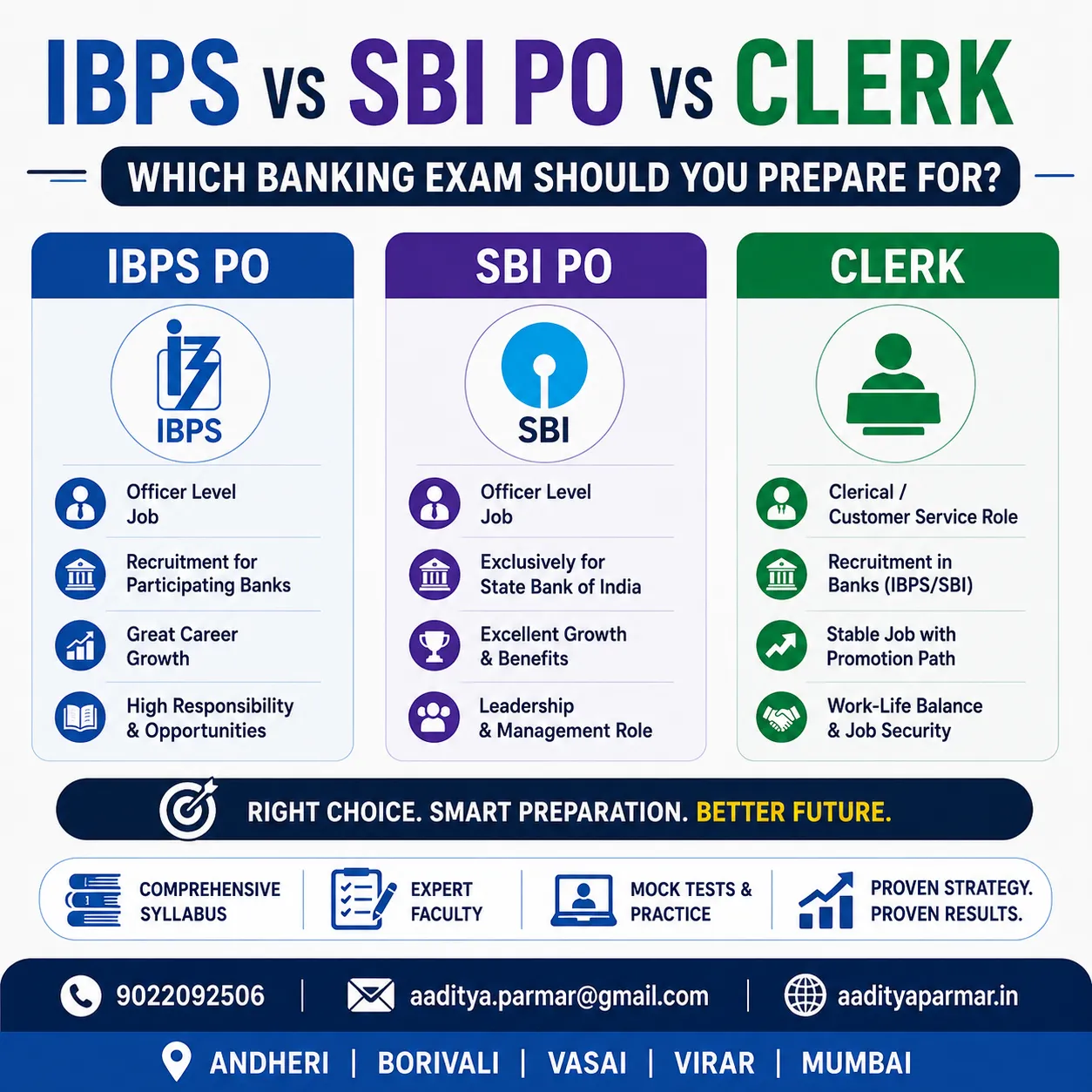
IBPS vs SBI PO vs Clerk: Which Banking Exam Should You Prepare For?
Last updated: | Reading time: 14 minutes | Category: Bank Exam Preparation

Summary
Every year, lakhs of graduates ask the same question: IBPS vs SBI PO vs Clerk — which banking exam should you prepare for? The short answer is that there is no single “best” exam. There is only the exam that best fits your age, degree, risk appetite, salary expectations and how much time you can study every day.
In this guide, you will get a full, practical breakdown of IBPS PO, IBPS Clerk, SBI PO and SBI Clerk — their eligibility, selection process, exam pattern, in-hand salary, difficulty level, promotion path and annual vacancies. You will also get a decision framework, a step-by-step preparation plan, expert tips, common mistakes to avoid, and a long FAQ section so you can confidently answer “which banking exam should you prepare for?” for your own situation.
- SBI PO = highest salary, fastest growth, hardest competition, limited attempts (4 for General category).
- IBPS PO = excellent salary and growth with more vacancies and no cap on attempts (age-bound only).
- SBI Clerk = better pay than IBPS Clerk, huge vacancies, no interview, great for beginners.
- IBPS Clerk = the most beginner-friendly entry point with the highest number of vacancies.
Introduction
If you are a graduate sitting at your study table at 11 p.m., scrolling through notifications from IBPS PO, SBI PO, IBPS Clerk and SBI Clerk, you already know the feeling: “Should I apply for all of them? Can I prepare for all of them? Which one actually gives me a better life?”
You are not alone. India’s banking sector recruits tens of thousands of officers and clerks every single year across the public sector banks. SBI alone hires thousands of Probationary Officers and Junior Associates, while the Institute of Banking Personnel Selection (IBPS) conducts a single common exam for 11+ participating banks. That means one preparation can open many doors — but only if you aim at the right door first.
Here is the truth most aspirants learn a year too late: the syllabus for IBPS PO, SBI PO, IBPS Clerk and SBI Clerk is roughly 80–85% the same. Reasoning, Quantitative Aptitude, English Language, General Awareness and Computer Knowledge are common to all four. What actually differs is the level of difficulty, the speed required, the pay scale, the responsibility and the number of attempts.
So the real question is not “which syllabus should I study?” It is “which exam should I make my primary target — and which ones should I keep as backup?”
In this guide, you will learn exactly how to make that decision with clarity. You will see the numbers side by side, understand the trade-offs, and walk away with a concrete plan. Whether you are a final-year student, a working professional preparing part-time, or someone who has already attempted an exam and missed by a few marks, this article will give you a clear direction.
Let’s begin. By the end of this post, “IBPS vs SBI PO vs Clerk” will not be a confusing choice for you — it will be a calculated strategy.
Key Takeaways
- SBI PO is the most rewarding and the most competitive of the four exams — highest pay, fastest promotions, but only 4 attempts for General category candidates.
- IBPS PO offers a nearly identical job profile with more vacancies and no fixed attempt limit — making it the smarter primary target for many aspirants.
- Clerk exams (IBPS Clerk and SBI Clerk) are the easiest entry points — no interview stage, huge vacancies, and a strong work-life balance.
- SBI Clerk pays more than IBPS Clerk for the same work, but IBPS Clerk usually has more vacancies.
- The syllabus overlap is 80–85%, so you can prepare once and apply to all four exams.
- Make one exam your primary target and the rest your backup — spreading yourself evenly across four exams is the biggest mistake aspirants make.
- If you are 21–25 and confident, aim for SBI PO or IBPS PO. If you are 26–28 or want stability fast, aim for SBI Clerk or IBPS Clerk.
- Consistency beats intensity: 3 focused hours daily for 8–10 months is enough for a first-time selection.
What Is IBPS PO, IBPS Clerk, SBI PO and SBI Clerk?
Before you compare, you need to understand exactly what each exam is and who conducts it. This is the foundation of the entire IBPS vs SBI PO vs Clerk debate.
What Is IBPS PO?
The IBPS PO (Probationary Officer) exam is conducted by the Institute of Banking Personnel Selection (IBPS), an autonomous recruitment body based in Mumbai. Through this single exam, IBPS recruits Probationary Officers / Management Trainees for 11 participating public sector banks, including Bank of Baroda, Canara Bank, Punjab National Bank, Union Bank of India, Indian Overseas Bank and others.
Once selected, you start as an officer — typically at the Assistant Manager level — with responsibility for branch operations, customer service, credit appraisal, cash management and team supervision. You are not “junior staff”; you are management track from day one.
What Is IBPS Clerk?
IBPS Clerk (officially Customer Service Associate / Junior Associate) is also conducted by IBPS for the same 11 participating banks. The role is clerical in nature: you handle cash receipts and payments, account opening, passbook updates, KYC verification, data entry, cheque clearing and direct customer support at the counter.
The IBPS Clerk exam pattern is simpler than the PO exam, the difficulty level is lower, and there is no interview stage — a huge relief for many aspirants.
What Is SBI PO?
SBI PO is conducted directly by the State Bank of India — India’s largest bank, a Fortune 500 company, and the only Indian bank on the list of the world’s largest banks. SBI recruits Probationary Officers through its own independent exam, and the brand value of the role is unmatched.
SBI PO is widely considered the toughest of the four exams because of the high cut-offs, the sheer number of applicants (often 20–25 lakh registrations for 2,000–6,000 posts), and the difficult Mains paper with a Descriptive English section. But it also comes with the highest starting salary and the fastest promotion ladder.
What Is SBI Clerk?
SBI Clerk (Junior Associate — Customer Support & Sales) is SBI’s clerical recruitment exam. It is the entry-level position at SBI, is conducted separately from the PO exam, and follows a two-stage process: Prelims and Mains — again, no interview.
Because SBI recruits in very large numbers every year (often 8,000–13,000 Junior Associates at once), it is one of the most aspirant-friendly exams in the country. SBI Clerk syllabus closely mirrors IBPS Clerk, with a slightly higher difficulty in Reasoning and Quantitative Aptitude.
Quick clarity: “PO” = Officer (Group B / management level). “Clerk” = Junior Associate (clerical level). Higher pay, higher responsibility, higher difficulty. Clerk roles are ideal for stability and work-life balance.
Why IBPS vs SBI PO vs Clerk Matters
You might be thinking, “I’ll just apply everywhere and see what happens.” That strategy sounds safe, but it quietly costs you months. Here is why the choice between IBPS vs SBI PO vs Clerk genuinely matters:
- Different difficulty curves. SBI PO Mains is roughly 20–30% harder than IBPS PO Mains. Preparing at the SBI level and attempting IBPS feels easy; preparing only at Clerk level makes PO Mains feel impossible.
- Different attempt limits. SBI PO allows only 4 attempts for General category (7 for OBC, unlimited for SC/ST within age limits). IBPS PO has no attempt cap. Burning an SBI attempt casually is a mistake you cannot undo.
- Different pay and progression. Over a 20-year career, the difference between starting as a Clerk and starting as a PO can be several lakh rupees per year in total compensation.
- Different exam calendars. IBPS and SBI release notifications at different times. Knowing your primary exam helps you sequence your preparation and avoid clashes.
- Different job satisfaction. Some people thrive in the officer’s decision-making role; others love the defined hours and low pressure of a clerk’s desk. Both are respectable — but your daily life will be very different.
- Different backup value. A Clerk selection is not a dead end. Many clerks clear internal promotion exams (like the bank internal promotion exam) and become officers within 4–7 years.
In short, choosing the wrong primary exam does not just waste your effort — it wastes your attempts, and attempts are a limited resource.
Benefits of Choosing the Right Banking Exam
When you make a deliberate choice in the IBPS vs SBI PO vs Clerk decision, you unlock several advantages:
1. Faster Selection
You stop studying “everything a little” and start mastering what your primary exam actually rewards. Focused preparation typically reduces the time to selection by 3–6 months.
2. Higher Confidence
When your mock test scores start matching your target exam’s cut-off, your confidence skyrockets. Confidence is a real, measurable performance variable in competitive exams.
3. Better Salary Negotiation Power
If you clear two exams in the same cycle, you can choose the offer with better posting, better location or better growth. Options create leverage.
4. Lower Burnout
Chasing four exams with different patterns and different cut-offs is exhausting. A clear primary target keeps your study plan simple and sustainable.
5. Smarter Backup Planning
With one primary target and two backups, you automatically apply to the exams that share 80% of your syllabus — meaning your extra effort per backup exam is minimal.
6. Stronger Long-Term Career
Whether you become an officer at 24 or a clerk at 27, the right choice aligns with your life goals — family time, city preference, further studies, or entrepreneurial plans.
How It Works: Selection Process Explained
Here is how each of the four exams works, stage by stage.
IBPS PO Selection Process
- Preliminary Exam (Qualifying): 100 questions, 100 marks, 60 minutes. English Language (30Q), Quantitative Aptitude (35Q), Reasoning Ability (35Q). Scores are not counted in the final merit.
- Mains Exam: 155 questions, 200 marks, 3 hours + 30 minutes Descriptive Test (25 marks). Reasoning & Computer Aptitude, Data Analysis & Interpretation, General/Economy/Banking Awareness, English Language.
- Interview: 100 marks, conducted by participating banks.
- Final Merit: Mains (80%) + Interview (20%).
IBPS Clerk Selection Process
- Prelims: 100 questions, 100 marks, 60 minutes.
- Mains: 190 questions, 200 marks, 160 minutes — English (40Q), Reasoning & Computer Aptitude (50Q), Quantitative Aptitude (50Q), General/Financial Awareness (50Q).
- No Interview. Final merit is based entirely on Mains score.
SBI PO Selection Process
- Prelims: 100 questions, 100 marks, 60 minutes.
- Mains: 155 questions, 200 marks, 3 hours + Descriptive Test (50 marks — Letter Writing and Essay).
- Group Exercise & Interview: 50 marks combined.
- Final Merit: Mains (75%) + GE & Interview (25%).
SBI Clerk Selection Process
- Prelims: 100 questions, 100 marks, 60 minutes.
- Mains: 200 questions, 200 marks, 2 hours 40 minutes.
- No Interview. Final merit is based on Mains score.
Key insight: Clerk exams end at Mains. Officer exams require an interview. If you have strong communication skills, officer exams reward you; if you dread interviews, clerk exams are a smoother path.
Step-by-Step Guide: How to Decide and Prepare
Follow these eight steps to answer “which banking exam should you prepare for?” with total clarity.
Step 1: Check Your Eligibility Honestly
- Age: IBPS PO 20–30 years · SBI PO 21–30 years · IBPS Clerk 20–28 years · SBI Clerk 20–28 years (relaxations apply for reserved categories).
- Education: A bachelor’s degree in any discipline from a recognised university. Final-year students can often apply provisionally.
- Attempts: SBI PO — 4 for General, 7 for OBC, unlimited for SC/ST within age limits. IBPS exams — no fixed attempt cap.
If your age is above 28, cross Clerk exams off your list immediately. That single filter removes half the confusion.
Step 2: Decide Your Salary Target
Be honest about what you need to earn. Officer exams start significantly higher than clerk exams. If you are the primary earner in your family or have education loans, PO should be your primary target.
Step 3: Assess Your Academic Strength
- Strong in Maths? → PO is achievable.
- Weak in Maths but strong in English and Reasoning? → Clerk is a faster route; then take PO next cycle.
- Strong in General Awareness? → You have a natural advantage in Mains, which is where selections are actually decided.
Step 4: Pick One Primary Target and Two Backups
- Confident, 21–25 years old: Primary = SBI PO · Backups = IBPS PO, SBI Clerk
- Want best odds, 22–28 years old: Primary = IBPS PO · Backups = SBI PO, IBPS Clerk
- Beginner or 26–28 years old: Primary = IBPS Clerk · Backups = SBI Clerk, IBPS PO
- Want stability and no interview: Primary = SBI Clerk · Backups = IBPS Clerk
Step 5: Build a Shared Syllabus Foundation
Start with what is common: Quantitative Aptitude, Reasoning Ability and English Language. Use our complete bank exam syllabus guide as your master checklist. Master these three first — they cover Prelims for all four exams.
Step 6: Layer Exam-Specific Sections
Once the basics are solid, add General/Economy/Banking Awareness and Computer Aptitude for Mains. For SBI PO, add Descriptive English (Essay and Letter Writing) practice from month four onwards. Follow our current affairs for bank exams routine daily.
Step 7: Test Yourself with Targeted Mocks
Take at least two Prelims mocks per week and one Mains mock every fortnight. Compare your score against the previous year’s cut-off of your primary exam. Use our bank exam mock test series recommendations.
Step 8: Adjust Every 60 Days
If you are consistently scoring 15+ marks above cut-off in Clerk mocks, upgrade your primary target to PO. If you are struggling, downgrade for one cycle, get selected, and then prepare for promotion.
Examples: Real Aspirant Profiles
Abstract advice is useless without context. Here are four realistic profiles and the logical choice of exam for each.
Example 1: Rohit, 23, B.Com Graduate, Strong in Maths
Rohit studies 4 hours daily and his Quant accuracy is above 85%. He has 3 attempts left in SBI PO and no age pressure. Best choice: Primary = SBI PO, Backups = IBPS PO and SBI Clerk. His maths strength directly transfers to Data Analysis & Interpretation in PO Mains.
Example 2: Sneha, 27, Working Professional, 2 Hours a Day
Sneha works a 9-to-6 job and can only study at night. She needs a selection fast, and her age leaves very little room for Clerk exams. Best choice: Primary = IBPS PO (no attempt cap, more vacancies), Backup = SBI Clerk if age permits, otherwise focus fully on IBPS PO and RBI Grade B as an aspirational add-on.
Example 3: Arjun, 25, Weak in Maths, Excellent in English
Arjun’s Quant is his weakest area. Best choice: Primary = IBPS Clerk or SBI Clerk (lower maths weightage and difficulty), Backups = IBPS PO. He should spend 40% of his study time on Quant basics for six months before attempting PO seriously.
Example 4: Meera, 22, Final-Year Student, Wants Stability
Meera wants a government job with predictable hours and does not enjoy high-pressure roles. Best choice: Primary = SBI Clerk (better salary than IBPS Clerk), Backup = IBPS Clerk. Later, she can appear for the internal promotion exam and become an officer in 5–6 years without losing her work-life balance.
Comparison Table: IBPS vs SBI PO vs Clerk
Table 1: IBPS PO vs SBI PO vs Clerk — At a Glance
| Parameter | SBI PO | IBPS PO | SBI Clerk | IBPS Clerk |
|---|---|---|---|---|
| Conducted By | State Bank of India | IBPS | State Bank of India | IBPS |
| Post | Probationary Officer | Probationary Officer / MT | Junior Associate (Clerk) | Customer Service Associate |
| Age Limit (General) | 21–30 years | 20–30 years | 20–28 years | 20–28 years |
| Attempt Limit | 4 (General) | No fixed cap | No fixed cap | No fixed cap |
| Selection Stages | Prelims → Mains → GE & Interview | Prelims → Mains → Interview | Prelims → Mains | Prelims → Mains |
| Interview | Yes | Yes | No | No |
| Approx. Starting Gross Salary | ₹70,000–₹85,000/month* | ₹52,000–₹57,000/month* | ₹37,000–₹42,000/month* | ₹29,000–₹34,000/month* |
| Typical Annual Vacancies | 2,000–6,000 | 3,000–5,500 | 8,000–13,000 | 5,000–11,000 |
| Difficulty Level | Very High | High | Moderate | Easy to Moderate |
| Job Profile | Branch operations, credit, team handling | Branch operations, credit, customer service | Cash handling, KYC, account opening | Cash handling, KYC, data entry |
| Promotion Speed | Fastest | Fast | Slower (internal exams) | Slower (internal exams) |
| Work-Life Balance | Moderate | Moderate | Good | Good |
| Best For | Ambitious, confident aspirants | Balanced aspirants wanting best odds | Beginners wanting stability + better pay | Absolute beginners with age pressure |
*Salary figures are indicative, vary by location and bank, and are revised periodically. Always verify with the official notification.
Table 2: Prelims vs Mains Pattern Comparison
| Exam | Prelims | Mains | Descriptive / Interview |
|---|---|---|---|
| SBI PO | 100 Q / 100 marks / 60 min | 155 Q / 200 marks / 3 hrs | 50 marks descriptive + 50 marks GE & Interview |
| IBPS PO | 100 Q / 100 marks / 60 min | 155 Q / 200 marks / 3 hrs | 25 marks descriptive + 100 marks interview |
| SBI Clerk | 100 Q / 100 marks / 60 min | 200 Q / 200 marks / 2 hrs 40 min | None |
| IBPS Clerk | 100 Q / 100 marks / 60 min | 190 Q / 200 marks / 160 min | None |
Table 3: Which Banking Exam Should You Prepare For? — Decision Matrix
| Your Situation | Primary Target | Backup Exams |
|---|---|---|
| Age 21–25, strong Quant, 4+ hrs daily | SBI PO | IBPS PO, SBI Clerk |
| Age 24–28, wants best selection odds | IBPS PO | SBI PO, IBPS Clerk |
| Age 26–28, urgent selection needed | IBPS Clerk / SBI Clerk | IBPS PO (if age allows) |
| Weak in Maths, strong in English | SBI Clerk | IBPS Clerk, IBPS PO |
| Working professional, 2 hrs daily | IBPS Clerk → IBPS PO | SBI Clerk |
| Wants no interview round | SBI Clerk / IBPS Clerk | — |
Common Mistakes to Avoid in the IBPS vs SBI PO vs Clerk Decision
- Preparing for all four exams equally. This spreads your energy thin and usually results in clearing none. Pick one primary target.
- Ignoring the age factor. If you are 27, you have very few Clerk attempts left. Prioritise accordingly.
- Burning SBI PO attempts casually. With only 4 attempts for General category, every attempt should be a serious one.
- Focusing only on Prelims. Prelims is qualifying; Mains decides your merit. Aspirants who only practise Prelims-style questions hit a wall in Mains.
- Neglecting General Awareness. This is the easiest scoring section in Mains for all four exams — and the most ignored.
- Not attempting Descriptive English for SBI PO. Many aspirants lose 15–20 marks here simply because they never practised writing.
- Over-relying on coaching without self-study. Coaching guides you; only your own practice builds accuracy and speed.
- Skipping mock analysis. Taking 50 mocks without analysing them is worse than taking 15 with deep analysis.
- Applying to exams you will not attend. Cancelling or skipping exams wastes fees and application effort.
- Ignoring health and sleep. Burnout after six months of 10-hour study days is more common than failure due to lack of knowledge.
Expert Tips
- Decide your primary exam in the first week. Do not spend three months “deciding.” Decide, commit, then adjust.
- Prepare at the SBI PO level. If your foundation is built for the hardest exam, IBPS PO and all Clerk exams feel manageable.
- Target accuracy over attempts. In most bank Prelims, attempting 65–70 questions with 90% accuracy beats attempting 85 with 65% accuracy.
- Use sectional timers from day one. Bank exams are speed tests disguised as knowledge tests.
- Read one newspaper editorial daily. It improves English, builds General Awareness, and helps Descriptive papers — three benefits from one habit.
- Revise more, read less. Most aspirants consume new material instead of revising what they already know. Revision wins selections.
- Take one full-length mock every Sunday. Simulate exactly the exam-day timing and environment.
- Track your scores in a simple sheet. Watching your accuracy curve rise is the strongest motivator you can build for yourself.
- Prepare for the interview alongside Mains. Do not wait for Mains results — the gap is short.
- Join an online community of serious aspirants. Isolation is the silent killer of long preparation journeys.
Best Practices for Bank Exam Preparation
Study Plan Best Practices
- Study 3 focused hours daily rather than 8 unfocused hours.
- Divide your day: 1 hour Quant, 1 hour Reasoning, 45 minutes English, 15 minutes Current Affairs.
- Keep Saturdays for revision and Sundays for full-length mock tests.
- Maintain a “mistake notebook” for every wrong answer — this is your highest-value revision material.
Practice Best Practices
- Use topic-wise tests in the first two months, sectional tests next, and full-length mocks after that.
- Analyse every mock for at least as long as you took the mock itself.
- Practise with an on-screen calculator and rough paper to mimic the exam interface.
- Focus on shortcut techniques for Quant and elimination logic for Reasoning.
Application Best Practices
- Keep scanned copies of your photograph, signature, and documents ready 15 days before any notification closes.
- Apply within the first week of the application window — portals slow down near the deadline.
- Double-check category, age and qualification entries before submitting; corrections are rarely allowed.
Mental Health Best Practices
- Sleep 7–8 hours. Memory consolidation happens during sleep, not during late-night cramming.
- Exercise for 20 minutes daily — it measurably improves focus.
- Celebrate small wins: a better mock score, a faster sectional attempt, a new topic mastered.
- Remember that rejection is data, not identity. Every failed attempt tells you exactly what to fix.
Recommended Tools and Resources
Study Material and Guides
- Best books for bank exams — a curated list for Quant, Reasoning, English and General Awareness.
- Quantitative Aptitude tips and tricks — shortcut methods for speed and accuracy.
- Reasoning Ability practice sets — puzzles, seating arrangement and syllogism drills.
- English for bank exams — grammar rules, vocabulary and reading comprehension strategy.
- Banking awareness study plan — 90-day schedule for the static portion.
- Daily current affairs — exam-relevant updates curated for banking aspirants.
Exam-Specific Resources
- IBPS PO exam pattern and syllabus
- IBPS Clerk exam pattern and syllabus
- SBI PO syllabus and Mains strategy
- SBI Clerk syllabus and pattern
- Bank PO interview questions and answers
Digital Tools
- Mock test platforms: Bank exam mock test series with exam-like interfaces.
- Spaced-repetition apps: For memorising banking terms, static GK and formulas.
- Pomodoro timers: To build sustained focus for 3-hour Mains papers.
- Spreadsheets: A simple Google Sheet tracking mock scores, accuracy, and weak topics.
- Official portals: ibps.in and sbi.co.in/careers for authentic notifications.
Other Banking Exams Worth Preparing For
- RBI Grade B — the most prestigious banking exam in India.
- NABARD Grade A — excellent pay and a development-sector profile.
- IBPS RRB PO and Clerk — regional rural bank recruitment with high vacancies.
- SIDBI Grade A and individual bank recruitments.
Troubleshooting Your Preparation
Problem: “I keep failing to clear Prelims by 2–5 marks.”
- Increase your attempt count in your strongest section by 5 questions.
- Eliminate silly errors — usually 6–10 marks are lost to misreading, not lack of knowledge.
- Do 20 sectional tests at exam speed within two weeks.
Problem: “My speed is fine, but accuracy is poor.”
- Slow down for two weeks and target 95% accuracy on untimed practice.
- Revisit fundamentals — poor accuracy is almost always a conceptual gap, not a speed issue.
- Maintain a mistake notebook and re-solve every wrong question after 7 days.
Problem: “I cannot decide between IBPS vs SBI PO vs Clerk.”
- Apply your age filter first. It eliminates the most options.
- Then apply your salary need. That eliminates the rest.
- Commit to one primary target for 90 days; revisit the decision only after a full-length mock cycle.
Problem: “I am consistent for two weeks, then I stop.”
- Reduce your daily target to something you can do even on your worst day (e.g., 1 hour minimum).
- Study at the same time daily to build an automatic habit.
- Find an accountability partner or join a study group.
Problem: “General Awareness is dragging my Mains score down.”
- Read one monthly PDF compilation plus one newspaper editorial daily.
- Revise the previous three months’ current affairs every weekend.
- Do not try to memorise everything — focus on banking, economy, RBI policies and appointments.
Problem: “I cleared Mains but failed the interview.”
- Prepare a crisp 60-second self-introduction covering education, hobbies and motivation.
- Study your graduation subjects, your home state’s economy and the bank’s recent news.
- Attend mock interviews two weeks before the real one.
FAQs: IBPS vs SBI PO vs Clerk
1. Which is better — IBPS PO or SBI PO?
Both are excellent. SBI PO offers a higher starting salary, faster promotions and stronger brand value, but has only 4 attempts for General category candidates and tougher competition. IBPS PO offers comparable responsibility, abundant vacancies and no attempt limit. If you want the best odds with a similar pay scale, choose IBPS PO. If you want maximum growth and can crack the highest difficulty, choose SBI PO.
2. Can I prepare for IBPS PO and SBI PO together?
Yes. The syllabi overlap by 80–85%. Prepare at the SBI PO level, and IBPS PO will feel easier. Just make sure you practise SBI’s Descriptive English paper and IBPS’s speed-focused Prelims separately.
3. Is SBI Clerk easier than IBPS PO?
Yes, considerably. SBI Clerk has a simpler Mains paper and no interview or Descriptive section. However, IBPS PO pays almost double and offers a management career path.
4. What is the starting salary of IBPS PO vs SBI PO vs Clerk?
Indicative monthly gross figures: SBI PO ₹70,000–₹85,000; IBPS PO ₹52,000–₹57,000; SBI Clerk ₹37,000–₹42,000; IBPS Clerk ₹29,000–₹34,000. Actual figures depend on the city of posting, applicable allowances and periodic wage revisions, so always verify with the official notification.
5. How many attempts do I get in SBI PO?
General category candidates get 4 attempts; OBC gets 7; SC/ST candidates have no attempt limit within the age limit. Attempts are counted only when you actually appear for the Prelims exam.
6. Which exam has the most vacancies — IBPS Clerk or SBI Clerk?
SBI Clerk typically announces 8,000–13,000 vacancies in years of large recruitment drives, while IBPS Clerk usually ranges from 5,000 to 11,000 across participating banks. The exact numbers fluctuate every year.
7. Is IBPS Clerk a good career option?
Absolutely. It offers a government job with job security, pension benefits, medical facilities and a solid work-life balance. Many clerks later become officers through internal promotion exams.
8. Do I need coaching to crack banking exams?
Not necessarily. Coaching accelerates the process by providing structure and feedback. But thousands of candidates clear these exams through disciplined self-study, standard books and quality mock tests.
9. How many months of preparation are needed?
For a first-time aspirant, 8–10 months of consistent preparation (3 hours daily) is a realistic timeline. If you are already strong in aptitude, 4–6 months can be enough.
10. Can final-year students apply for these exams?
Yes, most notifications allow final-year students to apply provisionally, provided they produce proof of graduation by the date specified in the notification.
11. Which banking exam is easiest for beginners?
IBPS Clerk is generally considered the easiest entry point due to its lower difficulty, high vacancies and absence of an interview. SBI Clerk is a close second with better pay.
12. Does SBI PO have a service bond?
SBI PO typically includes a service bond of around ₹2 lakh with a minimum service requirement of about 3 years. IBPS PO usually has a shorter bond, often 1–2 years, varying by participating bank. Check the official notification for exact terms.
13. Can I switch from Clerk to PO later?
Yes. Two routes exist: appear for the PO exam again (if your age permits), or clear your bank’s internal promotion exam, which usually requires a few years of service plus internal test and interview clearance.
14. Is there an interview in IBPS Clerk or SBI Clerk?
No. Both Clerk exams conclude with the Mains exam, and final merit is based entirely on Mains scores.
15. What is the ideal preparation order — Clerk first or PO first?
If your age is under 25, target PO first and keep Clerk as a backup. If you are 26 or above, target Clerk first to secure a job, then aim for officer roles through internal promotion or the next PO cycle.
16. How do I decide between IBPS vs SBI PO vs Clerk?
Apply four filters in order: age limit, attempt availability, salary requirement, and difficulty tolerance. The exam that survives all four filters is your primary target; the rest become backups.
17. Is General Awareness really important for Mains?
Yes. It is one of the highest-scoring and least time-consuming sections in the Mains of all four exams. Regular reading gives you a significant ranking advantage.
18. Can I apply for IBPS and SBI exams in the same year?
Yes, and you should. Their exam calendars usually do not clash, and both accept the same qualification. Applying to both maximises your chances.
19. What is a good score in a bank exam Prelims mock?
As a benchmark, aim for 15–20 marks above the previous year’s category-wise cut-off for your target exam. Anything less means more practice on time management.
20. Does appearing for Prelims count as an attempt in IBPS exams?
For IBPS, there is no formal attempt cap, so it does not matter. For SBI PO, yes — simply appearing for the Prelims counts as one attempt.
Conclusion
The question IBPS vs SBI PO vs Clerk — which banking exam should you prepare for? has a different answer for every aspirant, but the decision process is always the same. Check your age. Check your attempts. Check your salary need. Check your strength in Quant, Reasoning and English. Whichever exam survives those four filters is your primary target — and the rest automatically become smart backups.
Here is what you should remember above everything else: you do not need to be the smartest person in the exam hall. You need to be the most consistent person in your study room. Lakhs of candidates apply; a small fraction prepares seriously; a smaller fraction prepares consistently; and only a few thousand make it. That gap is not talent — it is discipline, and discipline is entirely within your control.
Whether you choose SBI PO for its prestige, IBPS PO for its balance, SBI Clerk for its stability, or IBPS Clerk for its accessibility, you are choosing a career in India’s financial backbone. That is a worthy goal, and it is achievable.
Start today. Choose your primary exam. Build your daily routine. Take your first mock within two weeks. Six months from now, the version of you that starts today will be thanking you.
Your selection is not a matter of if. It is a matter of when — and “when” depends on when you begin.
Call to Action
Ready to turn this clarity into a selection?
- 📌 Download your free 2025 bank exam preparation plan and get a day-by-day study schedule.
- 🎯 Attempt a free full-length mock test for IBPS PO, SBI PO, IBPS Clerk or SBI Clerk and find your current level.
- 📚 Get the recommended book list for Quant, Reasoning, English and General Awareness.
- 💬 Join our aspirant community and ask your doubts directly.
Tell us in the comments: which banking exam did you choose as your primary target, and why? Your answer might help another aspirant make the right decision.
If this guide helped you, share it with a friend who is stuck between IBPS and SBI exams. One share could change someone’s career trajectory.
About the Author
Written by a Senior SEO & Content Specialist with 10+ years of experience covering competitive exams, banking recruitment and career strategy. Reviewed against official IBPS and SBI guidelines.