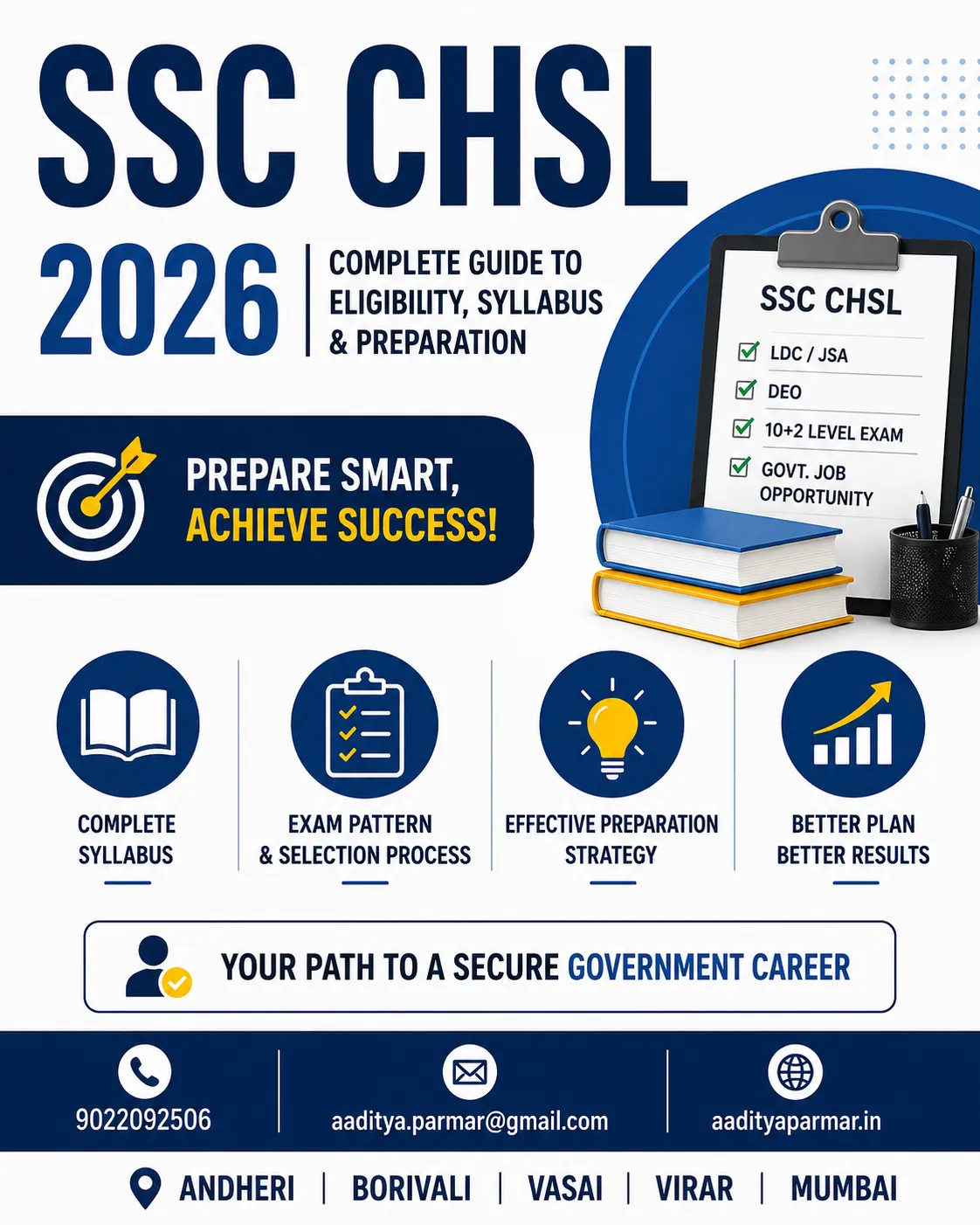
SSC CHSL 2026: Complete Guide to Eligibility, Syllabus & Preparation
Last updated: January 2026 | Reading time: ~18 minutes | Written by: SSC Exam Desk
Summary
This SSC CHSL 2026: Complete Guide to Eligibility, Syllabus & Preparation is your single-source roadmap for the Staff Selection Commission Combined Higher Secondary Level Examination. Inside, you will find the full SSC CHSL 2026 eligibility criteria, age limit and relaxations, the complete SSC CHSL 2026 syllabus, Tier 1 and Tier 2 exam pattern, indicative cut-offs, salary and job profile, a step-by-step 90-day study plan, comparison tables, common mistakes, expert tips, troubleshooting fixes and 20+ FAQs. If you are a 12th-pass candidate dreaming of a central government job in 2026, this guide is built for you.
Introduction
Imagine waking up on a Monday morning in 2026, knowing your salary is already credited, your job is secure, and your family is proud of the Government of India ID card in your wallet. That is exactly what cracking the SSC CHSL 2026 examination can give you — and it is far more achievable than most aspirants believe.
The Staff Selection Commission conducts the Combined Higher Secondary Level (CHSL) exam every year to recruit Lower Division Clerks (LDC), Junior Secretariat Assistants (JSA), Data Entry Operators (DEO) and Data Entry Operator Grade ‘A’ across ministries, departments and offices of the Government of India. The best part? You do not need a graduation degree to apply. A simple Class 12 pass certificate is enough to enter the race.
But here is the honest truth: lakhs of candidates apply, and only a few thousand get selected. The difference between the two groups is not talent — it is information plus execution. Most aspirants lose not because they studied too little, but because they studied the wrong things, in the wrong order, with the wrong strategy.
That is where this SSC CHSL 2026: Complete Guide to Eligibility, Syllabus & Preparation comes in. Whether you are a first-time aspirant, a working professional preparing in evening hours, or a repeat candidate who missed the cut-off by two marks last year, you will find a clear, step-by-step system here. Read it once end-to-end, bookmark it, and return to the section you need whenever you feel stuck.
Let’s build your selection story — one structured step at a time.
Key Takeaways
- Minimum qualification: You only need to pass Class 12 (10+2) from a recognised board — no degree required.
- Age band: Generally 18 to 27 years for LDC, JSA and DEO posts, with relaxations for SC, ST, OBC, PwBD, Ex-servicemen and other reserved categories.
- Two-tier structure: Tier 1 is a 100-question computer-based test (200 marks, 60 minutes); Tier 2 is a descriptive-and-objective CBT with 420 marks including a typing/skill test.
- Negative marking: 0.50 marks deducted per wrong answer in Tier 1, and 1 mark in Tier 2 modules (computer knowledge module excepted).
- Speed skills matter: LDC/JSA need 35 wpm English or 30 wpm Hindi typing; DEO needs 8,000 key depressions per hour; DEO Grade ‘A’ in C&AG needs 15,000 KDPH.
- Selection is merit-based: Final merit lists are prepared from combined Tier 1 + Tier 2 performance, followed by document verification.
- Preparation window: A focused 90 to 180 days of structured study with weekly mock tests is enough for a serious first attempt.
- No attempt limit: You can appear as many times as you want, as long as you are within the age limit.
Table of Contents
- Summary
- Introduction
- Key Takeaways
- What Is the SSC CHSL 2026 Exam?
- Why the SSC CHSL 2026 Exam Matters
- Benefits of Cracking SSC CHSL 2026
- SSC CHSL 2026 Eligibility Criteria Explained
- How the SSC CHSL 2026 Selection Process Works
- SSC CHSL 2026 Syllabus and Exam Pattern
- Step-by-Step SSC CHSL 2026 Preparation Guide
- Examples: Questions, Routines and Mock Analysis
- Comparison Tables
- Common Mistakes to Avoid
- Expert Tips from Toppers
- Best Practices for SSC CHSL 2026
- Recommended Tools and Books
- Troubleshooting: When Your Preparation Breaks Down
- FAQs on SSC CHSL 2026
- Conclusion
- Call to Action
What Is the SSC CHSL 2026 Exam?
The SSC CHSL 2026 is a national-level recruitment examination conducted by the Staff Selection Commission for Group C posts in various ministries, departments and subordinate offices of the Government of India. CHSL stands for Combined Higher Secondary Level, and the name itself tells you who it is designed for — candidates who have completed higher secondary education, i.e., Class 12.
In simple terms: if you have passed Class 12, you are already eligible to compete for a permanent central government job through this exam. There is no interview in the SSC CHSL selection process, which makes it one of the most transparent recruitment exams in India.
Posts Offered Through SSC CHSL 2026
- Lower Division Clerk (LDC) — Pay Level 2, clerical and file-management work in central government offices.
- Junior Secretariat Assistant (JSA) — Pay Level 2, similar clerical and administrative duties in ministries and departments.
- Data Entry Operator (DEO) — Pay Level 4, data entry and record-digitalisation roles.
- Data Entry Operator Grade ‘A’ — Pay Level 4/5, higher typing-speed requirement, often in the Office of the Comptroller and Auditor General (C&AG).
For a deeper breakdown of pay scales, in-hand salary, promotions and daily duties, read our detailed post on SSC CHSL salary and job profile.
Who Should Apply for SSC CHSL 2026?
- Class 12 pass students who want a government job immediately after school.
- Graduates who want a stable central government position while preparing for higher exams.
- Working professionals looking for a career switch into government service.
- Aspirants using CHSL as a stepping stone before attempting the SSC CGL 2026 complete guide level exam.
Why the SSC CHSL 2026 Exam Matters
You might be wondering why so many people chase this exam. The answer is simple: the SSC CHSL 2026 is the fastest doorway to a permanent central government job for a 12th-pass candidate in India.
Here is why this exam deserves your full attention:
- Low entry barrier, high reward. You do not need a college degree, coaching worth lakhs, or years of preparation. Class 12 is enough.
- Pan-India opportunity. Postings exist across ministries, departments and offices in every state and union territory.
- Job security in an uncertain economy. Central government service means protection from layoffs, economic slowdowns and corporate restructuring.
- Structured growth. Clear promotion channels, pay commissions, and internal departmental exam opportunities.
- Work-life balance. Fixed working hours, gazetted holidays, earned leave and medical benefits through CGHS.
- A platform for bigger goals. Many officers use CHSL as a launchpad for CGL, State PSC, or departmental promotion exams.
In a job market where private-sector roles demand constant reskilling, a government clerical position gives you something rare — predictability with dignity.
Benefits of Cracking SSC CHSL 2026
Let’s get specific. What do you actually gain the day your name appears in the SSC CHSL 2026 result list?
- Monthly salary with DA, HRA and TA. In-hand pay for LDC/JSA usually ranges from roughly ₹25,000 to ₹32,000 depending on city classification, while DEO roles tend to be higher.
- Pension benefits under NPS. A contribution-based pension scheme with employer matching.
- Medical facilities. Coverage for you and your dependants through CGHS or equivalent schemes.
- Job stability for life. No performance-linked downsizing, no notice-period anxiety.
- Leave entitlements. Casual leave, earned leave, medical leave, maternity/paternity leave and gazetted holidays.
- Transfer opportunities. Choose postings closer to home over time through department-level preferences.
- Respect and social standing. A Government of India role carries genuine prestige in your community.
- Time for further study. Predictable hours mean you can prepare for CGL, UPSC or state exams alongside your job.
SSC CHSL 2026 Eligibility Criteria Explained
Before you buy a single book, confirm that you meet the SSC CHSL 2026 eligibility criteria. Getting disqualified at the document verification stage after months of study is one of the most painful outcomes in this exam — and it is 100% avoidable.
1. Nationality
- You must be a citizen of India, or
- A subject of Nepal or Bhutan, or
- A Tibetan refugee who came to India before 1 January 1962 with the intention of permanently settling in India, or
- A person of Indian origin who migrated from Pakistan, Burma, Sri Lanka, East African countries of Kenya, Uganda, Tanzania, Zambia, Malawi, Zaire, Ethiopia or Vietnam with the intention of permanently settling in India.
2. Educational Qualification
- You must have passed the Class 12 (10+2) examination or an equivalent qualification from a recognised Board or University.
- For DEO and DEO Grade ‘A’ in the Office of the C&AG, some notifications require you to have studied Science stream with Mathematics as a subject at the Class 12 level. Always confirm this in the official notification for your target post.
- Your qualification must be acquired on or before the cut-off date mentioned in the official notification. Results awaited at that date generally do not count.
- Degrees or certificates from unrecognised boards will not be accepted.
3. Age Limit and Age Relaxation
The standard age band for SSC CHSL posts is generally 18 to 27 years as on the reference date specified in the notification. Reserved category candidates receive statutory relaxation.
| Category | Age Relaxation | Upper Age Limit (Approx.) |
|---|---|---|
| Unreserved (UR / General) | Nil | 27 years |
| OBC (Non-Creamy Layer) | 3 years | 30 years |
| SC / ST | 5 years | 32 years |
| PwBD (UR) | 10 years | 37 years |
| PwBD (OBC) | 13 years | 40 years |
| PwBD (SC/ST) | 15 years | 42 years |
| Ex-Servicemen | As per rules (generally service period + 3 years) | Varies |
| Departmental Candidates | Up to 40 years in specified cases | Varies |
Note: Age relaxation figures above are indicative and mirror past SSC notifications. Verify the exact numbers in the official SSC CHSL 2026 notification and read our dedicated post on SSC CHSL 2026 age limit and relaxation rules.
4. Number of Attempts
There is no restriction on the number of attempts for SSC CHSL. You can appear every year until you cross the upper age limit for your category.
5. Other Eligibility Conditions
- You must not have been convicted of any criminal offence.
- You must meet the medical fitness standards applicable to the post you are allotted.
- You must produce all original documents at the document verification stage — caste certificate, EWS certificate, PwBD certificate, domicile and educational certificates.
- OBC candidates must submit a valid Non-Creamy Layer certificate issued within the prescribed validity period.
How the SSC CHSL 2026 Selection Process Works
Understanding the selection funnel is half the battle. Here is the complete SSC CHSL 2026 selection process, stage by stage.
Stage 1: Online Registration and Application
You register on the official SSC portal through the One-Time Registration (OTR) system, fill the application form, upload your photograph and signature, and pay the application fee online. Keep your registration number and password safe — you will need them repeatedly. Our walkthrough on how to fill the SSC CHSL 2026 application form correctly covers every field.
Stage 2: Tier 1 — Computer-Based Examination (Objective)
Tier 1 is a screening test conducted in computer-based mode across multiple shifts and exam centres. It has 100 questions worth 200 marks, to be solved in 60 minutes (80 minutes for candidates eligible for a scribe). There is a negative marking of 0.50 marks for each wrong answer. Tier 1 is used to shortlist candidates for Tier 2, and its marks are carried forward into the final merit list.
Stage 3: Tier 2 — Computer-Based Examination (Objective + Skill Test)
Tier 2 is the decisive stage. It is conducted in two sessions on the same day: Session 1 covers Mathematical Abilities and Reasoning; Session 2 covers English Language, General Awareness, a Computer Knowledge module, and a Skill Test/Typing Test module. Tier 2 carries 420 marks in total and determines your final rank along with Tier 1.
Stage 4: Document Verification
Shortlisted candidates are called for document verification, where your eligibility claims are physically checked against original certificates. Any mismatch — age, category, qualification — can lead to cancellation of candidature.
Stage 5: Final Merit List and Posting
The Commission prepares the final merit list based on combined Tier 1 and Tier 2 scores. Posts are allotted according to merit, preference and vacancy availability, and you receive a posting order from the concerned department.
SSC CHSL 2026 Syllabus and Exam Pattern
The SSC CHSL 2026 syllabus is finite, predictable and completely learnable. That is genuinely good news: unlike exams with ever-changing patterns, CHSL rewards consistent preparation.
Tier 1 Exam Pattern
| Section | Questions | Marks | Suggested Time |
|---|---|---|---|
| General Intelligence & Reasoning | 25 | 50 | ~15 min |
| General Awareness | 25 | 50 | ~10 min |
| Quantitative Aptitude | 25 | 50 | ~20 min |
| English Language | 25 | 50 | ~15 min |
| Total | 100 | 200 | 60 min |
Negative marking: 0.50 marks per wrong answer. Unattempted questions carry no penalty.
Tier 2 Exam Pattern
| Session | Module | Questions | Marks | Time |
|---|---|---|---|---|
| Session 1 | Module I: Mathematical Abilities | 30 | 90 | 60 minutes |
| Session 1 | Module II: Reasoning & General Intelligence | 30 | 90 | |
| Session 2 | Module I: English Language & Comprehension | 40 | 120 | 60 minutes + 15 min skill test |
| Session 2 | Module II: General Awareness | 20 | 60 | |
| Session 2 | Module III: Computer Knowledge | 20 | 60 | |
| Session 2 | Module IV: Skill Test / Typing Test | — | Qualifying | |
| Total (Objective Modules) | 140 | 420 | — | |
Tier 2 also includes a negative marking of 1 mark for each wrong answer in the objective modules, with the Computer Knowledge module typically exempt. Always confirm the current rule in the official notification.
Tier 1 Syllabus: Section-Wise Topics
General Intelligence & Reasoning
- Analogy, classification (odd one out), series (number, alphabet, mixed)
- Coding-decoding, blood relations, direction sense
- Order and ranking, seating arrangement (linear and circular)
- Syllogism, statement-conclusion, statement-assumption
- Venn diagrams, mathematical operations, missing numbers
- Mirror and water images, paper folding and cutting, embedded figures
- Word formation, dictionary order, matrix and word-based puzzles
Boost your accuracy with our SSC CHSL reasoning shortcuts and tricks.
General Awareness
- Current affairs of the last 8–12 months (national, international, sports, awards)
- Indian history — ancient, medieval, modern, freedom struggle
- Indian polity and constitution, panchayati raj, governance
- Geography — India and world, physical, economic, climatic
- Indian economy — budget, banking, taxation, schemes
- General science — physics, chemistry, biology at the Class 10–12 level
- Static GK — books and authors, dances, festivals, national parks, minerals
- Organisations, abbreviations, scientific research and discoveries
Keep your GA sharp with our monthly current affairs digest for SSC exams and SSC CHSL general awareness short notes.
Quantitative Aptitude
- Number system, LCM and HCF, simplification, surds and indices
- Percentage, ratio and proportion, average, profit and loss, discount
- Simple and compound interest, partnership, mixtures and alligation
- Time, speed and distance, trains, boats and streams, time and work
- Algebra — linear equations, identities, quadratic equations
- Geometry, mensuration (2D and 3D), trigonometry, height and distance
- Data interpretation — tables, bar graphs, pie charts, line graphs
Speed in arithmetic is trainable. Start with our SSC CHSL quantitative aptitude preparation tips.
English Language
- Reading comprehension and cloze test
- Spotting errors, sentence improvement, fill in the blanks
- Synonyms, antonyms, one-word substitution, spelling correction
- Idioms and phrases, active-passive voice, direct-indirect speech
- Para jumbles, sentence rearrangement, homonyms and homophones
Follow our SSC CHSL English preparation strategy for a week-by-week plan.
Tier 2 Syllabus Highlights
- Mathematical Abilities: deeper arithmetic, algebra, geometry, trigonometry, statistics and data interpretation at the Class 12 level.
- Reasoning & General Intelligence: advanced series, syllogisms, coding-decoding, puzzles, matrices and non-verbal reasoning.
- English Language & Comprehension: grammar, vocabulary, comprehension, writing skills, synonyms/antonyms and error spotting.
- General Awareness: current affairs, static GK, polity, history, geography, economy and science.
- Computer Knowledge: basics of computers, software, internet, MS Office, networking, cyber security. Read our SSC CHSL Tier 2 computer knowledge guide.
- Skill Test / Typing Test: see the speed requirements below.
Typing and Skill Test Requirements
| Post | Required Speed | Mode |
|---|---|---|
| LDC / JSA | 35 words per minute in English or 30 wpm in Hindi | Computer typing |
| DEO | 8,000 key depressions per hour (approx. 27 wpm) | Computer typing |
| DEO Grade ‘A’ (C&AG) | 15,000 key depressions per hour (approx. 50 wpm) | Computer typing |
The typing test is usually qualifying in nature — but failing it means disqualification, no matter how high your marks are. Start practising today with our free online typing test practice for SSC CHSL and typing test mastery guide.
Step-by-Step SSC CHSL 2026 Preparation Guide
Here is a practical, 10-step framework you can start using this week. This is the exact skeleton top rankers follow — adapted so that it works whether you study full-time or alongside a job.
Step 1: Confirm Your Eligibility and Lock Your Target Post
Read the official notification carefully, verify your age, qualification and category, and decide whether you are aiming for LDC/JSA (easier typing requirement) or DEO (higher pay, higher typing speed). Your target post changes your typing practice schedule from day one.
Step 2: Download the Official Syllabus and Build a Topic Tracker
Print the syllabus or save it as a PDF. Create a simple spreadsheet or notebook page listing every topic with three columns: Not Started, In Progress, Mastered. Tracking prevents the classic trap of endlessly re-reading familiar topics while ignoring weak areas.
Step 3: Take a Diagnostic Mock Test Before You Study Anything
This feels counterintuitive, but it is the single most valuable thing you can do in week one. Attempt a full SSC CHSL mock test under real exam conditions and record your section-wise score. It tells you exactly where you stand and where your marks will come from fastest.
Step 4: Build a Realistic Weekly Timetable
Do not copy a topper’s 14-hour schedule. Build a timetable around your actual life. A working aspirant studying 4 focused hours daily will out-perform a full-time aspirant who studies 10 distracted hours.
Step 5: Master Concepts Before Speed
In Quantitative Aptitude and Reasoning, learn the concept, then the shortcut — never the other way around. Shortcuts without conceptual clarity collapse under exam pressure and create negative marking.
Step 6: Make General Awareness a Daily Habit, Not a Weekend Sprint
Spend 30 to 45 minutes every single day on current affairs, static GK and revision. Use flashcards or an app so that cumulative recall becomes automatic.
Step 7: Practise Sectional Tests Twice a Week
Sectional tests build speed within a single subject. Alternate between Quant/Reasoning and English/GA sectionals so that every topic gets attention twice a month.
Step 8: Take One Full-Length Mock Every Week, Then Analyse It for 90 Minutes
The mock is the test; the analysis is the training. For every wrong answer, write down whether the error was conceptual, calculative, or a misread question. Over eight weeks, you will see patterns — and fixing three recurring errors can gain you 15 to 20 marks.
Step 9: Start Typing Practice at Least 90 Days Before Tier 2
Fifteen minutes a day, every day. Accuracy first, then speed. Never practise typing with the backspace key held down — train your fingers to hit the right key the first time.
Step 10: Revise in Cycles and Protect Your Energy
Use spaced revision: day 1, day 3, day 7, day 21. Sleep 7 to 8 hours. Take one half-day off every week. Sustainable preparation beats heroic burnout every time.
Want a ready-made plan? Grab our 90-day SSC CHSL study plan and 6-month SSC CHSL 2026 preparation timetable.
Examples: Questions, Routines and Mock Analysis
Example 1: Quantitative Aptitude (Tier 1 Level)
Question: The average of 11 numbers is 36. If the average of the first six numbers is 34 and that of the last six is 39, find the sixth number.
Solution: Sum of 11 numbers = 11 × 36 = 396. Sum of first six = 6 × 34 = 204. Sum of last six = 6 × 39 = 234. The sixth number is counted in both groups, so 204 + 234 = 438, and 438 − 396 = 42. The sixth number is 42.
Example 2: Reasoning (Tier 1 Level)
Question: In a certain code, TEACHER is written as VGCEJGT. How is CHILD written in that code?
Solution: Each letter moves forward by two positions (T→V, E→G, A→C…). Apply the same rule: C→E, H→J, I→K, L→N, D→F. Answer: EJKNF.
Example 3: English Language
Question (Spot the error): “One of my friend is working in a bank.”
Solution: “One of” must be followed by a plural noun. The correct sentence is: “One of my friends is working in a bank.”
Example 4: General Awareness
Question: Which Article of the Indian Constitution deals with the Right to Constitutional Remedies?
Solution: Article 32 — often called the “heart and soul” of the Constitution by Dr. B. R. Ambedkar.
Example 5: A Sample Day for a Working Aspirant
- 6:00–7:00 AM: Current affairs + static GK revision (flashcards)
- 7:00–7:45 AM: Quantitative Aptitude — new concept + 20 practice questions
- Commute: Audio revision or vocabulary app
- 8:30–9:30 PM: Reasoning — 30 questions timed
- 9:30–10:15 PM: English — grammar rules + error spotting practice
- 10:15–10:30 PM: Typing practice, 15 minutes
- Weekend: One full-length mock + 90-minute analysis + revision of the week’s mistakes
Example 6: How to Analyse a Mock Test
Suppose you scored 128/200 in a Tier 1 mock with the following split:
- Reasoning: 42/50 (attempted 24, correct 21)
- General Awareness: 24/50 (attempted 18, correct 12)
- Quantitative Aptitude: 30/50 (attempted 20, correct 16)
- English: 32/50 (attempted 22, correct 17)
Diagnosis: Reasoning is strong — maintain it with light practice. GA accuracy is poor (12 of 18), suggesting guesswork; reduce blind attempts and revise static GK. Quant accuracy is 80% but attempts are low, so speed is the bottleneck — practise topic-wise timed sets. English has an accuracy problem, not a speed problem — revise grammar rules.
Action plan: Next week, add one daily timed quant set, 30 minutes of GA revision, and 20 grammar-based English questions. Retest after seven days and compare.
Comparison Tables
SSC CHSL 2026 vs SSC CGL vs SSC MTS
| Parameter | SSC CHSL 2026 | SSC CGL 2026 | SSC MTS 2026 |
|---|---|---|---|
| Qualification | Class 12 pass | Graduation | Class 10 pass |
| Posts | LDC, JSA, DEO, DEO Grade ‘A’ | Group B & C officer posts | Multi-Tasking Staff |
| Pay Level | Level 2 to Level 5 | Level 4 to Level 8 | Level 1 |
| Tiers | Tier 1 + Tier 2 | Tier 1 + Tier 2 | Session 1 + Session 2 |
| Difficulty | Moderate | High | Easy to moderate |
| Best For | 12th-pass aspirants wanting clerical/computer roles | Graduates targeting officer-level roles | 10th-pass candidates seeking entry-level jobs |
Comparing your options? Read SSC CHSL vs SSC CGL — which exam should you target in 2026?, SSC MTS 2026 complete guide and SSC GD Constable 2026 guide.
Post-Wise Comparison: LDC/JSA vs DEO
| Feature | LDC / JSA | DEO / DEO Grade ‘A’ |
|---|---|---|
| Pay Level | Level 2 | Level 4 (Grade ‘A’ may be higher) |
| Core Work | Files, letters, clerical records | Data entry, digitisation, reporting |
| Typing Requirement | 35 wpm English / 30 wpm Hindi | 8,000 KDPH (Grade ‘A’: 15,000 KDPH) |
| Approx. In-Hand Salary | ₹25,000–₹32,000 | ₹30,000–₹40,000 |
| Ideal For | General clerical aspirants | Fast typists and computer-savvy candidates |
Indicative Tier 1 Cut-Off Ranges for SSC CHSL
| Category | Indicative Cut-Off (Out of 200) |
|---|---|
| UR / General | 140–155 |
| EWS | 130–145 |
| OBC | 135–148 |
| SC | 118–132 |
| ST | 112–126 |
These are indicative ranges based on previous cycles and shift-wise normalisation. See our full SSC CHSL cut-off analysis year by year for exact figures.
Common Mistakes to Avoid in SSC CHSL 2026 Preparation
- Ignoring the notification. Skipping the official PDF and relying on WhatsApp forwards leads to wrong eligibility assumptions and application errors.
- Collecting books instead of finishing them. Three books completed beat twelve books started.
- Studying without mock tests. You cannot learn exam temperament from theory alone.
- Skipping mock analysis. Taking a mock and never reviewing it is entertainment, not preparation.
- Over-attempting to beat the negative marking. Blind guesses cost more marks than they earn.
- Neglecting typing practice. Failing a qualifying typing test after clearing Tier 2 is heartbreaking — and common.
- Leaving General Awareness to the last month. GA is cumulative; it cannot be crammed in four weeks.
- Comparing your Day 10 with someone’s Day 300. Comparison kills consistency.
- Studying only strong sections. Improvement comes from weak areas, not comfortable ones.
- Ignoring health and sleep. A tired brain makes the exact errors that cost you selection.
Expert Tips from Toppers and Mentors
- Attempt strategy: In Tier 1, start with your strongest section to build momentum, and leave the weakest for the end.
- The 20-second rule: If a question is not solvable in 20 to 30 seconds, move on and return later.
- Accuracy over attempts: A candidate with 85 attempts at 92% accuracy beats one with 100 attempts at 68% accuracy.
- Shift-proof preparation: Do not rely on “easy shift” luck — prepare for the hardest paper.
- Repeat revision beats new material: Re-read short notes four times instead of reading a new book once.
- Use the OMR-free mindset: In CBT, mark questions for review instead of guessing wildly.
- Practise with a stopwatch from week one. Speed is a habit, not a last-minute skill.
- Teach what you learn. Explaining a concept to a friend or writing a short note locks it into long-term memory.
- Keep a mistake notebook. Every repeated error becomes a permanent lesson.
- Simulate exam timing exactly. Practise at the same hour as your actual shift to train your body clock.
Best Practices for SSC CHSL 2026
- Follow the 60-30-10 rule: 60% time on practice questions, 30% on revision, 10% on new theory.
- Maintain a single master notebook for formulas, shortcuts, vocabulary and static GK facts.
- Do one full-length mock weekly and at least two sectional tests.
- Type for 15 minutes daily from the moment you start preparing, not from six weeks before Tier 2.
- Revise in cycles: Day 1 → Day 3 → Day 7 → Day 21.
- Track your accuracy weekly in a spreadsheet: attempts, correct, wrong, accuracy %.
- Read one newspaper daily for comprehension skill and current affairs.
- Sleep 7–8 hours and exercise 20 minutes daily — cognitive performance depends on it.
- Take one day off every week to prevent burnout and mid-preparation collapse.
- Verify every fact against ssc.gov.in before acting on it.
Recommended Tools and Books for SSC CHSL 2026
Digital Tools
- Official SSC portal (ssc.gov.in) — notifications, admit cards, answer keys and results. Bookmark it and check weekly.
- Online mock test platforms — for full-length and sectional tests with All-India rank. Explore our SSC CHSL 2026 mock test series.
- Typing tutors — TypingClub, Keybr, 10FastFingers and Ratatype for daily typing drills.
- Flashcard apps — Anki or Quizlet for static GK and vocabulary.
- Spreadsheet tools — Google Sheets or Excel for accuracy and mock-score tracking.
- Stopwatch and Pomodoro apps — for timed practice and focused study blocks.
- Current affairs apps — for daily news summaries relevant to SSC.
- Previous year paper PDFs — see our SSC CHSL 2026 previous year papers download page.
Books and Study Material
- Quantitative Aptitude: Rakesh Yadav (7300+), Kiran Publications chapterwise PYQs, Abhinay Sharma for arithmetic basics.
- Reasoning: RS Aggarwal Verbal & Non-Verbal, MK Pandey Analytical Reasoning.
- English: Plinth to Paramount, SP Bakshi Objective General English, Word Power Made Easy.
- General Awareness: Lucent’s General Knowledge, Disha’s current affairs yearbook, monthly magazines.
- Computer Knowledge: Lucent’s Computer, RS Aggarwal Computer Awareness.
- Practice: Kiran SSC CHSL previous year solved papers (at least 40 sets).
For a curated buying guide, read best books for SSC CHSL 2026 preparation.
Troubleshooting: When Your Preparation Breaks Down
Every aspirant hits a wall. Here is how to fix the ten most common breakdowns.
1. “My mock scores are dropping even though I study daily.”
This usually means you are learning new topics without consolidating old ones. Pause new learning for one week and do pure revision plus sectional practice. Scores almost always recover.
2. “I am slow in Quantitative Aptitude.”
Speed comes from recognition, not from typing faster. Learn squares up to 40, cubes up to 20, tables up to 25, and fraction-to-percentage conversions. Then do 30 timed questions daily with a 45-second cap per question.
3. “My accuracy is high but attempts are too low.”
Increase attempts gradually: aim for 5 more questions per mock than last time, without dropping accuracy below 88%. Do not jump 20 questions at once.
4. “I keep forgetting General Awareness.”
You are reading, not retrieving. Switch from passive reading to active recall — cover the answer, test yourself, then check. Use flashcards and weekly self-quizzes. Retrieval practice is dramatically more effective than re-reading.
5. “I cannot reach 35 wpm in typing.”
Stop chasing speed for two weeks. Set your typing tool to enforce accuracy above 97% and only then increase the speed ceiling. Slow, accurate practice builds durable muscle memory; fast, sloppy practice builds errors.
6. “I do not get time after work.”
Shrink your sessions. Three blocks of 60 focused minutes beat one vague three-hour session. Use your commute for audio and vocabulary. Protect your weekend mock slot like an appointment.
7. “I feel demotivated and want to quit.”
Motivation is a by-product of progress. Track micro-wins: topics mastered, accuracy improved, vocabulary learned. Set a weekly target you can actually hit — small wins rebuild momentum faster than motivational videos.
8. “I am confused between LDC/JSA and DEO.”
Test your typing speed today. If you comfortably cross 35 wpm, either is fine. If typing is weak and you want to avoid extra risk, prioritise LDC/JSA. If you can realistically reach 50 wpm, DEO Grade ‘A’ offers higher pay.
9. “I faced a technical issue during the online exam.”
If the system freezes, do not panic and do not close the window. Raise your hand and inform the invigilator immediately, and ensure the incident is recorded on the log sheet. After the exam, you may contact the SSC regional office with your registration number and centre details as per the notification’s grievance procedure.
10. “I have exam-day anxiety and blank out.”
Anxiety decreases with familiarity. Simulate the exam at least 20 times before the real one: same duration, same no-break rule, same screen-based practice. Also practise a 60-second breathing reset you can use before entering the hall.
FAQs on SSC CHSL 2026
1. What is the minimum educational qualification for SSC CHSL 2026?
You must have passed Class 12 (10+2) or an equivalent examination from a recognised board or university. Some DEO posts, particularly in the C&AG office, may additionally require Science with Mathematics at the Class 12 level.
2. What is the age limit for SSC CHSL 2026?
The general age band is 18 to 27 years as on the reference date in the official notification, with relaxations of 3 years for OBC, 5 years for SC/ST, and 10 years for PwBD candidates in the unreserved category.
3. How many times can I attempt SSC CHSL 2026?
There is no limit on the number of attempts. You may appear every year until you exceed the upper age limit applicable to your category.
4. Is there negative marking in SSC CHSL 2026?
Yes. Tier 1 deducts 0.50 marks per wrong answer. Tier 2 deducts 1 mark per wrong answer in the objective modules, with the Computer Knowledge module typically exempt.
5. Is there an interview in SSC CHSL 2026?
No. The SSC CHSL selection process has no interview stage. Selection depends on Tier 1 and Tier 2 performance, the qualifying skill test, and document verification.
6. What is the typing speed required for LDC and DEO?
LDC/JSA requires 35 words per minute in English or 30 wpm in Hindi. DEO requires approximately 8,000 key depressions per hour, while DEO Grade ‘A’ in the C&AG requires about 15,000 key depressions per hour.
7. How many vacancies will be released for SSC CHSL 2026?
Vacancy numbers vary each year and are announced in the official notification and subsequent corrigenda. Always check the latest notification on ssc.gov.in for the current figure, as it often changes during the recruitment cycle.
8. What is the salary of an LDC or JSA under SSC CHSL?
LDC and JSA posts fall under Pay Level 2. In-hand salary typically ranges between roughly ₹25,000 and ₹32,000 per month, depending on the city classification (X, Y or Z) and applicable DA rates. DEO roles at Pay Level 4 usually earn more.
9. Is SSC CHSL harder than SSC CGL?
SSC CHSL is generally considered less difficult than SSC CGL because the eligibility is lower (Class 12 vs graduation) and the competition pool is broader but the syllabus depth is shallower. However, CHSL still requires disciplined preparation.
10. Can final-year Class 12 students apply for SSC CHSL 2026?
Generally, you must have already passed Class 12 by the cut-off date specified in the notification. Candidates whose results are awaited are usually not eligible. Verify the exact cut-off date in the official notification.
11. How long does SSC CHSL preparation take?
A serious aspirant with 4 to 6 hours of daily study typically needs 3 to 6 months of structured preparation, including mock tests and typing practice. Candidates with weaker basics should budget 6 to 9 months.
12. Is coaching necessary for SSC CHSL 2026?
No, coaching is not mandatory. Thousands of candidates clear CHSL through self-study using standard books, free online resources, previous year papers and mock test series. What matters is a structured plan and consistent execution.
13. What is the Tier 1 qualifying cut-off for SSC CHSL?
Cut-offs vary by year, category and shift normalisation. Historically, UR cut-offs have hovered in the range of 140 to 155 out of 200, with reserved categories usually lower. Check our detailed cut-off analysis.
14. Does SSC CHSL Tier 1 score count in the final merit list?
In recent cycles, the final merit list is prepared based on combined performance in Tier 1 and Tier 2. Confirm the weightage in the official notification for SSC CHSL 2026, as rules can be revised.
15. What documents are required at document verification?
Usually your Class 10 and Class 12 certificates and mark sheets, category certificate (SC/ST/OBC-NCL/EWS), PwBD certificate if applicable, domicile certificate, photo ID, and passport-size photographs. Keep both originals and photocopies ready.
16. Can I choose my exam centre for SSC CHSL 2026?
Yes, you can select preferred examination centres during the application process. However, the Commission allots the final centre based on availability and administrative constraints.
17. What is the application fee for SSC CHSL 2026?
Fees are usually modest and are exempted for women, SC, ST, PwBD and Ex-servicemen candidates. Check the official notification for the exact amount for the 2026 cycle.
18. Is the typing test compulsory for all SSC CHSL posts?
Yes, the skill test is applicable to all posts but the required speed differs. LDC/JSA candidates must meet the typing requirement, while DEO candidates must meet the key-depression requirement.
19. How should I prepare for SSC CHSL General Awareness?
Cover the last 8 to 12 months of current affairs, then build static GK through daily flashcards. Revise weekly, and never rely on last-minute cramming. Start with our SSC CHSL general awareness notes.
20. What is the best strategy for the last 30 days before SSC CHSL Tier 1?
Stop new topics. Do one full mock every alternate day, revise your mistake notebook daily, strengthen your strongest two sections to near-perfect accuracy, and practise typing daily. Sleep well and simulate exact exam timing.
21. Can graduates apply for SSC CHSL 2026?
Yes. Graduates are fully eligible — the requirement is a minimum of Class 12. Many graduates apply to CHSL while preparing for higher exams.
22. Where can I check the SSC CHSL 2026 result and answer key?
All official updates — tentative answer keys, final answer keys, results and merit lists — are published on ssc.gov.in. Never trust unofficial sources for result dates.
Conclusion
You now have a complete picture. The SSC CHSL 2026: Complete Guide to Eligibility, Syllabus & Preparation you just read covers everything that stands between you and a Government of India job: eligibility rules you must verify, a syllabus that is finite and learnable, a two-tier exam pattern you can train for, a step-by-step preparation framework, comparison tables to sharpen your decisions, common mistakes to sidestep, expert tips that toppers swear by, recommended tools and books, and fixes for the exact problems that derail most aspirants.
Here is the honest reality: information alone never selects anyone. Thousands of candidates read the same syllabus and the same books. What separates the selected from the rest is consistent, tracked, test-driven execution over a focused 90 to 180 day window.
So keep this guide bookmarked. Confirm your eligibility today, take a diagnostic mock this week, build your timetable tomorrow, and start your first timed sectional test within 48 hours. Do those four things, and you are already ahead of the majority who are still “planning” to start.
Your Class 12 certificate is enough. Your consistency is what will decide the outcome. Start today — and let 2026 be the year your name appears in the SSC CHSL merit list.
Call to Action
Ready to begin? Here is exactly what to do next.
- 📥 Download SSC CHSL 2026 previous year papers and attempt one today.
- 🧪 Join the SSC CHSL 2026 free mock test series and take your diagnostic test this week.
- 📅 Get the 90-day SSC CHSL 2026 study plan and start with Day 1 tomorrow.
- ⌨️ Practise free online typing tests for 15 minutes every single day.
- 📘 Check the best books for SSC CHSL 2026 before you buy anything.
- 🔔 Subscribe for SSC CHSL 2026 notification alerts so you never miss a deadline.
Share this guide with a friend who is preparing for SSC CHSL 2026 — your one share could change someone’s career. And if you have a question that was not answered here, drop it in the comments below; our experts reply to every serious query.
Your selection story starts with one mock test. Take it today.
Disclaimer: The eligibility criteria, exam pattern, dates, cut-offs and vacancy figures mentioned in this SSC CHSL 2026 guide are based on previous official notifications and typical trends. The Staff Selection Commission may revise any of these details. Always verify the latest information on the official website ssc.gov.in before applying.