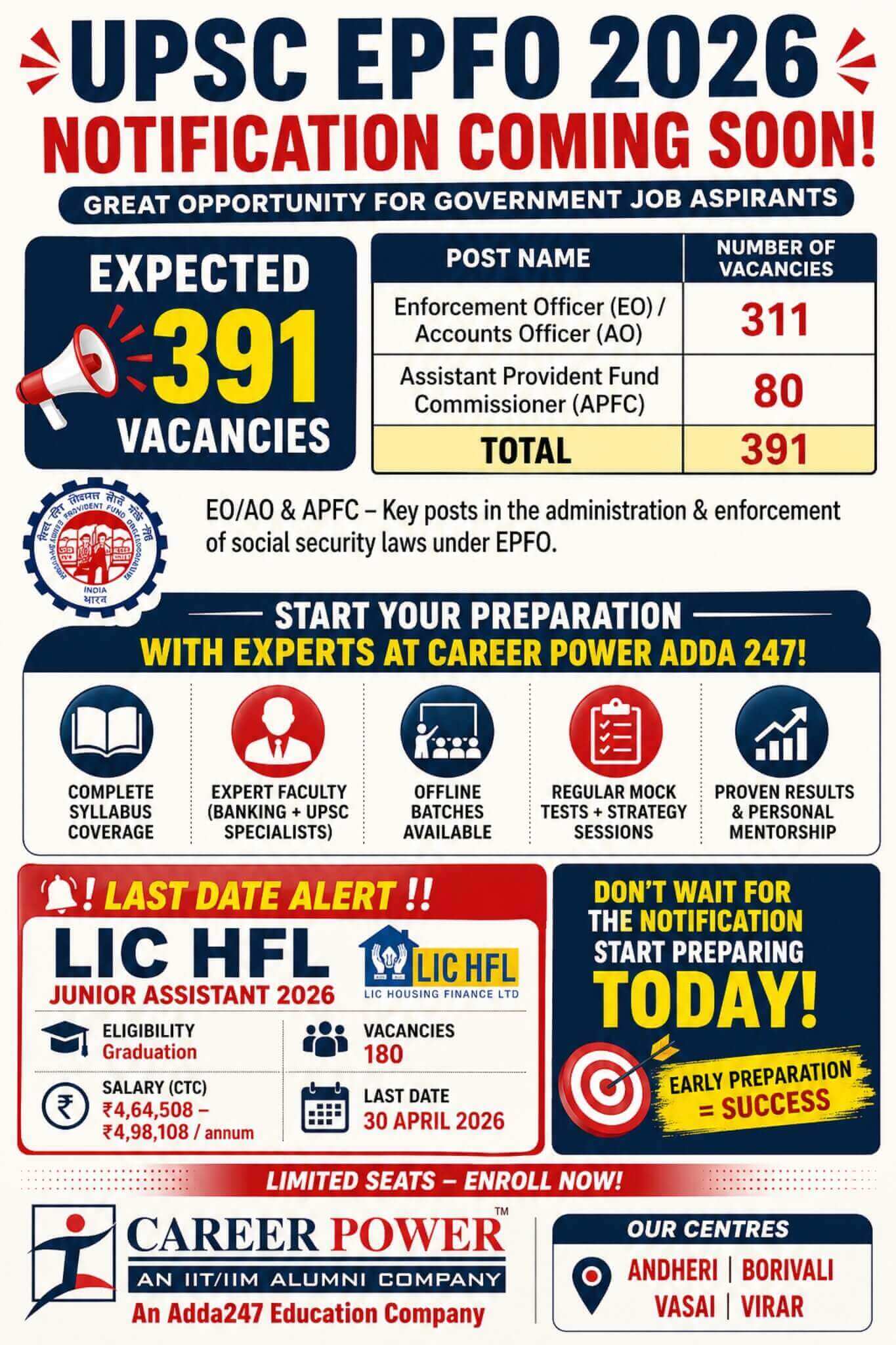
UPSC EPFO 2026 Notification Soon: Exam Date, Vacancy, Eligibility, Syllabus & Complete Preparation Guide
Summary: UPSC EPFO 2026 Notification Soon — What You Need to Know
The UPSC EPFO 2026 Notification Soon announcement is one of the most awaited updates for graduates who want a stable, well-paid central government job. The Union Public Service Commission (UPSC) recruits candidates for the Employees’ Provident Fund Organisation (EPFO) for two flagship posts: Enforcement Officer / Accounts Officer (EO/AO) and Assistant Provident Fund Commissioner (APFC).
In simple terms: the notification will soon be live on upsc.gov.in, applications will be accepted through the UPSC online portal, and selection will happen through an objective Recruitment Test (300 marks) followed by an Interview (100 marks). If you hold a Bachelor’s degree and fall in the 21–30 age bracket, this is your window to apply.
This guide breaks down the complete picture — expected dates, vacancies, eligibility, exam pattern, syllabus, salary, a step-by-step application process, expert tips, common mistakes and a big set of FAQs — so you can move from “waiting for the notification” to “exam-ready” today.
Introduction: Why UPSC EPFO 2026 Notification Soon Is Big News
If you have been refreshing the UPSC website every morning hoping to see the UPSC EPFO 2026 Notification Soon update, you are not alone. Thousands of graduates — from commerce students to engineering and arts graduates — see EPFO recruitment as a rare combination of prestige, pay and work-life balance.
Here is the reality that smart aspirants understand: the EPFO cycle does not follow a fixed annual calendar like many other exams. It is vacancy-driven. That means when the notification finally arrives, the application window can be short, the competition can be fierce, and the preparation time can feel limited.
The winners are never the people who start preparing the day the notification drops. The winners are the people who started today — using the waiting period to build the syllabus, practise previous year papers and understand the application process so that nothing catches them off guard.
By the end of this post, you will know exactly what to expect from the UPSC EPFO 2026 notification, how to apply correctly, how the exam works, and how to build a study plan that actually gets you a score above the cut-off. Let’s get you ready.
Key Takeaways
- The notification is expected soon on upsc.gov.in for EPFO EO/AO and APFC posts — the 2026 cycle is a fresh recruitment opportunity.
- Two-stage selection: an objective Recruitment Test of 300 marks (2 hours) plus an Interview of 100 marks.
- Eligibility is simple: a Bachelor’s degree in any discipline, age 21–30, with standard category relaxations.
- Four core subjects: General English, Indian Polity & Economy, General Accounting Principles, and Industrial Relations & Labour Laws.
- Negative marking applies in the Recruitment Test, so accuracy matters more than blind attempts.
- Apply only through the official portal with a valid OTR (One Time Registration); no offline applications are accepted.
- Fees in recent cycles: ₹25 for SC/ST/PwBD/women/ex-servicemen, ₹200 for others — confirm in the 2026 notification.
- Start now, not later. A 90–120 day plan built during the waiting period gives you a decisive edge over last-minute applicants.
- Verify everything officially. Dates, vacancy counts and fees in this post are indicative and must be confirmed on upsc.gov.in.
What Is the UPSC EPFO 2026 Notification Soon?
The UPSC EPFO 2026 Notification Soon refers to the official recruitment advertisement that the Union Public Service Commission will publish for filling posts in the Employees’ Provident Fund Organisation (EPFO). EPFO is a statutory body under the Ministry of Labour & Employment, Government of India, responsible for administering the Employees’ Provident Funds & Miscellaneous Provisions Act, 1952, the Employees’ Pension Scheme, 1995 and the Employees’ Deposit Linked Insurance Scheme, 1976.
In plain language: EPFO manages the retirement savings of crores of Indian workers. The officers recruited through this exam are the people who enforce compliance, audit establishments, handle accounts and protect the financial future of the working class. That is why the role carries real weight and real responsibility.
When we say the notification is “soon,” we mean that the official advertisement — containing the exact number of vacancies, pay levels, eligibility conditions, application dates and exam schedule — is expected to be uploaded shortly on the official UPSC website. Until that PDF appears, every date and number you see elsewhere (including in this post) is an estimate based on past recruitment trends.
Which Posts Does the UPSC EPFO 2026 Notification Cover?
- Enforcement Officer / Accounts Officer (EO/AO) — the larger recruitment, usually advertised in the hundreds. Pay Level 8 in the 7th CPC matrix.
- Assistant Provident Fund Commissioner (APFC) — a smaller, more senior recruitment. Pay Level 10 in the 7th CPC matrix.
For a full breakdown of duties, promotions and in-hand pay, see our detailed guide on EPFO EO/AO salary and job profile and our companion article on APFC salary and career growth.
Why the “Soon” Matters More Than You Think
EPFO recruitment is not annual. Between cycles, aspirants sometimes wait two to three years. That irregularity is exactly why the UPSC EPFO 2026 notification is such a critical event — it may be your best shot for a long time. Missing the application window because you were unprepared is a mistake you cannot undo.
Why It Matters
You might be wondering whether EPFO is worth the effort compared with banking, SSC or state PSC exams. Here is why it genuinely matters:
- Central government status and job security: This is a UPSC-conducted, central government recruitment. The stability is unmatched in the private sector.
- Attractive pay: EO/AO sits at Pay Level 8 (basic ₹44,900), while APFC sits at Pay Level 10 (basic ₹56,100). With DA, HRA and allowances, the gross package is highly competitive for a graduate-level entry job.
- A limited window: Because recruitment is irregular, each notification is a rare opening. The UPSC EPFO 2026 Notification Soon update could be the only one for your age band.
- Applications surge instantly: The moment the notification is out, lakhs of applicants will apply. Preparation started after the notification is preparation started too late.
- Syllabus is finite and predictable: Four defined subjects. No endless current affairs. No essay paper. This is one of the most “crackable” UPSC-conducted exams for a focused graduate.
- Career mobility: EPFO officers gain exposure to labour law, finance, audit and compliance — skills that are valuable across government and the private sector.
- Real social impact: You directly protect workers’ retirement savings. Few jobs give you that sense of purpose.
If you have been treating EPFO as a “backup exam,” it is time to upgrade it to a primary target. The UPSC EPFO 2026 Notification Soon news is your signal.
Benefits of an EPFO Job: What You Actually Get
Let’s move past vague phrases like “good package” and look at concrete benefits you can expect as an EPFO officer:
1. Financial Benefits
- Basic pay: ₹44,900 for EO/AO (Level 8) and ₹56,100 for APFC (Level 10) as per the 7th CPC pay matrix.
- Dearness Allowance (DA): Revised periodically and usually revised twice a year.
- House Rent Allowance (HRA): Based on your posting city class (X, Y or Z).
- Transport Allowance and other allowances as applicable to central government employees.
- Pension benefits under the National Pension System (NPS) applicable to central government employees.
- Medical facilities through the Central Government Health Scheme (CGHS) as per eligibility.
2. Career Benefits
- Clear promotion hierarchy from EO/AO upward through departmental and UPSC channels.
- Opportunities for deputation and cross-departmental exposure.
- Structured service rules, leave entitlements and job protection.
3. Personal & Lifestyle Benefits
- Reasonable working hours compared with many private-sector roles.
- Dignity and social standing attached to a central government officer post.
- A genuine sense of contribution to national social security.
Compare this with the cost — one application fee, one objective test, one interview — and the return on investment becomes obvious. The UPSC EPFO 2026 Notification Soon moment is a low-cost, high-reward opportunity.
How It Works: The UPSC EPFO 2026 Selection Process Explained
Understanding the process before the notification drops gives you a massive advantage. Here is how the recruitment works, stage by stage.
Stage 1: Official Notification Release
UPSC publishes the recruitment advertisement on its official website with the vacancy count, post-wise break-up, eligibility, reservation details, fee structure, exam date and application window. This is the only document that is legally authoritative. Always download and save the PDF — see our page on the UPSC EPFO 2026 notification PDF for a direct download and summary.
Stage 2: Online Application
Applications are accepted only online through the UPSC online recruitment portal. You must complete One Time Registration (OTR) and then apply for the specific EPFO recruitment. Read our UPSC EPFO 2026 application form guide for a field-by-field walkthrough.
Stage 3: Recruitment Test (Objective)
The Recruitment Test is an objective (multiple-choice) paper of 300 marks with a duration of about 2 hours. It covers four broad areas:
- General English — grammar, vocabulary, comprehension, sentence correction, fill in the blanks.
- Indian Polity & Economy — Constitution, governance, economic concepts, budgets, banking basics.
- General Accounting Principles — accounting fundamentals, journal, ledger, trial balance, financial statements.
- Industrial Relations & Labour Laws — key labour legislations, trade unions, dispute resolution, social security law.
Negative marking applies. In previous cycles, one-third of the marks allotted to a question were deducted for each wrong answer. The exact penalty is restated in the official notification. Detailed topic-wise coverage is available in our UPSC EPFO 2026 syllabus and exam pattern guides.
Stage 4: Interview / Personality Test
Candidates who clear the Recruitment Test are shortlisted for an interview carrying 100 marks. The interview assesses general awareness, communication, reasoning and suitability for a regulatory and financial role. Practical interview insights are covered in our UPSC EPFO interview experience article.
Stage 5: Final Merit, Document Verification and Joining
Final selection is based on the combined performance in the Recruitment Test and the Interview. Shortlisted candidates then undergo document verification and medical examination before receiving the appointment letter from EPFO.
Step-by-Step Guide: How to Apply for UPSC EPFO 2026
Follow this sequence exactly. Doing it in order prevents 90% of application rejections.
Step 1: Confirm That the Notification Is Live
- Visit upsc.gov.in and open the “What’s New” or “Examinations / Recruitment” section.
- Download the official notification PDF and read it fully — especially eligibility, age cut-off date and fee clauses.
- Bookmark our UPSC EPFO 2026 notification PDF page for a plain-language summary.
Step 2: Check Your Eligibility Carefully
- Education: Bachelor’s degree in any discipline from a recognised university.
- Age: Generally 21 to 30 years as on the closing date, with relaxations for OBC, SC/ST, PwBD and ex-servicemen.
- Nationality: Indian citizen (other categories as specified in the notification).
- Verify every clause against the official PDF — see UPSC EPFO 2026 eligibility criteria for a detailed breakdown.
Step 3: Complete Your One Time Registration (OTR)
- If you are a first-time UPSC applicant, create your OTR on the UPSC online portal.
- Enter your name exactly as it appears on your matriculation certificate.
- Keep your valid photo ID (Aadhaar, PAN, Passport, Voter ID) and educational documents handy.
- Save your OTR ID and password in a secure note.
Step 4: Fill the Online Application Form
- Log in and select the EPFO recruitment from the list of active applications.
- Fill personal details, educational qualifications, address and service preferences.
- Select your exam centres in order of priority.
- Double-check spelling, date of birth and category — corrections later may not be allowed.
Step 5: Upload Photograph and Signature
- Use a recent, clear, front-facing photograph with a plain background.
- Sign in black ink on white paper and scan at high resolution.
- Strictly follow the file size and dimension limits mentioned in the notification — mismatched uploads are the #1 cause of form rejection.
Step 6: Pay the Application Fee
- Pay online via net banking, debit card, credit card or other permitted modes.
- In recent cycles: ₹25 for SC/ST/PwBD/women/ex-servicemen and ₹200 for others — confirm the exact 2026 figures.
- Wait for the payment confirmation and save the transaction receipt.
Step 7: Submit and Download the Confirmation Page
- Review the entire form one final time before final submission.
- Download and save the submitted application PDF on your phone, laptop and cloud drive.
- Note the registration number for admit card downloads later.
Step 8: Prepare While You Wait for the Admit Card
- Follow our 90-day UPSC EPFO study plan.
- Start solving UPSC EPFO previous year question papers immediately.
- Track admit card release on our UPSC EPFO 2026 admit card page.
Examples: Three Real Aspirant Scenarios
Let’s make this practical with three realistic profiles. See which one sounds like you.
Example 1: Rohan — The Final-Year Commerce Student
Profile: B.Com final year, 21 years old, comfortable with accounting but weak in English comprehension.
Strategy: Rohan treats the waiting period before the UPSC EPFO 2026 Notification Soon release as free preparation time. He finishes General Accounting Principles notes first because it is his strength, then spends one hour daily on English grammar and reading comprehension. He completes two previous year papers before the notification arrives.
Result: When the notification drops, he applies within the first week and enters the final three months with accounting and English already locked down.
Example 2: Priya — The Working Professional
Profile: 27-year-old working in a private firm, graduates in Arts, has only 2 hours daily.
Strategy: Priya cannot afford an all-day schedule, so she focuses on high-yield topics: Indian Polity basics, key labour laws, and accounting fundamentals. She solves short mock tests during commutes and reserves weekends for full-length papers.
Result: Her focused, consistent 2-hour routine beats many aspirants who study eight unfocused hours.
Example 3: Arjun — The Second-Attempt Aspirant
Profile: 29 years old, appeared in a previous EPFO cycle but missed the cut-off narrowly.
Strategy: Arjun knows the paper’s texture. He performs a section-wise error analysis of his old attempt, identifies Industrial Relations & Labour Laws as his weak area, and rebuilds it from scratch using a structured notes system.
Result: His score jumps because he fixed the exact sections dragging him down. Check our UPSC EPFO 2026 cut-off analysis to benchmark your target score.
Lesson: Regardless of your profile, the winners are those who start during the waiting period and prepare section-wise with data, not guesswork.
Comparison Table: EO/AO vs APFC and Vacancy Trends
Table 1: EO/AO vs APFC — Post-Wise Snapshot
| Parameter | Enforcement Officer / Accounts Officer (EO/AO) | Assistant Provident Fund Commissioner (APFC) |
|---|---|---|
| Recruiting Body | UPSC for EPFO | UPSC for EPFO |
| Pay Level | Level 8 (7th CPC) | Level 10 (7th CPC) |
| Basic Pay | ₹44,900 | ₹56,100 |
| Typical Vacancy Volume | Higher (often several hundred) | Lower (usually a small number) |
| Educational Qualification | Bachelor’s degree | Bachelor’s degree |
| Selection Stages | Recruitment Test + Interview | Recruitment Test + Interview |
| Nature of Work | Enforcement, accounts, audit, compliance | Supervisory, administrative, regional office leadership |
| Competition Level | High | Very high (fewer seats) |
Table 2: EPFO Recruitment Trend — Why the 2026 Cycle Matters
| Recruitment Cycle | Indicative Vacancy Scale | What It Tells You |
|---|---|---|
| 2017 Cycle | Very large EO/AO recruitment (thousands) | EPFO can open big when vacancies accumulate |
| 2020 Cycle | Several hundred EO/AO posts | Cycles became smaller and irregular |
| 2023 Cycle | Several hundred EO/AO posts | Gradual, steady recruitment continued |
| 2026 Cycle (Expected) | To be confirmed in the notification | Apply early; prepare now, not after the PDF drops |
Note: Past-cycle figures are indicative and drawn from official notifications. Always confirm current numbers on upsc.gov.in and epfindia.gov.in.
Table 3: What to Do Before vs After the Notification
| Before the Notification (Now) | After the Notification (Soon) |
|---|---|
| Complete OTR and keep documents scanned | Apply within the first week to avoid server rush |
| Finish accounting and English basics | Shift to revision + full-length mock tests |
| Solve 2–3 previous year papers | Solve weekly timed tests with negative marking |
| Build labour law and polity notes | Memorise key sections, cases and definitions |
| Track updates on the official site | Track admit card and exam city intimation |
Common Mistakes to Avoid
Every year, capable candidates lose out — not because they lacked talent, but because they repeated avoidable errors. Here are the mistakes to eliminate.
Application Mistakes
- Waiting for the last date: Servers slow down, payments fail and panic sets in. Apply in the first week.
- Name mismatch: Your application name must match your matriculation certificate exactly.
- Wrong category selection: Claiming a relaxation you cannot prove at document verification is fatal.
- Ignoring photo/signature specifications: Oversized or blurred uploads cause rejection.
- Multiple applications: Submitting duplicate forms for the same recruitment can get all of them rejected.
- Not saving the confirmation page: Without it, you have no proof of submission.
Preparation Mistakes
- Ignoring General English: Many aspirants assume it is “easy marks.” It is, but only if you practise comprehension and grammar under time pressure.
- Neglecting Industrial Relations & Labour Laws: This section is scoring for those who prepare it and a graveyard for those who don’t.
- Reading without testing: Studying without mock tests gives a false sense of readiness.
- Blind guessing in the exam: With negative marking, reckless attempts destroy your score.
- No previous year paper practice: PYQs reveal the examiner’s style far better than any coaching note.
- Following too many sources: Three good resources revised five times beat fifteen resources read once.
Expert Tips from a Senior SEO & Exam Content Analyst
These are the insights that separate shortlisted candidates from the rest.
- Treat the waiting period as your syllabus season. By the time the UPSC EPFO 2026 Notification Soon PDF appears, two of the four sections should already be at revision stage.
- Master one accounting cycle first. Journal → Ledger → Trial Balance → Final Accounts. Once you can do this manually, objective questions become pattern recognition.
- Learn labour law by “purpose,” not by section number alone. Ask: what problem did this Act solve? Your recall will double.
- Build a one-page formula sheet for accounting ratios and a one-page timeline sheet for labour legislation history.
- Do a “negative marking audit.” In every mock, count how many marks you lost to wrong answers. Aim to cut that number by half within a month.
- Read the notification twice. Once for eligibility, once for exam-day instructions, centre codes and document requirements.
- Prepare for the interview from day one. Read EPFO’s annual reports and scheme updates — it shows genuine interest.
- Use structured data and answer-first writing if you are publishing your own notes online — AI search engines reward clear definitions and Q&A formatting.
- Follow official sources only for dates: upsc.gov.in, the UPSC online portal and epfindia.gov.in. Social media “leaks” are unreliable.
- Protect your health. Sleep, hydration and 20 minutes of movement daily protect your memory more than an extra hour of tired revision.
Best Practices for UPSC EPFO 2026 Success
- Fix a daily minimum: Even on bad days, do 30 minutes. Consistency compounds.
- Study in blocks: Two hours of focused study with a 10-minute break outperforms four hours of distracted reading.
- Revise on a schedule: Revise after 1 day, 7 days, 30 days. Use flashcards for definitions and accounting terms.
- Solve at least one full paper weekly in the final two months, strictly timed.
- Maintain an error notebook for every wrong answer — with the reason, not just the correct option.
- Use official syllabus as your checklist: Tick topics only when you can explain them to someone else.
- Group your subjects by difficulty: Tackle your weakest section in your freshest hours.
- Keep documents ready in advance: Degree certificate, category certificate, ID proof, photo and signature scans.
- Verify eligibility before paying the fee. No refunds and no second chances.
- Track deadlines on a calendar with reminders three days before the closing date.
- Write concise, structured notes — bullet points, tables and definitions you can revise in 15 minutes.
- Stay calm about the “soon.” You cannot control the release date; you can control your readiness.
Recommended Tools & Resources
You do not need expensive resources. You need the right ones, used consistently.
Official & Essential
- upsc.gov.in — notifications, exam calendar, admit cards and results.
- upsconline.gov.in — OTR and online application portal.
- epfindia.gov.in — EPFO schemes, circulars and annual reports for interview preparation.
- labour.gov.in — Ministry of Labour & Employment updates.
Study & Practice Tools on Our Blog
- UPSC EPFO previous year question papers — the single highest-value resource.
- Free UPSC EPFO mock tests — section-wise and full-length.
- Best books for UPSC EPFO — curated, no clutter.
- UPSC EPFO current affairs — weekly digest tailored to the exam.
- Industrial Relations & Labour Laws notes — simplified, exam-focused.
- General Accounting Principles notes — with solved examples.
- 90-day UPSC EPFO study plan — day-by-day roadmap.
- UPSC exam calendar 2026 — plan around other UPSC exams.
Productivity Tools
- Spaced-repetition flashcard apps for accounting terms and labour law definitions.
- A Pomodoro timer for focused study blocks.
- Cloud storage to back up your application PDF, admit card and photo ID.
- A simple spreadsheet to log mock scores, accuracy and weak topics over time.
- A PDF reader with annotation so you can mark up the official notification and syllabus.
Troubleshooting: Common Problems Solved
Something not working? Find your issue below.
Application & Portal Issues
- “OTR already exists” error: You may have registered earlier. Use the “forgot password” option or retrieve your OTR ID instead of creating a duplicate.
- Photo upload rejected: Re-scan or re-crop the image to the exact dimensions and file size in the notification. Avoid WhatsApp-compressed images.
- Signature rejected: Sign with black ink on plain white paper in a clear, steady hand — do not use cursive that becomes illegible when scaled.
- Payment failed but amount debited: Wait for the transaction status to update. If the fee is not reflected after 24–48 hours, raise a grievance through the official portal with your transaction reference.
- Website not loading near the deadline: This is exactly why you should apply early. If you must apply late, try early morning or late night slots.
- Name or date of birth entered incorrectly: Check whether a correction window is announced. If not, contact UPSC through the official grievance channel immediately.
- Cannot download the confirmation page: Log out, clear your browser cache, log in again and re-download. Also check your email for the auto-generated confirmation.
Preparation Issues
- “I keep forgetting labour law sections.” Switch from rote memorisation to story-based learning: link each Act to a problem it solved and a real example.
- “My mock scores are stagnant.” Stop taking new mocks for a week. Instead, re-solve your last three papers and analyse every wrong answer deeply.
- “I run out of time in the paper.” Practise sectional time limits: allocate fixed minutes per section and stick to them, skipping stubborn questions.
- “I cannot balance work and study.” Reduce the syllabus to high-yield topics and study in 45-minute focused blocks rather than long, scattered sessions.
- “I feel overwhelmed by the ‘soon’ uncertainty.” Reframe it: an unknown date means more preparation time than those who panic and wait. Channel your energy into one mock test today.
FAQs on UPSC EPFO 2026 Notification Soon
1. When will the UPSC EPFO 2026 notification be released?
The UPSC EPFO 2026 notification is expected to be released soon on the official UPSC website, upsc.gov.in. Because EPFO recruitment is vacancy-driven, the exact date is announced only through the official notification. Always confirm the date on upsc.gov.in before planning your application.
2. How many vacancies will be announced in the UPSC EPFO 2026 notification?
The exact number will be confirmed only in the official notification. Based on past cycles, several hundred vacancies of Enforcement Officer/Accounts Officer (EO/AO) and a small number of Assistant Provident Fund Commissioner (APFC) posts are usually advertised. See our EPFO vacancy trend analysis for historical patterns.
3. What is the educational qualification required for UPSC EPFO 2026?
You need a Bachelor’s degree in any discipline from a recognised university. Final-year students may also apply if they can produce proof of passing at the time of document verification, as specified in the notification. Read the full eligibility criteria guide.
4. What is the age limit for UPSC EPFO 2026?
The general age limit is usually 21 to 30 years as on the closing date mentioned in the notification, with standard relaxations for OBC, SC/ST, PwBD, ex-servicemen and other reserved categories. The exact cut-off date is published in the official notification.
5. What is the UPSC EPFO 2026 exam pattern?
The selection has two stages: an objective Recruitment Test (RT) of 300 marks for 2 hours, and an Interview or Personality Test of 100 marks. The RT covers General English, Indian Polity and Economy, General Accounting Principles, and Industrial Relations and Labour Laws. There is negative marking for wrong answers. See our exam pattern breakdown.
6. Is there negative marking in the UPSC EPFO Recruitment Test?
Yes. In previous UPSC EPFO recruitment tests, one-third of the marks assigned to a question were deducted for every wrong answer. The exact penalty is always restated in the official notification, so read it carefully before the exam.
7. What is the application fee for UPSC EPFO 2026?
In recent cycles, the fee was ₹25 for SC, ST, PwBD, women and ex-servicemen candidates, and ₹200 for all other candidates. The exact fee for the 2026 cycle will be confirmed in the official notification.
8. How do I apply for UPSC EPFO 2026?
You apply online through the UPSC online application portal. First complete your One Time Registration (OTR), then log in, select the EPFO recruitment, fill in your details, upload the photo and signature in the prescribed format, pay the fee, and download the confirmation page. Follow our step-by-step application guide.
9. What is the salary of an EPFO Enforcement Officer (EO/AO)?
The EO/AO post is in Pay Level 8 of the 7th CPC pay matrix with a basic pay of ₹44,900. After adding DA, HRA, transport allowance and other benefits, the gross monthly salary typically crosses ₹60,000, varying by city and DA rate. Details are in our salary and job profile guide.
10. Is the UPSC EPFO exam tough?
The competition is high, but the syllabus is limited and clearly defined. With 4 to 6 months of focused preparation using previous year papers, section-wise notes and mock tests, a serious candidate can clear the Recruitment Test. Start with our 90-day study plan.
11. How many attempts are allowed in the UPSC EPFO exam?
There is no fixed limit on the number of attempts. You can apply for every EPFO recruitment cycle for which you meet the age and eligibility conditions, and age relaxations apply to reserved categories.
12. Can I choose my exam centre for UPSC EPFO 2026?
Yes. While filling the online application you can indicate your preferred exam centres in order of priority. UPSC allots centres based on availability, and the final allotment is printed on your UPSC EPFO 2026 admit card.
13. Is the UPSC EPFO 2026 notification available in Hindi?
UPSC typically publishes notifications and application interfaces in both English and Hindi. Check the official website for the Hindi version once the notification is live.
14. What should I do right now while waiting for the notification?
Complete your OTR, scan your documents, finish the accounting and English basics, and solve at least two previous year papers. This way, when the notification arrives, you only need to apply and revise — not start from zero.
Conclusion
The UPSC EPFO 2026 Notification Soon headline is not just news — it is a countdown. Somewhere between today and the release of that PDF, a large number of aspirants will prepare seriously, and a larger number will keep telling themselves they will start “once the notification comes.”
You now have everything you need to be in the first group:
- A clear understanding of the posts, pay levels and eligibility.
- The complete selection process — Recruitment Test (300 marks) plus Interview (100 marks).
- The four-subject syllabus and the negative marking reality.
- A step-by-step application process you can execute in under an hour.
- Expert tips, common mistakes to avoid, best practices and troubleshooting fixes.
Most importantly, you have time — right now, before the rush begins. Use it. A focused candidate who starts today will always outrank a talented candidate who starts the day the notification drops.
One final note on accuracy: dates, vacancy counts and fees in this article are indicative and drawn from past recruitment patterns. Always verify the final details in the official notification on upsc.gov.in. If you spot any change, contact our editorial team and we will update this guide.
Call to Action
Your move. The notification will arrive when it arrives. Your preparation should not wait for it.
- 👉 Download the free study plan: 90-Day UPSC EPFO Study Plan
- 👉 Attempt a free mock test today: Start the UPSC EPFO Free Mock Test
- 👉 Practise with real papers: UPSC EPFO Previous Year Question Papers
- 👉 Never miss the notification: Subscribe to UPSC EPFO 2026 Notification Alerts
- 👉 Get guided preparation: Explore UPSC EPFO Online Coaching
Share this guide with a friend who is waiting for the UPSC EPFO 2026 Notification Soon update — one WhatsApp message could change someone’s career trajectory.
Bookmark this page. We update it the moment the official notification is released. Now close this tab, open your books, and take the first step.
You do not need luck. You need a plan and a start date. Make that date today.