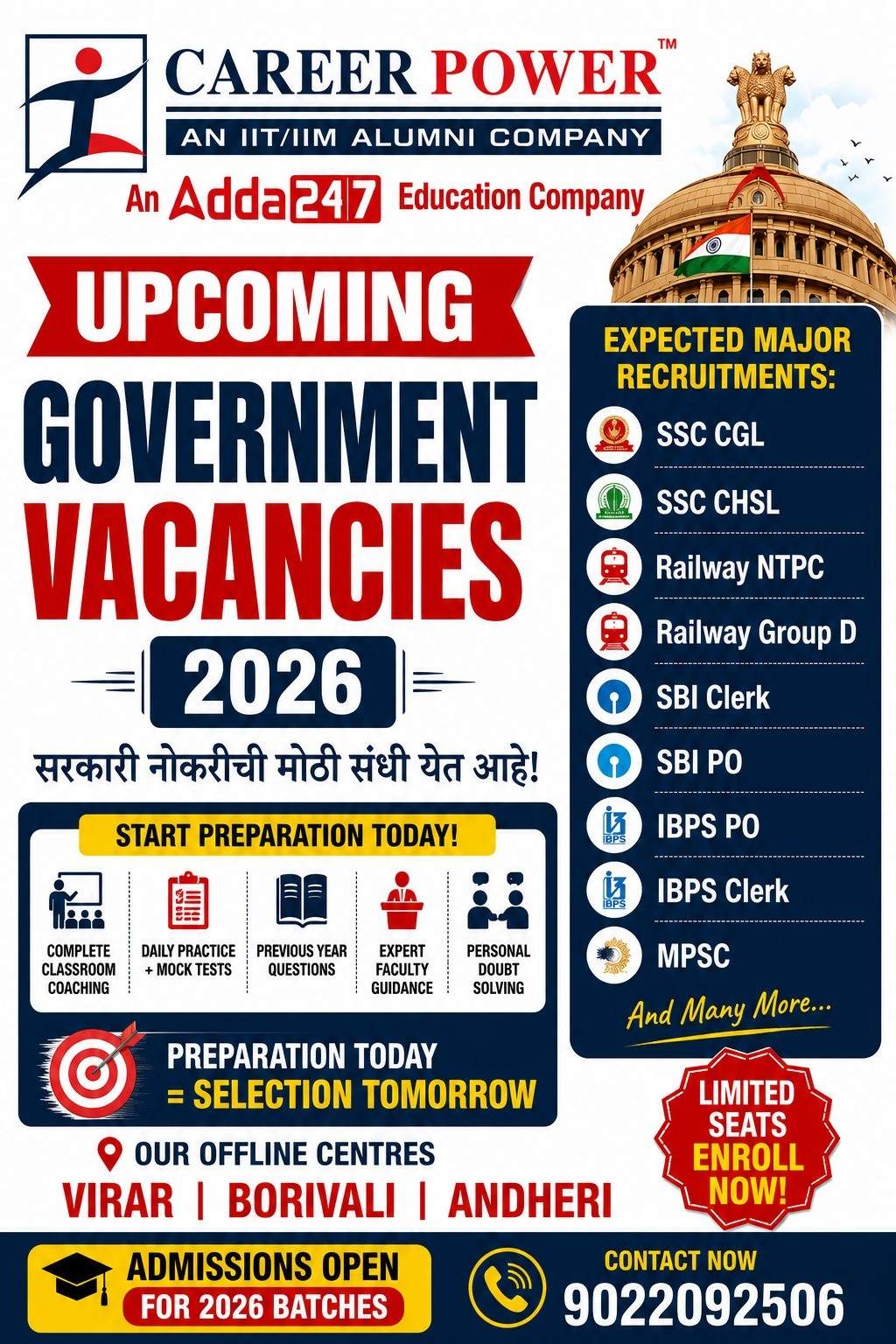
Upcoming Government Vacancies 2026: The Complete Guide to Eligibility, Exam Dates, Salary & How to Apply
Summary
Upcoming Government Vacancies 2026 are expected to open across central ministries, state
departments, public sector banks, railways, defence, teaching, and public sector undertakings (PSUs). This guide
breaks down every major recruitment cycle expected in 2026 — from SSC, UPSC, IBPS, and RRB to State PSCs and
police recruitment — along with eligibility, age limits, salary structures, selection stages, and a practical
step-by-step application process.
If you are preparing for government jobs in 2026, this post gives you a single, reliable roadmap: what is coming,
when to apply, how to prepare, and the mistakes that quietly eliminate thousands of otherwise qualified
candidates.
Introduction
Every year, millions of aspirants wait for that one notification that can change the direction of their career.
For 2026, the wait is especially exciting. Recruitment boards across India are expanding headcount in railways,
banking, education, healthcare, defence, and state administration — and the volume of Upcoming Government
Vacancies 2026 is expected to be one of the highest in recent memory.
But here is the honest truth: a vacancy is only useful if you actually apply on time, correctly, and with the
right preparation. Many candidates miss out not because they were unqualified, but because they applied late,
uploaded the wrong document, or studied without knowing the exam pattern.
This guide is designed to fix that. You will learn exactly what Upcoming Government Vacancies 2026
means for your profile, which posts match your qualification, how the selection process works from start to
finish, and how to build a preparation plan that fits around your job or studies. Whether you are a fresh
graduate, a diploma holder, or a working professional planning a switch, there is a seat at the table for you.
Before you start, bookmark our Government Exam Calendar so you never miss
a notification again.
Key Takeaways
- Upcoming Government Vacancies 2026 will span central and state recruitments, including SSC, UPSC, IBPS, RRB, State PSCs, police, teaching, defence, and PSUs.
- Most notifications release 4–8 weeks before the application deadline, so early tracking is critical.
- Eligibility usually depends on three things: educational qualification, age limit, and category relaxations.
- Nearly every major recruitment now follows a multi-stage selection: prelims → mains → interview/skill test → document verification → medical.
- A single application mistake — wrong photo, wrong category, unpaid fee — can cancel your candidature.
- Starting preparation 6–12 months in advance dramatically improves your chances in competitive exams.
- Always verify details on the official recruitment portal; third-party sources are for alerts only.
Table of Contents
- Summary
- Introduction
- Key Takeaways
- What Are Upcoming Government Vacancies 2026?
- Why Upcoming Government Vacancies 2026 Matter
- Benefits of Applying Early
- How the Government Recruitment Process Works
- Step-by-Step Guide to Apply
- Real Examples: Who Should Target What
- Comparison Table: Major Exams at a Glance
- Common Mistakes to Avoid
- Expert Tips from Toppers
- Best Practices for 2026
- Recommended Tools & Resources
- Troubleshooting Application Problems
- FAQs on Upcoming Government Vacancies 2026
- Conclusion
- Call to Action
What Are Upcoming Government Vacancies 2026?
Upcoming Government Vacancies 2026 refers to all confirmed and anticipated recruitment
notifications expected to be released for the 2026 recruitment cycle by central and state government bodies.
These vacancies cover permanent, contractual, and contractual-to-permanent positions across Group A, Group B,
Group C, and Group D services.
The main categories include:
- Central Government Recruitments: SSC (CGL, CHSL, MTS, CPO, JE), UPSC (CSE, CDS, NDA), IB, CISF, CRPF, and ministry-level hiring.
- Banking & Insurance: IBPS PO, IBPS Clerk, SBI PO, SBI Clerk, RBI Grade B, NABARD, LIC AAO.
- Railways: RRB NTPC, RRB Group D, RRB ALP, RRB JE, and zone-wise technical posts.
- State Government Jobs: State PSCs, state police, state teaching (TET), health, and revenue departments.
- Defence & Paramilitary: Agniveer, Indian Army, Navy, Air Force, Coast Guard, BSF, ITBP.
- PSUs & Autonomous Bodies: ONGC, NTPC, BHEL, SAIL, ISRO, DRDO, and similar organisations.
Related reading: Railway Recruitment 2026 – Full Guide and
State Government Jobs 2026.
Why Upcoming Government Vacancies 2026 Matter
Government jobs remain one of the most stable career paths available, and 2026 is a particularly significant
cycle. Here is why you should pay close attention to Upcoming Government Vacancies 2026:
- Job security: Government roles offer exceptional protection against economic downturns and layoffs.
- Scale of hiring: Large-volume recruitments mean more opportunities for first-time aspirants.
- Retirement-driven openings: A significant share of vacancies arises from superannuation in older departments.
- Pay revision: Implementation of updated pay scales and allowances improves overall compensation.
- Career mobility: Promotions under structured service rules allow long-term growth without switching employers.
- Social impact: Roles in health, education, and administration directly affect your community.
In short, if you are planning to appear for government exams, 2026 is not the year to wait and watch. It is the
year to prepare and apply.
Benefits of Applying Early to Government Vacancies 2026
“I will apply at the last minute” is the most expensive sentence in competitive exam preparation. Here is what
applying early actually gets you:
- Zero server pressure: Portals crash in the final 24 hours. Early applicants avoid the rush entirely.
- Time to fix errors: If your photo or signature is rejected, you still have days — not minutes — to re-upload.
- Correction window access: Many boards open a correction window; missing it can invalidate your form.
- Mental clarity: Once the application is submitted, your focus fully shifts to preparation.
- Admit card readiness: Correct details mean no last-minute panic about admit cards.
- Fee certainty: You avoid payment gateway failures during peak load.
- Better planning: Knowing your confirmed exam dates helps you sequence multiple exams without clashes.
How the Government Recruitment Process Works
Most recruitments for Upcoming Government Vacancies 2026 follow a standard pipeline. While
specifics vary by board, the broad framework looks like this:
- Notification Release: The board publishes the official notice with post details, vacancies, eligibility, syllabus, and dates.
- Online Application: You register, fill the form, upload documents, and pay the fee.
- Correction Window: A limited period to correct specific fields in your application.
- Admit Card Release: Usually 7–15 days before the exam date.
- Tier 1 / Prelims: Objective screening test — general awareness, reasoning, quantitative aptitude, English.
- Tier 2 / Mains: Higher-difficulty objective and/or descriptive papers.
- Skill / Typing / Trade Test: Mandatory for clerical, technical, and operational roles.
- Interview / Personality Test: For Group A and many Group B roles.
- Document Verification: Original certificates are checked against your online claims.
- Medical Examination: Fitness verification, especially for police, defence, and railways.
- Final Merit List & Joining: Selection list published, followed by posting orders.
Understanding this pipeline early helps you prepare each stage instead of scrambling at the last moment.
Step-by-Step Guide: How to Apply for Upcoming Government Vacancies 2026
Follow this process for every notification you target in the 2026 cycle.
Step 1: Build a Notification Tracker
- List the boards relevant to your qualification (SSC, IBPS, RRB, State PSC, etc.).
- Bookmark their official websites and check them twice a week.
- Note expected months for each notification based on the government exam calendar.
Step 2: Read the Official Notification PDF Completely
- Confirm age limits and category relaxations.
- Confirm educational qualification, including percentage requirements if any.
- Note the exact cut-off date for age and qualification eligibility.
Step 3: Keep Documents Ready in Advance
- Recent passport-size photograph (as per the board’s size and format).
- Signature on white paper, scanned cleanly.
- Class 10 and 12 marksheets, degree certificate, category certificate, ID proof.
- Scanned copies saved in a dedicated folder so you are never hunting for them.
Step 4: Register on the Official Portal
- Use a personal email ID and mobile number that stays active for the entire recruitment cycle.
- Save your registration number and password securely — you will need them for admit cards.
Step 5: Fill the Application Form Carefully
- Match your name exactly as it appears on your matriculation certificate.
- Double-check category, date of birth, and qualification fields.
- Select exam centre preferences thoughtfully.
Step 6: Upload Documents and Pay the Fee
- Resize images to the exact specifications mentioned in the notification.
- Use a reliable payment method and wait for the confirmation page.
- Download and save the fee receipt and submitted application PDF.
Step 7: Verify and Track
- Reopen your application after 24 hours to confirm all details are correct.
- Check for admit card updates weekly as the exam approaches.
Step 8: Prepare in Parallel
- Begin preparation before the notification drops — not after.
- Use our SSC CGL syllabus breakdown and
IBPS PO preparation strategy as starting points.
Examples: Which Upcoming Government Vacancies 2026 Suit Your Profile?
Example 1: The Fresh Graduate (Any Stream)
Rahul completed his B.Com in 2025 with no work experience. His best-fit targets are SSC CGL, IBPS PO, IBPS Clerk,
RRB NTPC, and State PSC clerical roles. Strategy: begin with SSC CHSL and IBPS Clerk for early confidence, then
scale up to CGL and PO-level exams.
Example 2: The Engineering Diploma Holder
Priya holds a diploma in Electrical Engineering. She should prioritise RRB JE, RRB ALP, state electricity board
recruitments, and PSU technician roles. Her technical background gives her a genuine edge in the technical section.
Example 3: The Working Professional Seeking Stability
Arjun works in a private firm and wants a career switch. His realistic path is to target 2–3 high-value exams —
SSC CGL, RBI Grade B, or State PSC — with a structured 10–12 month weekend-plus-weekday study plan.
Example 4: The Defence Aspirant
Sneha wants a uniformed service career. Her focus areas are NDA/CDS (if age-eligible), Agniveer, CAPF, and state
police recruitment — all of which require physical fitness preparation running in parallel with written exam study.
Related reading: Defence Jobs 2026, Teaching Jobs 2026,
and Government Job Eligibility Checker.
Comparison Table: Major Upcoming Government Vacancies 2026
| Recruitment | Typical Qualification | Age Range (General) | Selection Stages | Approx. Pay Level |
|---|---|---|---|---|
| SSC CGL | Bachelor’s Degree | 18–32 years | Tier 1 → Tier 2 → Skill Test → DV | Level 4–8 |
| SSC CHSL | Class 12 Pass | 18–27 years | Tier 1 → Tier 2 → Typing Test → DV | Level 2–4 |
| IBPS PO | Bachelor’s Degree | 20–30 years | Prelims → Mains → Interview | Bank Officer Scale I |
| RRB NTPC | Class 12 / Graduate | 18–33 years | CBT 1 → CBT 2 → Typing/Aptitude → DV | Level 2–6 |
| UPSC CSE | Bachelor’s Degree | 21–32 years | Prelims → Mains → Interview | Level 10+ |
| State PSC | Bachelor’s Degree | 21–40 years (varies) | Prelims → Mains → Interview | State Pay Scale |
| State Police / CAPF | Class 12 / Graduate | 18–28 years | Written → Physical → Medical → DV | Level 3–6 |
| PSU (Engineer/Executive) | B.E./B.Tech or Equivalent | 21–30 years | CBT → Group Discussion → Interview | Executive Scale |
Note: Age relaxations apply for SC/ST/OBC/PwBD/Ex-servicemen as per government rules. Always confirm from the official notification.
Expected Vacancy Snapshot for 2026
| Sector | Expected Hiring Window | Volume | Primary Qualification |
|---|---|---|---|
| Railways | Q1–Q3 2026 | Very High | 10th / 12th / ITI / Degree |
| Banking | Q2–Q4 2026 | High | Graduate |
| SSC Group B & C | Q2–Q4 2026 | Very High | 12th / Graduate |
| State Police | Q1–Q4 2026 | High | 12th / Graduate |
| Teaching | Q2–Q4 2026 | Moderate–High | B.Ed. / TET |
| Healthcare | Year-round | Moderate | Nursing / MBBS / Paramedical |
| Defence | Q1–Q3 2026 | Moderate | 10th / 12th / Graduate |
Common Mistakes to Avoid in Upcoming Government Vacancies 2026
- Applying on the final day: Portal overload causes failed applications every single cycle.
- Ignoring the notification PDF: Blogs and videos summarise; only the official PDF is authoritative.
- Wrong category selection: Choosing the wrong category can permanently disqualify you.
- Name mismatch: Your name must match your matriculation certificate exactly.
- Poor-quality scans: Blurred photos and signatures are the number one rejection reason.
- Assuming fee payment succeeded: Always confirm the payment status page and save the receipt.
- Missing the correction window: Many candidates never realise a correction window existed.
- Losing login credentials: Recovering them late can cost you an admit card.
- Over-applying: Applying for 15 exams with no focused preparation dilutes your results.
- Neglecting the physical/medical stage: Police and defence aspirants often fail here after clearing the written exam.
Expert Tips from Senior Mentors
- Pick a “core exam” and treat the rest as add-ons. Depth beats breadth in competitive preparation.
- Study the previous three years’ question papers before touching new material.
- Keep one master revision notebook for formulas, current affairs, and repeated mistakes.
- Attempt weekly full-length mocks under strict time conditions from month three onward.
- Track your accuracy ratio, not just your score — negative marking punishes careless attempts.
- Follow official sources (PIB, ministry sites, board portals) for current affairs accuracy.
- Prepare documents six months early. Delayed certificates cause avoidable disqualification.
- Build a two-hour buffer for exam-day travel, especially for computer-based tests at far-off centres.
Best Practices for Upcoming Government Vacancies 2026
- Create a personal vacancy dashboard: Board, post, notification date, last date, exam date — all in one sheet.
- Set calendar alerts at 30, 15, 7, and 2 days before every deadline.
- Maintain a single document folder with properly named and resized files.
- Verify eligibility before every application — do not rely on memory.
- Follow a fixed daily study routine: consistent 3–4 hours beats occasional 10-hour marathons.
- Revise current affairs monthly, not yearly.
- Prepare a clean, professional résumé even for exams with interviews — see our
resume tips for government jobs. - Track your health if you are targeting police or defence posts.
Recommended Tools & Resources
- Official Portals: SSC, IBPS, UPSC, RRB, and State PSC websites — your primary source of truth.
- National Career Service (NCS) Portal: Government-run job matching platform for multiple sectors.
- Mock Test Platforms: For full-length CBT-style practice and analytics.
- Previous Year Papers: Available through official portals and trusted publishers.
- Current Affairs Apps: For daily, monthly, and annual compilations.
- Image Resizing Tools: To match exact photo and signature specifications.
- Spreadsheet Trackers: Google Sheets or Excel to manage deadlines across boards.
- Study Material: See our best books for competitive exams list.
Troubleshooting Common Application Problems
1. “Photo or Signature Rejected”
- Re-check dimensions, file size, and format (usually JPEG/JPG).
- Use a plain white background and ensure the face is clearly visible.
- Re-upload before the deadline — do not wait for the correction window.
2. “Payment Failed but Amount Debited”
- Wait 24–48 hours; most gateways auto-reconcile.
- Do not pay twice immediately — first check your application status.
- If unresolved, contact the board’s helpdesk with your transaction ID.
3. “Portal Not Loading / Server Error”
- Try early morning hours when traffic is lowest.
- Switch browsers, clear cache, and disable extensions.
- Use a stable internet connection and avoid mobile hotspots.
4. “Forgot Registration Number or Password”
- Use the “Forgot Password” link with your registered email or mobile.
- Always save your registration PDF in a secure cloud folder.
5. “Admit Card Not Downloading”
- Confirm your application status is “Accepted.”
- Check for board announcements about staggered admit card release.
6. “Application Status Shows Rejected”
- Identify the stated reason from the portal or rejection notice.
- Check whether a correction window or representation process applies.
- If no remedy exists, apply early and correctly to the next notification.
FAQs on Upcoming Government Vacancies 2026
1. What are Upcoming Government Vacancies 2026?
They are the government job notifications expected to be released for the 2026 recruitment cycle across central
and state departments, banks, railways, defence, teaching, healthcare, and PSUs.
2. When will Upcoming Government Vacancies 2026 be announced?
Notifications are typically staggered throughout the year. Large recruitments usually appear in the first and
second quarters, with additional cycles continuing through the fourth quarter. Always confirm dates on the
official board portals.
3. Can final-year students apply for Upcoming Government Vacancies 2026?
Many examinations allow final-year students to apply provisionally, provided they can produce the qualifying
certificate before the cut-off date specified in the notification. Some boards require the degree at the time
of application, so read the eligibility section carefully.
4. What is the age limit for government jobs in 2026?
Age limits vary widely — commonly 18–27 years for clerical roles, 18–32 years for SSC CGL, 20–30 years for bank
PO, and 21–32 years for UPSC. Category-based relaxations apply as per government rules.
5. Is there negative marking in government exams in 2026?
Most objective papers apply negative marking for incorrect answers, commonly one-fourth or one-third of the
assigned marks. Confirm the exact penalty in your specific exam’s notification.
6. How many government vacancies are expected in 2026?
Combined recruitment across railways, SSC, banking, state police, teaching, and healthcare is expected to be
substantial, with several sectors recruiting in large volumes. Exact numbers vary by board and are announced
only in official notifications.
7. Can I apply for multiple Upcoming Government Vacancies 2026 at the same time?
Yes. There is no restriction on applying to multiple recruitments, provided you meet the eligibility criteria
for each and your exam dates do not clash. However, focus your preparation on a limited number of exams for
better results.
8. What documents do I need for Upcoming Government Vacancies 2026?
Typically: photograph, signature, Class 10 and 12 certificates, degree certificate, category certificate (if
applicable), ID proof, and experience certificates where required. Keep both digital and physical copies ready.
9. Are government jobs in 2026 available for 12th-pass candidates?
Yes. SSC CHSL, RRB Group D, RRB NTPC (certain posts), state police constable, postal, and clerical roles are
frequently open to Class 12 or Class 10 pass candidates.
10. How should I prepare for Upcoming Government Vacancies 2026?
Start 6–12 months in advance. Build a strong foundation in quantitative aptitude, reasoning, English, and
general awareness; solve previous year papers; take weekly mock tests; and revise current affairs monthly.
11. What is the salary for entry-level government jobs in 2026?
Entry-level pay depends on the pay level of the post, along with dearness allowance, house rent allowance, and
other benefits. Clerical positions generally start at Pay Level 2–4, while graduate-level posts range higher.
12. Is there an interview for all government jobs in 2026?
No. Many Group C and clerical recruitments have no interview stage and rely purely on written and skill tests.
Group A and several Group B roles include a personality test or interview.
13. How can I get instant alerts for Upcoming Government Vacancies 2026?
Subscribe to our free job alert service, follow official board portals, and set
calendar reminders for expected notification windows.
14. What is the selection process for state police recruitment in 2026?
Typically: written examination → physical standards test → physical efficiency test → medical examination →
document verification. Physical preparation should begin at least six months in advance.
15. Can I change my exam centre after applying?
Usually no, except during a designated correction window if the board permits it. Choose your centre preferences
carefully during the initial application.
16. How do I avoid rejection of my application this year?
Apply at least a week before the deadline, match your details exactly with your certificates, upload
specification-compliant documents, confirm fee payment, and verify your application after submission.
17. Are private employees eligible for government jobs in 2026?
Yes. Private-sector employees can apply freely as long as they meet the age and qualification criteria. Many
working professionals prepare while employed and switch after selection.
18. What if I clear the exam but fail document verification?
Your candidature may be cancelled if documents do not match your application claims. Always ensure that the
details you submit are accurate and supported by original certificates.
Conclusion
Upcoming Government Vacancies 2026 represent a genuine opportunity for anyone willing to
prepare with discipline and apply with care. The scale of hiring, the diversity of posts, and the range of
eligibility criteria mean that almost every serious aspirant can find a role that matches their qualification
and ambition.
But opportunity alone does not create a career. Action does. Track notifications early, read every official
notice, keep your documents ready, prepare before the exam date is announced, and treat every application with
the precision it deserves.
You do not need to be the smartest person in the exam hall. You need to be the most consistent, the most
informed, and the most prepared. Start today — not when the notification arrives.
Call to Action
Ready to grab your seat in the 2026 recruitment cycle?
- 📥 Subscribe to free job alerts and get every notification in your inbox.
- 🗓️ Download the Government Exam Calendar 2026 and plan your year.
- 📝 Check your eligibility for the top 2026 recruitments.
- 📚 Get the best books for competitive exams.
- 💬 Ask our mentors a question — we reply to every serious aspirant.
Share this guide with a friend who is preparing for government jobs in 2026. One notification
shared is one career transformed.
Disclaimer: Notification dates, vacancy counts, eligibility criteria, and exam patterns mentioned in this
article are indicative and subject to change. Always verify details from the official recruitment
notification before applying.