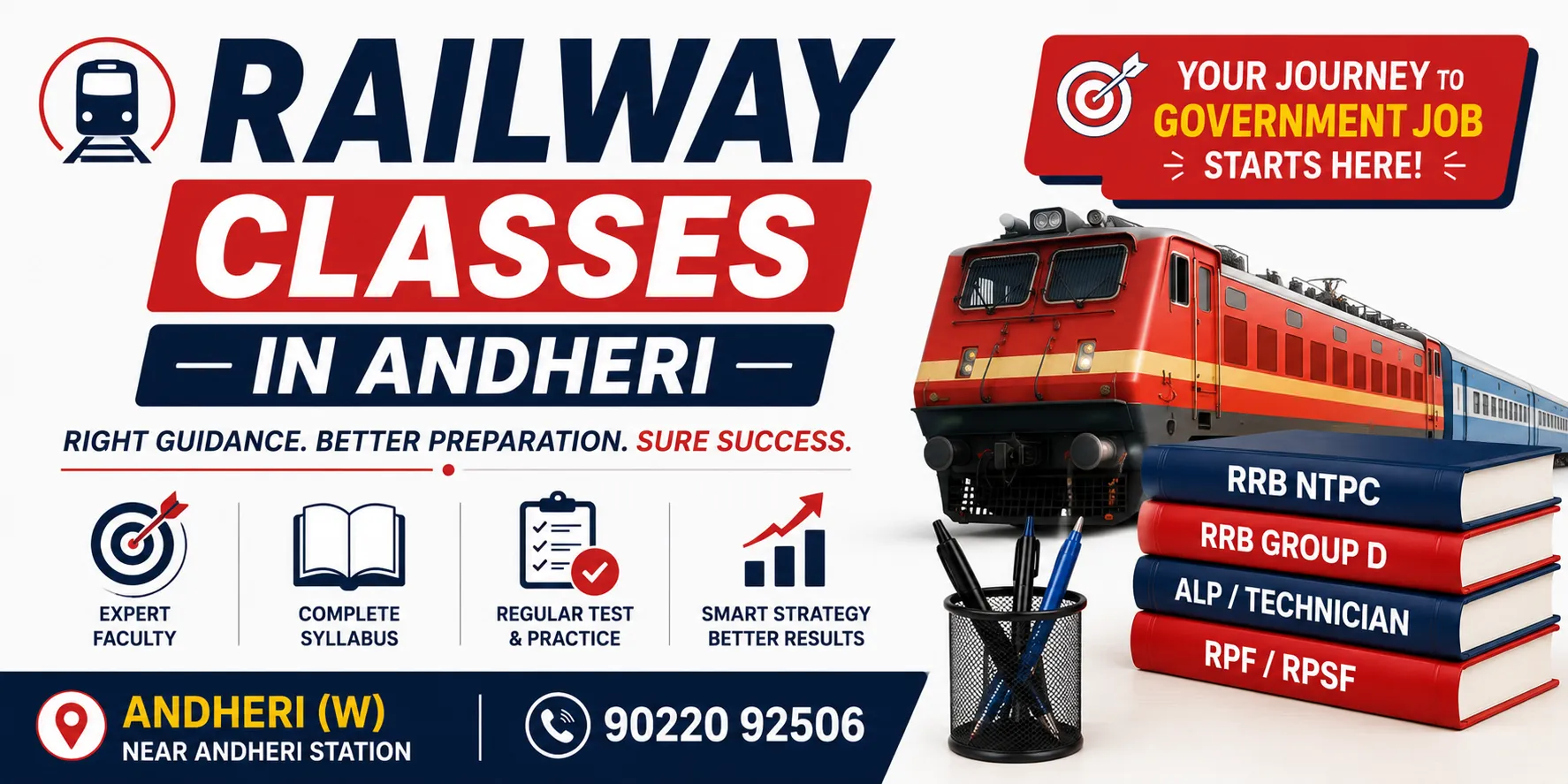
The Ultimate Guide to Railway Classes in Andheri, Mumbai: Your Path to a Government Railway Job
Summary: Railway Classes in Andheri, Mumbai at a Glance
If you have been dreaming about a stable, pensionable government railway job, the right
railway classes in Andheri, Mumbai can shorten your journey dramatically. Andheri is one of
Mumbai’s best-connected education hubs — it has metro lines, suburban rail, bus routes and a dense network of
coaching institutes within walking distance of Andheri, Andheri East, Jogeshwari, Vile Parle and Marol.
This guide walks you through what railway classes in Andheri, Mumbai actually teach, why they
matter for RRB NTPC, Group D, ALP, JE and RPF exams, how much they cost, how to choose the right institute,
a step-by-step preparation plan, real success stories, common mistakes and expert tips — all in plain, practical
language.
Introduction: Why Andheri Is the Smart Address for Railway Exam Preparation
Every year, lakhs of aspirants across India apply for government railway jobs — and only a
fraction make it through. The competition is brutal, the syllabus is wide, and the cut-offs shift every cycle.
So the question is not whether you are hardworking. The question is whether you are preparing smartly.
That is exactly where railway classes in Andheri, Mumbai come in.
Andheri sits at the centre of Mumbai’s western suburbs. For a student, that means three powerful advantages:
- Connectivity: Andheri is served by Western Railway, Metro Line 1, Metro Line 7 and Chhatrapati Shivaji Maharaj International Airport — so you can reach class from Borivali, Bandra, Kurla or Thane without losing half your day to travel.
- Concentration of quality faculty: Because Andheri is a business and education hub, experienced RRB faculty members prefer teaching here.
- Ecosystem: Coaching centres, libraries, test-series centres, stationery shops and study cafés all sit in the same 3–4 km radius.
You do not need to be a topper. You need a system. And this guide gives you that system.
“A government railway job is not won in the exam hall. It is won in the 300 mornings before it.”
Key Takeaways
- Railway classes in Andheri, Mumbai prepare you for RRB NTPC, Group D, ALP, JE, RPF and ministerial posts across Indian Railways.
- A typical offline batch runs 3–6 hours a day for 4–12 months, covering Maths, Reasoning, General Awareness, General Science and (for technical posts) subject-specific topics.
- Course fees in Andheri usually range from ₹8,000 to ₹35,000 — and many institutes offer EMI or scholarship tests.
- The single biggest predictor of success is mock test volume, not the number of hours you sit in class.
- Choose an institute based on faculty, batch size, test series quality and past results — not on flashy advertisements.
- Hybrid learning (offline class + online test series + recorded revision) gives most students the best results.
- A realistic, distraction-free 6–12 month plan is enough for a well-prepared student to clear CBT-1 and CBT-2.
What Are Railway Classes in Andheri, Mumbai?
Railway classes in Andheri, Mumbai are structured coaching programmes designed specifically to
help aspirants clear recruitment exams conducted by the Railway Recruitment Boards (RRBs) under
the Ministry of Railways, Government of India. Unlike generic competitive-exam coaching, these classes are
tailored to the exact pattern, syllabus, marking scheme and negative-marking rules of railway exams.
What Railway Classes in Andheri, Mumbai Typically Cover
- Mathematics / Quantitative Aptitude — Number System, Simplification, Percentage, Ratio & Proportion, Time–Speed–Distance, Profit & Loss, Mensuration, Data Interpretation.
- Reasoning & General Intelligence — Coding-Decoding, Blood Relations, Syllogism, Seating Arrangement, Puzzles, Non-Verbal Reasoning.
- General Awareness & Current Affairs — Indian Polity, History, Geography, Economy, Static GK, Railways-specific facts, sports, awards.
- General Science — Physics, Chemistry and Biology at Class 10 level for NTPC and Group D.
- Technical / Trade Subjects — for ALP, Technician and JE posts (Mechanical, Electrical, Electronics, Civil).
- Regional Language & English — Grammar, comprehension, vocabulary and error spotting.
- Mock Tests & CBT Simulation — computer-based test practice matching the real RRB interface.
- Physical Efficiency Test (PET) Training — for Group D and RPF posts.
- Document Verification & Interview Guidance — for NTPC and JE level posts.
Who Should Join Railway Classes in Andheri, Mumbai?
- Graduates aiming for RRB NTPC (Station Master, Goods Guard, Clerk, Junior Account Assistant).
- Class 10 / 12 / ITI pass candidates targeting RRB Group D.
- ITI / Diploma holders aiming for Assistant Loco Pilot (ALP) and Technician.
- Diploma / Engineering graduates targeting Junior Engineer (JE).
- Working professionals preparing on weekends or evenings.
- Repeat aspirants who have cleared CBT-1 but not CBT-2.
Why Railway Classes in Andheri, Mumbai Matter for Your Government Railway Job
You could absolutely self-study. Thousands do. But let’s be honest about what you are up against:
- Enormous applicant numbers: RRB NTPC and Group D notifications routinely attract between 1 crore and 2 crore applications across India. Mumbai’s RRB region alone is fiercely competitive.
- Negative marking: One-third of the marks are deducted for every wrong answer. Guessing without practice is dangerous.
- Normalisation: When an exam is held across multiple shifts, your score is normalised — so “easy shift” advantages disappear. Consistency is everything.
- Speed factor: RRB CBT-1 gives you roughly 100 questions in 90 minutes. That is under 54 seconds per question.
- Dynamic cut-offs: You are competing against the best-prepared candidates in your region, not against a fixed benchmark.
Well-run railway classes in Andheri, Mumbai close these gaps by giving you a fixed timetable,
a mentor who has solved the paper before, an updated question bank, and — most importantly — a scoreboard
that shows exactly where you stand every single week.
Railway Recruitment at a Glance
| Exam | Qualification | Key Selection Stages | Typical Vacancies per Cycle |
|---|---|---|---|
| RRB Group D | Class 10 / ITI | CBT → PET → DV | 30,000–1,00,000+ |
| RRB NTPC | Class 12 / Graduate | CBT-1 → CBT-2 → Typing/Skill → DV | 10,000–35,000 |
| RRB ALP & Technician | ITI / Diploma | CBT-1 → CBT-2 → CBAT → DV | 5,000–64,000 |
| RRB JE | Diploma / Degree (Engg.) | CBT-1 → CBT-2 → DV | 1,000–13,000 |
| RRB RPF / RPSF | Class 10 / Graduate | CBT → PET/PMT → DV | 4,000–10,000 |
Always verify the latest official notifications, dates and vacancy counts on the
official Indian Railways portal
and your regional RRB website (for Mumbai, that is
RRB Chandigarh or the relevant regional board).
Benefits of Joining Railway Classes in Andheri, Mumbai
1. A Fixed, Disciplined Study Structure
Self-study collapses the moment motivation dips. A classroom gives you a timetable you cannot negotiate with.
For most aspirants, that single factor is worth the entire fee.
2. Expert Faculty Who Have Cracked the Pattern
The best railway classes in Andheri, Mumbai employ faculty who have either cleared RRB exams
themselves or taught for 8–15 years. They know which chapters are high-yield and which ones you can safely
de-prioritise.
3. Updated Study Material Aligned to the Latest Syllabus
RRB frequently revises exam patterns. Coaching institutes update their booklets, PDFs and question banks
every cycle — something you cannot do alone without buying new books each year.
4. Regular Mock Tests With Real CBT Interface
Practising on the actual RRB computer-based test interface removes exam-day anxiety and improves accuracy
under time pressure.
5. Peer Group Motivation
Sitting beside 30 people who are grinding daily is contagious. You will compare scores, share shortcuts and
push each other — and that environment is nearly impossible to recreate alone in a Mumbai bedroom.
6. Doubt-Solving on Demand
A doubt that sits unresolved for a week becomes a permanently weak topic. In class, it gets cleared in
90 seconds.
7. Interview, DV and PET Guidance
Stages after the written exam — Document Verification, Physical Efficiency Test, skill tests — are where
many candidates stumble. Good institutes run dedicated preparation modules for these.
8. Networking & Peer Referrals
Seniors who cleared last cycle often return as guest mentors, sharing actual paper difficulty levels and
preparation shortcuts.
9. Motivation Through Measurable Progress
Weekly test reports transform vague “I’m studying” into concrete “I improved from 62 to 78 in Reasoning.”
That data keeps you going when the exam feels far away.
10. A Locally Optimised Commute
Because Andheri is a transport hub, you spend less time travelling and more time revising — a real
advantage in a city where commuting easily eats two hours a day.
How Railway Classes in Andheri, Mumbai Work
Most reputed institutes in Andheri follow a predictable, effective cycle. Here is the typical structure:
Stage 1 — Diagnostic Test & Batch Allocation
On day one, you take a baseline test. Based on your score, you are placed in a foundation, intermediate or
advanced batch. This matters because a Graduate-level NTPC aspirant and a Class-10 Group D aspirant should
not be taught at the same pace.
Stage 2 — Concept Building (Months 1–4)
- Chapter-wise concept classes with board explanations.
- Homework sets after every lecture.
- Weekly quizzes to lock in the concepts.
Stage 3 — Practice & Sectional Tests (Months 4–7)
- Sectional mock tests (Maths, Reasoning, GA, Science separately).
- Speed drills with a stopwatch.
- Error logbook reviews with your mentor.
Stage 4 — Full-Length Mocks & Analysis (Months 7–10)
- 2–3 full CBT mocks per week under real exam conditions.
- Post-test discussion: question-by-question dissection.
- Attempt-strategy coaching: which questions to skip, when to guess.
Stage 5 — Revision, PET & Final Prep (Last 4–6 Weeks)
- Rapid revision of static GK, formulas, and shortcut sheets.
- Daily full-length mocks.
- PET practice for Group D and RPF candidates.
- Document Verification and interview preparation.
Batch Formats Available in Andheri
- Offline classroom batches — best for discipline and peer interaction.
- Online live batches — best for working professionals.
- Hybrid batches — offline class + online mocks + recorded revision.
- Weekend-only batches — Saturday and Sunday intensive sessions.
- Crash courses — 30–45 day revision programmes before the exam.
Step-by-Step Guide to Choosing and Maximising Railway Classes in Andheri, Mumbai
Step 1: Decide Your Target Post First
Do not join a random batch. Decide whether you are aiming for Group D, NTPC, ALP, JE or RPF. Each has a
different syllabus weightage. Your target post determines your batch, your study material and your
practice plan.
Step 2: Research at Least 5 Institutes in Andheri
- Search Google Maps for “railway classes in Andheri” and read the reviews carefully.
- Check the institute’s YouTube channel — the quality of free lectures reveals the quality of paid ones.
- Look for verified past results, not just posters.
- Ask current students about faculty turnover.
Step 3: Attend Demo Lectures
Never enroll without a demo. Attend at least two demos from different institutes. Judge the faculty on
clarity, depth and patience with doubts.
Step 4: Inspect the Study Material & Test Series
- Is the material updated for the current exam cycle?
- Are mock tests on a real CBT-like interface?
- Do you get detailed solutions and performance analytics?
Step 5: Check Batch Size and Faculty-to-Student Ratio
A batch of 25–40 students is ideal. Anything beyond 80 means your doubts may never be answered.
Step 6: Understand Total Fees, EMI & Refund Policy
- Compare fee-to-feature ratio, not just the headline fee.
- Ask whether mock tests and study material are included.
- Check if a scholarship test can reduce your fees.
Step 7: Build a Personal Weekly Schedule
Example schedule for an Andheri student attending an evening batch:
- 6:00–8:00 AM: Maths practice (new chapter problems).
- 8:00–9:00 AM: Current Affairs reading.
- 10:00 AM–5:00 PM: Job / college.
- 6:00–9:00 PM: Railway class.
- 9:30–10:30 PM: Revision of the day’s lecture + 20 reasoning questions.
- Sunday: Full-length mock + detailed analysis.
Step 8: Track Weekly Metrics
- Number of questions solved per week.
- Mock test accuracy percentage.
- Average time per question.
- Number of weak topics eliminated.
Step 9: Apply for the Exam and Complete Documentation Early
Keep scanned copies of your Class 10 and 12 certificates, ITI/Diploma/Degree marksheets, caste certificate,
photo and signature ready. Do not wait for the last day of the application window.
Step 10: Peak at the Right Time
In the last three weeks, stop learning new topics. Focus only on revision, mocks and your error logbook.
This single habit separates selected candidates from near-misses.
Examples: How Students in Andheri Turned Coaching into Selection
Example 1: From Delivery Rider to RRB Group D
Rahul, 23, from Andheri East, worked 10-hour delivery shifts and studied in the evenings. He joined a
weekend batch of railway classes in Andheri, Mumbai and committed to 90 minutes of daily
self-study. Over nine months he completed 40 full-length mocks. He improved from 38/100 to 68/100 and
cleared Group D CBT with a comfortable margin.
Example 2: B.Com Graduate Cracks NTPC CBT-2
Priya, 26, failed NTPC CBT-1 by two marks in her first attempt. After joining a hybrid batch near Andheri
station, she focused almost entirely on speed — 60-second-per-question drills in Maths and Reasoning. In
her second attempt she cleared both CBT-1 and CBT-2 and is now a Junior Clerk in Western Railway.
Example 3: ITI Student Secures ALP
Imran, 21, from Jogeshwari, completed an ITI Electrician course and joined a dedicated ALP batch. The
technical faculty drilled him on trade-specific questions while the aptitude trainers handled Maths and
Reasoning. He cleared CBT-1, CBT-2 and the Computer-Based Aptitude Test (CBAT).
Example 4: Working Professional Uses the 4 AM Rule
Sneha, 29, a private-sector employee, studied from 4:00 to 6:30 AM daily and attended online live classes
in the evening. She used her commute to revise formula sheets on her phone. Two years of consistency
produced an NTPC selection.
The common thread: none of these students were geniuses. All of them used structured
coaching, a fixed timetable, and hundreds of mock questions.
Comparison Table: Coaching Options for Railway Classes in Andheri, Mumbai
Table 1 — Batch Format Comparison
| Format | Typical Fee Range | Best For | Pros | Cons |
|---|---|---|---|---|
| Offline Classroom (Andheri) | ₹15,000–₹35,000 | Full-time aspirants | Discipline, peer group, instant doubt-solving | Fixed timings, commute time |
| Online Live Batch | ₹8,000–₹20,000 | Working professionals | Flexible, recorded backup, cheaper | Less peer pressure, self-discipline needed |
| Hybrid Batch | ₹18,000–₹30,000 | Serious repeat aspirants | Best of both worlds | Higher cost |
| Weekend Batch | ₹10,000–₹22,000 | Job holders | No conflict with work | Slower syllabus coverage |
| Crash Course | ₹5,000–₹12,000 | Last-45-day revision | Fast, focused, affordable | Not for beginners |
| Self-Study + Test Series | ₹1,500–₹6,000 | Disciplined self-learners | Cheapest, fully flexible | No mentoring, high dropout risk |
Table 2 — What to Check Before Enrolling
| Parameter | Ideal Standard | Red Flag |
|---|---|---|
| Batch size | 25–40 students | 100+ students in one hall |
| Faculty experience | 8+ years of RRB coaching | Faculty teaching 5 different exams |
| Mock tests | 40+ full-length CBT mocks | Only PDF question papers |
| Study material | Updated for current cycle | Photocopied old notes |
| Doubt-solving | Daily fixed slot | “Ask the faculty on WhatsApp” |
| Past results | Verifiable selection list | Only topper posters, no proof |
Common Mistakes Students Make With Railway Classes in Andheri, Mumbai
- Enrolling in the cheapest batch: Low fees usually mean low faculty quality and outdated material.
- Joining a “multi-exam” batch: A batch that teaches SSC, Banking and Railways together spreads itself too thin.
- Skipping mocks: Attending every class but never taking a timed test is the single biggest cause of failure.
- Ignoring General Awareness: Many aspirants treat GA as “free marks” but never actually revise it.
- Over-collecting books: Ten books and zero revisions is worse than one book revised ten times.
- Not maintaining an error logbook: Repeating the same mistakes in every mock is a silent score-killer.
- Random guessing with negative marking: Blind guessing can wipe out your entire score.
- Comparing your speed with others: Focus on accuracy first, speed second. Speed follows accuracy.
- Changing institutes mid-preparation: Switching material and methods resets your progress.
- Neglecting PET and DV stages: Thousands are rejected at the physical or documentation stage every cycle.
- Ignoring health and sleep: Burnout in month five destroys month-ten performance.
- Not reading the official notification: Eligibility, age relaxation and document rules are all in that single PDF.
Expert Tips for Getting the Most Out of Railway Classes in Andheri, Mumbai
- Sit in the first three rows. Attention compounds.
- Write notes by hand. Handwritten notes improve retention far more than typing.
- Revise within 24 hours. Every lecture should be reviewed the same night.
- Maintain a one-page formula sheet per subject and revise it weekly.
- Treat mock tests as real exams. No phone, no breaks, no pausing.
- Analyse every mock for 60 minutes. The analysis matters more than the score.
- Keep an error logbook and re-solve every wrong question after 7 days.
- Set sectional cut-off targets rather than a single overall target.
- Study current affairs for 20 minutes daily instead of cramming before the exam.
- Use the commute: Andheri’s long metro and local-train rides are perfect for flashcard revision.
- Form a 3-person study group. Teaching each other exposes weak spots fast.
- Sleep 7 hours. Memory consolidation happens during sleep, not during all-nighters.
- Follow one mentor per subject. Too many strategies create confusion.
- Track your mock scores on a graph. Upward trends build genuine confidence.
Best Practices for Success in Railway Classes in Andheri, Mumbai
Academic Best Practices
- Complete 60–70% of the syllabus at concept level before starting full-length mocks.
- Target a minimum of 40 full-length mocks before the actual exam.
- Prioritise high-weightage topics: Percentage, Ratio, Time & Work, Coding-Decoding, Syllogism, General Science.
- Solve previous years’ papers for at least the last 10 years.
- Use the elimination method in Reasoning rather than full calculation.
Time-Management Best Practices
- Divide CBT-1 time into three blocks: first pass on easy questions, second pass on medium, third pass on tough.
- Never spend more than 90 seconds on a single question in the first pass.
- Attempt General Awareness first — it is fast and builds momentum.
Lifestyle Best Practices
- Fix your sleep and wake-up times, even on Sundays.
- Walk or do light exercise 30 minutes daily — it directly improves focus.
- Reduce social media to a fixed 20-minute window.
- Keep protein-rich snacks and water at your desk to avoid energy crashes.
Financial & Administrative Best Practices
- Ask about EMI options if the fee is a constraint.
- Keep all documents scanned and stored in cloud plus a physical folder.
- Note every official deadline in a single calendar with reminders.
Recommended Tools & Resources for Railway Aspirants in Andheri
- Official RRB websites — notifications, admit cards, answer keys and results (always your primary source).
- RRB CBT mock interface apps — practise on a layout that mirrors the real exam screen.
- NCERT Class 6–10 Science and Maths books — the foundation for General Science and Quantitative Aptitude.
- Lucent’s General Knowledge — a dependable static GK reference.
- Daily current affairs apps — 15 minutes a day is enough.
- Pomodoro timer apps — 50 minutes of study, 10 minutes of break.
- Formula and flashcard apps — ideal for Andheri’s long commutes.
- Spreadsheets or habit trackers — to log weekly mock scores and accuracy trends.
- YouTube channels of your chosen institute — free revision marathons before the exam.
- Local libraries and study rooms in Andheri — for distraction-free practice days.
Want a deeper look at exam patterns? Read our guides on
RRB NTPC Syllabus and Exam Pattern,
RRB Group D Preparation Strategy, and
RRB ALP & Technician Complete Guide.
Troubleshooting: When Railway Classes in Andheri, Mumbai Aren’t Working
Problem 1: “My mock scores are stuck at the same number.”
- Diagnose by section. Weakness is usually concentrated in one or two topics, not spread across the paper.
- Revisit fundamentals for two weeks before taking another full mock.
- Solve 50 topic-specific questions per day for the weakest area.
Problem 2: “I understand in class but forget everything at home.”
- Revise the lecture within 12 hours. Memory decays fast.
- Convert each chapter into 10 flashcards in your own words.
- Teach the topic aloud to a friend — the strongest revision technique available.
Problem 3: “I can’t finish the paper in time.”
- Practise with a timer on every single question set.
- Learn 30+ shortcut tricks for calculation-heavy topics.
- Skip and mark. Never fight a question in the first pass.
Problem 4: “I’m losing motivation.”
- Reconnect with your “why” — a government railway job means stability, pension, medical benefits and respect.
- Break the goal into weekly wins. Celebrate small improvements.
- Talk to a selected senior from your institute. Their story will reset your energy.
Problem 5: “The batch is too fast for me.”
- Request a switch to a foundation or slower batch — this is common and usually allowed.
- Attend the recorded backup lectures at 0.75x speed for difficult chapters.
- Book one-on-one time with your faculty for the two weakest topics.
Problem 6: “My fee feels like a burden.”
- Look for scholarship tests — many Andheri institutes offer up to 50% waivers.
- Consider a hybrid or online batch, which costs significantly less.
- Ask about installment plans; most reputed institutes offer them.
Problem 7: “There’s too much noise at home.”
- Use the institute’s reading room or a paid study library in Andheri.
- Shift your heaviest study block to early morning when the house is quiet.
- Use noise-cancelling headphones for mock tests.
Problem 8: “The exam got postponed and I lost momentum.”
- Treat the delay as extra revision time, not a break.
- Maintain 50% intensity — reduce hours but never drop to zero.
- Use the extra weeks to strengthen one weak subject completely.
FAQs: Railway Classes in Andheri, Mumbai
1. Which are the best railway classes in Andheri, Mumbai?
The best railway classes in Andheri, Mumbai are those with experienced RRB-specific
faculty, batches of 25–40 students, updated study material, at least 40 full-length CBT mocks and a
verifiable record of selections. Always attend a free demo before deciding.
2. What is the fee for railway classes in Andheri, Mumbai?
Fees generally range from ₹8,000 to ₹35,000, depending on the course duration, whether it
is online, offline or hybrid, and whether it covers Group D, NTPC, ALP, JE or RPF.
3. How long does it take to prepare for RRB exams through railway classes in Andheri?
Most students need 6 to 12 months of consistent preparation to comfortably clear CBT-1 and
CBT-2. Working professionals may take 12–18 months.
4. Can I attend railway classes in Andheri, Mumbai while doing a job?
Yes. Many institutes run weekend and evening batches for working professionals, and most
also provide recorded lectures you can watch anytime.
5. Are online railway classes as effective as offline classes in Andheri?
Online classes are highly effective when they include live doubt-solving, timed mocks and downloadable
notes. A hybrid model — offline classes in Andheri plus online mocks — usually delivers the
strongest results.
6. Do I need a degree to join railway classes in Andheri, Mumbai?
No. Entry requirements depend on your target post. Group D requires Class 10 or ITI, NTPC requires Class 12
or graduation, and JE requires a Diploma or Engineering degree.
7. What is the syllabus for railway exams?
The core syllabus includes Mathematics, Reasoning, General Awareness and General Science,
plus technical or trade subjects for ALP, Technician and JE posts.
8. How many mock tests should I take before the exam?
Aim for a minimum of 40 full-length CBT mocks plus unlimited sectional tests.
9. Is negative marking applicable in RRB exams?
Yes. One-third of the marks allotted to a question are deducted for every wrong answer. This is why
accuracy training matters more than raw speed.
10. Can I prepare for multiple railway exams at the same time?
Yes. The core syllabus for Group D, NTPC and ALP overlaps significantly. What changes is the difficulty
level and the technical section. Many Andheri institutes run integrated batches for this reason.
11. Does coaching guarantee selection?
No. Coaching provides structure, faculty and resources. Selection depends on your own consistency
and mock-test volume. Treat coaching as a tool, not a guarantee.
12. What documents do I need ready before applying?
Class 10 and 12 certificates, ITI/Diploma/Degree marksheets, caste certificate (if applicable), EWS or PwBD
certificate (if applicable), a recent photograph and a scanned signature.
13. How many hours should I study daily?
Full-time aspirants should target 6–8 hours per day; working professionals can manage with
a focused 3–4 hours daily plus extra hours on weekends.
14. Is Andheri a good location for railway coaching compared to other Mumbai areas?
Yes. Andheri’s metro, suburban rail and road connectivity make it one of the most accessible coaching
hubs in Mumbai, drawing students from Borivali, Bandra, Kurla, Thane and Navi Mumbai.
15. What are the age limits for railway jobs?
Age limits vary by post — generally 18–33 for Group D and 18–30 for NTPC, with relaxation for OBC, SC, ST,
PwBD and ex-servicemen candidates. Always confirm in the official notification.
16. Can I switch institutes midway if the teaching doesn’t suit me?
It is possible but not recommended. Frequent switching disrupts your material, method and momentum. Instead,
raise the issue with the institute and request a batch or faculty change.
17. What is the salary of a railway employee?
Entry-level Group D pay is based on Level 1 of the 7th CPC pay matrix (approximately ₹18,000 basic plus
allowances), while NTPC posts start at Level 2–6, with higher starting pay for JE and ministerial roles.
18. Do railway classes in Andheri, Mumbai help with PET preparation?
Reputed institutes for Group D and RPF run dedicated Physical Efficiency Test modules
covering running, weight lifting and general fitness routines.
Conclusion: Your Government Railway Job Starts With One Decision
A government railway job offers what very few careers in India still offer — stability, a pension,
medical benefits for your family, job security and social respect. But it is not handed out. It is
earned through months of disciplined, structured preparation.
Railway classes in Andheri, Mumbai give you the three things self-study rarely provides:
a system, a mentor, and a scoreboard. They compress your learning curve, keep you accountable, and turn
scattered effort into measurable progress.
You do not need to be the smartest person in the room. You only need to be the most consistent one. Pick
the right institute, follow the plan in this guide, take your mocks seriously, and give yourself a genuine
twelve months.
The notification will come. The vacancy will open. And when it does, you will be ready — not because you
got lucky, but because you prepared.
“Start where you are. Use what you have. Do it consistently. The railway job will follow.”
Call to Action: Take the Next Step Today
You have read the roadmap. Now it is time to walk it.
- 📞 Book a free demo lecture at a top-rated railway class in Andheri this week.
- 📝 Download our free RRB preparation checklist — click here to get it.
- 📚 Read next: RRB NTPC Syllabus & Exam Pattern, RRB Group D Study Plan, and Best Government Job Exams After Graduation.
- 💬 Join our Telegram community for daily current affairs, free PDFs and mock test alerts — join here.
- 📩 Subscribe to our newsletter for the latest railway notifications delivered straight to your inbox — subscribe now.
Your government railway job is not a dream. It is a plan — and you just read the plan.
Start today. ⏱️🚆