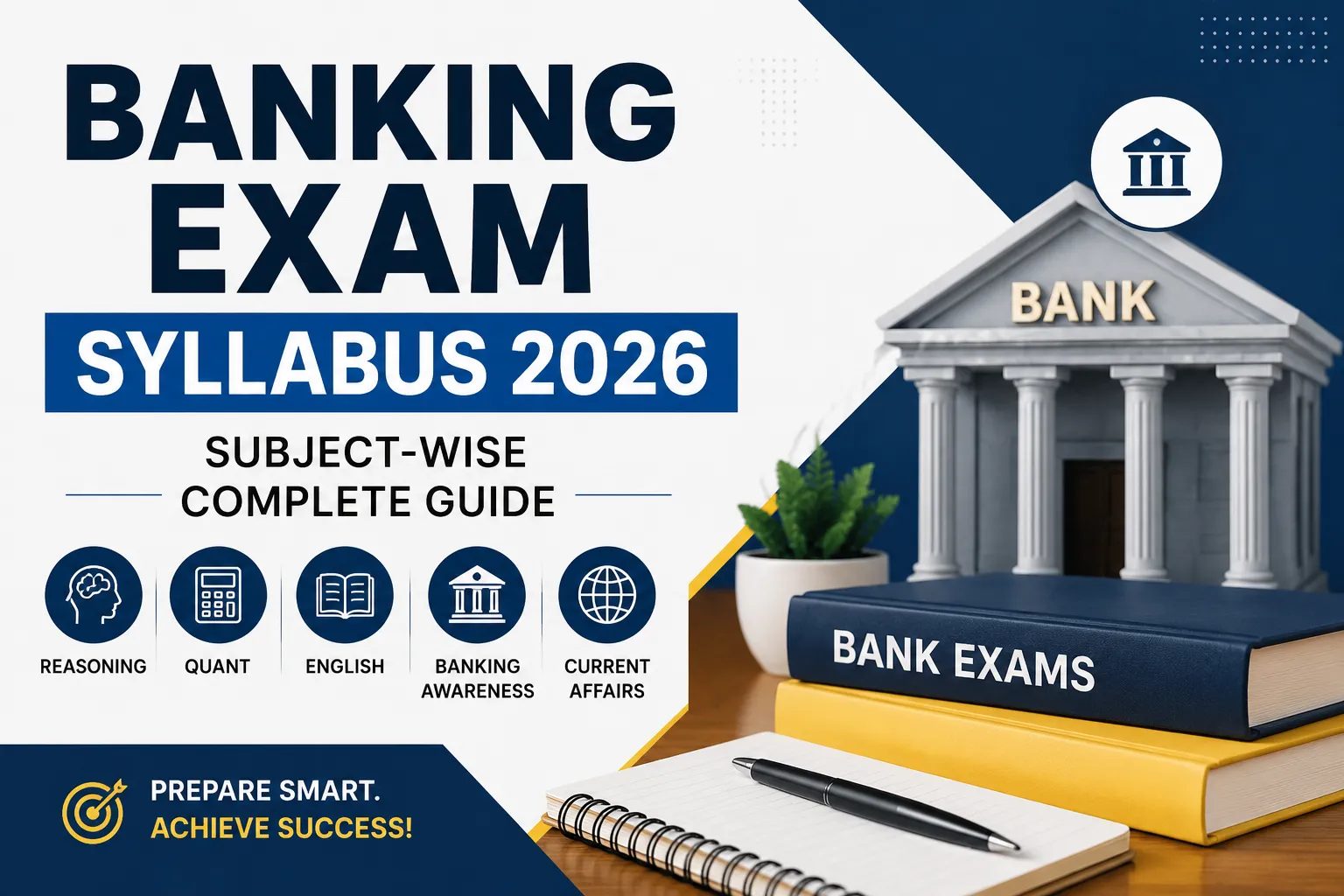
Banking Exam Syllabus 2026: Subject-Wise Complete Guide
Summary
The Banking Exam Syllabus 2026 is your single most important document as an aspirant. Whether you are targeting IBPS PO, SBI PO, IBPS Clerk, SBI Clerk, or RBI Grade B, the core subjects remain almost identical: Quantitative Aptitude, Reasoning Ability, English Language, General Awareness, Banking Awareness, and Computer Aptitude. What changes is the depth, the weightage, and the difficulty level of each stage.
In this Banking Exam Syllabus 2026: Subject-Wise Complete Guide, you will get a topic-by-topic breakdown of every subject, a comparison table of major exams, a step-by-step preparation plan, expert tips, common mistakes, recommended tools, and answers to the most frequently asked questions. Read it once, bookmark it, and use it as your preparation checklist for the entire year.
Introduction
Every year, lakhs of graduates dream of wearing that bank ID card. And every year, a large number of them fail — not because they lacked talent, but because they studied without a map. The Banking Exam Syllabus 2026 is that map. When you know exactly what is asked, what is not asked, and how much weight each topic carries, your preparation stops being guesswork and starts becoming strategy.
Here is the good news: banking exams are among the most predictable competitive exams in India. The syllabus barely changes year after year. That means if you start today with the right subject-wise plan, you have a genuine, realistic shot at selection in 2026 — even if you are a working professional or a complete beginner.
This guide is written to be your one-stop reference. You will learn the complete banking exam syllabus, understand why each subject matters, see real examples of questions, and pick up the exact habits that toppers use. Let’s begin.
Key Takeaways
- The Banking Exam Syllabus 2026 for IBPS, SBI, and other public sector banks is broadly the same across Prelims and Mains.
- Core subjects are Quantitative Aptitude, Reasoning Ability, English Language, General Awareness, Banking Awareness, and Computer Aptitude.
- Prelims tests speed and accuracy; Mains tests depth, application, and stamina.
- General Awareness and Banking Awareness give the highest return on investment because they are memory-based and highly scoring.
- Descriptive writing (Essay, Letter, Précis) appears in Mains for most officer-level posts.
- Official notifications from IBPS, SBI, and RBI are the final authority — always cross-check the syllabus there.
- A 6–8 month structured plan with weekly mock tests is the sweet spot for most aspirants.
Table of Contents
- What Is the Banking Exam Syllabus 2026?
- Why the Banking Exam Syllabus 2026 Matters
- Benefits of Following a Subject-Wise Syllabus
- How the Banking Exam Syllabus 2026 Works
- Subject-Wise Banking Exam Syllabus 2026 Breakdown
- Step-by-Step Preparation Guide
- Examples of Questions You Will Face
- Comparison Table: IBPS vs SBI vs RBI Syllabus 2026
- Common Mistakes to Avoid
- Expert Tips from Toppers
- Best Practices for 2026
- Recommended Tools & Resources
- Troubleshooting Your Preparation
- FAQs on Banking Exam Syllabus 2026
- Conclusion
- Call to Action
What Is the Banking Exam Syllabus 2026?
The Banking Exam Syllabus 2026 is the officially prescribed list of subjects, topics, and sub-topics that will be tested in recruitment exams conducted by the Institute of Banking Personnel Selection (IBPS), the State Bank of India (SBI), the Reserve Bank of India (RBI), and various other public and private sector banks.
It is released along with the official notification for each exam. The syllabus tells you:
- Which subjects will appear in Prelims and Mains
- Which topics fall under each subject
- How many questions come from each section
- Total marks and time duration
- Whether there is a negative marking penalty (usually ¼ or ⅓ of the question’s marks)
- Whether a descriptive paper or interview stage exists
Think of it as the blueprint of the exam hall. The syllabus does not just tell you what to study — it tells you what not to study, which is just as valuable.
👉 For a stage-by-stage breakdown, see our guide on the IBPS PO 2026 exam pattern and Banking Exam Syllabus 2026.
Why the Banking Exam Syllabus 2026 Matters
You might be wondering: “Why can’t I just study everything?” Because time is your scarcest resource. Here is why the banking exam syllabus 2026 deserves your full attention before you open a single book:
- It prevents wasted effort. Topics like trigonometry or advanced calculus are not asked. Skipping them saves you weeks.
- It reveals weightage. Data Interpretation alone can carry 15–20 questions. Knowing this changes how you allocate time.
- It shapes your strategy. Prelims rewards speed; Mains rewards accuracy and depth. The syllabus tells you which to prioritise when.
- It reduces anxiety. Uncertainty is the biggest stressor in exam preparation. A clear syllabus replaces fear with a checklist.
- It aligns you with the official exam. Coaching notes can be outdated; the official syllabus is always current.
- It helps you choose the right exam. Comparing syllabi helps you decide between IBPS PO, SBI PO, and RBI Grade B based on your strengths.
In short, the syllabus is not a formality — it is your competitive advantage.
Benefits of Following a Subject-Wise Syllabus
When you structure your preparation around the subject-wise banking exam syllabus 2026, you unlock several practical benefits:
- Faster coverage: You move through topics in a logical order instead of jumping randomly.
- Better retention: Grouping related topics (e.g., all arithmetic chapters together) strengthens memory.
- Smarter revision: You know exactly which high-weightage topics to revise first.
- Improved mock test scores: Section-wise practice mirrors the real exam structure.
- Higher confidence: Tracking completed topics gives you visible, motivating progress.
- Fewer surprises: New question types rarely appear outside the prescribed topics.
- Balanced preparation: You avoid the trap of over-studying one subject and neglecting another.
How the Banking Exam Syllabus 2026 Works
Most banking recruitment follows a multi-stage selection process. Here is how the Banking Exam Syllabus 2026 is organised across stages:
Stage 1: Preliminary Examination (Qualifying)
A short, objective test with three sections: English Language, Quantitative Aptitude, and Reasoning Ability. It is usually 100 questions / 100 marks in 60 minutes. Its only purpose is to shortlist candidates for Mains — Prelims marks are typically not counted in the final merit list.
Stage 2: Mains Examination (Merit-Determining)
More sections, more marks, more time. Along with Reasoning, Quant, and English, you get General/Economy/Banking Awareness, Data Analysis & Interpretation, and often a Descriptive Test (Essay, Letter, Précis). This is where merit is actually built.
Stage 3: Descriptive Test / Language Proficiency
Usually 25–50 marks, testing your written English through essays, letters, and précis on banking and economic topics.
Stage 4: Interview / Group Exercise
Shortlisted candidates face a Personal Interview, and in SBI’s case, also Group Exercises. This carries significant weight in the final merit list.
👉 Understand the full shortlisting logic in our guide on the banking exam selection process and Banking Exam Syllabus 2026 stages.
Subject-Wise Banking Exam Syllabus 2026 Breakdown
This is the heart of this Banking Exam Syllabus 2026: Subject-Wise Complete Guide. Let’s break down every subject, topic by topic.
1. Quantitative Aptitude
The most feared and most decisive subject. The banking exam syllabus 2026 for Quantitative Aptitude includes:
- Simplification & Approximation
- Number Series (missing, wrong, and double-pattern series)
- Quadratic Equations & Inequalities
- Data Interpretation — Bar graphs, Pie charts, Tables, Line graphs, Caselets, and Mixed DI
- Arithmetic Word Problems — Percentage, Profit & Loss, Simple & Compound Interest, Ratio & Proportion, Average, Time & Work, Time, Speed & Distance, Mixtures & Alligation, Partnership, Boats & Streams, Pipes & Cisterns, Ages, Mensuration
- Permutation, Combination & Probability
- Data Sufficiency
👉 Sharpen your speed with our Quantitative Aptitude shortcuts and Banking Exam Syllabus 2026 topic list.
2. Reasoning Ability
Pure logic, minimal calculation. In the subject-wise banking exam syllabus 2026, Reasoning includes:
- Puzzles & Seating Arrangement (linear, circular, floor-based, box-based, month/year-based, day-based)
- Syllogism
- Coding-Decoding (old and new pattern)
- Blood Relations
- Direction Sense
- Order & Ranking
- Alphanumeric & Symbol Series
- Inequalities
- Input-Output (mostly Mains)
- Logical & Analytical Reasoning — Statement-Assumption, Cause & Effect, Critical Reasoning (Mains)
- Data Sufficiency
👉 Master the trickiest part with our Reasoning Ability puzzle-solving tips for Banking Exam Syllabus 2026.
3. English Language
Often underestimated, but a high-scoring section if prepared well. Topics include:
- Reading Comprehension (including economy and banking-based passages)
- Cloze Test (fill in the blanks)
- Error Detection & Sentence Correction
- Sentence Rearrangement / Para Jumbles
- Para Completion & Paragraph Fillers
- Synonyms & Antonyms
- Idioms & Phrases
- Word Usage & Word Swap
- Connectors & Sentence Improvement
- Descriptive Writing — Essay, Letter, Précis (Mains)
👉 Build grammar strength with our English Language section guide for Banking Exam Syllabus 2026.
4. General Awareness (GA)
Memory-based and highly scoring. The Banking Exam Syllabus 2026 for GA covers:
- Current Affairs — national, international, sports, awards, appointments, summits
- Banking & Financial Awareness — RBI policies, repo rate, monetary policy, banking terminology
- Static GK — capitals, currencies, national parks, important days, books & authors
- Indian Economy — Union Budget, Economic Survey, GDP, inflation, fiscal policy
- Government Schemes & Initiatives
- Insurance & Financial Market Awareness
👉 Stay current with our Current Affairs for Banking Exams 2026 and Banking Exam Syllabus 2026 updates.
5. Banking Awareness & Financial Awareness
A subset of GA, but crucial for Mains and interview. Topics include:
- History of banking in India & nationalisation
- Types of banks — scheduled, non-scheduled, cooperative, payments banks, small finance banks
- RBI functions, monetary policy tools, CRR, SLR, repo, reverse repo
- NPA, SARFAESI Act, IBC, Basel norms
- Money market vs capital market, SEBI, IRDAI, NABARD, SIDBI
- Digital banking — UPI, NEFT, RTGS, IMPS, NPCI, CBDC
- Banking sector reforms and committees
👉 Deepen your knowledge with our Banking Awareness study material and Banking Exam Syllabus 2026 notes.
6. Computer Aptitude
Usually merged with Reasoning in Mains. The syllabus covers:
- Fundamentals of computers, hardware, and software
- Operating systems and Microsoft Office basics
- Networking, internet, and email
- Database management basics
- Cyber security and digital payment systems
- Shortcut keys and basic computer terminology
7. Descriptive Test (Mains)
- Essay Writing — banking, economy, social issues, technology
- Letter Writing — formal, informal, and business letters
- Précis Writing — summary of a passage
Step-by-Step Preparation Guide for the Banking Exam Syllabus 2026
Follow this sequence and you will cover the entire Banking Exam Syllabus 2026 without chaos.
Step 1: Download the Official Notification
Get the syllabus directly from the official website — ibps.in, sbi.co.in, or rbi.org.in. Print the syllabus and stick it on your wall.
Step 2: Take a Diagnostic Mock Test
Before studying anything, attempt one full mock test. This tells you your current strengths and weaknesses across the subject-wise banking exam syllabus 2026. You cannot improve what you have not measured.
Step 3: Build Your Subject Priority List
Rank subjects by two factors: your current ability and exam weightage. Usually the order looks like this:
- Start with: Reasoning and Quantitative Aptitude basics
- Run parallel: English (daily reading habit) and General Awareness (15 minutes daily)
- Layer in: Banking Awareness and Computer Aptitude
- Finish with: Descriptive writing practice
Step 4: Create a Weekly Study Timetable
A simple and proven split:
- Reasoning: 2 hours/day, 5 days a week
- Quantitative Aptitude: 2 hours/day, 5 days a week
- English: 1 hour/day, 6 days a week
- General & Banking Awareness: 30 minutes/day, every day
- Computer Aptitude: 3 hours/week
- Revision & Mock Tests: 1 full test per week (Prelims), 1 full test per fortnight (Mains)
Step 5: Practice Topic-Wise Before Full-Length Mocks
Do not jump to full mocks too early. Master one topic at a time, then attempt 20–30 questions on it. Only when you can solve a topic with 85%+ accuracy should you move on.
Step 6: Maintain an Error Notebook
Every wrong answer goes into a notebook with the reason: calculation mistake, concept gap, or misread question. Review it every Sunday. This single habit separates toppers from repeaters.
Step 7: Increase Mock Frequency in the Final 60 Days
Shift to 3–4 mocks per week, with strict sectional timing. Analyse every mock for at least 60 minutes — the analysis matters more than the attempt.
Step 8: Revise the Full Syllabus in the Last 15 Days
No new topics. Only revision, formulas, GA capsules, and mock analysis. Trust your preparation.
👉 Download our free 90-day banking exam study plan aligned with the Banking Exam Syllabus 2026.
Examples of Questions You Will Face
Here is a flavour of what each subject looks like in the Banking Exam Syllabus 2026.
Quantitative Aptitude Example
A shopkeeper marks an article 40% above cost price and offers a 25% discount. What is his profit percentage?
Working: Let CP = 100. MP = 140. SP = 140 × 0.75 = 105. Profit = 5%. Answer: 5%.
The lesson: percentage and profit-loss questions are simple arithmetic dressed in wordy clothing. Learn the base-100 technique and you will solve these in under 30 seconds.
Reasoning Example
Eight people sit around a circular table facing the centre. A sits third to the left of B, who sits second to the right of C…
The lesson: seating arrangements look intimidating but follow fixed rules. Draw the circle, place confirmed positions first, and eliminate possibilities systematically.
English Example
Identify the error: “The bank has taken several measure to reduce the number of non-performing assets.”
Answer: “measure” should be “measures” (plural after “several”). The lesson: read every sentence aloud in your head — most errors hide in pluralisation and prepositions.
General Awareness Example
Which institution regulates the Indian money market and issues currency notes?
Answer: Reserve Bank of India (RBI). The lesson: banking awareness questions are often one-line definitions you either know or don’t. Daily 15-minute reading wins these marks.
Computer Aptitude Example
What does CTRL + SHIFT + N do in a spreadsheet application?
The lesson: computer aptitude rewards familiarity, not deep technical study.
Comparison Table: Banking Exam Syllabus 2026 Across Major Exams
The overall structure of the Banking Exam Syllabus 2026 is similar across exams, but section weightage and Mains depth differ. Use this table to choose the right target and plan accordingly.
| Exam | Prelims Sections | Mains Sections (Key) | Descriptive Test | Final Stage |
|---|---|---|---|---|
| IBPS PO | English, Quantitative Aptitude, Reasoning | Reasoning & Computer Aptitude, Data Analysis & Interpretation, English, General/Economy/Banking Awareness | Yes (English — Essay & Letter) | Interview |
| SBI PO | English, Quantitative Aptitude, Reasoning | Reasoning & Computer Aptitude, Data Analysis & Interpretation, English, General/Economy/Banking Awareness | Yes (English — Essay & Letter) | Group Exercise + Interview |
| IBPS Clerk | English, Quantitative Aptitude, Reasoning | English, Quantitative Aptitude, Reasoning & Computer Aptitude, General/Financial Awareness | No (in most cycles) | Provisional Allotment |
| SBI Clerk | English, Quantitative Aptitude, Reasoning | English, Quantitative Aptitude, Reasoning & Computer Aptitude, General/Financial Awareness | No | Language Test / Local Language |
| RBI Grade B | General Awareness, English, Quantitative Aptitude, Reasoning | Economic & Social Issues, English (Descriptive), Finance & Management, Statistics (Paper II/III) | Yes (English Descriptive) | Interview |
Note: Section composition and marks may vary with each official notification. Always verify against the latest notification on the official website.
👉 Planning for the central bank? Read our dedicated RBI Grade B Banking Exam Syllabus 2026 preparation guide.
Common Mistakes to Avoid in Banking Exam Syllabus 2026 Preparation
- Ignoring the official syllabus. Relying only on coaching material means you may miss newly added topics.
- Neglecting General Awareness. It is the easiest section to score in — and the easiest to ignore. Do not.
- Studying without practising. Reading theory for hours without solving questions creates an illusion of progress.
- Attempting mocks too early. Full mocks before basic topic mastery only damages confidence.
- Not analysing mock tests. Attempting 100 mocks without analysis is worse than attempting 20 with deep analysis.
- Chasing speed before accuracy. Speed follows accuracy, never the other way round.
- Skipping the Descriptive Test. Many candidates clear Mains cut-offs but fail the descriptive paper.
- Over-relying on one subject. Sectional cut-offs exist. A brilliant Quant score cannot save a failed Reasoning section.
- Changing resources repeatedly. Pick one book and one mock series — stick with them.
- Comparing yourself to others. Your only benchmark should be your own previous mock score.
Expert Tips from Successful Candidates
- Master Data Interpretation first. It appears in both Prelims and Mains and carries high weightage across the Banking Exam Syllabus 2026.
- Solve 2 puzzles daily. Consistency beats marathon sessions for Reasoning.
- Read one editorial daily. It improves vocabulary, comprehension, and descriptive writing simultaneously.
- Make a GA capsule weekly. Compress current affairs into one-page notes every Sunday.
- Practise sectional timing. Prelims is won in the last 10 minutes — train for that pressure.
- Use the elimination method. In English and GA, eliminating two options raises your accuracy dramatically.
- Attempt easy questions first. No one gets extra marks for solving in order. Scan, then solve.
- Write descriptive answers by hand. Typing practice is not enough — speed-writing matters.
- Take one full day off each month. Burnout is the silent killer of long preparation journeys.
- Trust the process. Most successful candidates failed at least one attempt before clearing.
Best Practices for Covering the Banking Exam Syllabus 2026
- Follow a written plan. Put your weekly targets on paper or in a tracker.
- Study in Pomodoro blocks. 50 minutes of focus + 10 minutes of break keeps retention high.
- Revise within 24 hours, 7 days, and 30 days. Spaced repetition is scientifically proven.
- Maintain separate notebooks for formulas, error logs, and GA notes.
- Solve previous year papers for the last 5–10 years of your target exam.
- Simulate real exam conditions — same time of day, no distractions, strict timer.
- Track accuracy, not just attempts. Aim for 85%+ accuracy before chasing speed.
- Keep weekends for revision instead of new topics.
- Stay physically active. Exercise improves concentration and reduces exam stress.
- Review and adapt monthly. A plan that isn’t reviewed is just a wish.
Recommended Tools & Resources for Banking Exam Syllabus 2026
Books
- Quantitative Aptitude: R.S. Aggarwal, Sarvesh Kumar Verma (Quantum CAT for advanced practice)
- Reasoning: R.S. Aggarwal, A Modern Approach to Verbal & Non-Verbal Reasoning
- English: Wren & Martin (High School English Grammar), Norman Lewis (Word Power Made Easy)
- General & Banking Awareness: Monthly banking awareness magazines and official RBI publications
- Computer Aptitude: Lucent’s Computer book
Online Resources
- Official websites: ibps.in, sbi.co.in, rbi.org.in
- Mock test platforms: Testbook, Oliveboard, Adda247, PracticeMock
- Current affairs sources: The Hindu, Indian Express, PIB, RBI press releases
- Video learning: YouTube channels dedicated to quant and reasoning shortcuts
👉 Explore our curated list of best books for the Banking Exam Syllabus 2026.
Troubleshooting Your Preparation
Problem 1: My mock scores are not improving.
Fix: Stop attempting new mocks for a week. Review your last five tests topic by topic. Identify the three topics where you lose the most marks and drill them exclusively. Often the issue is not knowledge but time allocation.
Problem 2: I forget General Awareness within days.
Fix: Stop reading long articles. Convert everything into one-line facts, then revise them every alternate day. Use revision apps or write them on flashcards.
Problem 3: Reasoning puzzles take too long.
Fix: Practise only two-puzzle-per-day drills with a stopwatch. If a puzzle takes more than 8 minutes, abandon it in the real exam and move on. Train the skill of letting go.
Problem 4: I cannot finish the Quant section.
Fix: Learn simplification and approximation first — these are free marks. Then master percentage, ratio, and average, which form the base for most arithmetic questions.
Problem 5: I feel demotivated after failures.
Fix: Zoom out. Banking exams allow multiple attempts and multiple exams per year. One failed attempt is data, not destiny. Focus on the next 30 days only.
Problem 6: I have less than 60 days to prepare.
Fix: Prioritise high-weightage topics across the Banking Exam Syllabus 2026 — DI, puzzles, simplification, error detection, and current affairs. Skip low-weightage topics entirely and attempt mocks every alternate day.
FAQs on Banking Exam Syllabus 2026
1. What is the Banking Exam Syllabus 2026 for IBPS PO?
IBPS PO Prelims covers English Language, Quantitative Aptitude, and Reasoning Ability. Mains adds Reasoning & Computer Aptitude, Data Analysis & Interpretation, General/Economy/Banking Awareness, and a Descriptive English paper.
2. Is the Banking Exam Syllabus 2026 different for SBI and IBPS?
The subjects are almost identical. SBI tends to ask slightly tougher questions and includes Group Exercises in the final stage, while IBPS has a traditional interview. Always check the respective official notification.
3. How many subjects are there in the banking exam syllabus?
There are six core subjects: Quantitative Aptitude, Reasoning Ability, English Language, General Awareness, Banking Awareness, and Computer Aptitude. Descriptive writing is an additional component in Mains.
4. Has the Banking Exam Syllabus 2026 changed from 2025?
For most exams, the core syllabus remains stable. Minor changes in section weightage, question types, or the inclusion of new topics (such as CBDC or digital banking) may occur. The official notification is the final authority.
5. Which subject carries the highest weightage in the banking exam syllabus?
In Prelims, Reasoning and Quantitative Aptitude usually carry equal weightage (35 questions each), followed by English (30 questions). In Mains, Data Analysis & Interpretation and General Awareness often carry the highest marks.
6. Is there negative marking in banking exams?
Yes. Most banking exams deduct ¼ or ⅓ of the marks assigned to a question for every wrong answer. Blind guessing is not advisable.
7. How long does it take to complete the Banking Exam Syllabus 2026?
For a beginner, 6–8 months of consistent study is ideal. Working professionals may need 8–10 months. Candidates with prior preparation can complete revision in 3–4 months.
8. Is General Awareness difficult in banking exams?
Not at all. It is the most scoring section because it is purely memory-based. Fifteen minutes of daily newspaper reading plus a monthly current affairs capsule is usually sufficient.
9. Do I need to prepare for the Descriptive Test?
Yes, for officer-level posts like IBPS PO and SBI PO. Practise essays and letters on banking, economy, and social topics, and write by hand to build speed.
10. What is the best order to study the banking exam syllabus?
Start with Reasoning and Quantitative Aptitude basics, run English and General Awareness in parallel daily, then add Banking Awareness, Computer Aptitude, and finally Descriptive writing.
11. Can I clear banking exams without coaching?
Absolutely. Self-study works well when you have the official syllabus, quality books, a mock test series, and a disciplined weekly plan. Many successful candidates prepare entirely at home.
12. How many mock tests should I take before the exam?
Aim for at least 30–40 full-length Prelims mocks and 15–20 Mains mocks, with thorough analysis after each one.
13. Is Computer Aptitude hard to prepare for?
No. It is one of the easiest sections in the Banking Exam Syllabus 2026. A few days of focused study on computer fundamentals, shortcuts, and digital banking concepts is enough.
14. What is the difference between General Awareness and Banking Awareness?
General Awareness covers current affairs, static GK, and Indian economy. Banking Awareness focuses specifically on banking structure, RBI policies, financial terminology, and banking reforms.
15. Where can I download the official Banking Exam Syllabus 2026 PDF?
From the official websites of the recruiting bodies — ibps.in, sbi.co.in, and rbi.org.in. The syllabus and exam pattern are published as part of the official notification PDF.
Conclusion
The Banking Exam Syllabus 2026 is not just a list of topics — it is your competitive edge. It tells you where to focus, what to skip, and how to allocate every precious hour of your preparation. When you combine a clear syllabus with consistent daily effort, weekly mock tests, and honest self-analysis, selection stops being luck and starts becoming a matter of time.
Remember, every topper you admire once sat exactly where you are right now — confused, overwhelmed, and unsure. What separated them was not extraordinary intelligence. It was an ordinary plan executed with extraordinary consistency.
Use this Banking Exam Syllabus 2026: Subject-Wise Complete Guide as your reference document. Print it, track it, revise it, and return to it whenever you feel lost. Your 2026 selection letter is built one topic at a time.
Call to Action
Ready to turn the Banking Exam Syllabus 2026 into your selection strategy?
- 📥 Download the free Banking Exam Syllabus 2026 PDF checklist and tick off every topic as you finish it.
- 📝 Take a free full-length banking exam mock test today and find out exactly where you stand.
- 📅 Grab the 90-day banking exam study plan built around this syllabus.
- 💬 Join our Telegram community for daily current affairs, quizzes, and doubt clearing.
Your journey to a banking career starts with one decision — and one topic. Start with Simplification today. Come back tomorrow for the next one.