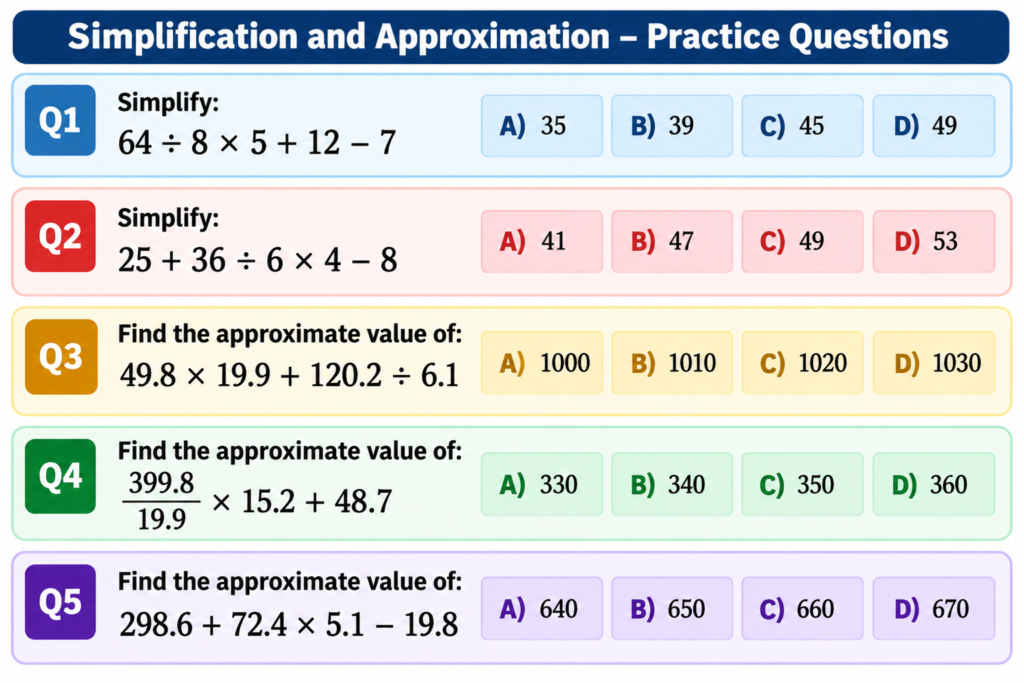

Simplification and Approximation are important topics in the Quantitative Aptitude section of competitive examinations such as SBI Clerk, SBI PO, IBPS Clerk, IBPS PO, and other banking exams. These topics can help students improve their calculation speed and accuracy with regular practice.
To solve Simplification questions, candidates need to perform mathematical operations according to the correct order of operations. BODMAS is a useful rule to remember while solving these expressions.
Approximation questions follow a slightly different approach. Instead of calculating the exact answer, candidates estimate a value close to the actual result by rounding numbers to convenient values. This technique helps save time, especially in exams where speed is essential.
In this chapter, we will cover the fundamental concepts of Simplification and Approximation, important calculation rules, useful shortcuts, different question patterns, and solved examples to help students strengthen their quantitative aptitude skills.
Simplification is the process of solving a mathematical expression by applying arithmetic operations in the correct sequence. The objective is to obtain the exact value of the given expression.
For example:
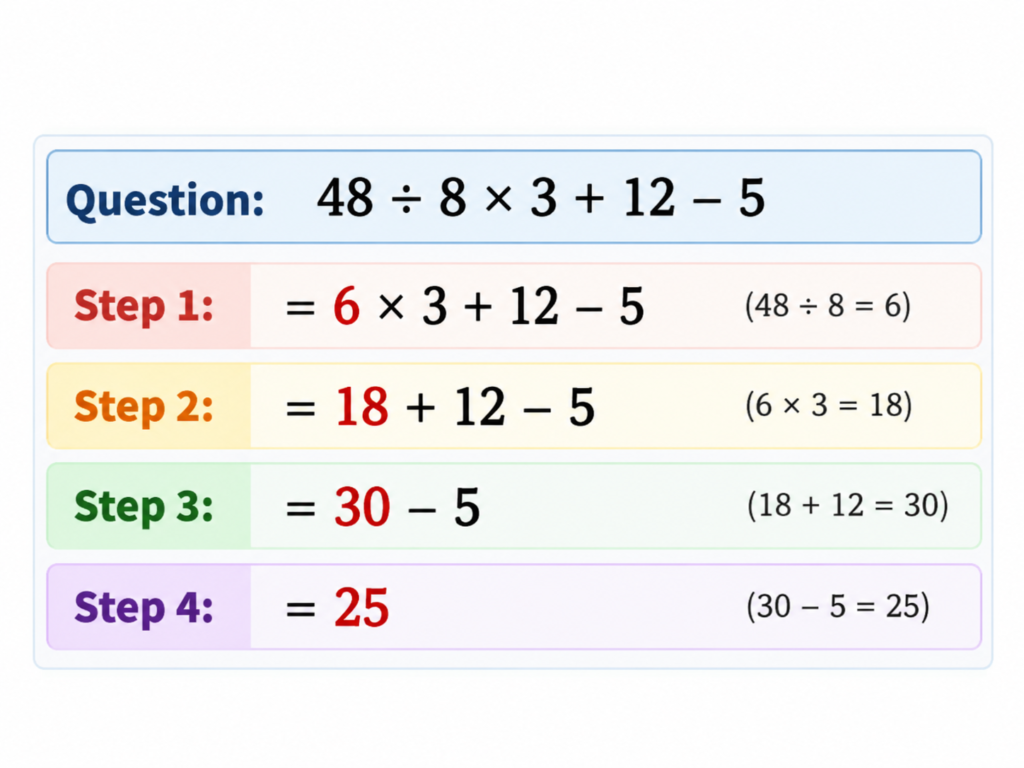
Step 1: Apply BODMAS rule.
BODMAS stands for Brackets, Orders, Division, Multiplication, Addition and Subtraction. Division and multiplication are performed from left to right, followed by addition and subtraction from left to right.
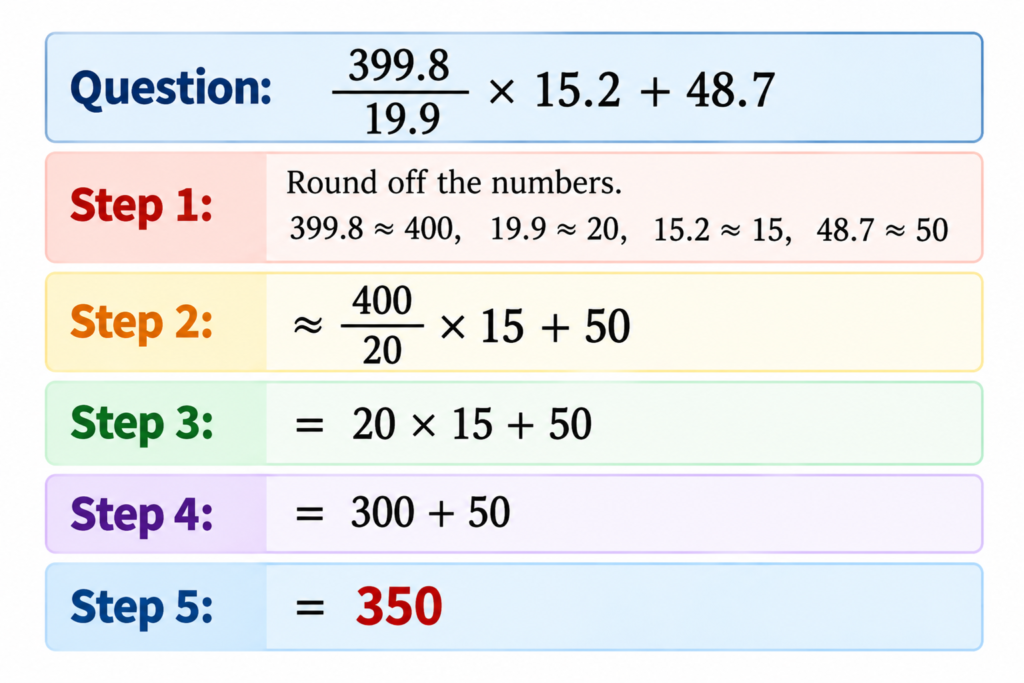
Approximation is the process of finding a value that is close to the exact answer without performing every calculation precisely. It generally involves rounding numbers to nearby convenient values before solving the expression.
For example:
Simplification and Approximation can help candidates:
Solve calculation-based questions more quickly.
Improve accuracy in arithmetic operations.
Manage time effectively during competitive examinations.
Develop stronger mental calculation skills.
Build a solid foundation for other Quantitative Aptitude topics.
Preparation tip: Learn the BODMAS rule thoroughly, practise tables, squares and cubes, and solve a variety of questions regularly to improve your performance.