
Banking | SSC | Railway | CAT Exam Preparation
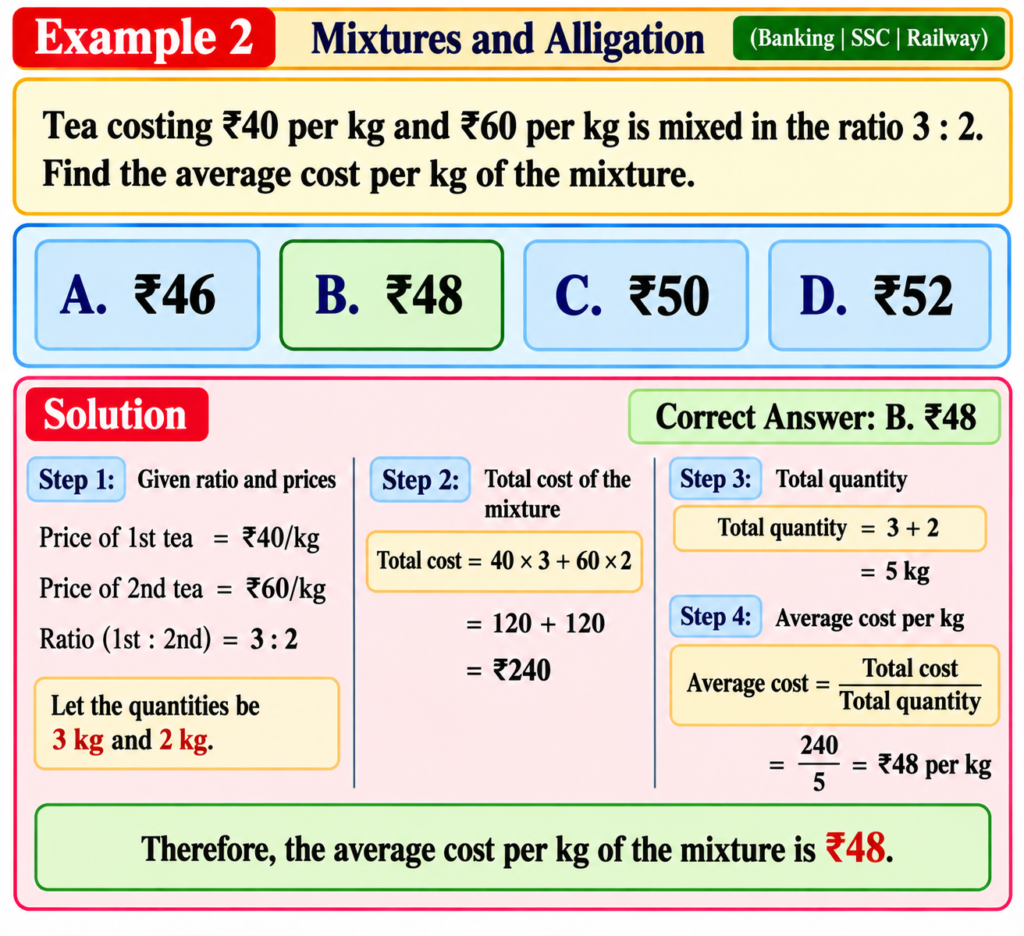
A mixture is formed by combining two or more substances. When substances have different prices or concentrations, we can calculate the average price or concentration of the resulting mixture using the concept of a weighted average.
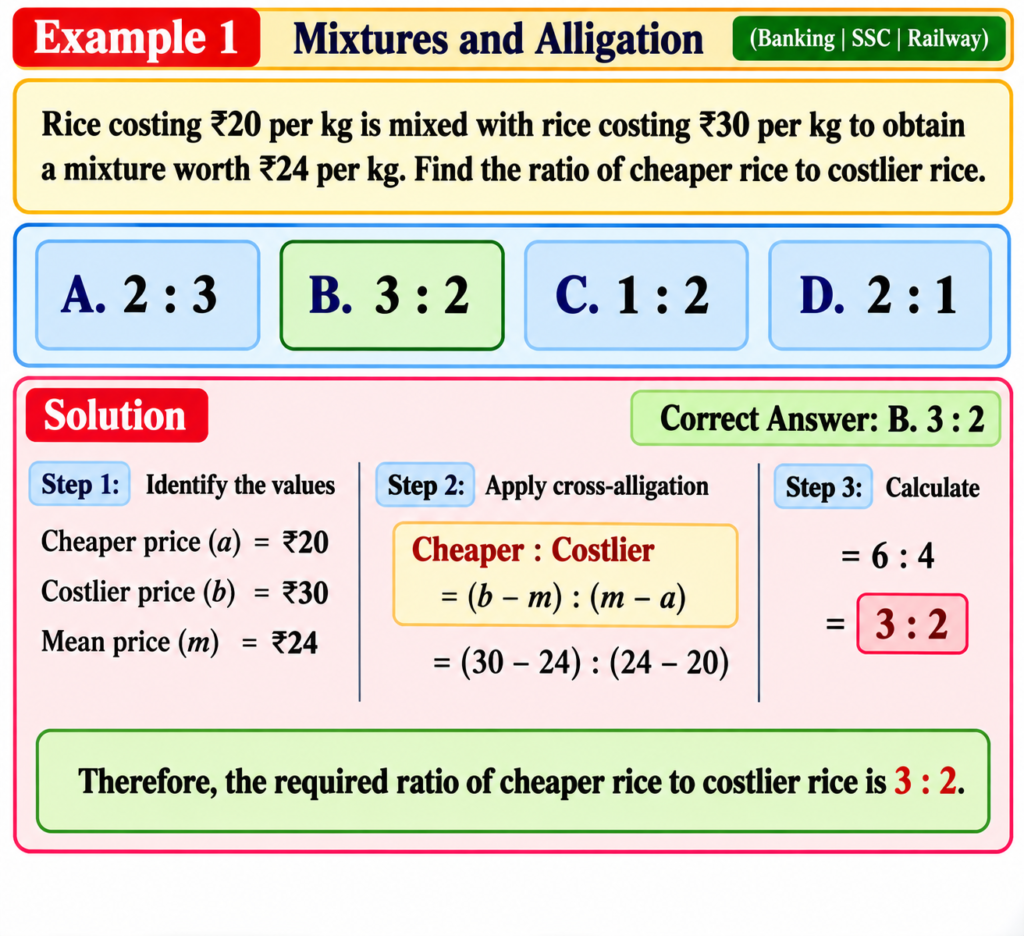
For example, if rice costing ₹40 per kg is mixed with rice costing ₹60 per kg, the cost per kg of the mixture depends on the quantities of both types of rice used.
Suppose:
a = Cost per kg of the first variety
b = Cost per kg of the second variety, where \(a<b\)
x = Quantity of the first variety
y = Quantity of the second variety
m = Average cost per kg of the mixture
The total cost of the first variety is \(ax\), and the total cost of the second variety is \(by\).
Therefore,
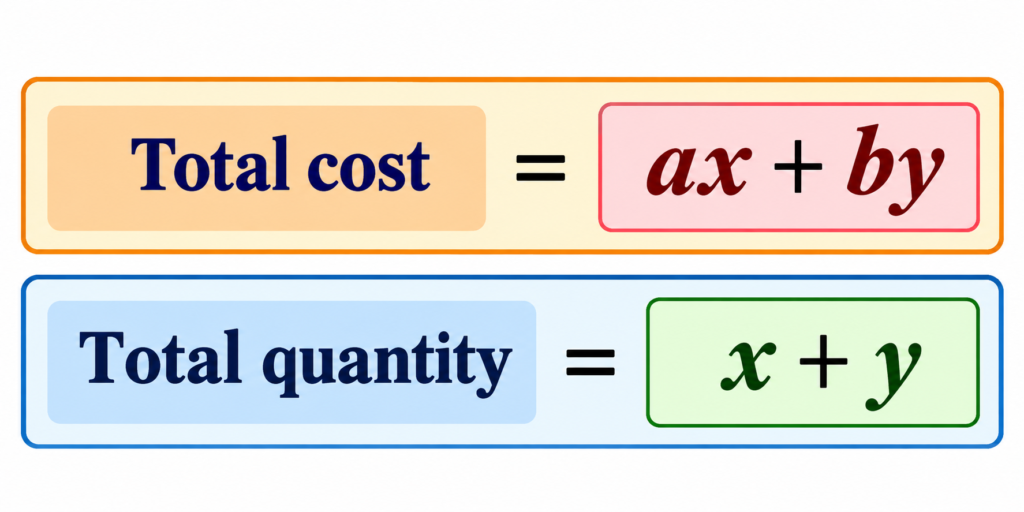
Hence, the average cost of the mixture is
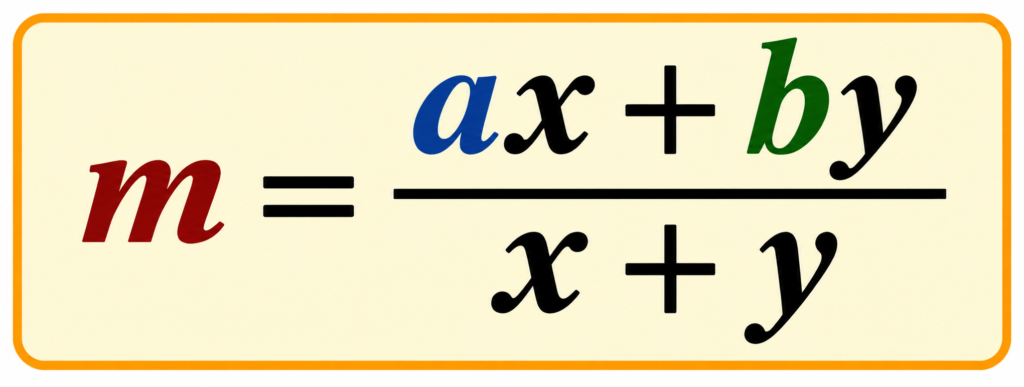
This formula is a weighted average because the average cost depends on the quantity of each variety used.
Starting with the average cost formula:
Multiplying both sides by (x+y):
Expanding the left-hand side:
Rearranging the terms:
mx-ax=by-my
Taking common factors:
x(m-a)=y(b-m)
Therefore,
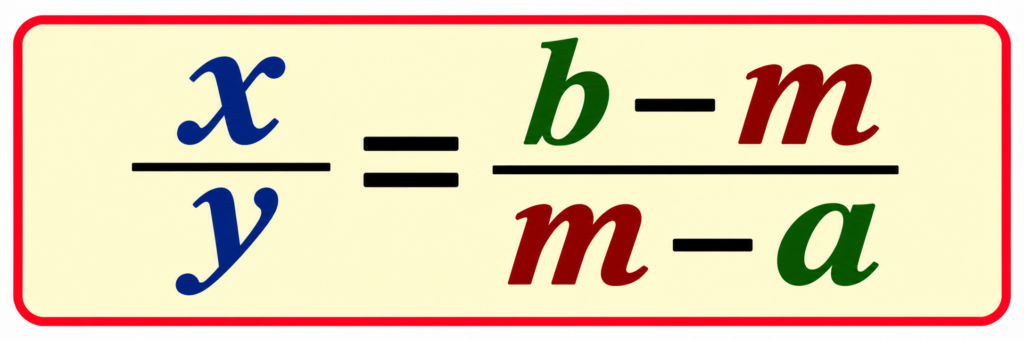
This is the fundamental formula used in the Alligation Method.
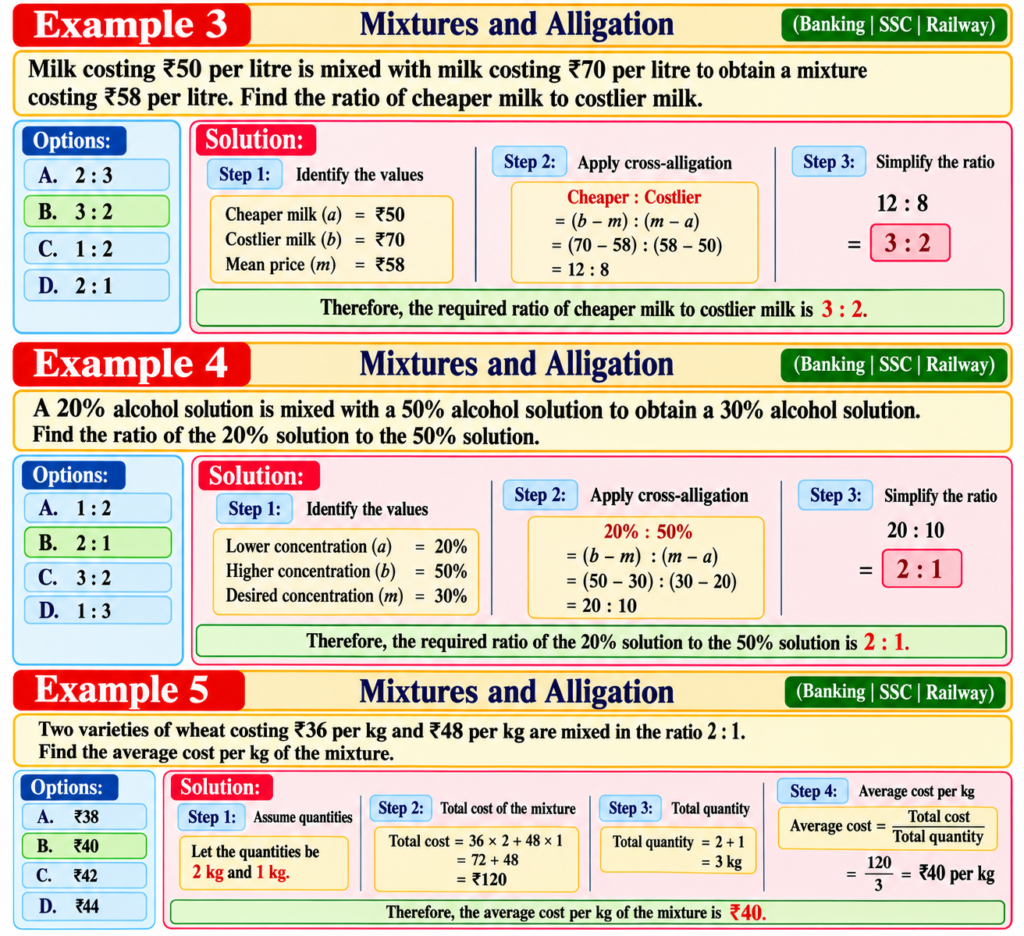
The cross-alligation method helps us find the ratio in which two varieties should be mixed to obtain a desired average price or concentration.
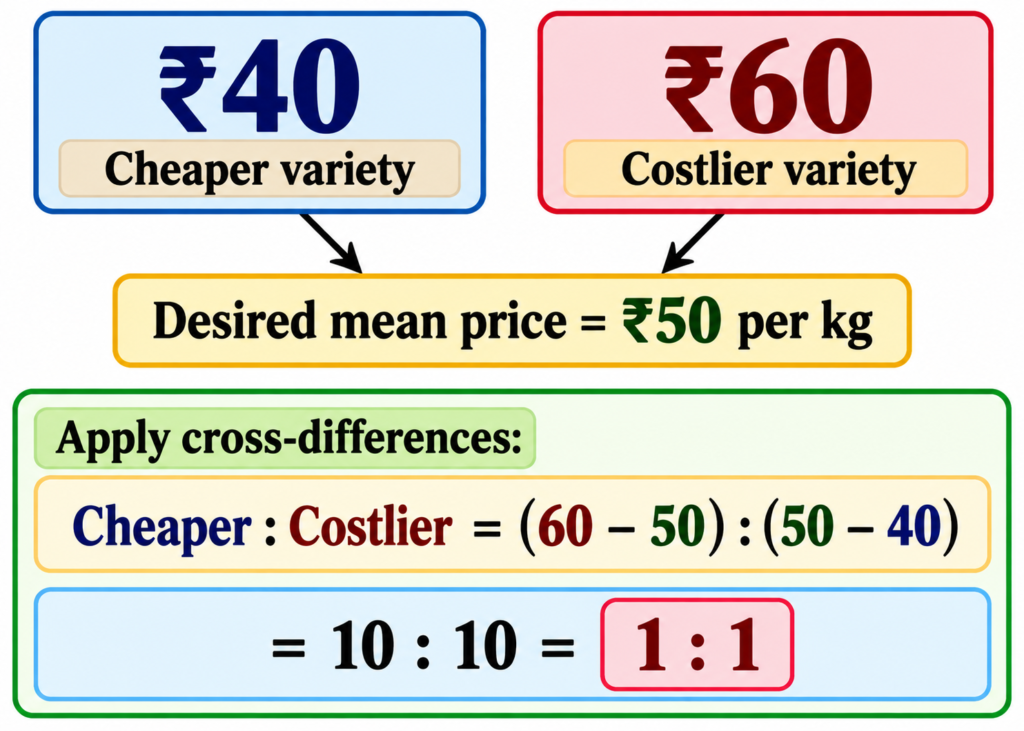
Remember: Subtract the mean from the higher value to get the quantity of the cheaper variety, and subtract the lower value from the mean to get the quantity of the costlier variety.
The average price of a mixture must lie between the prices of the two varieties when both quantities are positive.
If equal quantities are mixed, the average price is the arithmetic mean of the two prices.
If the desired mean is closer to the cheaper variety’s price, a larger quantity of the cheaper variety is required.
If the desired mean is closer to the costlier variety’s price, a larger quantity of the costlier variety is required.
The alligation method can also be applied to milk and water, profit percentages, marks, and solutions of different concentrations.
Exam practice: Always identify the lower value, higher value and desired mean before applying cross-alligation. This reduces calculation time in Banking, SSC and Railway examinations.