
Some rules to solve the problem of Syllogism for Banking/SSC/RAILWAY Logical Reasoning are as follows.
There are two ways to determine that which conclusion will follow.
Another method of solving such type of questions is by drawing Venn diagram representing the statements. However, it is important that all possible Venn diagrams show as. If a conclusion can be deduced from all the possible solutions then that conclusion is true. If the conclusion can be concluded from one of the possible Venn diagram and not from the other possible Venn diagram then that conclusion is taken as false.
Therefore, Let’s have a look at the table below to understand Syllogism more clearly
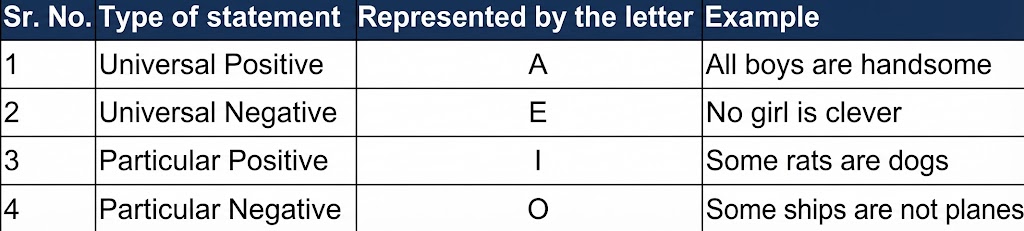
Following are the four major types of statements generally asked:
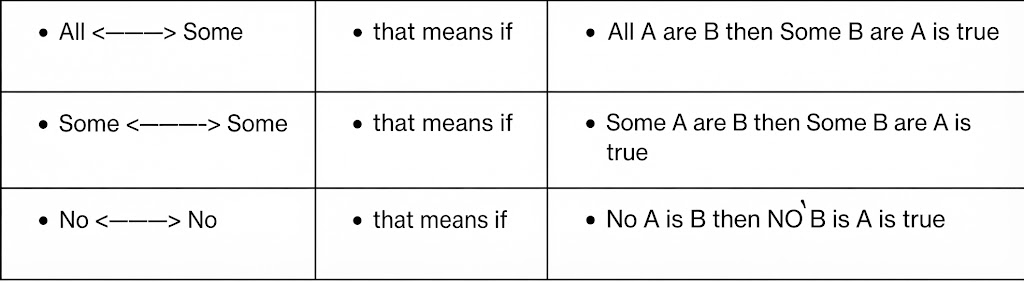
While deriving conclusions, following points should be kept in mind:
Some steps to convert a solution into the possibility are given below:
Some implementations for the solution from a single statement are given below:
Hence, Let’s have a look at the table below to understand Syllogism more clearly
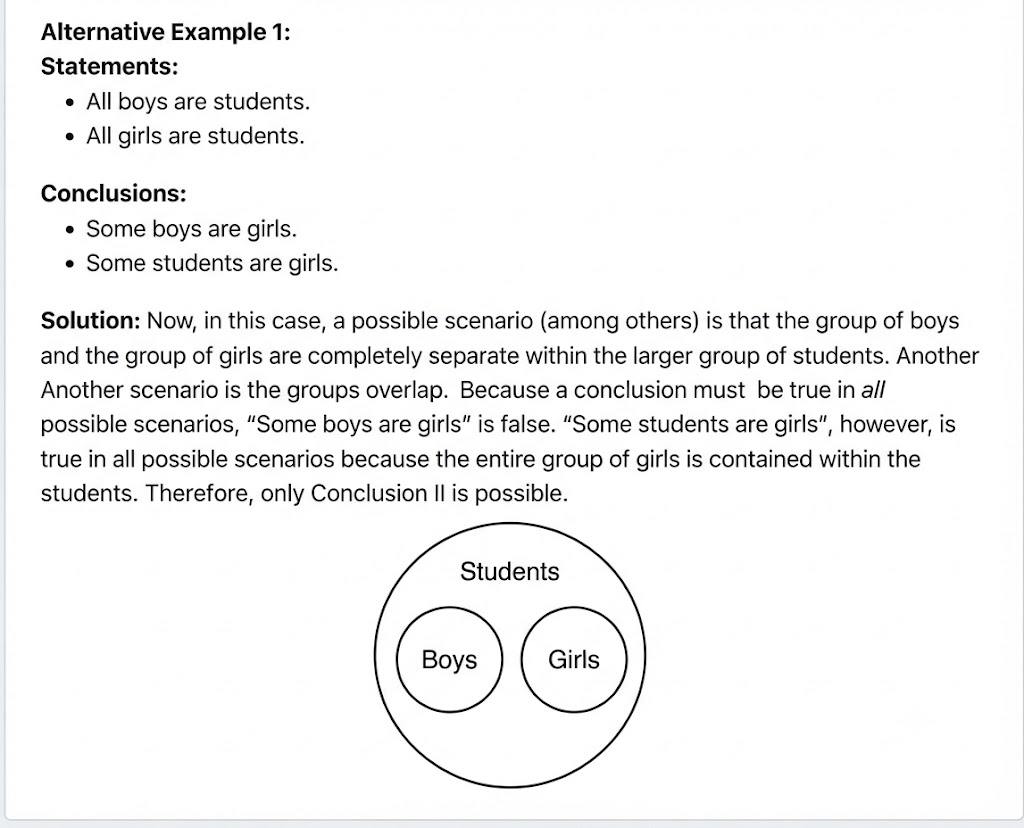
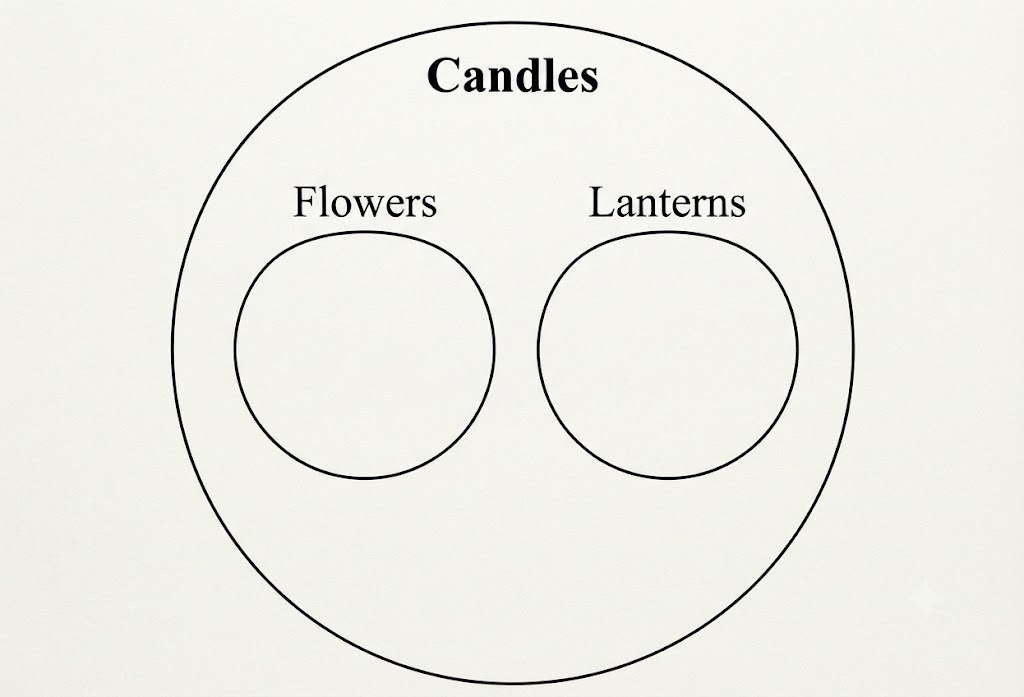
Solution: Three possible diagrams is show in the above for the given statements.
Conclusion I follows from last two possible solutions, but does not follow from the first possible solution. Therefore, this conclusion is false.
Conclusion II follows from all the three possible solutions.
Therefore, conclusion II is true
Directions (1–15): In each of the questions given below are given some statements followed by some conclusions. Read all conclusions and give the answer as follows:
(a) If only conclusion I follows. (b) If only conclusion II follows. (c) If either conclusion I or II follows. (d) If neither conclusion I nor II follows.
All cots are tables.
All tables are trains.
All trains are buses.
Conclusions: I. All tables are buses. II. All trains are tables.
Some mobile are computers.
Some computers are calculators.
Some calculators are phones.
Conclusions: I. Some phones are computers. II. Some computers are mobile.
All spoons are bowls.
Some bowls are glasses.
Some glasses are plates.
Conclusions: I. Some glasses are spoons. II. Some plates are bowls.
Some envelopes are packets.
Some packets are boxes.
All boxes are parcels.
Conclusions: I. Some parcels are packets. II. Some parcels are envelopes.
Some cards are plastics.
Some plastics are metals.
All metals are pots.
Conclusions: I. Some pots are cards. II. No pot is a card.
Some desks are tents.
Some tents are rivers.
All rivers are ponds.
Conclusions: I. Some ponds are tents. II. Some ponds are desks.
All cots are pens.
Some pens are knives.
All knives are rats.
Conclusions: I. Some rats are cots. II. Some rats are pens.
Some forests are huts.
Some huts are walls.
Some walls are nets.
Conclusions: I. Some nets are forests. II. Some nets are huts.
All tables are windows.
All windows are rooms.
All rooms are buses.
Conclusions: I. Some buses are tables. II. No rooms are tables.
Some trees are boxes.
All boxes are bricks.
All bricks are dogs.
Conclusions: I. No dogs are trees. II. Some bricks are trees.
All goats are flowers.
No flower is branch.
Some branches are roots.
Conclusions: I. Some roots are goats. II. No root is goat.
All pots are rings.
All bangles are rings.
All rings are paints.
Conclusions: I. Some paints are not pots. II. Some bangles are paints.
Some pens are books.
All books are pencils.
All pencils are jars.
Conclusions: I. No books are jars. II. Some pens are pencils.
Some bowls are spoons.
Some spoons are forks.
All forks are plates.
Conclusions: I. Some bowls are forks. II. Some spoons are plates.
Some bottles are jars.
All jars are buckets.
All buckets are tanks.
Conclusions: I. All jars are tanks. II. No buckets are tanks.