Summary: Union Bank Apprentice Recruitment 2026 in 60 Seconds
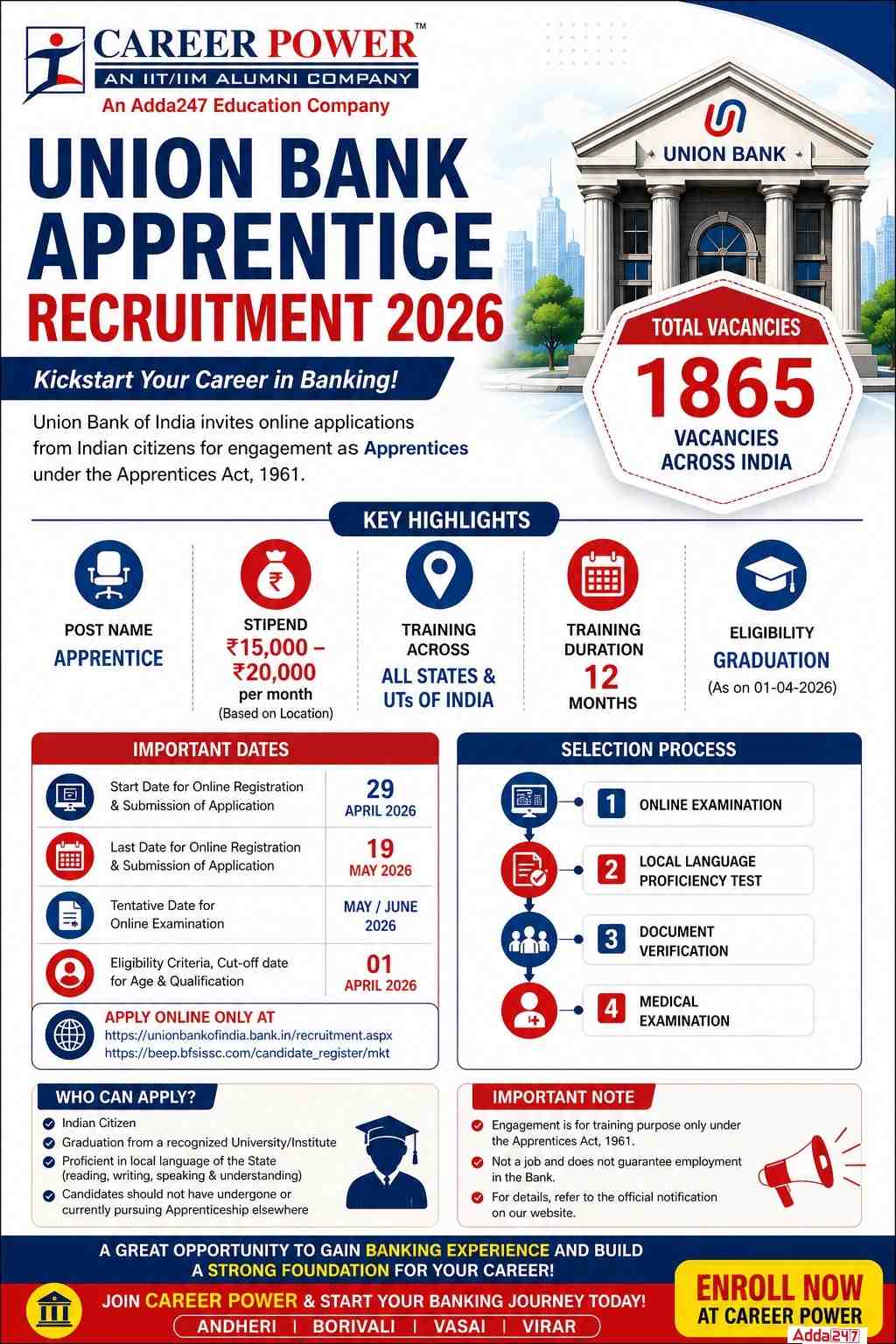
The Union Bank Apprentice Recruitment 2026 is your opportunity to join one of India’s largest public sector banks as a Graduate Apprentice under the Apprentices Act, 1961 and the National Apprenticeship Training Scheme (NATS). Selected candidates receive 12 months of paid, on-the-job banking training, a monthly stipend, a nationally recognised apprenticeship certificate, and real branch experience that strengthens every future bank exam application you submit.
In this guide, you’ll get the full picture of the Union Bank Apprentice Recruitment 2026 process — who can apply, how the merit-based shortlisting works, how to avoid rejection during document verification, and the exact steps to register on the NATS portal before filling the bank’s online form.
Introduction: Why Union Bank Apprentice Recruitment 2026 Is Your Smartest Career Move
You’ve probably noticed something about bank hiring in India: competition for clerk and PO posts is brutal, with lakhs of candidates chasing a few thousand seats. But there’s a smarter door into the banking world that many aspirants still overlook — apprenticeship. The Union Bank Apprentice Recruitment 2026 is that door.
Think about it. You get a stipend every month. You get trained inside a real branch by real bankers. You handle credit files, KYC verification, customer onboarding and digital banking operations — the exact work you’d be tested on in interviews. And you finish the year with a certificate that carries weight on your résumé, plus a work history you can actually talk about.
Unlike a regular job, apprenticeship isn’t a lifelong commitment. It’s a one-year structured learning contract. There’s no bond forcing you to stay, and no penalty for moving to a better opportunity. That makes the Union Bank Apprentice Recruitment 2026 a low-risk, high-return step for graduates who want banking exposure before their first permanent role.
In this guide, I’ll walk you through everything — from eligibility and age limits to the merit list formula, the NATS registration step that most candidates get wrong, and the document checklist that decides whether your application survives verification. Let’s get you application-ready.
Key Takeaways: Union Bank Apprentice Recruitment 2026 at a Glance
- What it is: A 12-month paid apprenticeship at Union Bank of India under the Apprentices Act, 1961.
- Who can apply: Graduates in any discipline from a recognised university (freshers welcome in most cycles).
- Age band: Generally 20–28 years, with standard relaxations for SC/ST/OBC/PwBD/Ex-servicemen as per government norms.
- Selection: Usually merit-based on graduation marks, followed by document verification — many recent cycles had no written exam.
- Stipend: Paid monthly as per the Apprentices Act; recent Union Bank cycles offered around ₹15,000 per month.
- Mandatory step: You must register on the official apprenticeship portal first and use that registration number in the bank’s form.
- No job guarantee: Apprenticeship is training, not permanent employment — but it dramatically improves your bank exam profile.
- Golden rule: Always verify dates, vacancy counts and stipend from the official notification before applying.
What Is Union Bank Apprentice Recruitment 2026?
Union Bank Apprentice Recruitment 2026 is the bank’s annual apprenticeship engagement drive, conducted to hire Graduate Apprentices across branches and offices in multiple states. It runs under the framework of the Apprentices Act, 1961, executed through the National Apprenticeship Training Scheme (NATS) and the National Apprenticeship Promotion Scheme (NAPS).
Here’s the key distinction you must understand before you apply: an apprentice at Union Bank is not a bank employee. You are a trainee engaged on a fixed-term contract of one year. You receive a stipend, not a salary. You receive an experience certificate, not an appointment letter. And there is no automatic absorption into the bank’s permanent cadre.
That said, the programme is far more than a token internship. Apprentices are typically placed in branches and made part of day-to-day banking operations — account opening, KYC documentation, cheque clearing support, digital banking assistance, customer service desks, and basic credit and deposit product support. You learn how a bank actually functions, not how it’s described in a textbook.
The engagement is governed by the Apprentice Act’s stipend provisions, which link monthly stipend to a prescribed percentage of the minimum wage for semi-skilled workers in the relevant state and category. Because of this, the exact stipend can vary slightly by location — another reason to read the official notification line by line.
What the Union Bank Apprentice Recruitment 2026 Includes
- Advertisement / Notification: Published on the official Union Bank of India website with state-wise vacancy distribution.
- Online Application Form: A single online registration window — no offline applications.
- Merit List: Prepared from qualifying marks (usually graduation percentage), category-wise and state-wise.
- Document Verification: Shortlisted candidates submit originals for verification.
- Medical Fitness: A basic fitness certificate is often required before joining.
- Engagement: 12 months of structured branch training with a stipend and completion certificate.
Why Union Bank Apprentice Recruitment 2026 Matters for Your Career
Let’s be honest about the job market. A fresh graduate with a degree and no experience is competing against thousands of identical résumés. Interviewers ask, “Tell me about a time you handled a difficult customer” — and most freshers have nothing to say. The Union Bank Apprentice Recruitment 2026 fixes that gap directly.
1. It Converts Theory Into Real Banking Experience
You will learn banking operations from the inside. When you later sit for a Bank PO or Clerk interview, you won’t be reciting definitions — you’ll be describing what you actually did. That’s a completely different level of confidence.
2. It Gives You a Competitive Edge in Bank Exams
Apprentices routinely report that the reasoning, general awareness and banking awareness sections feel easier after a few months in a branch. You begin to understand RTGS, NEFT, priority sector lending and KYC norms because you’ve processed them, not just read about them.
3. It Offers Financial Independence Early
A monthly stipend while you prepare for your next exam is a huge psychological and financial advantage. You’re earning, learning and building a résumé at the same time — instead of studying full-time with zero income.
4. It Opens Doors Beyond Banking
Lending institutions, NBFCs, fintechs, insurance companies and BPO/KPO firms all value apprenticeship certificates from public sector banks. Many candidates convert their apprenticeship into roles in operations, back-office processing and customer relationship teams.
5. It Signals Discipline to Future Employers
Completing a 12-month structured training programme proves you can show up, follow process, and work with customers. That’s exactly what recruiters are screening for.
Benefits of Union Bank Apprentice Recruitment 2026
Here’s a quick breakdown of the tangible and intangible gains you should expect.
Financial Benefits
- Monthly stipend: Approximately ₹15,000 per month in recent Union Bank cycles (verify the exact figure in the 2026 notification).
- Low application cost: Recent cycles charged either no fee or a nominal amount for reserved categories.
- No bond or security deposit: You can exit for a better opportunity without financial penalty.
- Government-backed scheme: Stipend may partly be supported under NAPS/DBT in applicable cases.
Career Benefits
- Public sector bank tag on your résumé within weeks of joining.
- Nationally recognised apprenticeship certificate on completion.
- Internal understanding of credit, deposits, and compliance — invaluable for interviews.
- Strong networking with branch managers, POs and clerks who can guide your next move.
- Interview content: real stories, real numbers, real problem-solving examples.
Personal Development Benefits
- Confidence in handling customers face-to-face.
- Improved communication in English, Hindi and regional languages.
- Time management while balancing work and exam preparation.
- Professional etiquette, dressing and workplace discipline.
How Union Bank Apprentice Recruitment 2026 Works: The Full Process
The recruitment process is simpler than a typical bank exam, but it has a strict sequence. Skip a step and your application fails automatically — even if you’re fully eligible.
Step 1: Notification Release
Union Bank of India publishes the detailed advertisement on its official website. The notification contains the number of vacancies, state-wise and category-wise break-up, age limits, stipend details, and the online application link. Bookmark our bank notification page so you never miss a release.
Step 2: NATS / Apprenticeship Portal Registration
This is the step that eliminates the largest number of applicants. You must first create a candidate account on the official apprenticeship portal, complete your profile, and obtain an apprentice registration number. That number is mandatory in the bank’s online form.
Step 3: Online Application on the Bank’s Portal
You then fill the Union Bank online form, upload your photograph, signature, and educational documents, and select your preferred state. Always double-check your graduation percentage here — it decides your merit rank.
Step 4: Application Fee Payment (if applicable)
If the notification prescribes a fee, pay it online via net banking, UPI, debit card or credit card, and save the payment receipt.
Step 5: Merit List Preparation
The bank prepares a state-wise and category-wise merit list based on the qualifying marks. Shortlisting is done strictly by rank order until vacancies are exhausted.
Step 6: Document Verification
Shortlisted candidates are called to submit original certificates — degree, marksheets, ID proof, caste or category certificate, and PwBD certificate where applicable.
Step 7: Medical Examination and Joining
A basic medical fitness check follows, and then you’re allotted a branch or office and your 12-month apprenticeship begins.
Step 8: Training and Certification
You complete on-the-job training, maintain your training log where required, and receive the completion certificate at the end of the term.
Union Bank Apprentice Recruitment 2026 Eligibility Criteria
The table below reflects the standard eligibility pattern used in recent Union Bank apprenticeship cycles. Always confirm the final criteria in the official 2026 notification before you apply.
| Criteria | Expected Requirement for 2026 |
|---|---|
| Nationality | Indian citizen (or as specified in the notification) |
| Educational Qualification | Graduate in any discipline from a UGC-recognised university; final-year students may apply in some cycles if they meet cut-off dates |
| Minimum Marks | As prescribed in the notification; higher marks improve merit rank significantly |
| Age Limit | Generally 20 to 28 years as on the specified cut-off date |
| Age Relaxation | SC/ST: 5 years; OBC (NCL): 3 years; PwBD: 10 years; Ex-servicemen as per rules |
| Prior Apprenticeship | Candidates who have already completed apprenticeship training under any scheme are usually NOT eligible |
| Skills | Basic computer literacy, regional language proficiency, customer-facing communication |
| NATS Registration | Mandatory — registration number required at the time of application |
Step-by-Step Guide: How to Apply for Union Bank Apprentice Recruitment 2026
Follow this sequence exactly. Print it, or keep it open on a second screen while you apply.
Before You Start: Keep These Ready
- Scanned photograph (recent, plain background, within size limits).
- Scanned signature (black ink, on white paper).
- Graduation degree certificate and consolidated marksheet.
- Class 10 and 12 marksheets for date-of-birth and name verification.
- Aadhaar card or another valid photo ID.
- Caste / category certificate (if claiming relaxation).
- PwBD certificate (if applicable).
- Active mobile number and a personal email ID that you check daily.
- Debit card, UPI or net banking access for the fee, if applicable.
Step 1: Register on the Official Apprenticeship Portal
Visit the national apprenticeship portal, create your candidate account with your name exactly as it appears on your degree, verify your email and mobile via OTP, and complete every profile field — education, skills, and preferences. Incomplete profiles generate errors later. Once done, note down your apprentice registration number securely.
Step 2: Read the Official Notification Twice
Confirm the vacancy for your state, the age cut-off date, the fee, and the exact qualification requirement. This five-minute read prevents a five-month wait for the next cycle.
Step 3: Open the Bank’s Online Application Link
Use only the link given in the official advertisement. Avoid links circulated on messaging groups — they’re often phishing attempts. For safe browsing habits, see our guide on avoiding fake job application links.
Step 4: Fill Personal and Educational Details
Enter your name, date of birth, category, and contact details precisely. Then enter your graduation details: university, year of passing, and aggregate percentage. Compute your percentage accurately — rounding errors here can push you out of the merit list.
Step 5: Enter Your Apprentice Registration Number
Paste the registration number you obtained in Step 1. If it doesn’t validate, your profile on the apprenticeship portal is probably incomplete. Fix it and try again.
Step 6: Upload Documents
Match the format, dimensions and file size stated in the notification. A blurry or oversized upload is the second most common reason for rejection.
Step 7: Preview and Submit
Use the preview screen and read every field aloud. Check spelling of your name, date of birth, category and percentage. Then submit.
Step 8: Pay the Fee and Save the Confirmation
Complete payment if applicable, then download the final submitted application PDF and save the acknowledgement number in three places — email, cloud storage and a printed copy.
Step 9: Track Updates
Check the official website and your registered email for merit list announcements, verification schedules and joining instructions. See our document verification checklist for what to carry.
Examples: How Union Bank Apprentice Recruitment 2026 Plays Out in Real Life
Example 1: The Fresher Who Started Early
Priya graduates in B.Com in June with 78%. She registers on the apprenticeship portal in July, keeps her documents scanned, and applies the day the Union Bank notification opens. Her state has 60 vacancies advertised. With 78%, she comfortably clears the merit cut-off, clears document verification in October, and joins a branch in November. By the time she writes her first Bank PO exam the following year, she can speak fluently about account opening workflows, KYC norms and customer service escalation. Her interview score is noticeably stronger than that of candidates with zero exposure.
Example 2: The Candidate Who Applied Late
Arjun is eligible with 82% marks — better than Priya’s. But he discovers the notification five days before the deadline, struggles to complete his NATS profile, and ends up applying on the final evening when the portal is overloaded. His payment fails twice. He eventually submits an incomplete application that gets rejected during scrutiny. His merit would have earned him a seat — his timing cost him the year.
Example 3: The Merit Calculation You Should Understand
Assume your university awards marks in CGPA. A CGPA of 7.6 on a 10-point scale converts to roughly 72.2% using the standard formula (CGPA × 9.5) or your university’s prescribed conversion method. If the notification caps eligibility at 60% but ranks candidates by percentage, then the difference between 72.2% and 75% can decide whether you’re called for verification. Always use the exact conversion method your university prescribes, and mention it if asked during verification.
Example 4: A Typical 12-Month Training Journey
- Months 1–2: Orientation, bank products, KYC and account opening processes, systems login and compliance basics.
- Months 3–5: Customer service desk, digital banking assistance, cheque handling and clearing support.
- Months 6–8: Deposit and loan product support, documentation checks, cross-selling basics.
- Months 9–10: Back-office operations, reporting, audit and record-keeping exposure.
- Months 11–12: Independent handling of assigned tasks, assessment, and certificate issuance.
Comparison Table: Union Bank Apprentice Recruitment 2026 vs Alternatives
Wondering whether to apply for an apprenticeship or aim for a permanent bank job? Here’s a clear side-by-side comparison.
| Feature | Union Bank Apprentice 2026 | SBI Apprentice | IBPS Clerk / Bank PO |
|---|---|---|---|
| Nature of Engagement | Fixed-term training, 12 months | Fixed-term training, 12 months | Permanent employment |
| Monthly Payment | Stipend (approx. ₹15,000 in recent cycles) | Stipend (varies by cycle) | Full salary with allowances and perks |
| Selection Process | Mostly merit-based + verification | Usually written test + verification | Prelims, Mains, Interview |
| Difficulty Level | Low to Moderate | Moderate | High |
| Job Security | None after term ends | None after term ends | Strong (government bank) |
| Best For | Freshers needing experience + income | Freshers targeting SBI exposure | Long-term banking career |
| Recommendation | Apply alongside exam preparation | Apply alongside exam preparation | Primary long-term goal |
Expert view: Treat the Union Bank Apprentice Recruitment 2026 and your permanent job preparation as parallel tracks — not either/or choices. The apprenticeship funds and strengthens your preparation.
Common Mistakes to Avoid in Union Bank Apprentice Recruitment 2026
- Skipping the apprenticeship portal registration: You cannot complete the bank form without a valid registration number.
- Applying on the last date: Servers slow down dramatically; payment failures spike in the final 24 hours.
- Name mismatch across documents: Your degree, ID proof and application must match exactly.
- Wrong percentage calculation: Using the wrong CGPA conversion method can cost you a merit seat.
- Selecting the wrong state: State-wise merit means your choice directly affects your competition.
- Uploading poor-quality scans: Blurred photographs and signatures are routinely rejected.
- Ignoring the registered email: Verification and joining communications often arrive with short notice.
- Assuming automatic employment: Apprenticeship does not guarantee a permanent bank job.
- Not keeping application proof: Always retain the submitted PDF and acknowledgement number.
- Trusting unofficial links: Apply only through the official bank website.
Expert Tips to Secure Union Bank Apprentice Recruitment 2026
- Build your documents folder today. Keep all scans in one cloud folder named clearly — you’ll apply faster than 90% of candidates.
- Register on the apprenticeship portal in advance. Do this even before the notification drops, so the process takes minutes, not days.
- Maximise your marks on paper. In merit-based selection, every decimal point counts. Use the exact conversion formula prescribed by your university.
- Apply for multiple banks’ apprenticeship drives. SBI, Canara, Bank of Baroda and others run similar programmes. More applications, better odds.
- Study banking awareness while you train. Turn your branch experience into exam answers by keeping a weekly notes file.
- Network deliberately. Your branch manager and PO colleagues are your best mentors for the next attempt.
- Document your achievements. Note your tasks, customer interactions and process improvements — they become interview material.
- Set reminders for key dates. Notification, application deadline, merit list, verification and joining.
- Verify everything from the official source. Blog posts (including this one) are guides, not notifications.
Best Practices for a Smooth Union Bank Apprentice Recruitment 2026 Application
- Use a desktop or laptop. Mobile browsers often cause upload and payment errors.
- Use a stable internet connection. Avoid public Wi-Fi when entering personal and banking details.
- Fill the form in one sitting where possible. Partially saved drafts can time out.
- Keep a personal email ID — never a shared or college email you’ll lose access to.
- Photograph and signature standards: follow the notification’s pixel dimensions exactly.
- Double-check category selection, since it affects age relaxation and merit cut-offs.
- Save every screen. Screenshot the confirmation page and payment receipt.
- Prepare for verification early. Original certificates, plus photocopies and self-attested sets.
- Keep your profile updated on the apprenticeship portal even after applying.
Recommended Tools for Union Bank Apprentice Recruitment 2026
These tools will speed up your application and preparation without any cost.
- Official apprenticeship portal: for candidate registration and your apprentice registration number.
- Union Bank of India official website: the only verified source for the notification and online form.
- Google Alerts: set alerts for “Union Bank Apprentice Recruitment 2026” to catch updates automatically.
- Cloud storage (Drive/Dropbox): keep every scanned document in one shared folder.
- PDF compressor and image resizer: to meet strict upload size limits.
- A spreadsheet tracker: log each application with bank name, date, registration number and status.
- Banking awareness apps and RBI press releases: to build current affairs knowledge.
- Grammar and proofreading tools: useful when writing your résumé and application details.
- A professional résumé builder: to convert your apprenticeship into a strong portfolio.
- Our bank exam preparation strategy guide: a structured plan you can follow alongside the apprenticeship.
Troubleshooting Common Issues in Union Bank Apprentice Recruitment 2026
Problem 1: My apprentice registration number isn’t accepted
Fix: Log in to the apprenticeship portal and confirm that your profile is 100% complete — including education and bank details where required. Incomplete profiles are the most common cause of validation failure.
Problem 2: OTP not arriving on my mobile
Fix: Check spam folders, disable DND for transactional SMS if possible, wait 5–10 minutes, then request a fresh OTP. Avoid requesting repeatedly within a minute.
Problem 3: The website is not loading on the deadline day
Fix: Try early morning hours, switch browsers, clear cache and cookies, and use a desktop connection. This is why applying early matters so much.
Problem 4: Payment deducted but application not submitted
Fix: Do not pay again immediately. Wait for the transaction status to settle, check your application status, and if the fee is deducted but the form shows incomplete, use the grievance channel mentioned in the notification with your transaction ID.
Problem 5: I entered the wrong percentage or category
Fix: If a correction window is provided, use it immediately. If not, email the designated helpdesk with documentary proof — and never leave this until the verification stage.
Problem 6: Uploaded documents rejected
Fix: Re-scan at 200–300 DPI, crop to the specified dimensions, and compress to the stated file size. Re-upload in the same session if the portal allows.
Problem 7: I lost my application PDF
Fix: Log in with your registration number and password to re-download it. If login fails, use the “forgot password” route linked to your registered mobile and email.
Problem 8: I didn’t receive the verification call letter
Fix: Check spam email, SMS inbox, and the official website’s notice section. Contact the bank’s recruitment helpdesk if the date is close.
FAQs: Union Bank Apprentice Recruitment 2026
1. What is Union Bank Apprentice Recruitment 2026?
It is Union Bank of India’s annual drive to engage Graduate Apprentices for a 12-month paid training term under the Apprentices Act, 1961 and the National Apprenticeship Training Scheme.
2. Is there a written exam for Union Bank Apprentice Recruitment 2026?
In several recent cycles, selection was merit-based on graduation marks with no written examination, followed by document verification. However, the bank may introduce a test in any cycle — always check the official notification.
3. What is the stipend for Union Bank Apprentice Recruitment 2026?
Stipend is paid as per Apprentices Act provisions. Recent Union Bank cycles offered approximately ₹15,000 per month. The exact amount for 2026 will be specified in the notification and may vary slightly by state.
4. What is the age limit for Union Bank Apprentice Recruitment 2026?
Generally 20 to 28 years as on the prescribed cut-off date, with relaxations of 5 years for SC/ST, 3 years for OBC (NCL), 10 years for PwBD, and additional relaxation for ex-servicemen as per rules.
5. Can final-year students apply for Union Bank Apprentice Recruitment 2026?
Only if the notification permits it and you can produce proof of passing within the specified deadline. Otherwise, you must have completed your graduation before the cut-off date.
6. Is NATS registration mandatory for Union Bank Apprentice Recruitment 2026?
Yes. Candidates must register on the official apprenticeship portal and quote the apprentice registration number in the bank’s online application. Applications without it are rejected.
7. Will I get a permanent job at Union Bank after the apprenticeship?
No. Apprenticeship does not guarantee permanent employment. You receive training, a stipend and a certificate. Any permanent job requires you to clear the bank’s regular recruitment process.
8. How many vacancies are expected in Union Bank Apprentice Recruitment 2026?
Recent Union Bank apprenticeship cycles advertised several hundred seats across states. The exact 2026 vacancy count will be confirmed in the official advertisement.
9. Can I apply for more than one state in Union Bank Apprentice Recruitment 2026?
Usually only one state and one application per candidate is permitted. Submitting multiple applications can lead to cancellation.
10. What documents are needed for Union Bank Apprentice Recruitment 2026?
Photograph, signature, degree certificate and marksheet, Class 10 and 12 certificates, photo ID, category certificate (if applicable), PwBD certificate (if applicable), and your apprenticeship registration number.
11. Is there an application fee for Union Bank Apprentice Recruitment 2026?
Recent cycles charged no fee or a nominal fee. Confirm the exact amount and category-wise exemptions in the official notification.
12. What is the duration of the apprenticeship at Union Bank?
The training term is typically 12 months, as prescribed under the Apprentices Act and the scheme guidelines.
13. Can candidates with prior apprenticeship experience apply?
14. Does apprenticeship experience help in bank interviews?
Yes, significantly. You gain practical exposure to banking operations, customer handling and compliance, which gives you concrete examples to discuss in interviews.
15. How will I know if I’m shortlisted?
Shortlists and merit lists are published on the official bank website, and updates are sent to your registered email and mobile number.
16. What happens if my documents don’t match my application?
Your candidature can be cancelled at any stage — including after joining. Always enter details exactly as they appear on your original documents.
17. Can I leave the apprenticeship early?
You may exit as per the terms of the engagement, but completing the full term is strongly recommended for the certificate and experience.
18. Where can I find the official Union Bank Apprentice Recruitment 2026 notification?
Only on the official Union Bank of India website and through the official apprenticeship portal. Avoid third-party links shared on social media.
Conclusion: Your Banking Career Can Start Now
The Union Bank Apprentice Recruitment 2026 is one of the few opportunities that pays you, trains you and builds your résumé simultaneously — with no bond and no barrier to applying for better roles when they come along. For a fresh graduate, that combination is rare.
But eligibility alone won’t get you selected. What gets you selected is preparation: a complete apprenticeship portal profile, an accurate percentage, correctly scanned documents, an early application, and a plan for what you’ll do after your 12 months are up. Handle those details, and you’ll be far ahead of the thousands of candidates who start reading the notification ten days before the deadline.
Remember this too — the apprenticeship isn’t the finish line, it’s your launchpad. Use the year to learn banking from the inside, build relationships inside the branch, and convert everything you learn into a stronger performance in your next Bank PO or Clerk attempt.
Call to Action: Get Application-Ready Today
Don’t wait for the notification to arrive before you start preparing. Here’s exactly what to do next:
- Register on the official apprenticeship portal today and complete your profile 100%.
- Scan and organise all your documents in one clearly labelled cloud folder.
- Bookmark the official Union Bank of India website and check it twice a week.
- Set a Google Alert for “Union Bank Apprentice Recruitment 2026” so you hear about the notification first.
- Read our bank exam preparation strategy and our SBI Apprentice Recruitment 2026 guide to expand your options.
- Subscribe to our job alerts and share this guide with the friends who’ll be applying alongside you.
Your one year of experience starts with one application. Start today — and apply early, every time.
Disclaimer
This article is an informational guide. All details regarding the Union Bank Apprentice Recruitment 2026 — including vacancy count, eligibility, age limits, stipend, important dates and selection procedure — are indicative based on previous recruitment cycles and must be verified from the official notification published on the Union Bank of India website and the official apprenticeship portal. We are not affiliated with Union Bank of India.