
Reasoning Notes for Banking, SSC, Railway and Other Competitive Exams
1. Introduction to Blood Relations
Blood relation is an important topic in the Reasoning section of competitive examinations. It deals with identifying how two or more people are related to each other through family connections.
Questions may describe a family directly or provide relationships through statements, coded symbols, or a family tree. The candidate must analyse the information carefully and determine the correct relationship.
Common relationships include:
Father, mother, son and daughter
Brother and sister
Grandfather and grandmother
Uncle and aunt
Nephew and niece
Cousin
Father-in-law and mother-in-law
Son-in-law and daughter-in-law
Brother-in-law and sister-in-law
2. Important Family Relationships
A. Paternal Relationships
Paternal relationships refer to relatives connected through the father’s side of the family.
Father’s father → Paternal grandfather
Father’s mother → Paternal grandmother
Father’s brother → Paternal uncle
Father’s sister → Paternal aunt
Father’s brother’s wife → Aunt by marriage
Father’s sister’s husband → Uncle by marriage
Father’s brother’s or sister’s child → Cousin
B. Maternal Relationships
Maternal relationships refer to relatives connected through the mother’s side of the family.
Mother’s father → Maternal grandfather
Mother’s mother → Maternal grandmother
Mother’s brother → Maternal uncle
Mother’s sister → Maternal aunt
Mother’s brother’s wife → Aunt by marriage
Mother’s sister’s husband → Uncle by marriage
Mother’s brother’s or sister’s child → Cousin
C. Relationships Across Generations
Father’s or mother’s father → Grandfather
Father’s or mother’s mother → Grandmother
Son’s son → Grandson
Son’s daughter → Granddaughter
Daughter’s son → Grandson
Daughter’s daughter → Granddaughter
Grandson’s son → Great-grandson
Granddaughter’s daughter → Great-granddaughter
D. Relationships Through Marriage
Son’s wife → Daughter-in-law
Daughter’s husband → Son-in-law
Husband’s father → Father-in-law
Wife’s father → Father-in-law
Husband’s mother → Mother-in-law
Wife’s mother → Mother-in-law
Husband’s brother → Brother-in-law
Wife’s brother → Brother-in-law
Brother’s wife → Sister-in-law
Sister’s husband → Brother-in-law
Important: In ordinary competitive-exam questions, the term cousin generally refers to the child of one’s uncle or aunt. Some relationships may also vary according to cultural or extended-family usage.
3. Basic Gender Identification
Identifying the gender of each person is an essential step in solving blood-relation questions.
Relationship

Terms such as cousin, child, parent, sibling and grandchild do not independently establish gender.
4. Symbols Used in Blood-Relation Diagrams
For quick analysis, candidates can use the following symbols:
Male: +
Female: −
Marriage: A horizontal connection between spouses
Parent-child relationship: A vertical connection between generations
Siblings: People connected to the same parents
Examples:
Father → Son: Male → Male
Father → Daughter: Male → Female
Mother → Son: Female → Male
Mother → Daughter: Female → Female
These symbols are a convenient study convention. Always follow any specific symbols defined in the question.
5. How to Solve Blood-Relation Questions
Step 1: Identify all people.
Write down the names or labels used in the question.
Step 2: Determine gender.
Mark each person as male, female, or unknown.
Step 3: Find the generations.
Place grandparents at the top, parents in the middle, and children below them.
Step 4: Connect the relationships.
Draw a simple family tree or use arrows to connect the people.
Step 5: Start from the person mentioned first.
Follow the chain one relationship at a time instead of guessing the final answer.
Step 6: Check the final relationship.
Confirm both the gender and generation before selecting an answer.
6. Additional Rules and Shortcuts
Rule 1: Brother and sister share parents.
If A is the brother of B, A is male and B is A’s sibling. However, B’s gender is not established unless further information is given.
Rule 2: A parent’s sibling is an uncle or aunt.
The gender of the parent’s sibling determines whether the person is an uncle or aunt.
Rule 3: The children of siblings are cousins.
If two people are siblings, their children are cousins to one another.
Rule 4: Marriage does not establish blood relation.
A daughter-in-law, son-in-law or brother-in-law is related through marriage, not necessarily by blood.
Rule 5: Only son and only daughter are important clues.
If a question states that a person has only one son, that son is the person’s sole male child. Do not assume there are no daughters unless the wording rules them out.
Rule 6: Avoid assuming gender.
If the question says, “A is the child of B,” the gender of A is unknown.
Rule 7: Read pronouns carefully.
Words such as his, her, he and she may provide important clues about gender.
Rule 8: Draw a family tree for long questions.
For chains containing four or more relationships, a diagram is usually more reliable than mental calculation.
Pointing out to a lady, Rajan said, “She is the daughter of the woman who is the mother of the husband of my mother.” Who is the lady to Rajan?
(a) Aunt (b) Granddaughter (c) Daughter (d) Sister
Solution:
Family relationship diagram:
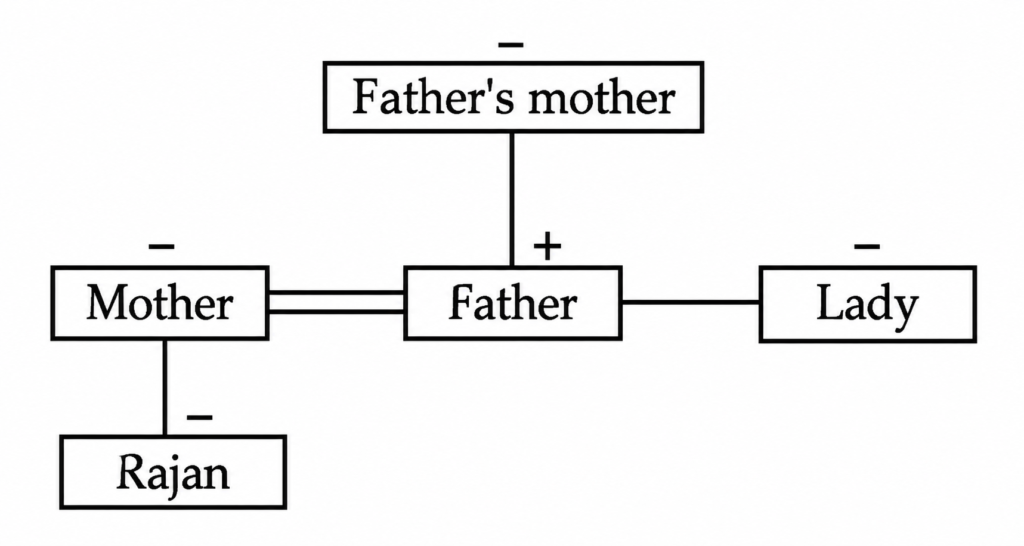
Hence, the lady is the sister of Rajan’s father. So, she is his aunt.
Answer: (a) Aunt
A is B’s sister. C is B’s mother. D is C’s father. E is D’s mother. Then how is A related to D?
(a) Daughter (b) Granddaughter (c) Grandmother (d) Grandfather
Solution:
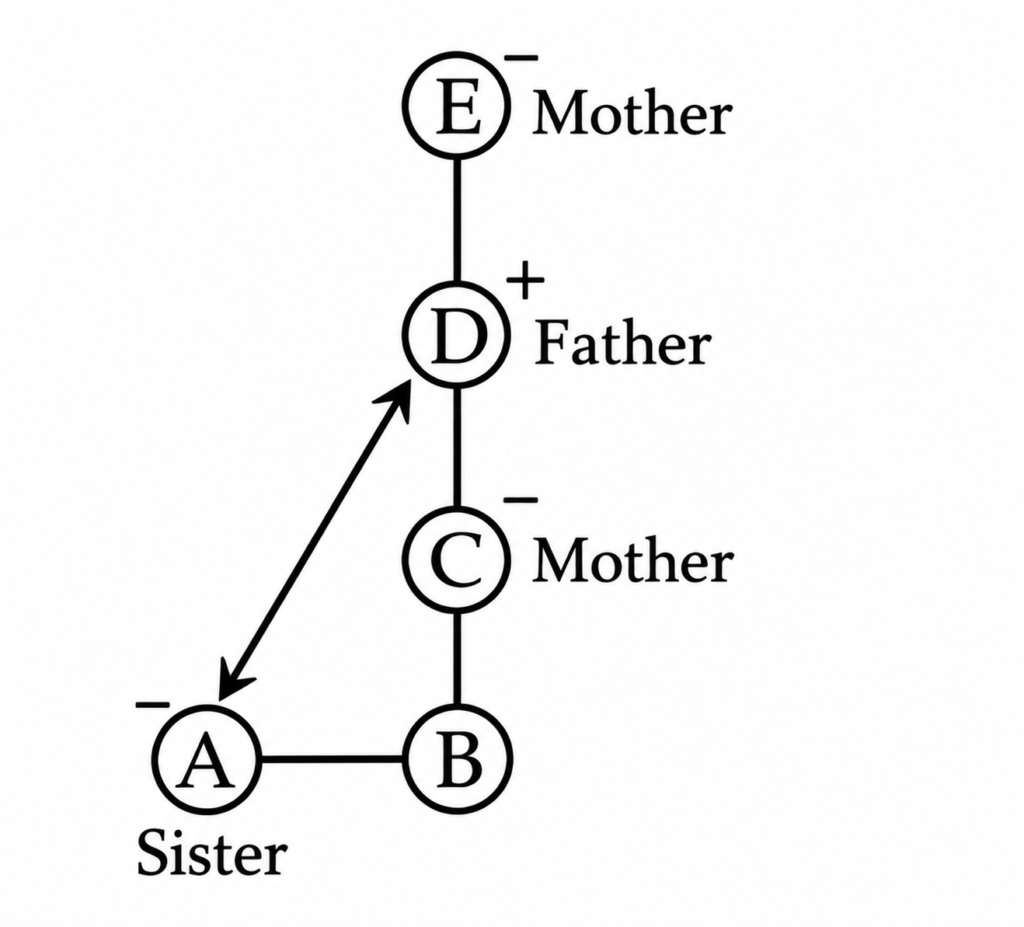
A is the daughter of C, and C is the daughter of D.
Therefore, A is the granddaughter of D.
Answer: (b) Granddaughter
A is the mother of B. B is the sister of C. D is the son of C. E is the brother of D. F is the mother of E. G is the granddaughter of A. A has only two children, B and C.
How is F related to H?
(a) Son-in-law (b) Daughter-in-law (c) Father-in-law (d) Granddaughter
How is C related to E?
(a) Father (b) Son (c) Mother (d) Cousin brother
Who is the mother of G?
(a) C (b) B (c) F (d) Either B or F
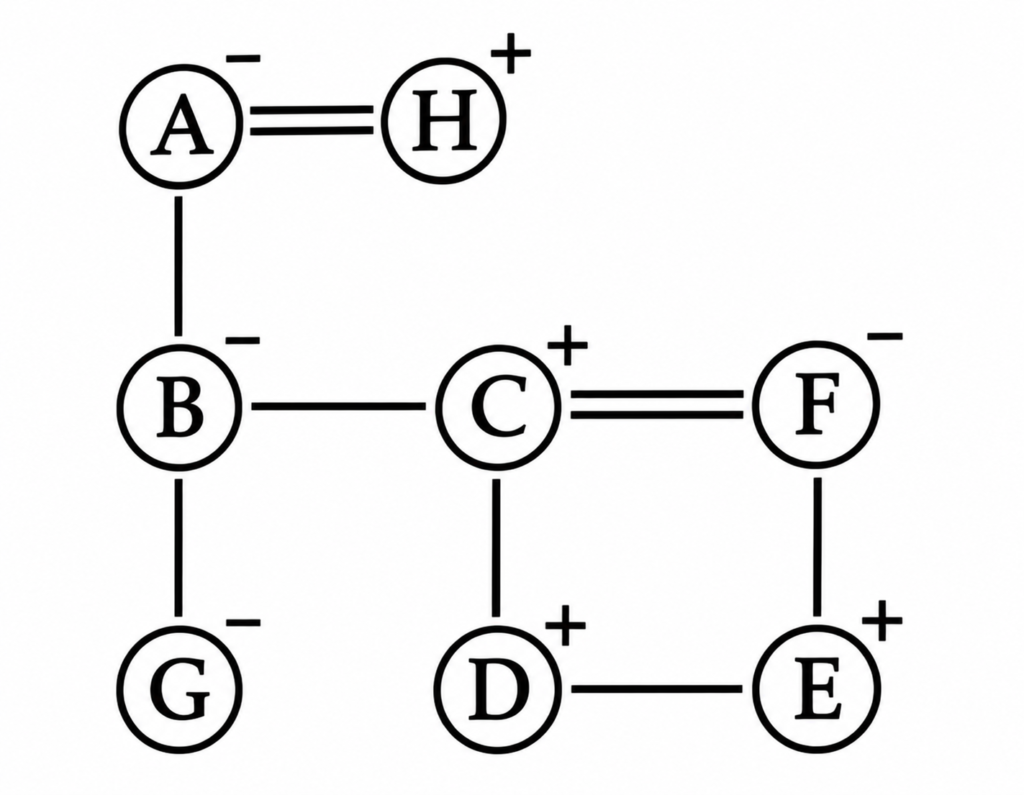
(3) Option (b)
From the above figure, it is clear that F is the daughter-in-law of H.
(4) Option (a)
From the above figure, it is clear that C is the father of D.
(5) Option (d)
From the above diagram, it is clear that either B or F is the mother of G.
Read the following information carefully and answer the questions.
A - B means A is the father of B.
A + B means A is the daughter of B.
A ÷ B means A is the son of B.
A × B means A is the wife of B.
In the statement ‘P + S - T‘, how is P related to T?
(a) Sister (b) Wife (c) Son (d) Daughter
Solution:
P + S → P is the daughter of S.
S - T → S is the father of T.
Family diagram:
S (+)
|
P (−) ─── T(+/-)
Hence, P is the sister of T.
Answer: (a) Sister
In the statement P × Q - T, how is T related to P?
(a) Daughter (b) Mother (c) Sister (d) Cannot determine
Solution:
P × Q → P is the wife of Q.
Q - T → Q is the father of T.
Family diagram:
P (−) ═══ Q (+)
|
T(+/-)
T may be the son or daughter of P because the gender of T is not specified.
Hence, the relationship cannot be determined more precisely.
Answer: (d) Cannot determine
Which of the following expressions means that T is the wife of P?
(a) P × S ÷ T
(b) P ÷ S × T
(c) P - S ÷ T
(d) P - S + T
Solution:
P - S → P is the father of S.
S + T → S is the daughter of T.
Family diagram:
P (+) ═══ T (−)
|
S (−)
Here, P is the father of S, and S is the daughter of T. Therefore, P and T are the parents of S, and T is the wife of P.
Answer: (d) P - S + T
Read the following information carefully and answer the questions given below.
A is the son of B. C, B’s sister, has a son D and a daughter E. F is the maternal uncle of D.
(a) Cousin (b) Nephew (c) Uncle (d) Brother
(a) Sister (b) Daughter (c) Niece (d) Wife
(a) Nil (b) One (c) Two (d) Three
Read the following information and answer the questions given below.
A is the father of C. But C is not his son. E is the daughter of C. F is the spouse of A. B is the brother of C. D is the son of B. G is the spouse of B. H is the father of G.
(a) A (b) C (c) F (d) H
(a) B (b) C (c) D (d) E
The following information is given about a family.
Meena is Reena’s only sibling.
Sita is Ruchi’s grandmother.
Nutan is Sujata’s and Ram’s grandchild.
Sujata has only one child, a son.
Meena is Vishu’s sister-in-law and Ruchi’s mother.
Nutan is Vishu’s daughter.
Ram is Sita’s husband.
(a) Sister (b) Cousin (c) Aunt (d) Niece
(a) Mother (b) Aunt (c) Mother-in-law (d) Sister
(a) Father (b) Uncle (c) Grandfather (d) Brother
(a) Brother (b) Husband (c) Sister (d) None of these