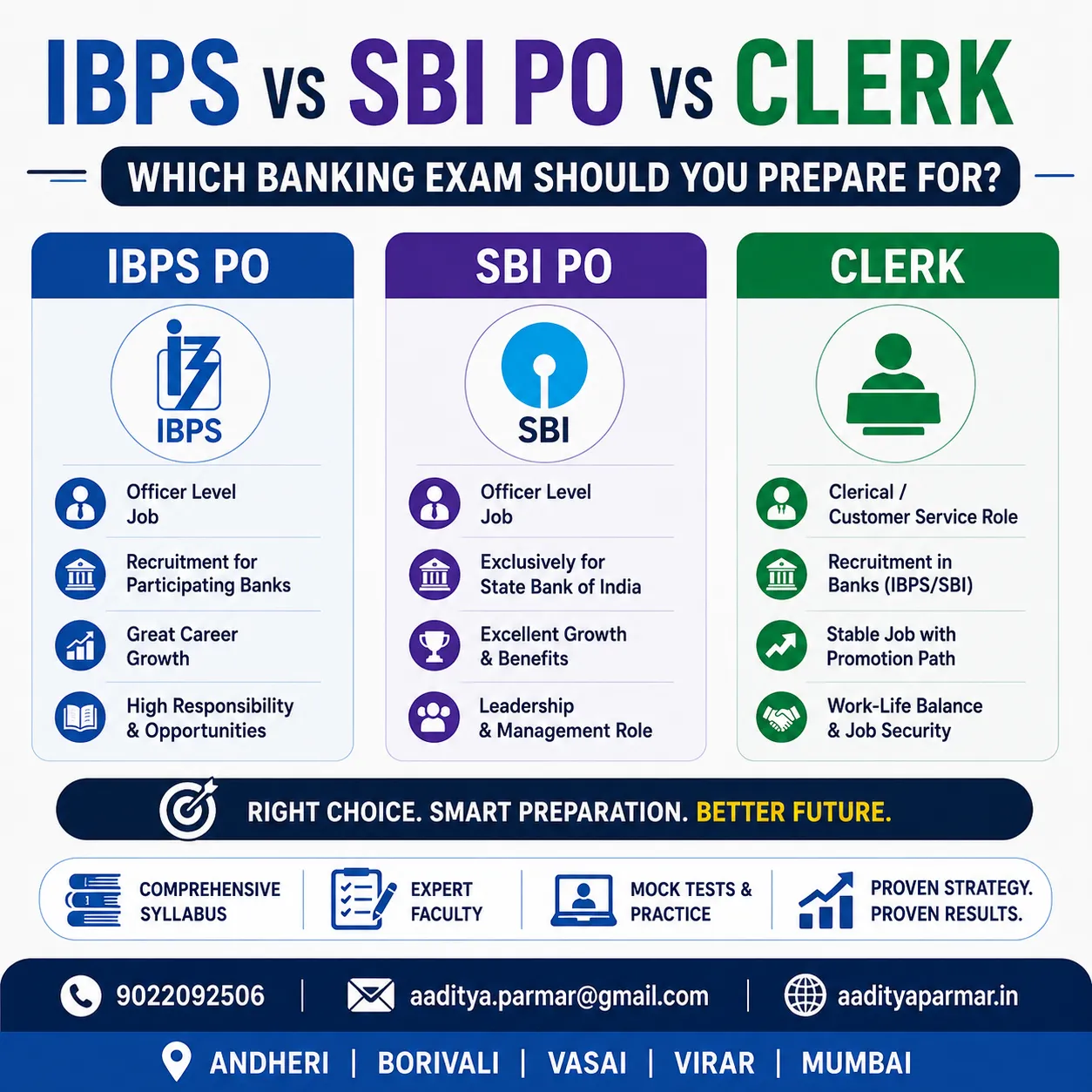
Best Classes for SBI PO/Clerk – Complete Guide for Banking Aspirants
Summary
The Best Classes for SBI PO/Clerk – Complete Guide for Banking Aspirants is your single-page decision manual for choosing coaching that actually moves your score. In this guide you will learn what world-class SBI PO/Clerk classes include, why choosing the right one matters, how to compare online vs offline vs hybrid formats, a step-by-step selection framework, real aspirant examples, a comparison table, common mistakes, expert tips, recommended tools, troubleshooting fixes, and detailed FAQs.
By the end, you will be able to shortlist 2–3 options, test them properly with demo classes, and build a study routine that turns classroom learning into exam-day performance.
Introduction: Why the Right SBI PO/Clerk Classes Can Change Your Career
Every year, lakhs of graduates dream of wearing the banker’s badge. The State Bank of India offers one of the most prestigious and competitive opportunities in the country through the SBI PO and SBI Clerk exams. The competition is fierce, the syllabus is wide, and the margin between selection and rejection is often just a few marks.
This is exactly why the Best Classes for SBI PO/Clerk – Complete Guide for Banking Aspirants matters. The right classes do not just teach you Quantitative Aptitude, Reasoning, English, and General Awareness — they give you structure, accountability, exam-level practice, and a mentor who tells you what to fix before it is too late.
But here is the uncomfortable truth: not every popular coaching institute is right for you. A batch that suits a working professional in Mumbai may be wrong for a full-time aspirant in Patna. A faculty member who is brilliant at Reasoning may be average at teaching Data Interpretation.
In this guide, you will get a practical, no-nonsense framework to evaluate the Best Classes for SBI PO/Clerk, avoid expensive mistakes, and build a preparation strategy that gives you the best possible shot at your first attempt — or your next one. If you are starting from zero, begin with our SBI PO exam pattern and syllabus page before you compare classes.
Key Takeaways
- The Best Classes for SBI PO/Clerk are judged by results, teaching quality, doubt support, and mock-test quality — not by flashy marketing or celebrity faculty alone.
- Online live batches usually offer the best balance of cost, flexibility, and exam-level practice for most aspirants.
- Demo classes are non-negotiable. Attend at least two before you pay for any SBI PO/Clerk classes.
- Classes cover roughly 40% of your preparation; the remaining 60% is self-practice, mock tests, and error analysis.
- Aim for 30–50 full-length mock tests before prelims and revise the syllabus at least twice.
- Cheap is not always better, and expensive is not always superior — match the batch to your learning style, budget, and available hours.
- Check for SBI-specific content (SBI PO mains, descriptive paper, GD & interview) rather than generic bank exam material.
- Combine classes with standard books, free notes, and daily current affairs to build depth.
What Are the Best Classes for SBI PO/Clerk?
The Best Classes for SBI PO/Clerk are structured coaching programs — online, offline, or hybrid — that prepare you for every stage of the SBI Probationary Officer (PO) and SBI Clerk (Junior Associate) recruitment process: Prelims, Mains, and, for PO, the Descriptive Test, Group Discussion, and Interview.
They typically combine:
- Concept lectures: Quant, Reasoning, English, and General/Banking Awareness taught from basics to advanced level.
- Practice sets and assignments: Topic-wise worksheets to convert theory into speed.
- Mock tests and sectional tests: Exam-like online tests with All-India ranking and performance analytics.
- Doubt-solving support: Live sessions, chat support, or mentor calls.
- Study roadmap: A weekly schedule that tells you exactly what to do next.
- Interview and descriptive modules (SBI PO): Letter writing, essay writing, GD practice, and mock interviews.
Popular Types of SBI PO/Clerk Classes You Can Choose From
- Live online classes: Real-time teaching with chat-based doubt solving and recordings.
- Recorded/Self-paced batches: Best for working professionals and repeaters.
- Offline classroom coaching: Traditional institutes in cities with physical classrooms and test centres.
- Hybrid programs: Online lectures with offline test series or mentor meetings.
- Free and freemium classes: YouTube lectures plus paid test series — a smart budget option.
For a deeper look at what each exam demands, read our detailed pages on the SBI PO syllabus and the SBI Clerk syllabus.
Why Choosing the Best Classes for SBI PO/Clerk Matters
You can absolutely prepare for SBI PO/Clerk on your own, but the probability of success rises sharply when your effort is directed by an experienced system. Here is why the choice of classes matters so much:
- Competition density: For a few hundred SBI PO vacancies, lakhs of candidates apply. Even a 1–2 mark improvement in accuracy can change your fate.
- Time efficiency: Good classes compress months of trial and error into a clear roadmap.
- Exam-level calibration: SBI’s question style differs from IBPS, RRB, and other bank exams. SBI-specific classes train you for that exact pattern.
- Speed requirements: Prelims give roughly 60 seconds per question. Classes teach shortcut techniques and sectional time strategy.
- Accountability: Scheduled classes and tests keep you consistent, which is the single biggest predictor of selection.
- Cost of the wrong choice: A bad batch wastes 3–6 months and several thousand rupees — a loss you cannot easily recover in a competitive cycle.
Simply put, the Best Classes for SBI PO/Clerk – Complete Guide for Banking Aspirants is not about buying content; it is about buying clarity, feedback, and momentum.
Benefits of Joining the Best Classes for SBI PO/Clerk
1. Structured Syllabus Coverage
You get a week-by-week plan covering Prelims and Mains topics in the right order, so you never wonder “what should I study today?”
2. Expert Faculty and Shortcut Techniques
Experienced mentors teach calculation shortcuts, approximation tricks, puzzle-solving frameworks, and reading comprehension strategies that save precious seconds.
3. Exam-Level Mock Tests with Analytics
Ranked mock tests reveal your weak areas by topic, question type, and accuracy — far more useful than simply checking your score. Explore our SBI PO mock test strategy guide for how to use them correctly.
4. Doubt-Solving Support
Getting unstuck quickly prevents small doubts from becoming permanent weaknesses.
5. Complete Study Material
PDFs, formula sheets, current affairs capsules, and previous-year papers bundled in one place.
6. Peer Competition and Motivation
Leaderboards and batchmates keep you accountable on days when motivation dips.
7. Interview and Descriptive Preparation (SBI PO)
GD practice, essay/letter evaluation, and mock interviews prepare you for the final stage — which most self-study aspirants neglect entirely.
8. Time and Cost Savings vs Trial-and-Error Study
One well-chosen batch can replace a shelf of unread books and hundreds of wasted hours.
How Do the Best Classes for SBI PO/Clerk Actually Work?
Understanding the delivery model helps you evaluate what you are really paying for. A high-quality program usually follows this cycle:
Step A: Diagnostic Assessment
You begin with a baseline test to identify your starting level in Quant, Reasoning, English, and Awareness.
Step B: Concept Classes
Live or recorded lectures deconstruct each topic — from percentages and ratios to puzzles, syllogisms, grammar, and banking awareness.
Step C: Practice and Homework
Topic-wise assignments are assigned immediately after each class, because retention depends on application within 24–48 hours.
Step D: Sectional Tests
Short tests measure mastery of individual sections and expose speed bottlenecks.
Step E: Full-Length Mock Tests
Simulated exams replicate the real interface, sectional timing, and difficulty level.
Step F: Analysis and Mentorship
You review errors, receive feedback, and adjust your strategy — this is the step most aspirants skip, and it is the most valuable one.
Step G: Revision Cycles
Structured revision rounds, formula recall sessions, and current affairs recap ensure nothing is forgotten before the exam.
Working Professionals
Weekend plus recorded classes, 2 hour evening slots, and weekly mock analysis work best.
Full-time Aspirants
Daily live classes, 6 hours of study, and 3 mocks per week create the fastest improvement curve.
Repeaters
Skip full syllabus batches; choose advanced practice, test-series-heavy programs and mentorship focused on accuracy.
Step-by-Step Guide: How to Choose the Best Classes for SBI PO/Clerk
Follow this eight-step framework to pick the right program without guesswork.
- Define your profile: Note your available hours per week, budget, city, learning style, and whether you are a fresher, working professional, or repeater.
- List your non-negotiables: For example, “live doubt-solving,” “recordings for 1 year,” “SBI-specific mains content,” or “offline test centre.”
- Shortlist 4–6 providers: Include a mix of large edtech platforms, reputed local institutes, and freemium options.
- Attend demo classes: Judge teaching clarity, pace, language, and how the faculty handles questions.
- Inspect the mock tests: Attempt one free mock. Check question quality, interface, sectional timing, and analytics depth.
- Verify results and reviews: Look for genuine selection stories and honest feedback on forums and communities, not just testimonials on the seller’s own website.
- Check the fine print: Batch duration, validity, number of live hours, refund policy, device limits, and whether interview training is included.
- Enroll, then follow the system: Pay for one batch, commit to it fully, and track weekly metrics instead of hopping between courses.
Quick Checklist Before You Pay
- A free demo class attended
- One free mock test attempted
- Faculty experience verified
- Recording validity and batch duration confirmed in writing
- Number of live hours and doubt sessions clarified
- Refund and transfer policy understood
- Interview and descriptive modules included or priced separately
Examples: Real Aspirant Scenarios
Example 1: The Final-Year Student with 6 Free Hours Daily
Situation: Priya is in her final year of B.Com in a small town with no reputed offline institute.
Choice: She joins a live online foundation batch for SBI PO/Clerk, attends daily classes, and attempts two full mocks every week.
Result: In 9 months she completes the syllabus twice, solves 60+ mocks, and clears SBI Clerk prelims and mains with a comfortable margin.
Example 2: The Working Professional with 2 Hours a Day
Situation: Rahul works 10 hours a day in an IT firm and cannot attend fixed live slots.
Choice: He picks a recorded batch with weekend live doubt sessions and an intensive test series.
Result: He studies 2 hours on weekdays and 5 hours on weekends, concentrating on Quant and Reasoning. He clears SBI Clerk in his second attempt and later SBI PO prelims.
Example 3: The Repeater Who Plateaued at 55 Marks
Situation: Ankit has appeared twice and keeps missing the cut-off by 2–4 marks.
Choice: Instead of another full syllabus batch, he joins an advanced test-series-plus-mentorship program focused on accuracy and time management.
Result: By fixing his puzzle selection strategy and reducing silly errors in English, he crosses the cut-off in his third attempt.
Example 4: The Budget-Conscious Aspirant
Situation: Meera cannot afford premium coaching.
Choice: She uses free YouTube concept lectures, purchases a low-cost test series, and follows a disciplined self-study timetable from our SBI PO 6-month study plan.
Result: With consistent daily practice and 40 mocks, she clears SBI Clerk — proof that the “best” classes are the ones you actually complete.
Comparison Table: Best Classes for SBI PO/Clerk – Online vs Offline vs Hybrid
| Parameter | Live Online Classes | Recorded / Self-Paced | Offline Classroom Coaching | Hybrid |
|---|---|---|---|---|
| Cost Range (indicative) | Moderate | Low | Highest | Moderate to High |
| Flexibility | Medium (fixed timings, recordings available) | Very High | Low | High |
| Doubt Solving | Live chat / doubt sessions | Email or forum support | Face-to-face, instant | Both online and offline |
| Mock Tests | Extensive, with analytics | Varies by provider | Usually offline + online | Extensive |
| Discipline Required | High | Very High | Low (external structure) | Medium |
| Best For | Most aspirants, small towns, working professionals | Working professionals, repeaters | Aspirants needing classroom pressure | Those wanting the best of both |
| Mains & Interview Support | Available in premium batches | Often limited | Usually included | Usually included |
Note: Fees and features change frequently. Always verify current details on the official website of the provider before enrolling.
Evaluation Matrix: How to Score Any Batch Out of 100
| Criterion | Weight | What to Check |
|---|---|---|
| Teaching Quality | 25 | Demo class clarity, faculty experience |
| Mock Test Quality | 20 | Exam-level difficulty, analytics |
| Doubt Support | 15 | Response time and availability |
| Study Material | 15 | PDFs, current affairs, previous papers |
| Affordability | 10 | Value for money, EMI options |
| Flexibility | 10 | Recordings, validity period |
| Mentorship & Interview Prep | 5 | One-to-one guidance, GD/interview mocks |
Common Mistakes to Avoid While Choosing SBI PO/Clerk Classes
- Choosing based on ads alone: Heavy marketing does not guarantee quality teaching or results.
- Hoarding multiple batches: Buying three courses and finishing none is the fastest route to failure.
- Ignoring the demo class: A faculty member’s teaching style must match your learning style.
- Chasing celebrity faculty: Only a fraction of the syllabus may actually be taught by them.
- Overlooking mock-test quality: Poorly designed mocks either demoralise you or make you overconfident.
- Skipping the fine print: Validity periods, device limits, and refund rules are frequently missed.
- Treating classes as study time: Watching lectures is passive; solving questions is where marks are built.
- Switching courses mid-preparation: Constant switching resets your progress and destroys momentum.
- Neglecting General Awareness: Many aspirants ignore this section until the last month and lose easy marks.
- Not attempting mocks under timed conditions: Untimed practice creates a false sense of mastery.
Expert Tips from Mentors and Toppers
- Select your questions, not just your options: In prelims, skipping a tough puzzle is often smarter than solving it.
- Maintain an error notebook: Every mock mistake should be written down with the reason — concept gap, silly error, or time pressure.
- Follow the 70–30 rule: 70% practice, 30% learning. Lectures alone never produced a topper.
- Attempt 30–50 full mocks: Consistency in mock volume correlates strongly with selection.
- Master two high-accuracy areas first: Usually English and Reasoning for beginners, then scale up Quant.
- Revise current affairs weekly, not monthly: Spaced repetition beats last-minute cramming.
- Use mentors for strategy, not for motivation: Ask specific questions like “Why did my DI accuracy drop?” rather than “How do I crack SBI PO?”
- Protect your sleep: Memory consolidation happens during rest; sleep-deprived studying is inefficient studying.
- Prepare for Mains and Interview from day one: SBI PO rewards candidates who think beyond prelims.
Best Practices for Getting Maximum Value from Your Classes
- Follow one system: One batch, one test series, one revision plan.
- Attend classes live whenever possible: Live attendance improves focus and enables real-time doubts.
- Practise within 48 hours of every class: Apply concepts immediately to lock them in.
- Take one full mock per week early on, then two to three per week closer to the exam.
- Analyse every mock for at least 60 minutes: Analysis is where the real learning happens.
- Keep a weekly tracker: Topics completed, mocks attempted, accuracy percentage, revision status.
- Use the mentor’s time wisely: Come prepared with specific questions and mock data.
- Revise formulas and rules weekly: Speed comes from recall, not just understanding.
- Take breaks: A 20-minute walk after three hours of study improves retention more than a fourth hour of tired scrolling.
Recommended Tools & Resources for SBI PO/Clerk Aspirants
Online Class Platforms to Evaluate
Large edtech platforms such as Adda247, Oliveboard, Testbook, Unacademy, PW (Physics Wallah) Skills, and Career Power offer SBI PO/Clerk batches in various formats, alongside many respected regional institutes. Compare them using the matrix above rather than relying on brand size alone.
Mock Test and Practice Platforms
- Full-length and sectional mock test series with All-India ranking
- Topic-wise practice apps for Quant, Reasoning, and English
- Previous-year paper archives for SBI PO and SBI Clerk
Study and Productivity Tools
- Notion or Google Sheets: For syllabus trackers and mock-analysis logs.
- Anki or Quizlet: Spaced-repetition flashcards for formulas and banking terms.
- Pomodoro timers: For focused 25–50 minute study blocks.
- Focus apps: To block distracting notifications during class and practice.
- Current affairs apps and monthly PDFs: For daily and monthly General Awareness revision.
- Grammar and writing tools: To polish descriptive answers and essays.
Books Worth Pairing With Any Batch
Standard quant, reasoning, and English books plus a banking awareness yearbook remain valuable supplements. See our curated list in the best books for SBI PO and SBI Clerk guide, and download free revision material from our SBI PO free study material page.
Troubleshooting: When Your Classes Aren’t Working
Problem 1: My mock scores are stuck at the same range
- Shift from full mocks to sectional tests to isolate the weak section.
- Redo the last five mocks question by question and classify each error.
- Reduce your question attempts and improve accuracy before increasing speed.
Problem 2: I run out of time in Quant and Reasoning
- Adopt a fixed question-selection rule (attempt only familiar patterns first).
- Learn approximation and table-based calculation shortcuts.
- Practise timed sets of 10 questions in 8 minutes.
Problem 3: I understand the class but forget while solving
- Practise the same topic within 24 hours of the lecture.
- Create one-page summary sheets at the end of every topic.
- Revise those sheets weekly for the first four weeks.
Problem 4: I cannot keep up with the live batch schedule
- Watch recordings at 1.25x speed and prioritise high-weight topics.
- Reserve one weekend block purely for backlog clearance.
- Ask the mentor for a compressed catch-up plan.
Problem 5: The faculty’s teaching style isn’t clicking
- Switch to a different faculty within the same platform if allowed.
- Supplement with free YouTube lectures for that specific topic.
- If the entire batch is a mismatch, cut your losses early and switch once — not repeatedly.
Problem 6: I feel demotivated after low mock scores
- Remember that early mocks are diagnostic tools, not verdicts.
- Track improvement in accuracy, not just marks.
- Talk to a mentor or a serious study partner rather than spiralling alone.
FAQs on the Best Classes for SBI PO/Clerk
1. Which are the Best Classes for SBI PO/Clerk for beginners?
For beginners, the best classes are foundation batches that start from basics, offer live doubt-solving, and include a structured study plan with weekly tests. Online live or hybrid foundation batches work especially well because you get recordings for revision.
2. Is online coaching better than offline classes for SBI PO and SBI Clerk?
Online coaching is typically more affordable, flexible, and packed with analytics-rich mock tests. Offline classes offer face-to-face interaction and a disciplined environment. If you are self-disciplined, online is usually better value; if you need external structure, choose offline or hybrid.
3. How much do the Best Classes for SBI PO/Clerk cost?
Costs vary from a few thousand rupees for recorded batches to significantly higher amounts for premium live and offline programs. Fees change every season, so verify the current price, batch duration, and refund policy directly with the provider.
4. Can I crack SBI PO or SBI Clerk without joining any classes?
Yes. Many candidates crack these exams through self-study using standard books, free lectures, and mock tests. Classes mainly save time by providing a roadmap, curated material, doubt support, and exam-level practice.
5. How many hours should I study along with SBI PO/Clerk classes?
Aim for 4–6 focused hours per day alongside your classes, increasing to 7–8 hours in the final two months. Prioritise practice and mock analysis over passive lecture watching.
6. Do SBI PO/Clerk classes include mock tests and interview preparation?
Most premium batches include full-length mocks, sectional tests, and previous-year papers. SBI PO interview preparation, descriptive paper practice, and GD sessions are often part of top-tier programs — confirm whether they are included or charged separately.
7. When should I join the Best Classes for SBI PO/Clerk?
Beginners should join 8–12 months before the expected notification; those with a base can join 4–6 months before. Starting early gives you time to complete the syllabus, attempt 30–50 mocks, and revise twice.
8. Are free YouTube classes enough for SBI PO/Clerk preparation?
Free lectures are excellent for concept building, but they rarely provide structured timelines, personalised feedback, or ranked mock tests. A hybrid approach — free conceptual learning plus a paid test series — is a smart budget strategy.
9. How many mock tests should I attempt before the SBI PO prelims?
Most successful candidates attempt 30–50 full-length mocks plus 60–100 sectional tests, always followed by detailed analysis.
10. Which is better for SBI Clerk: a dedicated Clerk batch or a combined PO/Clerk batch?
If your only target is SBI Clerk, a dedicated Clerk batch keeps you focused on the right difficulty level. If you are targeting both exams, a combined PO/Clerk batch is efficient because the syllabus overlap is roughly 85–90%.
11. Can working professionals manage SBI PO/Clerk classes?
Yes. Choose recorded or weekend batches, study 2 hours on weekdays, and reserve 5–6 hours on weekends for mocks and analysis. Consistency matters more than total hours.
12. What should I do if my coaching institute’s mocks feel easier than the real exam?
Supplement with a tougher, independent test series. Practising on harder-than-actual papers builds confidence and improves speed under pressure.
13. Do I need separate classes for SBI PO Mains?
If your prelims strategy is solid, you can continue with the same batch if it includes mains-level content. Otherwise, join a focused mains batch that covers high-level Data Interpretation, puzzles, and descriptive writing.
14. How do I know whether a class is genuinely good before paying?
Attend a demo, attempt a free mock, ask to see a sample study plan and doubt-support process, and seek feedback from serious aspirants in online communities. Never decide based on advertisements alone.
15. Can the Best Classes for SBI PO/Clerk guarantee selection?
No coaching program can guarantee selection. Classes improve your probability of success by providing structure, direction, and practice — but consistent personal effort, revision, and mock analysis remain the deciding factors.
Conclusion: Choose Smart, Study Consistently, and Select
The Best Classes for SBI PO/Clerk – Complete Guide for Banking Aspirants comes down to one simple insight: the right class does not make the exam easy, it makes your effort count. A well-chosen batch gives you a clear roadmap, expert guidance, exam-level practice, and honest feedback — the four pillars that separate selected candidates from borderline ones.
Start by defining your profile and non-negotiables. Shortlist a handful of options, attend demos, test their mocks, and verify the fine print. Then commit fully to one system, practise relentlessly, and analyse every mistake. Remember that 30–50 well-analysed mocks are worth more than a hundred casually attempted ones.
SBI PO and SBI Clerk rewards discipline far more than genius. Thousands of ordinary graduates with average academic records crack these exams every year simply because they chose a sensible plan and refused to quit. You can be one of them — starting today.
Call to Action
Ready to take the next step toward your banking career?
- 📘 Download the complete SBI PO exam pattern and syllabus guide
- 📝 Read the SBI Clerk syllabus and selection process breakdown
- 🗓️ Get your free 6-month SBI PO study plan
- 🎯 Start a free SBI PO mock test today
- 📚 See the best books for SBI PO and SBI Clerk
- 💬 Talk to our mentors and get personalised guidance
- 🔔 Subscribe for weekly banking exam updates, free PDFs, and notification alerts
Your selection story starts with one decision. Choose your classes wisely, show up every single day, and let the results speak for you. All the very best, future banker!