The Doctrine of Separation of Powers: A Primer for Law Aspirants
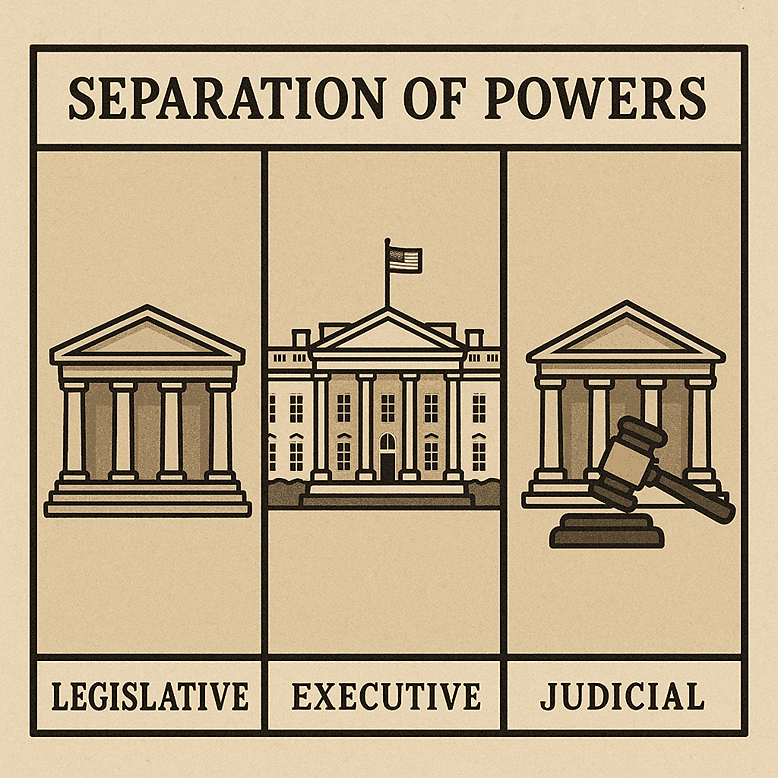
The Doctrine of Separation of Powers is a structural principle of governance that ensures the three primary functions of a state—making laws, executing them, and interpreting them are not concentrated in a single hand.
1. Historical Evolution
The concept was first systematically formulated by the French jurist Baron de Montesquieu in his 1748 masterpiece, De L'Esprit des Lois (The Spirit of the Laws). Montesquieu argued that "constant experience shows us that every man invested with power is apt to abuse it." To prevent this, he proposed that power should be a check to power.
While Montesquieu popularized it, the roots can be traced back to Aristotle, who identified the three agencies of government as the General Assembly, the Public Officials, and the Judiciary.
2. The Three Pillars
A "strict" application of the doctrine implies three things:
-
Exclusive Personnel: The same person should not form part of more than one of the three organs.
-
Exclusive Function: One organ should not exercise the functions belonging to another.
-
Independence: One organ should not control or interfere with the others.
3. The Indian Context: A Functional Overlap
In India, we do not follow a "rigid" separation of powers like the United States. Instead, we follow a system of checks and balances based on parliamentary democracy.
-
Executive & Legislature: Under the Cabinet system, the Executive (Prime Minister and Council of Ministers) is drawn from the Legislature. This is a direct overlap. According to Article 75(3), the Council of Ministers is collectively responsible to the Lok Sabha.
-
Executive & Judiciary: The Executive plays a role in the appointment of judges, and the Judiciary, through Judicial Review, can strike down executive actions.
-
Legislature & Judiciary: While the Legislature makes laws, the Judiciary has the power to declare them unconstitutional if they violate the "Basic Structure" of the Constitution (as established in the Kesavananda Bharati case).
4. Important Constitutional Articles for Entrance Exams
Law students should memorize these specific articles that reflect the separation of powers in India:
-
Article 50: A Directive Principle that directs the State to separate the judiciary from the executive in public services.
-
Articles 121 & 211: These prevent the Parliament and State Legislatures from discussing the conduct of judges (except in impeachment proceedings).
-
Articles 122 & 212: These prevent the Courts from inquiring into the validity of proceedings of the Parliament and State Legislatures.
-
Articles 53 & 154: Provide that the executive power of the Union and the State shall be vested in the President and the Governor, respectively.
5. Landmark Judicial Pronouncements
Case laws are the "gold mine" for law entrance marks. Note these three pivotal cases:
-
Ram Jawaya Kapur v. State of Punjab (1955): The Supreme Court held that the Indian Constitution has not indeed recognized the doctrine of separation of powers in its absolute rigidity, but the functions of the different branches have been sufficiently differentiated.
-
Indira Gandhi v. Raj Narain (1975): The Court held that the separation of powers is a part of the Basic Structure of the Constitution. Even a Constitutional Amendment cannot destroy the division of power between the organs.
-
I.R. Coelho v. State of Tamil Nadu (2007): The Court reaffirmed that judicial review is a fundamental feature of the separation of powers, ensuring that the legislature does not exceed its constitutional limits.
6. Why it Matters for Entrance Exams
In the Legal Reasoning section of CLAT/AILET, you may get a "Principle-Fact" question based on this doctrine. Remember:
-
If the Legislature passes a law that performs a judicial function (like declaring a specific person guilty), it violates the doctrine.
-
If the Judiciary starts making policy (Judicial Overreach), it is often criticized for violating the separation of powers.
Conclusion
For a law aspirant, the takeaway is clear: the separation of powers is not about water-tight compartments but about balanced interdependence. It is a system designed to ensure that the rule of law prevails over the rule of whim.