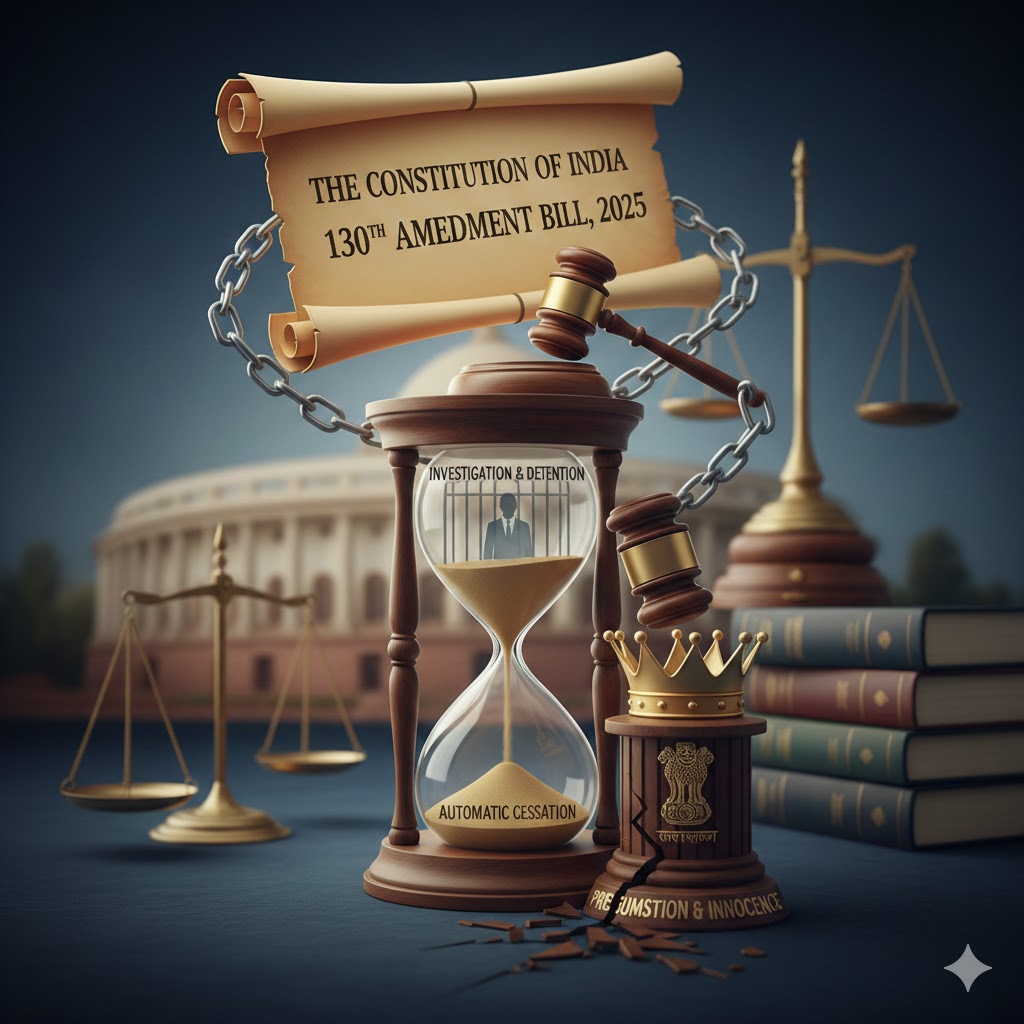
The Constitution (130th Amendment) Bill, 2025: A New Frontier in Ministerial Accountability
For law entrance aspirants eyeing MH CET LAW 2026, staying abreast of legislative shifts is as critical as mastering the law of contracts. One of the most significant and debated legal updates of 2025 is the introduction of The Constitution (One Hundred and Thirtieth Amendment) Bill, 2025. Introduced in the Lok Sabha in August 2025, this Bill seeks to fundamentally alter the relationship between criminal investigation and executive tenure by proposing the automatic removal of Ministers including the Prime Minister and Chief Ministers under specific conditions of detention.
Key Provisions of the Bill
The Bill introduces a stringent mechanism to bridge what the government describes as a "legal gap" in the Representation of the People Act (RPA), 1951. Currently, under the Lily Thomas v. Union of India precedent, an elected representative is disqualified only upon conviction. The 2025 Bill, however, targets the period of arrest and investigation.
The 30-Day Rule: A Union or State Minister (including the PM/CM) must be removed from office if they are arrested and detained in custody for 30 consecutive days.
Threshold of Offence: This rule applies only to "serious criminal offences" those punishable by imprisonment of five years or more.
Automatic Cessation: For a Prime Minister or Chief Minister, the Bill mandates resignation by the 31st day. Failure to do so leads to the automatic cessation of their office.
Constitutional Changes: The Bill proposes amendments to Articles 75 (Central Ministers), 164 (State Ministers), and 239AA (Special provisions for Delhi).
The Legal Debate: Accountability vs. Political Misuse
This Bill has sparked a fierce constitutional debate that aspirants should analyze through the lens of Administrative Law and the Basic Structure Doctrine.
1. The Pro-Accountability Argument
Supporters argue that while ordinary government employees face suspension after just 48 hours in custody, Ministers—who hold the highest public trust—should not remain in power while incarcerated. It aims to prevent "governance from jail," ensuring that the executive remains functional and maintains moral authority.
2. Constitutional Concerns
Critics and legal experts have raised red flags regarding several core legal principles:
-
Presumption of Innocence: The Bill triggers a "punitive" action (loss of office) before any judicial determination of guilt, potentially violating the principle of "innocent until proven guilty."
-
Federalism and Political Weaponization: Under the current federal structure, a central investigative agency could theoretically arrest a State Chief Minister, leading to their automatic removal after 30 days. This has led to fears that the law could be used to destabilize elected state governments.
-
Separation of Powers: By giving the "permanent executive" (police/investigative agencies) the power to effectively unseat an elected "political executive" through detention, the Bill may disrupt the balance of power.
In law entrance exams, you aren't just tested on the "what," but the "why" and "how." This update is a perfect candidate for Legal Reasoning passages.
You may be asked to apply the "30-day rule" to a hypothetical scenario or evaluate if a specific arrest meets the "5-year punishment" threshold. Furthermore, understanding the interplay between the 130th Amendment Bill and existing laws like the RPA 1951 is essential for the Current Affairs section.
As the Bill remains under review by the Joint Parliamentary Committee (JPC), its journey will likely define the constitutional discourse of late 2025 and 2026.