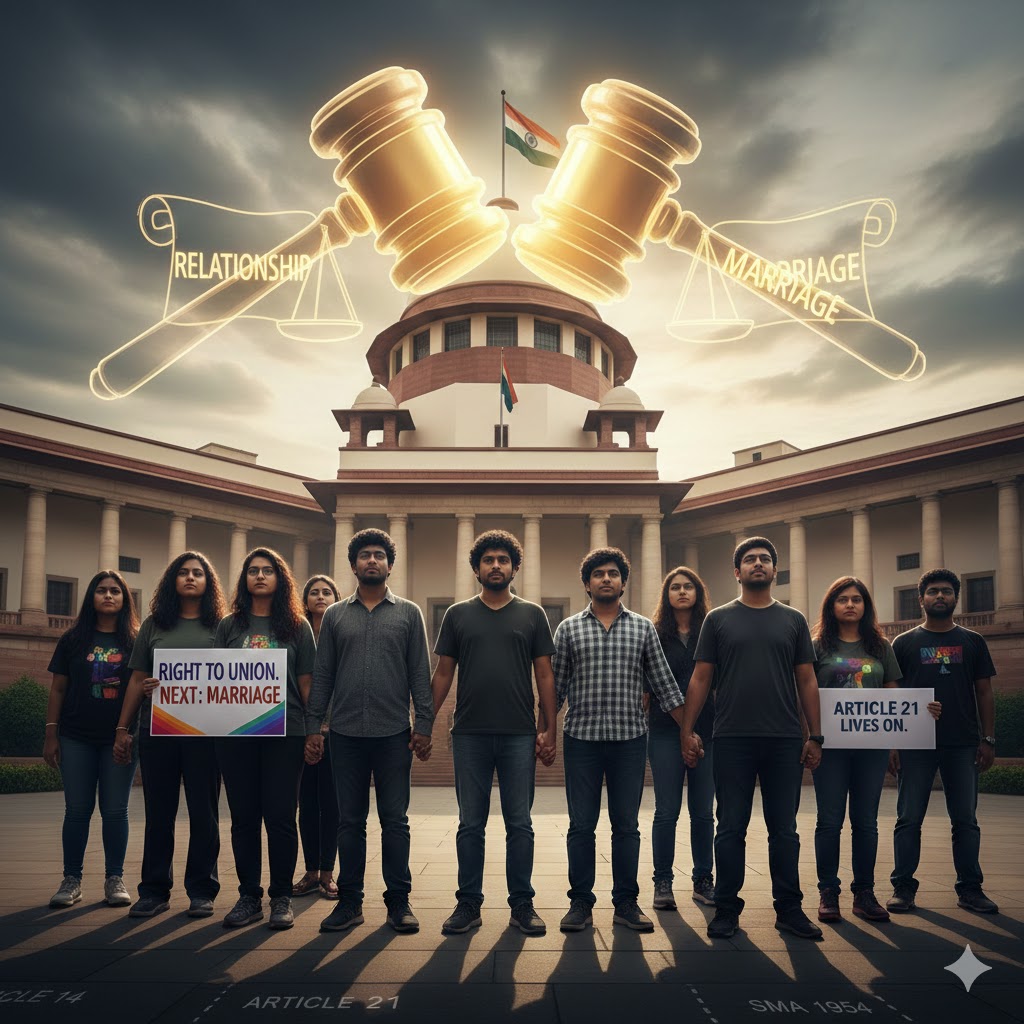
Marriage Equality in India: Unpacking the Supriyo Chakraborty Verdict (2023)
For decades, the fight for LGBTQIA+ rights in India has been a journey of "one step at a time." From the decriminalization of homosexuality in 2018 to the recognition of the "right to privacy," the trajectory seemed to point toward full legal equality. However, the 2023 judgment on same-sex marriage served as a stark reminder of the boundaries between judicial interpretation and legislative power.
1. The Core Question: Is Marriage a Fundamental Right?
The petitioners, led by Supriyo Chakraborty and Abhay Dang, argued that the Special Marriage Act (SMA) of 1954 was unconstitutional because it only recognized unions between a "man" and a "woman." They contended that the right to marry should be a fundamental right under Article 21 (Right to Life and Liberty) and Article 14 (Right to Equality).
The Verdict: The 5-judge Constitution Bench held that there is no unqualified fundamental right to marry under the Indian Constitution. The Court clarified that marriage is a "statutory" institution—meaning it is a right created by laws made by Parliament, not a natural right inherently protected by the Constitution.
2. The 3:2 Split: Civil Unions and Adoption
While the bench was unanimous on some fronts, it was deeply divided on others. The "Minority" opinion (CJI D.Y. Chandrachud and Justice S.K. Kaul) and the "Majority" opinion (Justices Bhat, Kohli, and Narasimha) disagreed on two critical points:
-
Civil Unions: The minority argued that queer couples have a right to form "civil unions"—a legal status that would grant them many of the same benefits as marriage (like inheritance and insurance). The majority rejected this, stating that creating a new legal status like "civil unions" is the job of the Parliament, not the courts.
-
Adoption Rights: The minority believed that the Central Adoption Resource Authority (CARA) regulations were discriminatory for preventing unmarried queer couples from adopting. The majority disagreed, upholding the existing regulations that prioritize the "traditional" family structure for adoption.
3. Key Protections Granted by the Court
Despite the refusal to legalize same-sex marriage, the judgment offered several significant protections and acknowledgments for the community:
-
The Right to Relationship: The Court confirmed that the right to choose a partner and cohabit is a fundamental right under Article 21.
-
Protection from Harassment: The Court issued strict directives to the police to ensure queer couples are not harassed or intimidated for choosing to live together.
-
Transgender Rights: The Court clarified that transgender persons in heterosexual relationships have the right to marry under existing personal and statutory laws.
-
The "Committee" Promise: The Union Government committed to forming a high-level committee (headed by the Cabinet Secretary) to address the practical concerns of queer couples, such as joint bank accounts, pensions, and hospital visitation rights.
4. Why the Court Refused to "Read Down" the Law
Many wondered why the Court didn't simply interpret the word "marriage" to be gender-neutral. The majority held that:
-
Separation of Powers: The judiciary cannot "legislate from the bench." Rewriting the Special Marriage Act would involve changing over 160 other laws involving succession, tax, and divorce, which is a task for the legislature.
-
Statutory Limitations: The SMA was specifically designed to facilitate inter-caste and inter-faith marriages within a heterosexual framework. Changing its core definition would, in the Court's view, exceed its judicial mandate.
5. What Lies Ahead?
The 2023 judgment shifted the "ball" from the Court’s court to the Parliament’s. For the LGBTQIA+ community, the focus has now moved toward legislative advocacy and ensuring the government follows through on the promised committee to provide "ancillary rights" (like insurance and medical proxy).
"The right to enter into a union includes the right to associate with a partner of one’s choice." — CJI D.Y. Chandrachud (Minority Opinion)
Conclusion
The Supriyo Chakraborty judgment was not the total victory many had hoped for, but it wasn't a total defeat either. It officially recognized the right to a relationship and the right to live without fear of state interference. While the doors of the marriage registry remain closed for now, the legal recognition of the community’s dignity has never been more visible.