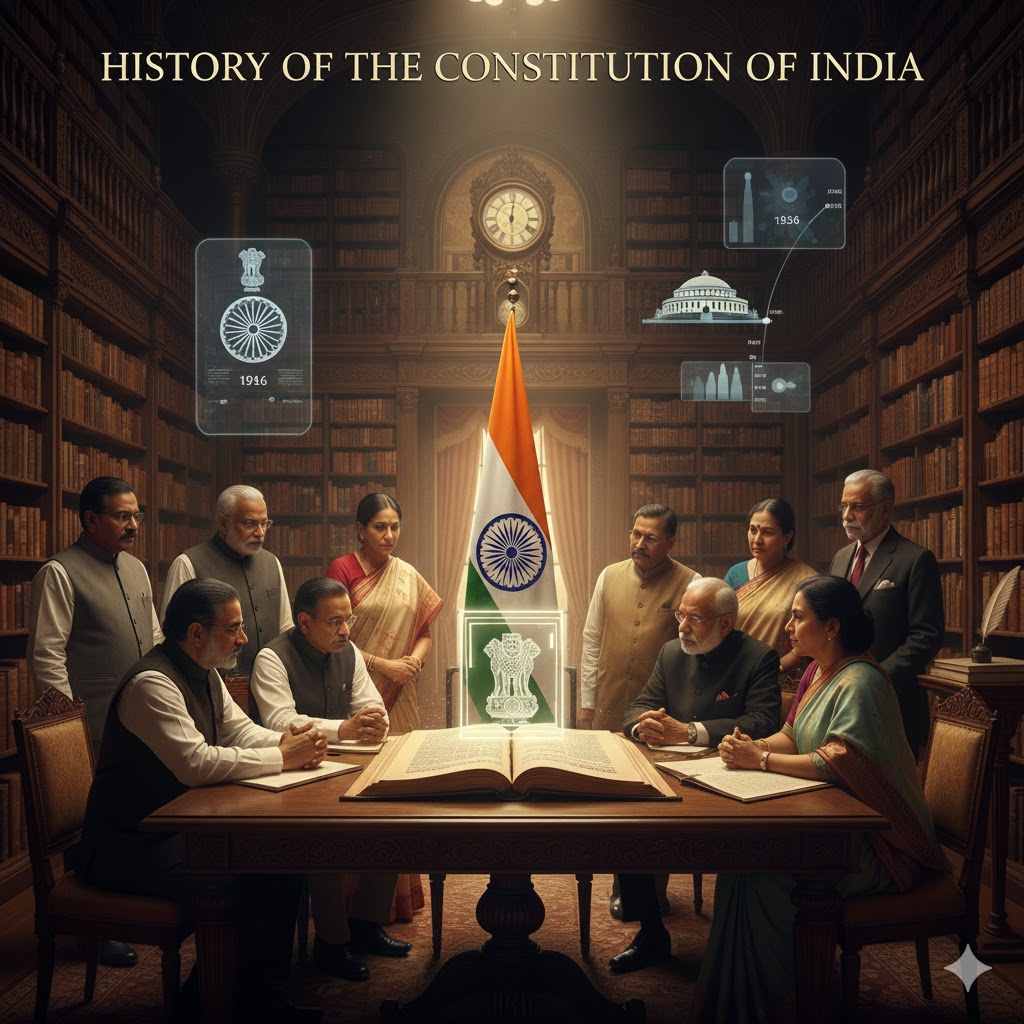
The History of our Constitution
The Birth of a Nation: A Brief History of India's Constitution
The Constitution of India is not just a legal document; it's the living soul of a diverse nation, a testament to democratic ideals, and the longest written constitution of any sovereign country in the world. Its journey from a dream of self-rule to a meticulously crafted framework for governance is a story intertwined with India's struggle for independence.
The Seeds of Self-Governance (Pre-1947)
The idea of Indians governing themselves with their own rules began to take shape long before formal independence.
-
Early Demands: As early as the late 19th and early 20th centuries, Indian leaders began to articulate the need for a constitution written by Indians. Mahatma Gandhi, in 1922, famously stated that Swaraj (self-rule) would not be a gift from the British Parliament but "a declaration of India's full self-expression."
-
Motilal Nehru Committee Report (1928): This was a significant step, proposing a constitutional framework for India. It envisioned dominion status within the British Empire and included a bill of rights, marking an early blueprint for fundamental rights.
-
The Government of India Act, 1935: While imposed by the British, this Act introduced provincial autonomy and a federal structure, laying some foundational elements that would later influence the Indian Constitution, particularly its parliamentary system.
-
Demand for a Constituent Assembly: By the 1930s, the demand for a Constituent Assembly elected by the people of India to draft their own constitution became a central plank of the national movement.
The Constituent Assembly: Crafting Destiny (1946-1949)
The pivotal phase began with the formation of the Constituent Assembly under the Cabinet Mission Plan of 1946.
-
Formation: The Assembly was indirectly elected by members of the Provincial Legislative Assemblies. Its first meeting took place on December 9, 1946, in the Central Hall of Parliament House, Delhi. Dr. Sachchidananda Sinha was the interim president, followed by Dr. Rajendra Prasad who was elected as the permanent President.
-
"Objective Resolution" (1946): On December 13, 1946, Jawaharlal Nehru moved the historic "Objective Resolution." This resolution outlined the guiding principles and philosophy of the Constitution – declaring India an Independent, Sovereign, Republic, guaranteeing justice, equality, and freedom to its people, and ensuring adequate safeguards for minorities, backward and tribal areas. This Resolution was unanimously adopted on January 22, 1947, and later became the Preamble of the Constitution.
-
Partition and its Impact: The partition of India in August 1947 led to significant changes in the Assembly's composition and a renewed urgency in its task. Many members from the Muslim League withdrew, and the focus shifted entirely to drafting a constitution for independent India.
-
Drafting Committee: The most crucial body within the Assembly was the Drafting Committee, set up on August 29, 1947. Dr. B.R. Ambedkar was appointed its Chairman, a role for which he is rightfully known as the "Chief Architect of the Indian Constitution." The committee, comprising seven members, meticulously prepared the draft constitution.
-
Deliberations and Debates: The Constituent Assembly held eleven sessions over almost three years. Members engaged in extensive debates and discussions on every clause, drawing inspiration from constitutional practices across the world while adapting them to India's unique socio-political context. They studied the constitutions of countries like the UK, USA, Canada, Ireland, Australia, and Germany, adopting features like Fundamental Rights, Directive Principles, and the Parliamentary System.
Adoption and Commencement (1949-1950)
-
Final Draft: After painstaking work, the Draft Constitution was presented to the Assembly in November 1949.
-
Adoption: On November 26, 1949, the Constituent Assembly adopted the Constitution of India. This date is now celebrated as Constitution Day (Samvidhan Divas). The Preamble, 395 Articles, and 8 Schedules were the initial components.
-
Commencement: The Constitution came into full effect on January 26, 1950. This date was chosen for its historical significance, as it was on this day in 1930 that the Indian National Congress had proclaimed Purna Swaraj (complete self-rule). With its commencement, India officially became a Republic, marking the end of British dominion.
A Living Document
Since its adoption, the Indian Constitution has been amended over 100 times, reflecting its dynamic nature and adaptability to changing times and societal needs. Yet, its core principles of democracy, secularism, socialism, and justice remain unshakeable, forming the bedrock of the world's largest democracy.
The history of the Indian Constitution is a story of foresight, compromise, and an unwavering commitment to building an inclusive, equitable, and democratic future for all its citizens.