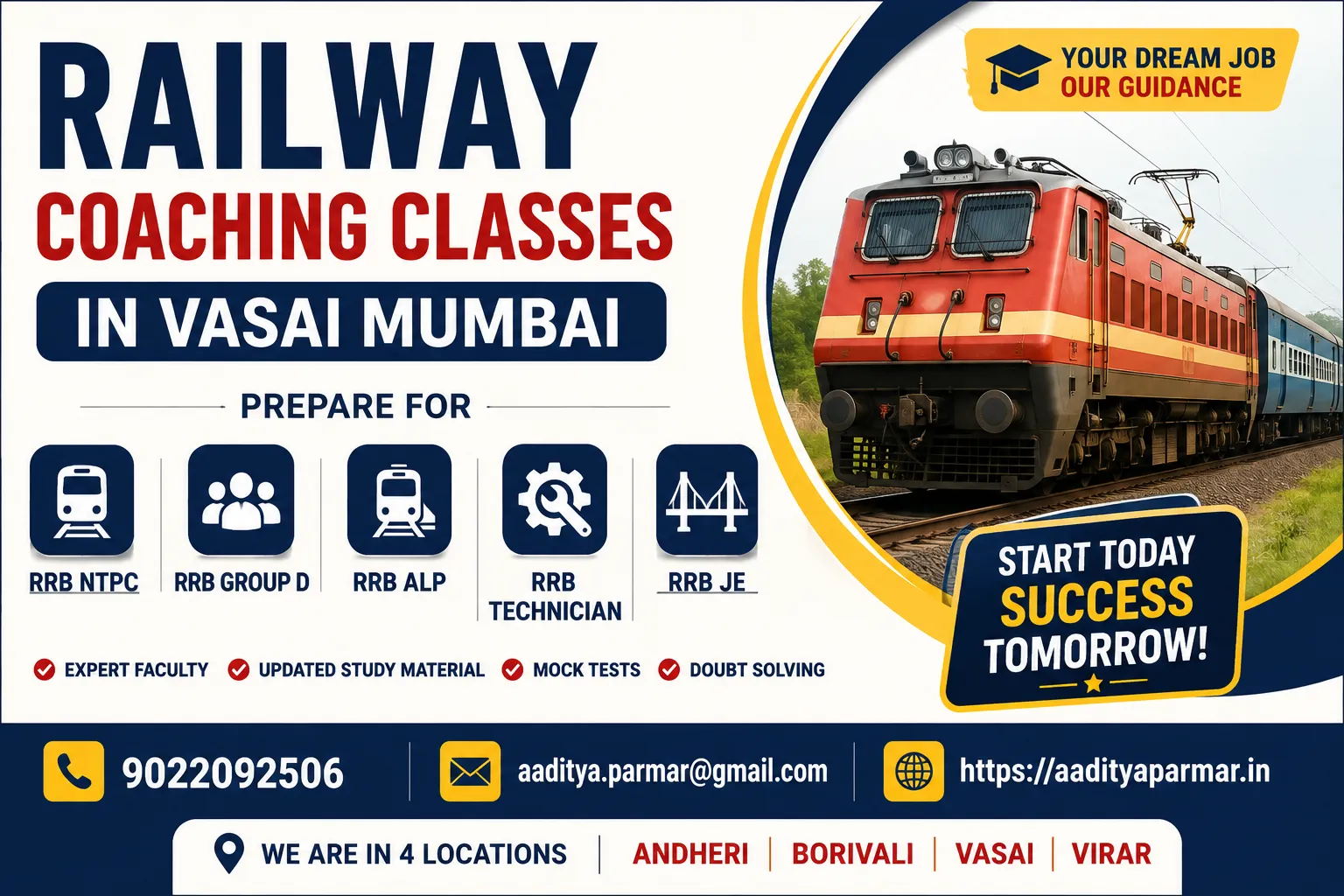
Railway Coaching Classes in Vasai Mumbai | RRB Exam Preparation
Railway Coaching Classes in Vasai Mumbai: Complete Guide for RRB Exam Preparation
Railway Coaching Classes in Vasai Mumbai have become an important search for students and working aspirants who are preparing for competitive railway recruitment examinations such as RRB NTPC, RRB Group D, RRB ALP, RRB Technician, RRB JE and other Railway Recruitment Board examinations.
For many candidates in Vasai, Nalasopara, Virar and nearby areas, railway examinations are attractive because they offer opportunities across different educational qualifications and technical/non-technical backgrounds. However, railway recruitment is not a single examination. Different RRB notifications are released for different posts, and the eligibility, syllabus, selection stages, medical standards, typing/aptitude requirements and examination pattern can vary considerably.
The official Railway Recruitment Boards currently list recruitment streams including Assistant Loco Pilot, NTPC Graduate, NTPC Undergraduate, Level-1/Group-D, Technician, Junior Engineer and other categories.
This guide explains how candidates can choose Railway coaching classes in Vasai Mumbai, which RRB exams they can target, how to prepare for them, what subjects to study, how to build a timetable, how mock tests should be used, and what students should look for before joining a railway coaching institute.
Important: Railway recruitment patterns, vacancies, dates, eligibility and selection stages can change from one CEN (Centralised Employment Notice) to another. Candidates should always verify the latest notification on the official RRB websites before applying or relying on a particular exam pattern.
Quick Summary
| Particular | Details |
|---|---|
| Main Recruitment Authority | Railway Recruitment Boards (RRBs) |
| Popular Railway Exams | NTPC, Group D/Level-1, ALP, Technician, JE and others |
| Preparation Location | Vasai, Mumbai Metropolitan Region |
| Suitable Candidates | 10th/ITI, 12th, Graduates and Technical candidates depending on post |
| Major Subjects | Mathematics, General Intelligence & Reasoning, General Awareness, General Science and post-specific subjects |
| Preparation Method | Concepts + Practice + Previous Papers + Mock Tests + Revision |
| Coaching Locations | Vasai and surrounding areas |
| Contact | 9022092506 |
| aaditya.parmar@gmail.com | |
| Website | aadityaparmar.in |
Introduction
Railway examinations are among the most popular government recruitment examinations in India.
Every year, candidates from different educational backgrounds prepare for opportunities in the Indian Railways through recruitment conducted by the Railway Recruitment Boards (RRBs) and related railway recruitment authorities.
The biggest mistake beginners make is treating "Railway Exam" as one common examination.
It is not.
A candidate preparing for RRB NTPC may have a different syllabus and selection process from someone preparing for RRB ALP or RRB Technician. Similarly, a candidate applying for a Level-1 post needs to carefully check the qualification and selection requirements applicable to that specific CEN.
For example, recent official recruitment notices have included:
- NTPC Graduate
- NTPC Undergraduate
- Assistant Loco Pilot
- Technician
- Level-1/Group-D
- Junior Engineer
- Section Controller
- Paramedical posts
- Ministerial and Isolated Categories
The official RRB recruitment notice listing confirms these separate recruitment categories.
Therefore, if you are searching for railway coaching classes in Vasai Mumbai, the first question should not be:
"Which railway class should I join?"
Instead, ask:
"Which RRB examination and post am I eligible for, and what preparation strategy does that examination require?"
Once that is clear, coaching becomes much more useful.
What Are Railway Recruitment Board Exams?
Railway Recruitment Board examinations are competitive recruitment examinations conducted for various posts within the Indian Railways.
The Railway Recruitment Boards release Centralised Employment Notifications (CENs) for different recruitment categories.
Each CEN specifies important information such as:
- Vacancies
- Posts
- Educational qualifications
- Age requirements
- Medical standards
- Examination stages
- Syllabus
- Application process
- Selection process
- Document requirements
- Examination dates
- RRB-wise or zone-wise details
This means candidates should never rely exclusively on an old railway exam notification.
For example, the official RRB recruitment portal currently lists CEN 01/2026 for Assistant Loco Pilot, while the 2025 recruitment calendar included separate CENs for NTPC Graduate, NTPC Undergraduate, Technician, Level-1 and other posts.
Why Choose Railway Coaching Classes in Vasai Mumbai?
Vasai is an important residential area in the Mumbai Metropolitan Region, and students from Vasai and nearby areas often look for competitive-exam preparation that is accessible without travelling deep into Mumbai every day.
A local railway coaching class in Vasai can be useful because it can provide a structured environment for:
- Regular classes
- Doubt solving
- Practice sessions
- Mock tests
- Previous-year question practice
- Current-affairs preparation
- Mathematics practice
- Reasoning practice
- General Science preparation
- Exam strategy
- Revision
For many students, the biggest benefit of coaching is not simply the classroom lecture.
It is consistency.
When students follow a fixed timetable, attend classes regularly and take scheduled tests, preparation becomes easier to manage.
Railway Exams You Can Prepare For
A good railway coaching programme should ideally help candidates understand the major RRB recruitment categories.
1. RRB NTPC
RRB NTPC stands for Non-Technical Popular Categories.
It includes different undergraduate and graduate-level posts depending on the recruitment notification.
Recent official notifications have separately covered:
- NTPC Graduate posts
- NTPC Undergraduate posts
The current RRB recruitment listings show separate CENs for NTPC Graduate and NTPC Undergraduate recruitment.
NTPC preparation generally involves subjects such as:
- Mathematics
- General Intelligence & Reasoning
- General Awareness
Certain posts can also involve additional stages such as typing or other prescribed requirements.
2. RRB Group D / Level-1
Railway Level-1 recruitment is commonly referred to by aspirants as RRB Group D.
The official RRB recruitment listings now use Pay Level-1 terminology for the relevant recruitment notice.
The recent Level-1 CEN is listed as CEN 09/2025 on the official recruitment notices page.
Candidates should always check the latest CEN for:
- Educational qualification
- Age limit
- Vacancies
- Physical requirements where applicable
- CBT pattern
- PET requirements
- Medical standards
- Document verification
The previous CEN 08/2024 Level-1 recruitment page also contains official notices and FAQs concerning the application process.
3. RRB Assistant Loco Pilot
RRB ALP stands for Assistant Loco Pilot.
It is a technical railway recruitment opportunity and has specific eligibility and selection requirements.
Candidates interested in ALP should pay particular attention to:
- Educational qualification
- ITI/diploma/technical eligibility
- Mathematics
- General Intelligence & Reasoning
- General Science
- Current affairs/general awareness
- Technical subjects
- Aptitude requirements
- Medical standards
The RRB ALP recruitment process can include multiple stages, and recent recruitment has included CBT-1, CBT-2, Computer Based Aptitude Test (CBAT), Document Verification and Medical Examination, depending on the recruitment framework. The official CEN 01/2024 ALP page records these stages, including CBAT activity.
The latest recruitment cycle should always be checked separately because requirements can change.
4. RRB Technician
RRB Technician recruitment is another important option for candidates with relevant technical qualifications.
The official CEN 02/2025 covered Technician Grade-I Signal and various Technician Grade-III categories.
The notification listed separate educational and post-specific requirements.
Therefore, candidates should not assume that every Technician post has identical eligibility.
A good coaching programme should explain:
- Post-wise eligibility
- Technical syllabus
- General subjects
- Previous-year questions
- CBT preparation
- Medical standards
- Post-specific requirements
The official RRB also issued a corrected version of CEN 02/2025 and advised candidates to use the updated version for future reference.
This is a good example of why candidates should rely on the latest official notification rather than screenshots or outdated social-media posts.
5. RRB Junior Engineer
RRB JE is particularly relevant for candidates with engineering or relevant technical qualifications.
Depending on the notification and post, the examination can include:
- Mathematics
- General Intelligence & Reasoning
- General Awareness
- General Science
- Technical abilities
Technical preparation is especially important.
Candidates should therefore choose coaching that understands their engineering/technical discipline rather than joining a programme focused only on generic aptitude.
6. Other Railway Recruitment Exams
Apart from the most commonly searched exams, railway recruitment can also include:
- Paramedical categories
- Ministerial and Isolated Categories
- Section Controller
- Various technical posts
- Other specialised categories
The official RRB recruitment listing includes these categories separately.
The correct preparation strategy depends on the exact post.
Who Should Join Railway Coaching in Vasai?
Railway coaching can be useful for different types of candidates.
10th/ITI Candidates
Candidates who have completed 10th or ITI can explore eligible Level-1, Technician or other posts depending on the notification.
12th Pass Candidates
Candidates with 12th qualification can explore eligible NTPC undergraduate and other posts.
Graduates
Graduates can target eligible NTPC graduate-level posts and other railway examinations.
Engineering Students
Engineering graduates can consider technical opportunities such as RRB JE, depending on the applicable discipline and notification.
Working Professionals
Candidates working full-time can benefit from structured evening/weekend batches.
Railway Exam Eligibility
There is no single eligibility criterion for every railway exam.
Eligibility depends on:
- Post
- CEN
- Educational qualification
- Age
- Technical qualification
- Medical standard
- Nationality
- Other applicable conditions
For example, the official NTPC Undergraduate CEN 07/2025 specifies different educational requirements for posts such as Commercial Cum Ticket Clerk and Trains Clerk.
Similarly, the Technician CEN 02/2025 specifies post-specific qualifications and medical standards.
Therefore:
Never decide your eligibility from a coaching advertisement alone. Check the official CEN.
Railway Exam Syllabus
Although the syllabus differs by recruitment, several subjects appear repeatedly across popular railway examinations.
These include:
Mathematics
- Number System
- BODMAS
- Decimals
- Fractions
- LCM
- HCF
- Ratio and Proportion
- Percentage
- Profit and Loss
- Simple Interest
- Compound Interest
- Time and Work
- Time and Distance
- Average
- Mensuration
- Algebra
- Geometry
- Trigonometry
- Statistics
- Data Interpretation
General Intelligence and Reasoning
Important topics include:
- Analogy
- Classification
- Coding-Decoding
- Number Series
- Alphabet Series
- Blood Relations
- Direction Sense
- Ranking
- Syllogism
- Venn Diagrams
- Mathematical Operations
- Puzzle
- Seating Arrangement
- Statement and Conclusion
- Data Sufficiency
- Decision Making
The difficulty varies depending on the recruitment.
General Awareness
General Awareness can include:
- Current Affairs
- Indian History
- Geography
- Indian Polity
- Economics
- Culture
- Sports
- Important Organisations
- Important Days
- Awards
- Books and Authors
- Government Schemes
- Science and Technology
- Railway-related developments
General Science
For relevant RRB examinations, General Science preparation commonly focuses on:
Physics
- Motion
- Force
- Work
- Energy
- Power
- Heat
- Light
- Sound
- Electricity
- Magnetism
Chemistry
- Atoms
- Molecules
- Elements
- Compounds
- Acids
- Bases
- Salts
- Metals
- Non-metals
- Chemical reactions
Biology
- Human body
- Nutrition
- Diseases
- Cells
- Plants
- Animals
- Genetics basics
- Environment
Technical Subjects for Railway Exams
Candidates preparing for technical recruitment should study the technical syllabus specified in their CEN.
For example, Technician and JE candidates may need to prepare discipline-specific technical subjects.
Possible areas can include:
- Electrical
- Mechanical
- Electronics
- Computer Science
- Civil
- Automobile
- ITI trade-specific concepts
The exact syllabus must be taken from the relevant notification.
Railway Coaching Classes in Vasai: What Should You Look For?
Choosing a coaching class should not be based only on the word "Railway" in the advertisement.
Look for the following.
1. Experienced Faculty
Teachers should understand the latest RRB question trends.
2. Complete Syllabus Coverage
The course should cover all relevant subjects.
3. Previous-Year Questions
Past questions should be integrated into teaching.
4. Regular Mock Tests
Tests should be conducted consistently.
5. Doubt-Solving Support
Students should have a way to clarify difficult questions.
6. Current Affairs
Current affairs should be updated regularly.
7. Revision
A course should not end after the syllabus is completed.
Revision is essential.
8. Performance Analysis
Students should know their:
- Accuracy
- Attempts
- Time taken
- Weak subjects
- Strong subjects
Why Previous-Year Papers Matter
Previous-year railway questions are extremely useful.
They show students what the examination actually tests.
Instead of asking:
"What should I study?"
you can ask:
"What has actually been asked?"
This helps prioritise preparation.
For every previous-year paper, record:
- Topic
- Question type
- Difficulty
- Time taken
- Mistake
- Correct method
Over time, you build a personal question database.
Railway Mock Test Strategy
Mock tests should be introduced gradually.
Beginner Stage
1 mock per week.
Intermediate Stage
2–3 mocks per week.
Advanced Stage
3–5 mocks per week depending on the examination schedule.
But remember:
Mock analysis is more important than mock count.
If you take 20 mocks but never analyse mistakes, your improvement can remain limited.
How to Analyse a Railway Mock Test
After every test, divide questions into four categories:
Category A – Correct and Fast
Excellent.
Category B – Correct but Slow
Improve speed.
Category C – Incorrect but Conceptually Solvable
Revise the concept.
Category D – Incorrect Due to Guessing
Improve question selection.
This simple system can dramatically improve preparation quality.
Railway Mathematics Preparation Strategy
Mathematics can become one of the highest-scoring sections when candidates develop calculation speed.
Start with:
- Tables
- Squares
- Cubes
- Fractions
- Percentage conversions
Then move to:
Arithmetic → Advanced topics → Mixed questions → Timed tests
Do not spend 10 minutes solving one question during practice.
Learn the concept first.
Then develop shortcuts.
Finally, practise under time pressure.
Railway Reasoning Preparation Strategy
Reasoning should be approached progressively.
Phase 1
Complete basic topics:
- Analogy
- Series
- Coding
- Classification
- Direction
- Blood Relations
Phase 2
Move to:
- Syllogism
- Venn Diagrams
- Statement-based questions
Phase 3
Practise:
- Puzzles
- Seating
- Complex arrangements
- Mixed reasoning
The objective is not simply solving more questions.
It is recognising the question pattern quickly.
Railway General Science Preparation Strategy
General Science is easier to manage when concepts are connected to everyday examples.
For example:
Instead of memorising the definition of electricity only, understand:
- Current
- Voltage
- Resistance
- Power
- Basic circuits
Similarly, in Biology:
Understand:
Organ → Function → Related system → Common disease
This makes revision easier.
Railway General Awareness Preparation
General Awareness requires consistent revision.
A good routine is:
Daily
20–30 minutes.
Weekly
Revise the week's notes.
Monthly
Complete a monthly current-affairs revision.
Before Exam
Revise important months repeatedly.
Focus especially on:
- Government schemes
- Appointments
- Awards
- Sports
- Economy
- Science and technology
- Important national events
- International events
- Railway-related developments
6-Month Railway Exam Preparation Plan
Month 1 – Foundation
Focus on:
- Basic Mathematics
- Basic Reasoning
- General Science fundamentals
- General Awareness basics
Goal:
Understand concepts.
Month 2 – Core Syllabus
Complete:
- Arithmetic
- Reasoning
- Science
- Static GK
Start previous-year questions.
Month 3 – Advanced Practice
Focus on:
- Difficult Maths
- Complex reasoning
- Mixed science
- Current affairs
Start sectional tests.
Month 4 – Full Syllabus
Complete remaining topics.
Start full-length mocks.
Month 5 – Intensive Testing
Take regular:
- Sectional tests
- Previous-year papers
- Full mocks
Analyse every test.
Month 6 – Revision
Focus on:
- Formulae
- Current affairs
- Science
- Weak topics
- Previous-year questions
- Mock tests
Avoid starting large new resources at the last minute.
3-Month Railway Preparation Strategy
If you have only three months:
Month 1
Foundation + high-priority topics.
Month 2
Complete syllabus + previous-year questions.
Month 3
Mocks + revision + current affairs.
The key is prioritisation.
Don't try to study every possible topic equally.
Daily Railway Study Timetable
A full-time student could use:
| Subject | Time |
|---|---|
| Mathematics | 90 minutes |
| Reasoning | 60 minutes |
| General Science | 60 minutes |
| General Awareness | 45 minutes |
| Current Affairs | 30 minutes |
| Previous-Year Questions | 45 minutes |
| Revision | 30 minutes |
Total:
Approximately 5–6 hours
Working candidates can use a smaller schedule.
Railway Preparation for Working Candidates
If you have a job, don't compare your timetable with a full-time aspirant.
Try:
Morning
Current affairs – 20 minutes
Commute
Vocabulary/GK revision
Evening
Mathematics – 60 minutes
Night
Reasoning/Science – 60 minutes
Weekend
Full mock + analysis
Consistency matters more than extremely long study sessions.
Railway Coaching Classes in Vasai for Beginners
Beginners often face three problems:
Problem 1: They don't know where to start.
Problem 2: They study random topics.
Problem 3: They don't know whether they are improving.
A structured railway coaching programme can solve these problems by providing:
Syllabus → Classes → Practice → Tests → Analysis → Revision
However, students should continue self-study alongside coaching.
No coaching institute can replace personal practice.
Railway Coaching in Vasai for RRB NTPC
Candidates preparing for NTPC should focus strongly on:
- Mathematics
- Reasoning
- General Awareness
- Current Affairs
- Previous-year papers
- Typing requirements where applicable to the specific post
NTPC recruitment has separate undergraduate and graduate CENs, so candidates should first identify the correct level. The official RRB portal currently lists CEN 07/2025 for NTPC Undergraduate and CEN 06/2025 for NTPC Graduate recruitment.
Railway Coaching in Vasai for Group D
For Level-1/Group-D aspirants, preparation should include:
- Mathematics
- Reasoning
- General Science
- General Awareness
- Current Affairs
- Mock tests
- Previous-year questions
Candidates should additionally prepare for any physical-efficiency requirements specified in the relevant notification.
Never assume that an old Group D selection process automatically applies to the next recruitment.
Railway Coaching in Vasai for ALP
ALP aspirants require a more specialised strategy.
In addition to common aptitude areas, candidates must pay close attention to:
- Technical qualification
- Technical syllabus
- CBT stages
- Aptitude requirements
- Medical requirements
Recent ALP recruitment included a Computer Based Aptitude Test after the CBT stages.
Railway Coaching in Vasai for Technician
Technician preparation should combine:
General aptitude + technical preparation
Candidates should identify their exact Technician category before starting technical preparation because the qualification and post-specific requirements can differ.
The official CEN 02/2025 itself separates Technician Grade-I Signal and various Grade-III categories.
Railway Coaching in Vasai for RRB JE
JE candidates need a technical-first approach.
A recommended structure is:
Technical concepts → Technical MCQs → General subjects → Previous-year questions → Full mocks
Engineering candidates should avoid spending all their time on generic aptitude while neglecting technical preparation.
Railway Exam Preparation for 10th Pass Students
Students with 10th qualification should first identify which posts they are eligible for under the current notification.
Preparation should focus on:
- Basic Mathematics
- Reasoning
- General Science
- General Awareness
- Current Affairs
- Practice tests
Strong fundamentals can make later preparation much easier.
Railway Exam Preparation for 12th Pass Students
12th-pass candidates should explore eligible undergraduate railway posts.
For example, the latest NTPC Undergraduate notification includes posts such as Commercial Cum Ticket Clerk and Trains Clerk, subject to the detailed eligibility conditions of that CEN.
Candidates should always check:
- Minimum marks
- Age
- Typing requirements
- Post-specific conditions
Railway Exam Preparation for Graduates
Graduates can consider eligible:
- NTPC Graduate posts
- JE/technical opportunities if qualified
- Other graduate-level railway recruitment
Graduate candidates should not assume that every railway post is available to every graduate.
Post-specific qualification matters.
Common Railway Exam Preparation Mistakes
Mistake 1: Preparing for Every Railway Exam at Once
Choose a primary target.
Mistake 2: Ignoring the Official Notification
Always read the CEN.
Mistake 3: Studying Only Current Affairs
Core subjects matter.
Mistake 4: Avoiding Mathematics
Maths requires regular practice.
Mistake 5: Ignoring General Science
Science can be an important scoring area.
Mistake 6: Not Solving Previous Papers
Past papers are essential.
Mistake 7: Taking Mocks Without Analysis
Analysis drives improvement.
Mistake 8: Using Too Many Books
Choose limited resources.
Mistake 9: Ignoring Medical Requirements
Some railway posts have specific medical standards.
Mistake 10: Waiting for the Notification to Start
Start building fundamentals early.
How to Choose the Best Railway Coaching Classes in Vasai Mumbai
Before joining, ask the institute:
1. Which RRB exams are covered?
NTPC?
Group D?
ALP?
Technician?
JE?
2. Is the latest syllabus covered?
3. Are previous-year questions discussed?
4. How frequently are mock tests conducted?
5. Are doubt sessions available?
6. Is current affairs taught regularly?
7. Are technical batches available?
8. Are weekday and weekend batches available?
9. Is performance tracked?
10. Does the course include revision?
These questions can help students make a better decision.
Online vs Offline Railway Coaching
Both formats have advantages.
Offline Coaching
Best for students who prefer:
- Classroom discipline
- Face-to-face teaching
- Immediate doubt solving
- Peer competition
- Fixed schedules
Online Coaching
Useful for:
- Flexible schedules
- Working professionals
- Revision
- Recorded lectures
- Students who live farther away
Hybrid Approach
A combination can work well:
Offline classes + online practice + digital mock tests
The best format is the one you can follow consistently.
Why Mock Tests Should Be Part of Railway Coaching
A coaching institute should not simply finish the syllabus.
It should prepare students for the actual examination environment.
Mock tests help develop:
- Speed
- Accuracy
- Time management
- Question selection
- Exam temperament
- Confidence
Students should ideally progress from:
Topic Test → Sectional Test → Previous-Year Paper → Full Mock
How to Improve Railway Exam Speed
Speed doesn't mean rushing.
Speed means:
Correct method + familiarity + calculation ability + decision-making
To improve:
Step 1
Learn concepts.
Step 2
Practise standard question types.
Step 3
Time yourself.
Step 4
Identify slow topics.
Step 5
Practise those topics separately.
Step 6
Repeat.
Railway Exam Accuracy Strategy
Accuracy becomes especially important when incorrect answers carry negative marking under the applicable examination pattern.
Therefore, don't attempt a question merely because you have seen a similar concept.
Ask:
Can I solve this confidently within the available time?
If not, move ahead.
Railway Exam Current Affairs Strategy
Don't collect 100-page monthly PDFs and read them once.
Instead:
Read
Understand important events.
Highlight
Only relevant information.
Revise
Repeatedly.
Test
Use MCQs.
Repeat
Before examination.
This is much more effective than passive reading.
Railway Coaching Classes in Vasai Mumbai for Competitive Exam Aspirants
A good railway preparation environment should encourage students to become independent problem solvers.
The classroom should be used for:
- Learning concepts
- Understanding shortcuts
- Solving difficult questions
- Discussing previous-year questions
- Clearing doubts
- Learning exam strategy
Home study should be used for:
- Practice
- Revision
- Mock tests
- Current affairs
- Error correction
This combination creates a more complete preparation system.
Railway Exam Preparation Checklist
Mathematics
- Number System
- Percentage
- Ratio
- Average
- Profit & Loss
- SI & CI
- Time & Work
- Time & Distance
- Algebra
- Geometry
- Mensuration
- Statistics
Reasoning
- Analogy
- Series
- Coding-Decoding
- Classification
- Blood Relations
- Direction
- Syllogism
- Venn Diagram
- Puzzle
- Seating Arrangement
General Science
- Physics
- Chemistry
- Biology
General Awareness
- History
- Geography
- Polity
- Economics
- Current Affairs
- Sports
- Awards
- Government Schemes
- Science & Technology
Test Preparation
- Topic Tests
- Sectional Tests
- Previous-Year Papers
- Full-Length Mocks
- Mock Analysis
- Error Notebook
- Revision
Frequently Asked Questions
1. What are Railway Coaching Classes in Vasai?
Railway coaching classes in Vasai are competitive-exam preparation programmes designed to help candidates prepare for RRB examinations such as NTPC, Group D/Level-1, ALP, Technician, JE and other railway recruitment examinations.
2. Which railway exams can I prepare for in Vasai?
Depending on your qualification and the latest recruitment notification, you may prepare for RRB NTPC, Level-1/Group D, ALP, Technician, JE and other railway recruitment categories.
3. Is railway coaching necessary to clear RRB exams?
No. Coaching is not mandatory. Candidates can clear examinations through self-study. However, structured coaching can help with concepts, practice, doubt solving, mock tests and preparation discipline.
4. Which is the best railway coaching class in Vasai?
The best coaching option depends on faculty, syllabus coverage, test series, study material, doubt support, batch timings and your specific target examination. Candidates should compare these factors before enrolling.
5. Can 10th-pass students apply for railway jobs?
Some railway posts allow candidates with 10th qualification, while others require ITI, 12th, graduation or technical qualifications. Candidates must check the exact CEN.
6. Can 12th-pass students apply for RRB NTPC?
Yes, eligible 12th-pass candidates can apply for relevant undergraduate NTPC posts when the notification permits it. The exact qualification and post requirements must be checked in the applicable CEN.
7. Can graduates apply for railway exams?
Yes, graduates can apply for eligible graduate-level railway posts subject to the requirements of the relevant notification.
8. Can engineering students prepare for RRB JE?
Yes, candidates with the required engineering/diploma qualification in the relevant discipline can consider RRB JE when the notification's eligibility conditions are satisfied.
9. What subjects are common in railway exams?
Common subjects include Mathematics, General Intelligence & Reasoning, General Awareness and General Science, although the exact syllabus depends on the recruitment.
10. Is current affairs important for railway exams?
Yes. Current affairs can form an important part of General Awareness preparation.
11. Are previous-year papers important for RRB exams?
Yes. They help candidates understand question patterns, difficulty levels and frequently tested concepts.
12. How many hours should I study for railway exams?
There is no universal number. A full-time candidate may study around 4–6 focused hours, while working candidates can build preparation around 2–3 focused hours on weekdays and longer weekend sessions.
13. How long does it take to prepare for railway exams?
It depends on your starting level, target examination and available study time. Three to six months can provide a structured preparation period, while candidates starting from basics may benefit from longer preparation.
14. Are mock tests necessary?
Mock tests are highly recommended because they help improve speed, accuracy, time management and question selection.
15. How can I improve my railway exam Mathematics score?
Strengthen fundamentals, practise arithmetic regularly, improve calculations, solve previous-year questions and take timed tests.
16. How can I improve my Railway Reasoning score?
Begin with basic reasoning topics and gradually move towards puzzles, seating arrangements and mixed questions.
17. Can working professionals join railway coaching in Vasai?
Yes. Working candidates can choose suitable evening, weekend or hybrid preparation options depending on availability.
18. Should I prepare for multiple RRB exams together?
You can prepare for overlapping subjects together, but it is usually better to have one primary target. Add another examination only when the syllabus and eligibility overlap sufficiently.
19. Is RRB NTPC the same as RRB Group D?
No. They are different recruitment categories with different posts, qualifications and selection requirements.
20. Is RRB ALP a technical examination?
Yes. ALP recruitment has technical eligibility and technical/aptitude requirements in addition to common examination components.
21. Does RRB Technician have different eligibility for different posts?
Yes. Technician recruitment can contain different categories with different qualifications and requirements. The official CEN 02/2025, for example, separately identifies Technician Grade-I Signal and various Technician Grade-III categories.
22. Where can I check official railway recruitment notifications?
Candidates should use the official RRB websites. RRB itself warns candidates to rely on official RRB websites and avoid unofficial information circulating on social media.
23. Are Railway exams difficult?
Railway examinations are competitive because a large number of candidates apply. However, systematic preparation, practice and mock-test analysis can significantly improve performance.
24. Can I prepare for railway exams from Vasai?
Absolutely. Candidates can prepare from Vasai through offline coaching, self-study, online resources or a combination of these approaches.
25. Why should I start railway preparation early?
Starting early gives you time to build fundamentals, practise previous-year questions, develop speed and revise multiple times instead of relying on last-minute preparation.
Why Start Railway Exam Preparation in Vasai Early?
One of the biggest advantages of starting early is that you can separate preparation into phases.
Phase 1
Learn
Phase 2
Practise
Phase 3
Test
Phase 4
Analyse
Phase 5
Revise
Phase 6
Simulate the examination
This is much more effective than trying to complete everything in the last few weeks.
Final Preparation Strategy
If you are beginning your railway exam preparation in Vasai today, follow this simple system:
1. Select your target RRB exam.
2. Read the latest official notification.
3. Check your eligibility.
4. Download/prepare a syllabus checklist.
5. Build your Mathematics fundamentals.
6. Practise Reasoning daily.
7. Study General Science systematically.
8. Read current affairs consistently.
9. Solve previous-year questions.
10. Start sectional tests.
11. Take full-length mocks.
12. Analyse every mistake.
13. Revise weak topics.
14. Repeat until examination day.
Conclusion
Finding the right Railway Coaching Classes in Vasai Mumbai is only the beginning of your railway exam journey.
The real difference comes from what you do after joining.
A student who attends classes but does not practise will struggle.
A student who studies randomly without testing may not know their actual preparation level.
A student who takes mocks but never analyses them will repeat the same mistakes.
The strongest approach is:
Learn the concept → Practise questions → Solve previous-year papers → Take mocks → Analyse mistakes → Revise → Repeat.
Whether your goal is RRB NTPC, RRB Group D/Level-1, RRB ALP, RRB Technician, RRB JE or another railway recruitment examination, begin by identifying the exact CEN applicable to your target post.
The official RRB recruitment listings demonstrate why this matters: different CENs are issued for different recruitment categories, including NTPC Graduate, NTPC Undergraduate, Level-1, ALP, Technician and other posts.
For candidates in Vasai and the wider Mumbai region, structured railway-exam preparation can help bring discipline to an otherwise overwhelming syllabus.
Start early.
Study consistently.
Practise intelligently.
Analyse your performance.
And keep the latest official RRB notification as your final source of truth.
Railway Coaching Classes in Vasai Mumbai – Contact Details
If you are looking for Railway Coaching Classes in Vasai Mumbai and preparation support for RRB examinations, you can get in touch for further information about available classes and preparation programmes.
Contact Details
Phone: 9022092506
Email: aaditya.parmar@gmail.com
Website: aadityaparmar.in
Location Coverage
Vasai | Mumbai | Nearby Areas
For students interested in broader competitive-exam preparation, the coaching network also serves candidates looking for preparation options in Andheri, Borivali, Vasai and Virar.