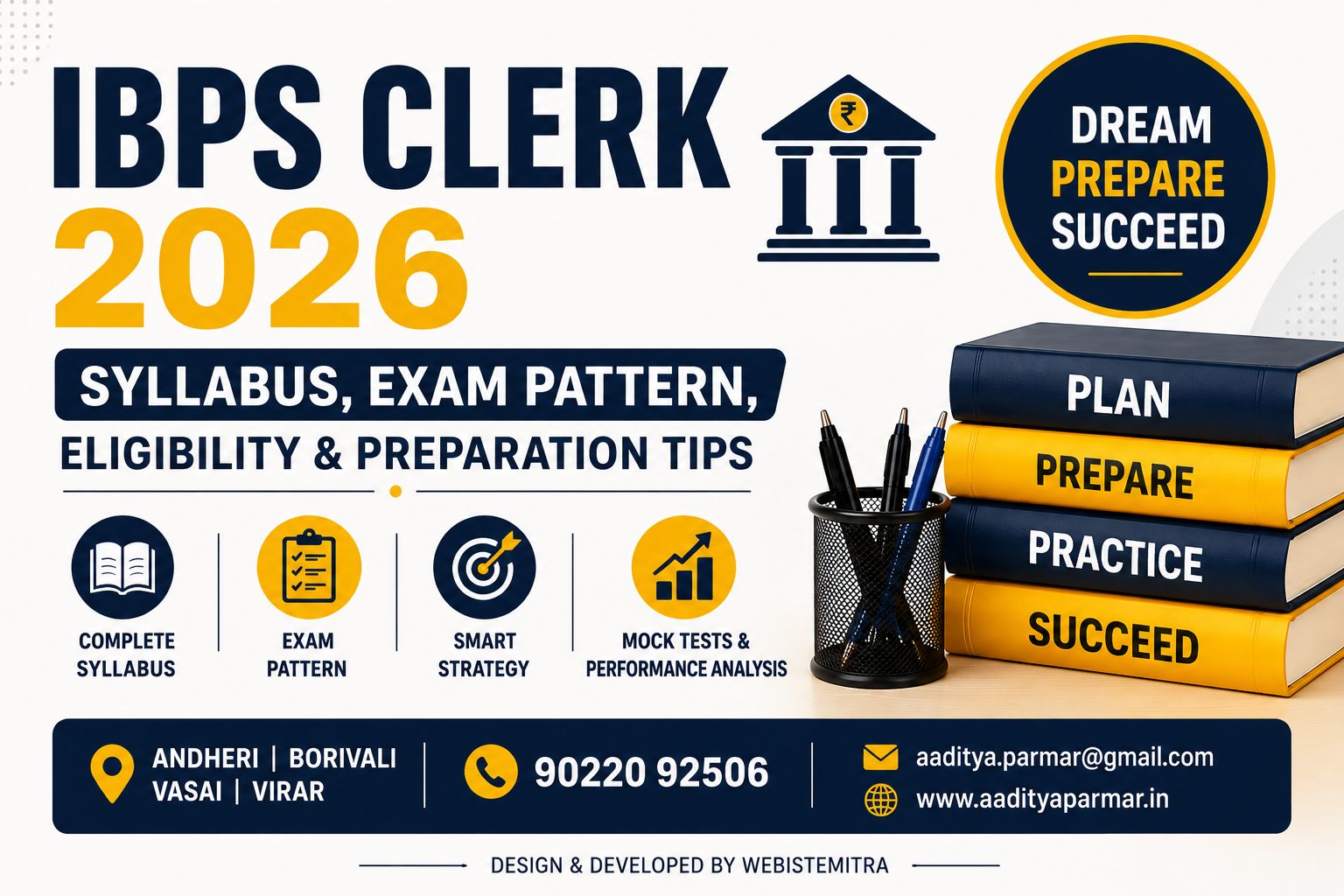
IBPS Clerk 2026: Syllabus, Exam Pattern, Eligibility & Preparation Tips
Summary
The IBPS Clerk 2026 exam is one of the most reliable gateways to a permanent banking job in India.
Conducted by the Institute of Banking Personnel Selection (IBPS) for 11 public sector banks, the recruitment
happens in two stages — Prelims (qualifying) and Mains (merit-deciding), with
no interview round.
In this IBPS Clerk 2026 guide, you will get the complete IBPS Clerk 2026 syllabus,
the latest IBPS Clerk 2026 exam pattern, IBPS Clerk 2026 eligibility criteria,
salary and job profile, expected important dates, a 90-day IBPS Clerk 2026 preparation strategy,
comparison tables, common mistakes, expert tips, and 15+ FAQs — everything you need to build a plan you can
actually stick to.
Introduction
Imagine opening your laptop on a Monday morning and knowing exactly what you need to study for the next three
hours. No guesswork. No “which book should I start with?” panic. That is what a clear understanding of
IBPS Clerk 2026 gives you — not just information, but direction.
Every year, lakhs of graduates apply for the IBPS Clerk recruitment, but only a few thousand make it. The gap
between the two groups is rarely talent. It is clarity plus consistency. Candidates who know the exact
IBPS Clerk 2026 syllabus, the marking scheme, the sectional timing, and their own strengths
prepare smarter. Candidates who treat the exam as a vague mountain of “bank preparation” burn out by month two.
You are reading this because you want to be in the first group. Good. From here, we will break down the
IBPS Clerk 2026 exam pattern, section by section, then walk through eligibility, salary,
a step-by-step study plan, mock-test strategy, and the small habits that separate a 55 from a 75. Whether you are
a final-year student, a working professional, or someone preparing after a gap year, this
IBPS Clerk 2026 preparation guide is designed to fit real life — not an imaginary 14-hour
study day.
Let us begin. By the end of this post, you will have a complete, printable roadmap for the
IBPS Clerk 2026 exam.
Key Takeaways
- Two-stage selection: IBPS Clerk 2026 has a Prelims (100 questions, 100 marks, 60 minutes) and a Mains exam (190 questions, 190 marks, 160 minutes).
- No interview: Your final merit is based on Mains performance plus provisional allotment to a participating bank.
- Prelims is only qualifying: Prelims marks are not counted in the final merit list — but you must clear the cut-off to reach Mains.
- Negative marking applies: 1/4th of the marks assigned to a question are deducted for every wrong answer. Blind guessing is expensive.
- Eligibility is broad: Any graduate, aged 20–28 years (with relaxations), can apply. There is no minimum percentage requirement.
- Sectional timing is strict: You cannot move to another section until the allotted time for the current one ends.
- Speed decides Prelims, accuracy decides Mains: Plan your practice around both, not just one.
- A 90-day structured plan with 25–30 full-length mocks is usually enough for a serious first-attempt candidate.
What Is the IBPS Clerk 2026 Exam?
The IBPS Clerk 2026 exam is a national-level recruitment examination conducted by the Institute
of Banking Personnel Selection to select candidates for the post of Clerk (Customer Support & Sales)
in public sector banks across India.
The exam is part of the Common Recruitment Process (CRP), which means one exam score is used by multiple
participating banks. Based on your Mains score and the preferences you fill, you are allotted to a bank and a
state. Banks that typically participate include:
- Bank of Baroda
- Canara Bank
- Bank of India
- Central Bank of India
- Indian Bank
- Indian Overseas Bank
- Punjab National Bank
- Punjab & Sind Bank
- UCO Bank
- Union Bank of India
- Bank of Maharashtra
The role itself is customer-facing: opening accounts, handling cash and digital transactions, assisting with
loans and KYC, cross-selling banking products, and acting as the first point of contact for most customers.
If you enjoy structured work, direct public interaction, and the stability of a government-linked job, this
profile suits you well.
Want the exact vacancy count, participating banks for this cycle, and application window? Read our detailed
IBPS Clerk 2026 notification breakdown.
Why the IBPS Clerk 2026 Exam Matters
You might wonder why this exam deserves a dedicated plan instead of being treated as a “backup” alongside
IBPS PO or SBI Clerk. Here is why it genuinely matters:
- Volume of vacancies: The Clerk recruitment usually offers thousands of posts — among the highest in any single bank recruitment cycle.
- No interview: For candidates who are strong in written exams but nervous in interviews, this is a massive advantage.
- Lower competition intensity per vacancy than PO: The difficulty level is moderate, and the syllabus overlaps heavily with other bank and insurance exams.
- Permanent job with a pensionable structure: You get job security, a defined pay scale, and clear promotion channels.
- Launchpad for internal promotions: Many clerks move to Officer and Manager roles through internal exams like the Internal Promotion Test and JAIIB/CAIIB certifications.
- Exam overlap efficiency: Preparing for IBPS Clerk 2026 simultaneously prepares you for SBI Clerk, RRB Clerk, IBPS PO Prelims, and several insurance exams.
In short, the IBPS Clerk 2026 exam is not a “lesser” exam. It is a smart, high-probability entry
point into the banking system — and once you are inside, your growth depends on your effort, not your entry tag.
Benefits of Becoming an IBPS Clerk in 2026
Here is what you actually gain once you clear the IBPS Clerk 2026 exam:
- Job security: A permanent position in a public sector bank with protection against arbitrary removal.
- Attractive in-hand salary: A gross monthly salary that comfortably exceeds what most fresh graduates earn in private jobs in similar cities.
- Allowances beyond basic pay: Dearness Allowance, House Rent Allowance, Transport Allowance, medical benefits, LTC, and more.
- Work-life balance: Fixed banking hours, gazetted holidays, and weekly offs (with rotational Saturdays in many branches).
- Home-state posting: You can choose your preferred state, which means you often work near your family.
- Loan benefits at concessional rates: Staff housing loans, car loans, and personal loans at rates far below market.
- Retirement benefits: Pension/NPS, gratuity, and provident fund contributions.
- Respect and stability: A bank job still carries social prestige and long-term family security.
- Fast-track certifications: Bank sponsors and supports JAIIB/CAIIB, which directly boosts your promotion prospects.
For a complete breakdown of in-hand pay by city, read our
IBPS Clerk salary and job profile guide.
IBPS Clerk 2026 Eligibility Criteria
Before you start preparing, confirm that you qualify. The IBPS Clerk 2026 eligibility criteria are
straightforward, but the age cut-off date and category relaxations matter a lot.
1. Nationality
- A citizen of India, or
- A subject of Nepal or Bhutan, or
- A Tibetan refugee who came to India before 1 January 1962 with the intention of permanent settlement, or
- A person of Indian origin who migrated from Pakistan, Burma, Sri Lanka, Kenya, Uganda, Tanzania, Zambia, Malawi, Zaire, Ethiopia, or Vietnam with the intention of permanent settlement in India.
2. Age Limit (as on the date specified in the official notification)
- Minimum age: 20 years
- Maximum age: 28 years
- OBC (Non-Creamy Layer): 3 years relaxation
- SC / ST: 5 years relaxation
- PwBD (Persons with Benchmark Disabilities): 10 years relaxation
- Ex-servicemen and other reserved categories: relaxation as per government rules
3. Educational Qualification
- A Bachelor’s degree in any discipline from a university recognised by the Government of India.
- You must possess a valid mark sheet or degree certificate proving you passed the graduation exam on or before the cut-off date.
- There is no minimum percentage requirement — a pass is enough.
- Working knowledge of computers is desirable.
- For certain states, proficiency in the local language is expected.
4. Number of Attempts
There is no fixed limit on the number of attempts. You can appear as many times as you want as long
as you satisfy the age and educational criteria.
Important: Eligibility rules are set by IBPS and can be updated in the official notification.
Always cross-check the final eligibility table on the official IBPS website before applying.
IBPS Clerk 2026 Exam Pattern (Prelims & Mains)
The IBPS Clerk 2026 exam pattern consists of two online (computer-based) tests. Understanding the
structure — especially sectional timing and negative marking — is the foundation of a smart strategy.
IBPS Clerk 2026 Prelims Exam Pattern
| Section | Questions | Marks | Sectional Time |
|---|---|---|---|
| English Language | 30 | 30 | 20 minutes |
| Numerical Ability | 35 | 35 | 20 minutes |
| Reasoning Ability | 35 | 35 | 20 minutes |
| Total | 100 | 100 | 60 minutes |
IBPS Clerk 2026 Mains Exam Pattern
| Section | Questions | Marks | Sectional Time |
|---|---|---|---|
| General / Financial Awareness | 50 | 50 | 35 minutes |
| General English | 40 | 40 | 35 minutes |
| Reasoning Ability & Computer Aptitude | 50 | 50 | 45 minutes |
| Quantitative Aptitude | 50 | 50 | 45 minutes |
| Total | 190 | 190 | 160 minutes |
Key Rules You Must Remember
- Negative marking: 1/4th of the marks assigned to a question are deducted for each wrong answer.
- No penalty for skipped questions: Leaving a question blank costs you nothing.
- Sectional timing: Each section has a fixed timer. You cannot return to a section once its time is over.
- Minimum qualifying marks: Typically 40% for unreserved categories and 35% for SC/ST/OBC/PwBD in each section, plus an overall cut-off.
- Prelims is qualifying in nature: The final merit list is prepared on the basis of Mains scores only.
- Language options: Questions (except English Language) are available in Hindi and English.
Exact question counts and timings can change slightly with each notification. Review the pattern in the
official IBPS Clerk 2026 notification before your exam.
IBPS Clerk 2026 Syllabus (Section-Wise)
The IBPS Clerk 2026 syllabus is predictable and well-defined. Master these topics and you will never
feel lost during revision.
English Language / General English
- Reading Comprehension (including economy- and banking-based passages)
- Cloze Test
- Error Detection and Sentence Correction
- Sentence Improvement and Sentence Rearrangement
- Para Jumbles and Para Completion
- Fill in the Blanks (single and double)
- Synonyms, Antonyms, Word Usage, Idioms and Phrases
- Connectors, Match the Column, and Misspelt Words
Numerical Ability / Quantitative Aptitude
- Simplification and Approximation
- Number Series (missing and wrong number)
- Quadratic Equations
- Data Interpretation (table, bar, pie, line, caselet, mixed graphs)
- Percentage, Ratio and Proportion, Average, Ages
- Profit, Loss and Discount
- Simple and Compound Interest
- Time, Speed and Distance; Boats and Streams; Trains
- Time and Work; Pipes and Cisterns
- Mixtures and Alligations
- Mensuration and Data Sufficiency
- Permutation, Combination and Probability (occasional)
Reasoning Ability & Computer Aptitude
- Puzzles and Seating Arrangement (linear, circular, floor, box, scheduling, month-day)
- Syllogism and Reverse Syllogism
- Inequality (direct and coded)
- Coding-Decoding
- Blood Relations and Direction Sense
- Order, Ranking and Sequence
- Alphanumeric and Symbol Series
- Data Sufficiency and Statement-Based Questions
- Computer Fundamentals, MS Office, Internet and Networking Basics
- Database Basics, Cyber Security Basics, Shortcut Keys
General / Financial Awareness
- Banking and Financial Awareness (RBI policies, monetary policy, repo rate, CRR, SLR)
- Banking terminology and abbreviations
- Current affairs of the last 6 months
- Government schemes, budget highlights, and economic surveys
- Static GK — capitals, currencies, headquarters, important days
- News related to SEBI, NPCI, IRDAI, and major financial institutions
- Awards, appointments, sports, and national/international events
For a monthly-updated resource list, bookmark our
current affairs for bank exams hub.
How It Works: The IBPS Clerk 2026 Selection Process
The selection process for IBPS Clerk 2026 works in a clear sequence:
- Application & fee payment: You register on the official IBPS portal, upload documents, select your state preference, and pay the application fee.
- Prelims exam: A 60-minute computer-based test. You must clear the sectional and overall cut-offs.
- Mains exam: A 160-minute test with four sections. This score decides your final merit.
- Provisional allotment: Based on your Mains score, state preference, category, and available vacancies, you are allotted to a participating bank.
- Document verification: You must produce original documents — degree certificate, ID proof, caste/PwBD certificates (if applicable), and photographs.
- Final joining: After verification and bank-specific formalities, you receive your posting and joining letter.
Remember: there is no interview and no group discussion. Your written performance is your entire
case. That should motivate you — the power is completely in your hands.
IBPS Clerk 2026 Salary, Job Profile & Career Growth
Salary (Indicative)
- Basic pay: Approximately ₹26,000–₹29,000 per month (as revised under the latest bipartite settlement).
- Gross monthly salary: Roughly ₹37,000–₹45,000 depending on your posting location and applicable allowances.
- In-hand salary: Typically ₹32,000–₹40,000 after statutory deductions, varying by city and state.
- Additional benefits: DA, HRA, transport allowance, medical facilities, LTC, PF, gratuity, and concessional staff loans.
Note: Salary figures change with each bipartite settlement. Always confirm the latest figure in the official notification.
Job Profile
- Handling cash receipts, payments, and clearing transactions
- Opening and maintaining customer accounts, KYC verification, and passbook updates
- Assisting customers with digital banking, UPI, and mobile banking
- Cross-selling banking products like insurance, mutual funds, and fixed deposits
- Processing loan applications and documentation at the branch level
- Supporting daily branch operations and reconciliation
Career Growth Path
- Clerk → Assistant Manager (via internal promotion exams)
- Assistant Manager → Manager → Senior Manager → Chief Manager
- JAIIB/CAIIB certifications accelerate promotions and increments
- Departmental exams open doors to specialised roles in credit, treasury, and compliance
IBPS Clerk 2026 Important Dates (Expected)
IBPS usually follows a predictable annual calendar. Based on recent trends, here is the expected timeline for
IBPS Clerk 2026:
| Event | Expected Window |
|---|---|
| Official notification release | Mid-2026 |
| Online application starts | Within 1–2 weeks of notification |
| Last date to apply | 3–4 weeks after application opens |
| Prelims admit card | 10–15 days before the exam |
| Prelims exam | Around August–September 2026 |
| Prelims result | 2–3 weeks after the exam |
| Mains exam | Around October–November 2026 |
| Mains result | Within 4–6 weeks |
| Provisional allotment | Following the Mains result |
Disclaimer: These dates are indicative projections based on previous cycles. The official schedule
may shift. Please verify all dates on the official IBPS website before planning.
Step-by-Step Guide to Prepare for IBPS Clerk 2026
A structured 90-day plan works better than six months of unfocused study. Here is a step-by-step approach to
IBPS Clerk 2026 preparation that you can adapt to your schedule.
Step 1: Baseline Assessment (Day 1–3)
- Take one full-length Prelims mock test without any preparation.
- Record your sectional scores, accuracy, and time spent per question.
- Identify your strongest and weakest sections honestly.
Step 2: Foundation Building (Week 1–4)
- Revise core concepts of Quantitative Aptitude — percentage, ratio, average, and profit-loss first.
- Learn shortcut techniques for simplification and number series.
- Practice 20–30 reasoning questions daily, focusing on puzzles and syllogism.
- Read one editorial or news article daily to build English comprehension.
- Start a daily current affairs routine — 20 minutes, no more.
Step 3: Skill Application (Week 5–8)
- Solve topic-wise question banks for every section.
- Attempt sectional tests with a timer — 20 questions in 15 minutes, for example.
- Maintain an error log for every mistake you make.
- Begin Data Interpretation practice twice a week.
- Cover the Mains-only topics: Computer Aptitude and General/Financial Awareness.
Step 4: Speed and Accuracy (Week 9–11)
- Attempt two full-length mocks per week and analyse them the same day.
- Refine your question-selection strategy — know when to skip.
- Target 85%+ accuracy in your strong sections and 70%+ in weaker ones.
- Practice calculation speed with tables, squares, and cubes up to 30.
Step 5: Final Revision & Mock Marathon (Week 12–13)
- Take a full-length mock every alternate day.
- Revise your error log and formula sheet daily.
- Revise the last 6 months of current affairs twice.
- Simulate exam-day conditions — same time, same device, no interruptions.
- Protect your sleep in the final week; do not start new topics.
Examples: Real Study Plans You Can Copy
Example 1: The Working Professional (3 Hours a Day)
- 6:00–7:00 AM: Quantitative Aptitude — new topic or revision
- 1:00–1:30 PM (lunch break): Current affairs reading
- 8:30–10:00 PM: Reasoning puzzles and English practice
- Sunday: One full-length mock + 90-minute analysis
Example 2: The Final-Year Student (6 Hours a Day)
- 7:00–9:00 AM: Quantitative Aptitude with fresh mind
- 10:00 AM–12:00 PM: Reasoning Ability, mostly puzzles
- 2:00–3:30 PM: English Language and vocabulary
- 4:00–4:30 PM: Current affairs and static GK
- 6:00–7:00 PM: Sectional tests and error-log review
Example 3: Smart Attempt Strategy in Prelims
Suppose you have 20 minutes for Numerical Ability with 35 questions. A realistic approach:
- Minutes 0–6: Solve 10 simplification and number-series questions (high accuracy, low time)
- Minutes 6–14: Attempt one or two easy Data Interpretation sets
- Minutes 14–18: Solve quadratic equations and arithmetic questions you are confident about
- Minutes 18–20: Re-check marked questions; do not start a new puzzle
This kind of planned sequencing can add 8–10 marks to your score without any extra knowledge. For more techniques,
read our guide on how to improve speed in quantitative aptitude.
Comparison Table: IBPS Clerk 2026 vs SBI Clerk vs IBPS PO
| Parameter | IBPS Clerk 2026 | SBI Clerk | IBPS PO |
|---|---|---|---|
| Conducting Body | IBPS | SBI | IBPS |
| Stages | Prelims + Mains | Prelims + Mains | Prelims + Mains + Interview |
| Interview | No | No | Yes |
| Prelims Level | Moderate | Moderate to Difficult | Moderate to Difficult |
| Mains Level | Moderate | Moderate to Difficult | High |
| Starting Basic Pay (approx.) | ₹26,000–₹29,000 | ₹26,000–₹29,000 | ₹48,000–₹52,000 |
| Job Profile | Customer support & sales | Customer service & cash | Officer / managerial |
| Postings | Anywhere in your chosen state | Anywhere in India | Anywhere in India |
| Best For | First bank job, exam beginners | Better pay, tougher exam | Leadership-track careers |
Preparing for one exam almost covers the others. Explore our
SBI Clerk 2026 notification guide and
IBPS PO 2026 syllabus and exam pattern to plan a combined strategy.
Common Mistakes in IBPS Clerk 2026 Preparation
- Collecting too many resources: Five books and ten YouTube channels create confusion, not clarity.
- Skipping mock-test analysis: Taking 30 mocks without analysing them is almost wasted effort.
- Ignoring General/Financial Awareness: Many candidates lose Mains merit here because they start too late.
- Practising without a timer: Untimed practice builds knowledge but not speed, and Prelims rewards speed.
- Chasing difficult puzzles: Spending 12 minutes on one puzzle destroys your entire reasoning section.
- Blind guessing: With 1/4th negative marking, random guesses reduce your score faster than leaving questions blank.
- Neglecting accuracy for attempts: 55 questions with 90% accuracy beat 70 questions with 60% accuracy.
- No revision plan: New topics every day without revision means you forget 40% of what you learned.
- Starting current affairs one month before the exam: Awareness is a habit, not a last-minute cram.
- Ignoring health and sleep: Burnout in month two is the most common reason for failed attempts.
Expert Tips from Senior Bank-Exam Mentors
- Master simplification first: It is the highest-accuracy, lowest-time section in Prelims quantitative.
- Solve 2 puzzles daily: Consistency beats marathon sessions when it comes to reasoning.
- Build a personal formula sheet: One page per topic you can revise in 15 minutes before the exam.
- Use the “3-strike rule”: If a question takes more than three attempts or 90 seconds, leave it and move on.
- Attempt in order of confidence: You are not required to follow the question order given.
- Read the newspaper for 20 minutes daily: This single habit improves English, awareness, and RC accuracy.
- Take mocks at the same time as your exam slot: Your brain learns to peak at that hour.
- Maintain an error log: The three mistakes you repeat most often are worth more than any new chapter.
- Target 85% accuracy in strong sections: Accuracy creates a buffer that lets you take calculated risks elsewhere.
- Do not change your strategy in the last week: Confidence matters more than last-minute tweaks.
Best Practices for IBPS Clerk 2026 Aspirants
- Set a weekly target, not a daily mood-based plan. Weekly goals survive bad days.
- Study at fixed hours. Consistency reduces the willpower needed to start.
- Mix sections daily. Studying one section for five days straight reduces retention.
- Review before you revise. Revise yesterday’s topic for 15 minutes before starting today’s.
- Track three metrics: attempts, accuracy, and time per question.
- Prioritise high-weight, high-accuracy topics. Efficiency beats completeness.
- Keep Sundays for mocks and reflection. Analysis days improve scores faster than study days.
- Use the official IBPS website as your source of truth. Avoid unverified coaching rumours.
Recommended Tools & Resources
| Purpose | Recommended Resource |
|---|---|
| Official information | IBPS official website and the IBPS Clerk 2026 notification PDF |
| Mock tests | Reputed online test series with Prelims and Mains pattern accuracy |
| Previous year papers | Last 5 years of IBPS Clerk question papers for pattern analysis |
| Quantitative practice | Speed maths books and topic-wise arithmetic workbooks |
| Reasoning practice | Puzzle-heavy question banks with increasing difficulty levels |
| English improvement | Grammar reference book, daily editorial reading, and vocabulary apps |
| Current affairs | Monthly PDFs, weekly quizzes, and banking awareness capsules |
| Time management | Pomodoro timer, habit-tracking app, and a Google Sheet error log |
| Speed calculation | Tables, squares, cubes, and percentage-to-fraction conversion charts |
| Concept clarification | Trusted YouTube channels dedicated to bank exam concepts |
Start with our curated
best books for IBPS Clerk 2026 list and
IBPS Clerk previous year papers archive.
Troubleshooting: Fixing Your Preparation Problems
“I run out of time in every mock test.”
- Track time per question, not per section. Identify the two topics that eat your minutes.
- Adopt the 3-strike rule and skip aggressively.
- Practise 15-question timed sets before jumping to full mocks.
“My accuracy is high but my attempts are low.”
- You are likely over-verifying. Solve the first 10 easy questions in under 5 minutes to build momentum.
- Learn shortcut formulas for percentage, ratio, and average problems.
“I forget current affairs within a week.”
- Switch from reading to quizzing. Take a 10-question retest 48 hours after reading.
- Link news to a category — banking, schemes, appointments — instead of memorising in isolation.
“My mock scores have plateaued.”
- Plateaus usually mean repeated errors, not lack of knowledge. Re-read your error log for the last 10 mocks.
- Change the difficulty level of your mock series to break the pattern.
“I feel demotivated after a low score.”
- Compare yourself with your score from two weeks ago, not with toppers’ scores.
- Take a half-day break — guilt-free rest improves the next mock more than an exhausted one.
“The exam-day interface feels unfamiliar.”
- Practise on the official mock test link provided by IBPS before the exam.
- Learn the on-screen calculator and the mark-for-review buttons in advance.
For a deeper breakdown of previous trends, see our
IBPS Clerk 2026 cut-off analysis and
free bank exam mock tests page.
FAQs on IBPS Clerk 2026
1. When will the IBPS Clerk 2026 notification be released?
Based on previous cycles, the IBPS Clerk 2026 notification is expected in mid-2026. The official
date will be announced on the IBPS website, so check it regularly.
2. Is there an interview in the IBPS Clerk 2026 selection process?
No. There is no interview or group discussion. Selection is based on the Mains examination, followed by document
verification and provisional allotment.
3. What is the IBPS Clerk 2026 exam pattern?
The IBPS Clerk 2026 exam pattern includes a Prelims exam (100 questions, 100 marks, 60 minutes)
and a Mains exam (190 questions, 190 marks, 160 minutes), both computer-based with sectional timing.
4. What is the age limit for IBPS Clerk 2026?
The minimum age is 20 years and the maximum is 28 years, with relaxations of 3 years for OBC-NCL, 5 years for
SC/ST, and 10 years for PwBD candidates.
5. Can I apply for IBPS Clerk 2026 without a graduation degree?
No. A Bachelor’s degree in any discipline from a recognised university is mandatory. You must possess the degree
or a valid mark sheet by the cut-off date mentioned in the notification.
6. Is there negative marking in the IBPS Clerk 2026 exam?
Yes. One-fourth of the marks assigned to a question are deducted for every incorrect answer. Skipped questions
carry no penalty.
7. Is Prelims score counted in the final merit list?
No. Prelims is qualifying in nature. Your final merit is determined solely by your Mains performance.
8. How many attempts can I take for IBPS Clerk?
There is no restriction on the number of attempts. You can appear as many times as you wish, as long as you meet
the age and educational eligibility criteria.
9. What is the salary of an IBPS Clerk in 2026?
The approximate starting basic pay is ₹26,000–₹29,000 per month, with a gross salary of roughly
₹37,000–₹45,000 depending on the posting location and applicable allowances.
10. How much time is needed to prepare for IBPS Clerk 2026?
A focused 3–4 months of preparation, with 3–4 hours daily and 25–30 full-length mocks, is usually sufficient for
most serious candidates.
11. Can final-year students apply for IBPS Clerk 2026?
You can apply only if you meet the graduation requirement by the cut-off date specified in the official
notification. Check that date carefully before applying.
12. Which sections carry the most weight in the IBPS Clerk Mains exam?
Quantitative Aptitude, Reasoning Ability & Computer Aptitude, and General/Financial Awareness each carry 50
marks, making them the highest-weight sections, followed by General English with 40 marks.
13. Is the IBPS Clerk 2026 exam bilingual?
Yes, all sections except the English Language section are available in both Hindi and English.
14. Can I choose my posting state in IBPS Clerk 2026?
Yes. You select a state during the application process. Your allotment depends on your Mains score, the state you
chose, your category, and vacancy availability.
15. What are the minimum qualifying marks in each section?
Generally, candidates must score at least 40% in each section (35% for SC/ST/OBC/PwBD), in addition to clearing
the overall cut-off.
16. Can I crack IBPS Clerk 2026 while working a full-time job?
Absolutely. Working professionals commonly clear this exam with a disciplined 3-hour daily routine built around
weekends dedicated to full-length mocks and analysis.
17. How important are mock tests for IBPS Clerk 2026 preparation?
Extremely important. Mock tests convert knowledge into exam-day performance. Aim for at least 25 full-length mocks
with same-day analysis.
Conclusion
Clearing the IBPS Clerk 2026 exam is not about genius. It is about clarity, consistency, and
honest self-review. You now have the complete picture: the IBPS Clerk 2026 syllabus, the detailed
IBPS Clerk 2026 exam pattern, the IBPS Clerk 2026 eligibility criteria, salary,
job profile, expected dates, a 90-day step-by-step plan, comparison tables, expert tips, and troubleshooting fixes
for the problems that derail most aspirants.
The exam rewards candidates who practise with a timer, analyse their mistakes, and revise relentlessly. Start
today with one mock test. Write down your three weakest topics. Fix them this week. That single action puts you
ahead of thousands of aspirants who are still deciding where to begin.
Your banking career does not start on the exam day. It starts the moment you commit to a plan and follow it for
the next 90 days. You have the roadmap — now walk it.
Call to Action
Ready to start your IBPS Clerk 2026 preparation the right way? Here is your next step:
- 📥 Download the IBPS Clerk 2026 notification guide and confirm your eligibility today.
- 🧪 Take a free full-length IBPS Clerk mock test and record your baseline score.
- 📚 Pick your books from the recommended list — and stick to only three.
- 🗓️ Download the 90-day IBPS Clerk 2026 study plan and pin it to your desk.
- 💬 Join our bank exam community for weekly quizzes, cut-off updates, and doubt-clearing sessions.
- 📧 Subscribe to our newsletter to get verified IBPS Clerk 2026 updates the day they are announced.
Share this guide with a friend who is preparing for IBPS Clerk 2026 — one clear
roadmap can change someone’s entire result. And if this post helped you, drop a comment with the section you
found most useful. Let’s get you to that allotment list.