
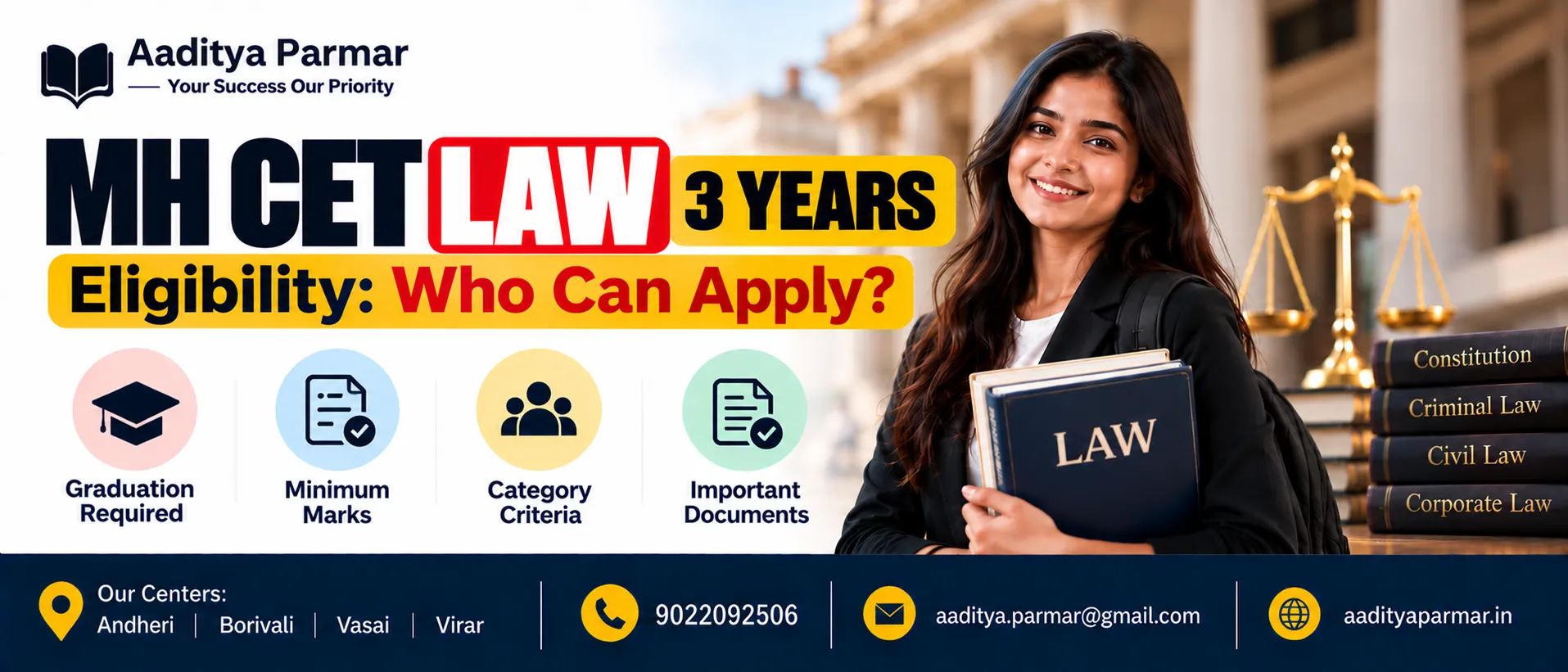
The Maharashtra Common Entrance Test for the three-year Bachelor of Laws programme, commonly known as MAH-LL.B. 3 Years CET or MH CET Law 3 Years, is the entrance examination used for admission to the first year of the three-year LL.B. degree course through the Maharashtra admission process.
Unlike the five-year integrated law programme, which students can pursue after Class 12, the three-year LL.B. course is designed for graduates. Candidates generally need to complete a recognised bachelor’s degree following the required 10+2+3 educational pattern and meet the minimum aggregate percentage prescribed for their candidature and category.
According to the official 2026–27 information brochure, the minimum qualifying aggregate marks are:
The brochure also permits eligible candidates appearing for their qualifying undergraduate or postgraduate examination in the relevant academic year to take the entrance examination. However, they must satisfy the qualification requirements and produce the prescribed degree or provisional certificate and mark lists during the Centralised Admission Process (CAP).
For the 2026–27 admission cycle, the brochure states that there is no upper age limit for the examination, subject to the outcome of pending court proceedings. Candidates must read the applicable brochure carefully before applying for a later cycle.
This guide explains the eligibility criteria, minimum marks, age limit, educational qualifications, category rules, final-year eligibility, distance education, documents, admission process and common eligibility questions. It also includes useful information for students looking for law entrance preparation guidance in Vasai and Mumbai.
Official reference: The Maharashtra State CET Cell’s 2026–27 information brochure for the three-year LL.B. CET is available on the official CET Cell website.
Important: The 2026–27 eligibility rules below are a verified reference for that admission cycle, not a guarantee that every rule will remain unchanged for 2027–28. Check the next official brochure before submitting an application.
Are you a graduate who wants to pursue a career in law? Are you wondering whether your bachelor’s degree, percentage, category, age or educational background makes you eligible for MH CET Law 3 Years?
The three-year LL.B. course can be a suitable option for graduates who want to enter the legal profession, explore legal research, work in compliance, pursue further legal studies or develop a deeper understanding of law.
However, before preparing for the entrance examination, you should confirm that you meet the eligibility criteria. This is important because qualifying in an entrance examination and being eligible for admission are not exactly the same thing.
Candidates must meet the prescribed academic requirements, satisfy the applicable candidature rules, provide the required documents and complete the admission process within the official deadlines.
For students in Vasai, Mumbai, Andheri, Borivali and nearby areas, understanding eligibility before beginning preparation can help prevent unnecessary confusion during application and counselling.
This article answers the most important question: Who can apply for MH CET Law 3 Years, and what qualifications are required?
MH CET Law 3 Years is the Maharashtra State Common Entrance Test for admission to the three-year LL.B. degree programme.
The Maharashtra State Common Entrance Test Cell conducts the examination for eligible candidates seeking admission to participating law colleges and institutions through the prescribed process.
The three-year LL.B. programme is a full-time regular professional degree course. It is intended for students who have completed the required undergraduate qualification rather than students applying immediately after Class 12.
The examination and admission process are governed by the applicable official information brochure, government rules, eligibility requirements and admission notices.
Students frequently confuse the two law entrance examinations. Although both lead to a law degree, their entry requirements differ.
| Feature | MH CET Law 3 Years | MH CET Law 5 Years |
|---|---|---|
| Entry qualification | Recognised bachelor’s degree under the prescribed pattern | Class 12 or equivalent qualification |
| Course duration | Three years | Five years |
| Programme type | LL.B. degree course | Integrated programme such as BA LL.B. or another approved integrated law degree |
| Intended applicants | Graduates | Students entering after higher secondary education |
| Entrance examination | MAH-LL.B. 3 Years CET | MAH-LL.B. 5 Years CET |
| Main eligibility consideration | Graduation and required aggregate marks | Class 12 qualification and applicable marks criteria |
If you have completed graduation, the three-year LL.B. route may be relevant to you. If you have just completed Class 12 and have not completed a bachelor’s degree, you should generally investigate the five-year integrated law route instead.
Always verify the exact requirements for the programme you intend to pursue.
The official 2026–27 brochure identifies several requirements that applicants must understand before applying.
The brochure states that candidates applying for the regular CET must be Indian nationals, subject to the separate rules for specified international and other special candidature categories.
Candidates who fall under NRI, OCI, PIO, foreign national or other specially defined categories should not automatically follow the ordinary Indian-national applicant route. The brochure provides separate procedures for certain such candidates, including exemptions from taking the CET and separate registration or admission arrangements where applicable.
If you belong to one of these categories, check the dedicated section of the official brochure before submitting an application.
The principal educational requirement for the three-year LL.B. course is a recognised bachelor’s degree.
The official 2026–27 brochure states that candidates must have graduated in any faculty from a qualifying university or recognised institution, subject to the prescribed educational pattern and minimum aggregate marks.
This means that candidates from several academic backgrounds may be eligible. You do not necessarily need to have studied law, political science or a related subject during graduation.
Depending on the recognition of the degree and the other applicable requirements, eligible graduates may come from streams such as:
These are examples of degree types, not a substitute for checking the recognition and duration of your particular qualification.
For the three-year LL.B. course, the prescribed basic educational pattern is generally:
Class 10 + Class 12 or equivalent + three-year graduation
The 2026–27 brochure explains the requirement as the 10+2+3 pattern. It also discusses qualifying education obtained through approved distance, correspondence and open-schooling modes, subject to the relevant rules.
Candidates with unusual educational pathways should check their documents and the official eligibility explanation carefully.
For example, if you completed Class 12 through an accepted open-schooling route and subsequently completed a recognised three-year bachelor’s degree, the mode of schooling alone does not automatically make you ineligible under the cited brochure. However, the full educational pattern and recognition requirements still apply.
Candidates must meet the minimum percentage applicable to their category and candidature.
The percentage is based on the aggregate marks across all parts of the qualifying degree, as explained in the official brochure. It should not be calculated solely from the final year or the last semester unless the applicable rules specifically provide otherwise.
For the 2026–27 cycle, the official brochure states that there is no upper age limit for admission to the LL.B. three-year CET examination, in view of pending court proceedings.
The brochure also notes that any eventual application of an age limit would be subject to the final outcome of relevant legal proceedings. It describes possible limits of 30 years for Open Category candidates and 35 years for Maharashtra State SC/ST candidates as part of that conditional explanation.
Candidates should therefore avoid relying on old articles that simply state a fixed age limit. Check the brochure for the academic year in which you intend to apply.
Being allowed to sit for the examination does not automatically mean that a candidate has completed every admission requirement.
Candidates must also satisfy the prescribed academic criteria, submit the required documents, complete CAP registration and follow the applicable admission and seat-allocation rules.
Eligibility and admission should be treated as related but distinct steps.
The minimum aggregate percentage is one of the most important parts of the eligibility criteria.
The following table reflects the category-wise requirements stated in the official 2026–27 brochure.
| Category or candidature | Minimum aggregate marks |
|---|---|
| Open Category | 45% |
| All India Candidature / outside-Maharashtra university candidates under the applicable rules | 45% |
| SEBC candidates under the cited brochure | 45% |
| EWS candidates under the cited brochure | 45% |
| Maharashtra State VJNT categories covered by the rules | 42% |
| Maharashtra State SBC candidates | 42% |
| Maharashtra State OBC candidates | 42% |
| Maharashtra State SC candidates | 40% |
| Maharashtra State ST candidates | 40% |
Read this table carefully: The relaxed percentage criteria are not automatically available to every candidate who belongs to a reserved category in any state. The brochure distinguishes Maharashtra State candidature and All India Candidature.
Candidates from outside Maharashtra are generally treated under the All India/Open Category rules for this purpose, regardless of their reserved category status in another state. The relevant official provisions should be checked before claiming any category-based relaxation.
Suppose a candidate has completed a three-year bachelor’s degree with a different percentage in each year. The candidate should not assume that the final-year percentage alone determines eligibility.
The brochure explains that aggregate marks should be calculated across all parts of the qualifying degree. For a semester-based course, the marks from all six semesters of a three-year degree are considered under the prescribed method.
This is especially important for students whose marks varied considerably across semesters.
No, candidates should not assume that a percentage just below the threshold will automatically qualify after rounding.
The 2026–27 brochure specifically explains that marks from 44.50% to 44.99% cannot be rounded up to 45% for the relevant Open, All India, SEBC and EWS categories. It also sets out similar restrictions for the 42% and 40% thresholds.
Calculate your aggregate carefully and read the official rounding provisions before applying.
Candidates applying under the Open Category generally need at least 45% aggregate marks in their qualifying bachelor’s degree under the cited 2026–27 rules.
They should also meet the other requirements, including the recognised educational pattern and nationality or candidature conditions relevant to their application.
Before submitting the form, Open Category candidates should:
Do not assume that a high CET score can compensate for failing a minimum academic eligibility requirement.
For the 2026–27 cycle, the brochure specifies a minimum aggregate of 42% for candidates belonging to the relevant Maharashtra State OBC category.
However, OBC candidates from outside Maharashtra should not automatically claim the Maharashtra State relaxation. The brochure states that candidates from outside-Maharashtra universities are treated under the applicable Open Category requirements for All India Candidature.
Candidates claiming the Maharashtra State OBC category should carefully check:
A candidate who lacks the required documentation should not assume that simply selecting OBC in the application will establish eligibility for the category-based benefit.
Under the cited 2026–27 brochure, candidates belonging to the Maharashtra State SC and ST categories have a minimum aggregate requirement of 40%.
Candidates should confirm that their category and candidature qualify under the Maharashtra State rules. Reserved-category status in another state does not automatically establish entitlement to Maharashtra’s category-based admission benefits.
Applicants should prepare the relevant documents, which may include:
The precise documentation depends on the candidate’s category and circumstances. Always check the latest official list.
The 2026–27 brochure specifies a minimum aggregate of 42% for the covered Maharashtra State VJNT and SBC categories.
The relaxation depends on meeting the applicable candidature and documentation rules. Applicants should confirm the exact category classification and required certificates rather than relying solely on a general description of their community or category.
For candidates who qualify under these rules, the main steps are to verify the degree requirement, calculate the aggregate percentage, confirm the category documentation and complete the application and admission process within the prescribed deadlines.
The official 2026–27 brochure lists a 45% minimum aggregate for SEBC candidates under its stated eligibility provisions.
Do not assume that all reserved categories receive the same percentage relaxation. The requirements differ according to the category and candidature type.
Candidates claiming SEBC status should review the latest official instructions for the relevant academic year, including any certificate, validity or other documentation requirements.
The cited brochure sets the minimum aggregate for EWS candidates at 45%.
Candidates claiming EWS status should ensure that they meet the applicable requirements and have the necessary eligibility documentation. An EWS claim should not be made merely because a candidate’s family income falls below a particular amount; the applicable official criteria and certificate requirements must be satisfied.
Check the current brochure for the required certificate format, issuing authority and submission deadline.
Yes. Under the 2026–27 brochure, candidates appearing or having appeared for the qualifying undergraduate or postgraduate examination in the relevant academic year can apply for the entrance examination, subject to the stated conditions.
However, this does not mean that a student can obtain admission without completing the qualifying degree.
The brochure states that such candidates become eligible for admission only if they produce the required provisional or degree certificate and the mark lists for all parts of the qualifying examination during CAP application.
Suppose a student is in the final year of a three-year BA programme and intends to pursue the three-year LL.B. course.
The student may be permitted to take the relevant CET under the current-cycle provisions. However, the student must complete the qualifying degree, meet the minimum aggregate requirement and provide the required documents within the admission process deadlines.
A candidate should not assume that merely appearing for the CET guarantees admission if the graduation requirements are not ultimately satisfied.
The 2026–27 brochure discusses applicants who have completed an undergraduate degree and a two- or three-year postgraduate degree after the prescribed educational pattern.
Postgraduate qualifications do not automatically replace the requirement for a valid foundational educational pathway. Candidates must satisfy the qualifying education and aggregate-mark requirements described in the brochure.
A postgraduate diploma should not automatically be treated as a postgraduate degree. The official brochure explicitly distinguishes the two.
If you have a postgraduate qualification, check the recognition of both your undergraduate and postgraduate programmes and confirm the applicable eligibility calculation.
The 2026–27 brochure states that Class 10, Class 12 and graduation qualifications may be obtained through regular, distance, correspondence or open-schooling modes, subject to the prescribed educational pattern and recognition rules.
It also specifically discusses qualifications obtained through recognised distance or correspondence methods.
However, there is an important qualification: the brochure states that a degree from an Open University that is contrary to the UGC Act, applicable regulations or the Rules of Legal Education will not be accepted.
Therefore, distance education is not a blanket approval for every degree from every institution.
Before applying, confirm:
If your educational history includes open schooling, distance graduation, correspondence study or an unusual entry pathway, it is wise to resolve the eligibility question before the application deadline.
The 2026–27 brochure provides for All India Candidature candidates who satisfy the applicable requirements.
Candidates from outside Maharashtra should check their eligibility as Indian nationals and generally apply under the applicable Open Category rules where prescribed by the brochure.
For the cited cycle, outside-Maharashtra university graduates are treated as Open Category candidates for the minimum-marks requirement, irrespective of their caste or category classification in another state.
This distinction matters because a candidate may be academically eligible for the examination while not being eligible to claim a particular Maharashtra State category benefit.
The brochure describes several types of Maharashtra State candidature. These provisions can involve factors such as:
The detailed criteria vary by candidature type. Do not decide your candidature based only on where you currently live.
For example, living in Vasai or Mumbai does not by itself prove that you qualify for every Maharashtra State candidature category. Review the official conditions and keep supporting documents ready.
No. Residence in Vasai or Mumbai does not replace the educational and candidature requirements.
Candidates living in these areas must still meet the degree requirement, minimum aggregate marks and other applicable rules.
Location may be relevant when planning exam preparation, selecting coaching arrangements, or checking practical travel options. It does not independently establish eligibility for the examination or a reserved-category admission benefit.
This is an important distinction for students searching for MH CET Law eligibility information in Vasai, Mumbai, Andheri or Borivali.
For academic year 2026–27, the official brochure states that there is no upper age limit for the three-year LL.B. CET in view of pending legal proceedings.
It also explains that the eventual position could be affected by the final outcome of relevant court cases and refers to possible limits under a conditional scenario.
Because age criteria have been the subject of legal proceedings, candidates should not rely on old articles that present a permanent age rule without qualification.
For the next admission cycle:
A working professional may apply if they satisfy the applicable educational, category and other eligibility requirements.
Employment by itself is not a substitute for the qualifying degree, nor does it automatically prevent an eligible graduate from applying. However, candidates should consider the full-time regular nature of the three-year LL.B. programme and whether their schedule will permit them to attend classes and meet institutional requirements.
Many students assume that they must have studied a particular subject during graduation to pursue law. The three-year LL.B. route is designed for graduates from different faculties, provided their qualifications meet the rules.
BA graduates may be eligible if their degree is recognised, the prescribed educational pattern is met, and their aggregate percentage satisfies the applicable category requirement.
Subjects such as political science, history, sociology or economics may provide useful background knowledge, but a specific BA specialisation is not automatically required by the general eligibility rule.
BCom graduates may also be eligible under the same general graduation criteria.
Commerce graduates may find that their previous study helps with certain commercial or financial concepts encountered during legal education, but the entrance examination requires preparation across its prescribed sections.
BSc graduates can also be eligible if they meet the educational and aggregate requirements.
A science background does not automatically create an eligibility disadvantage. Candidates should focus on the current CET syllabus and their own strengths and weaknesses.
Graduates of recognised management programmes may be eligible under the same general rule, subject to the recognition and educational-pattern requirements.
Candidates with an engineering degree may be eligible if their qualification and educational pathway satisfy the applicable requirements.
Engineering graduates should calculate aggregate marks according to the relevant rules and confirm that their degree and educational pattern are accepted.
The eligibility provisions refer broadly to graduation in any faculty. Candidates with other recognised bachelor’s degrees should examine the recognition, duration, educational pattern and minimum aggregate requirements rather than assuming that their stream alone disqualifies them.
Correctly calculating the aggregate percentage is essential, particularly for candidates whose marks are close to the eligibility threshold.
The official brochure explains that aggregate marks mean the marks for all parts of the qualifying degree taken together.
Suppose a candidate’s marks are:
Total marks obtained = 420 + 450 + 480 = 1,350.
Total maximum marks = 600 + 600 + 600 = 1,800.
Aggregate percentage = 1,350 ÷ 1,800 × 100 = 75%.
This is above the 45% threshold for the relevant Open Category under the cited 2026–27 rules, assuming the candidate meets all other requirements.
Suppose a three-year degree has six semesters. The candidate should calculate the aggregate using the marks obtained and maximum marks across all six semesters according to the official instructions.
Do not calculate eligibility using only the sixth semester or the final year unless the applicable official rules expressly require a different method.
Suppose a candidate’s calculated aggregate is 44.80% and the applicable minimum is 45%.
The candidate should not assume that this figure will be rounded up to 45%. The cited brochure explicitly says that the relevant below-threshold percentages cannot be rounded up to satisfy the minimum requirement.
If your university awards CGPA or CGPI rather than percentage marks, the 2026–27 brochure places responsibility on the candidate to obtain the correct conversion in consultation with the relevant school, college, board or university.
Candidates should secure an official conversion or supporting statement where required rather than relying on an unofficial online calculator.
The documents required depend on the candidate’s educational history, category, candidature and admission route.
Candidates should prepare the relevant documents well before the CAP deadlines.
Commonly relevant documents may include:
The exact list should be confirmed from the current admission instructions.
Candidates may need identity and personal documents as specified in the application and admission process. Keep your personal details consistent across the application, academic certificates and supporting records.
Depending on the claimed category and candidature, relevant documents may include:
The 2026–27 brochure specifies that certain Maharashtra reserved-category candidates must provide caste or tribe validity documentation and that applicable Non-Creamy Layer certificates must meet the stated validity requirements.
Reserved-category candidates from other states should check the applicable All India Candidature rules instead of assuming that their state certificate automatically gives them Maharashtra category benefits.
Candidates applying while appearing for the qualifying examination should also be prepared to produce the required provisional or degree certificate and mark lists for all parts of the qualifying examination during CAP, as prescribed by the brochure.
Eligibility is only one part of the process. Candidates should understand the broad steps involved in applying and obtaining admission.
Download the brochure for the relevant academic year from the official CET Cell website.
Check the educational qualifications, category rules, age criteria, application procedure, examination pattern, documents and admission conditions.
Before registering, check:
Follow the instructions in the official portal. Enter personal and academic information accurately, upload the requested files and pay the prescribed application fee through the authorised method.
The application dates and fees can change between cycles. Do not reuse an old deadline or fee amount from a previous year’s article.
Candidates should follow official instructions for downloading the hall ticket and reporting to the allotted examination centre.
Prepare according to the current syllabus and exam pattern. The 2026–27 brochure describes an online examination with four sections: Legal Aptitude and Legal Reasoning, General Knowledge with Current Affairs, Logical and Analytical Reasoning, and English.
After the examination, monitor official announcements about results, CAP registration and subsequent admission activities.
Candidates must follow the Centralised Admission Process instructions, submit the required documents and complete the prescribed forms.
Review the available participating colleges and the applicable option-filling instructions. Select preferences carefully and ensure that the details are correct before the final submission deadline.
If allotted a seat, follow the official instructions for acceptance, document verification and fee payment within the deadline.
Important for the 2027 cycle: The exact dates, portal links, fees and instructions should be taken from the next official brochure and admission notices.
Although this article focuses on eligibility, understanding the examination pattern helps candidates plan their preparation.
The official 2026–27 brochure specifies the following pattern:
| Section | Questions | Marks |
|---|---|---|
| Legal Aptitude and Legal Reasoning | 24 | 24 |
| General Knowledge with Current Affairs | 32 | 32 |
| Logical and Analytical Reasoning | 24 | 24 |
| English | 40 | 40 |
| Total | 120 | 120 |
The 2026–27 brochure also specifies:
These details are for the cited 2026–27 cycle and must be checked against the next applicable brochure before preparation or application decisions.
Some candidates spend months preparing before checking whether they meet the qualifying-degree requirement or category criteria.
Verifying eligibility early helps candidates:
If you are a graduate living in Vasai or Mumbai and intend to pursue the three-year LL.B. course, begin by confirming your qualification and reviewing the official brochure. Once you know that you meet the requirements, you can organise your CET preparation around the prescribed syllabus.
The three-year LL.B. course generally requires graduation. Students applying after Class 12 should investigate the five-year integrated law programme instead.
Eligibility is based on the aggregate across all parts of the qualifying degree as prescribed by the brochure.
The cited rules specify different minimum percentages for different categories and candidature types.
Candidates outside Maharashtra must check the All India Candidature provisions and applicable category rules.
The mode of education may be accepted under the specified conditions, but degree recognition and the educational pattern remain important.
Being permitted to sit for the CET does not eliminate the requirement to complete the qualifying degree and provide the prescribed documents during CAP.
The 2026–27 brochure discusses the age criteria in light of pending court proceedings. Candidates must check the current year’s position.
Even an academically eligible candidate must follow the application, document verification, option-filling and admission deadlines.
Candidates should follow the official instructions and obtain the correct conversion documentation where necessary.
Coaching websites can explain eligibility in simpler language, but the official CET Cell brochure and notices should be treated as the final authority.
Students in Vasai who want to pursue the three-year LL.B. programme can begin with an eligibility check and then develop a preparation plan around the official examination pattern.
If you are searching for MH CET Law 3 Years eligibility in Vasai, 3-year LLB CET preparation in Vasai or law entrance exam guidance in Vasai, make sure the information you read distinguishes between the eligibility requirements and the preparation process.
A practical preparation approach includes:
Students considering coaching or other preparation support should evaluate syllabus coverage, teaching style, practice tests, doubt-solving support and schedule convenience.
Residence in Vasai does not itself establish eligibility or guarantee admission. It is a location consideration for planning preparation, travel and access to educational services.
Candidates across Mumbai may come from different graduation backgrounds and have different preparation needs. Some may be full-time students, while others may be working professionals or recent graduates.
If you are looking for MH CET Law 3 Years eligibility in Mumbai, 3-year LLB CET coaching in Mumbai or law entrance preparation in Mumbai, first confirm that your academic background satisfies the applicable rules.
After verifying eligibility, create a study plan that includes:
Candidates in Andheri, Borivali, Vasai, Virar and other parts of Mumbai should verify the actual locations and services of any coaching provider before relying on a claim that a centre operates in their locality.
When evaluating a preparation programme, consider:
No coaching programme can guarantee an entrance-examination score, college allotment or admission. Choose a learning arrangement that supports your preparation and fits your circumstances.
For a website targeting students in Vasai and Mumbai, the article should answer local readers’ questions without turning the page into a list of repeated keywords.
Recommended title:
MH CET Law 3 Years Eligibility: Who Can Apply?
The title directly matches the primary question that prospective candidates may search for.
Phrases such as the following can appear where they genuinely fit the content:
Avoid inserting every phrase into every paragraph. Natural, useful content is preferable to repetitive wording.
Consider publishing related guides, provided each page answers a distinct question:
Each supporting page should provide unique value and link to this eligibility guide where relevant.
Link to existing pages on your website that genuinely support the reader’s next step, such as the syllabus guide, preparation strategy, contact page or other law entrance resources.
Do not create broken links or link to pages that do not exist.
If your website offers coaching or preparation services, provide accurate details about the services, teaching format, contact methods and actual locations served.
Do not claim a physical centre in Vasai, Mumbai, Andheri or Borivali unless the centre genuinely exists and the details are verified.
Make sure the article:
Eligibility articles can become outdated when the official brochure changes.
Review the article whenever a new brochure, corrigendum, public notice or admission schedule is released. Update the academic year in the title where appropriate, verify the category-wise percentages, and correct any outdated dates.
Link to the official CET Cell brochure and relevant notices. Make it clear which academic year the article covers and distinguish official rules from general preparation advice.
No article can guarantee a specific SEO score, first-page placement or top-three ranking. SEO plugin scores are diagnostic indicators rather than guarantees of search visibility.
This article is designed to support search relevance through detailed eligibility coverage, useful headings, local context, internal-link opportunities and structured data. Actual performance will also depend on the website’s technical health, competition, content quality across the site, user experience, indexing and other ranking factors.
Candidates who meet the prescribed graduation, aggregate-mark, nationality or candidature and other applicable eligibility requirements can apply. Under the 2026–27 brochure, the qualifying degree must follow the required educational pattern and meet the category-wise minimum marks.
Yes. The three-year LL.B. route generally requires a recognised bachelor’s degree under the prescribed educational pattern. Students who have completed only Class 12 should normally look into the five-year integrated law programme.
Under the 2026–27 brochure, the minimum is 45% for Open, All India, SEBC and EWS candidates under the applicable rules; 42% for specified Maharashtra State VJNT, SBC and OBC categories; and 40% for Maharashtra State SC and ST candidates.
A candidate with 45% aggregate may meet the minimum percentage requirement for the relevant categories under the cited brochure, provided the candidate also satisfies the educational-pattern, recognition, candidature and other applicable rules.
The cited 2026–27 brochure specifies 42% for candidates belonging to the relevant Maharashtra State OBC category. Candidates outside Maharashtra should check the All India Candidature provisions rather than assume they qualify for this relaxation.
The cited 2026–27 brochure specifies 40% aggregate marks for candidates belonging to the Maharashtra State SC and ST categories, subject to the other eligibility and documentation requirements.
The 2026–27 brochure specifies 45% aggregate marks for EWS candidates. Candidates should also check the prescribed EWS certificate requirements for their admission cycle.
Under the cited 2026–27 rules, candidates appearing or having appeared for the qualifying examination in the relevant academic year can apply for the CET, subject to the stated conditions. Admission requires completion of the qualifying degree and submission of the prescribed documents during CAP.
A BA graduate may be eligible if the degree is recognised, the educational pattern is accepted and the aggregate percentage meets the applicable threshold.
Yes, a BCom graduate may be eligible under the general graduation requirement, provided all other eligibility conditions are met.
Yes, a BSc graduate may be eligible if the degree and educational pathway meet the prescribed requirements and the candidate has the necessary aggregate marks.
An engineering graduate may be eligible, subject to the recognition of the degree, educational pattern, aggregate-mark calculation and other requirements in the applicable brochure.
The 2026–27 brochure permits qualifying education through specified distance, correspondence and open-schooling modes, subject to the applicable educational pattern and recognition rules. A degree that violates the relevant UGC or legal-education requirements is not automatically accepted.
The brochure provides for All India Candidature candidates who satisfy the requirements. Outside-Maharashtra candidates should check the applicable Open Category minimum percentage and other rules.
They should not assume so. The cited brochure treats outside-Maharashtra university graduates under the applicable All India/Open Category criteria, irrespective of their category status in another state.
For the 2026–27 cycle, the brochure states that there is no upper age limit in view of pending court proceedings, while also explaining that the final position is subject to legal outcomes. Candidates should verify the latest brochure before applying.
A working professional may apply if they satisfy the applicable eligibility criteria. However, the course is described as a full-time regular programme, so candidates should consider attendance and other institutional requirements.
No, a postgraduate degree is not generally compulsory when the candidate already has a qualifying bachelor’s degree. The candidate must still satisfy the applicable educational-pattern and aggregate requirements.
Not automatically. The cited brochure explicitly distinguishes a postgraduate diploma from a postgraduate degree. Candidates should review their qualification carefully.
The brochure explains that marks from all parts of the qualifying degree must be considered. For a semester-based three-year degree, this generally means considering all six semesters according to the official calculation rules.
Candidates should not assume this is allowed. The 2026–27 brochure explicitly states that percentages just below the prescribed thresholds cannot be rounded up to meet the requirement.
A candidate with CGPA may be eligible if the underlying degree and aggregate meet the rules. The candidate should obtain the correct percentage conversion through the relevant institution and follow the official documentation requirements.
No. Residence in Mumbai does not replace the qualifying degree, minimum percentage or other eligibility requirements. Candidature must be established under the official rules.
No automatic relaxation follows from living in Vasai. Candidates must satisfy the official educational, category and candidature requirements.
Depending on the candidate’s circumstances, documents may include Class 10 and Class 12 certificates, graduation mark sheets, degree or provisional certificate, identity documents, and applicable category or candidature certificates. The current brochure and CAP instructions provide the definitive list.
Under the 2026–27 provisions, eligible candidates appearing for the qualifying examination may take the CET, but they must meet the admission requirements and provide the prescribed provisional or degree certificate and mark lists during CAP.
Check the Maharashtra State CET Cell website and the official information brochure for the relevant academic year. Official notices take precedence over old articles and unofficial summaries.
Candidates in Vasai can review the syllabus and preparation resources available to them and compare any learning programmes based on genuine service details, syllabus coverage, practice tests, schedule and convenience. Verify a provider’s location and offerings before enrolling.
Candidates in Mumbai should first verify eligibility and then compare suitable study resources or preparation programmes based on the current syllabus, practice support, teaching method and schedule.
No. Eligibility allows a candidate to be considered under the applicable process, but admission depends on completing the required steps, meeting the rules, participating in CAP where applicable, available seats, merit and the admission criteria for the relevant institution.
The MH CET Law 3 Years eligibility criteria are especially important for graduates who want to enter the legal profession through the three-year LL.B. programme.
Under the official 2026–27 brochure, candidates generally need a recognised bachelor’s degree following the prescribed educational pattern. The minimum aggregate requirements are 45% for the relevant Open, All India, SEBC and EWS categories, 42% for specified Maharashtra State VJNT, SBC and OBC categories, and 40% for Maharashtra State SC and ST candidates.
The brochure also explains the position for final-year students, distance education, outside-Maharashtra candidates, aggregate-mark calculation and age criteria. These details should be read carefully because eligibility can depend on the candidate’s complete educational history and candidature type.
If you are preparing from Vasai, Mumbai, Andheri, Borivali or another area, start by checking the official eligibility rules, calculating your aggregate marks accurately and collecting the necessary documents. Once your eligibility is clear, you can organise your preparation around legal aptitude, reasoning, English and general knowledge.
For the next admission cycle, do not assume that every date or rule will remain the same. Use the latest official information brochure and public notices as your final reference.
For information about law entrance preparation guidance, you can use the following contact details: