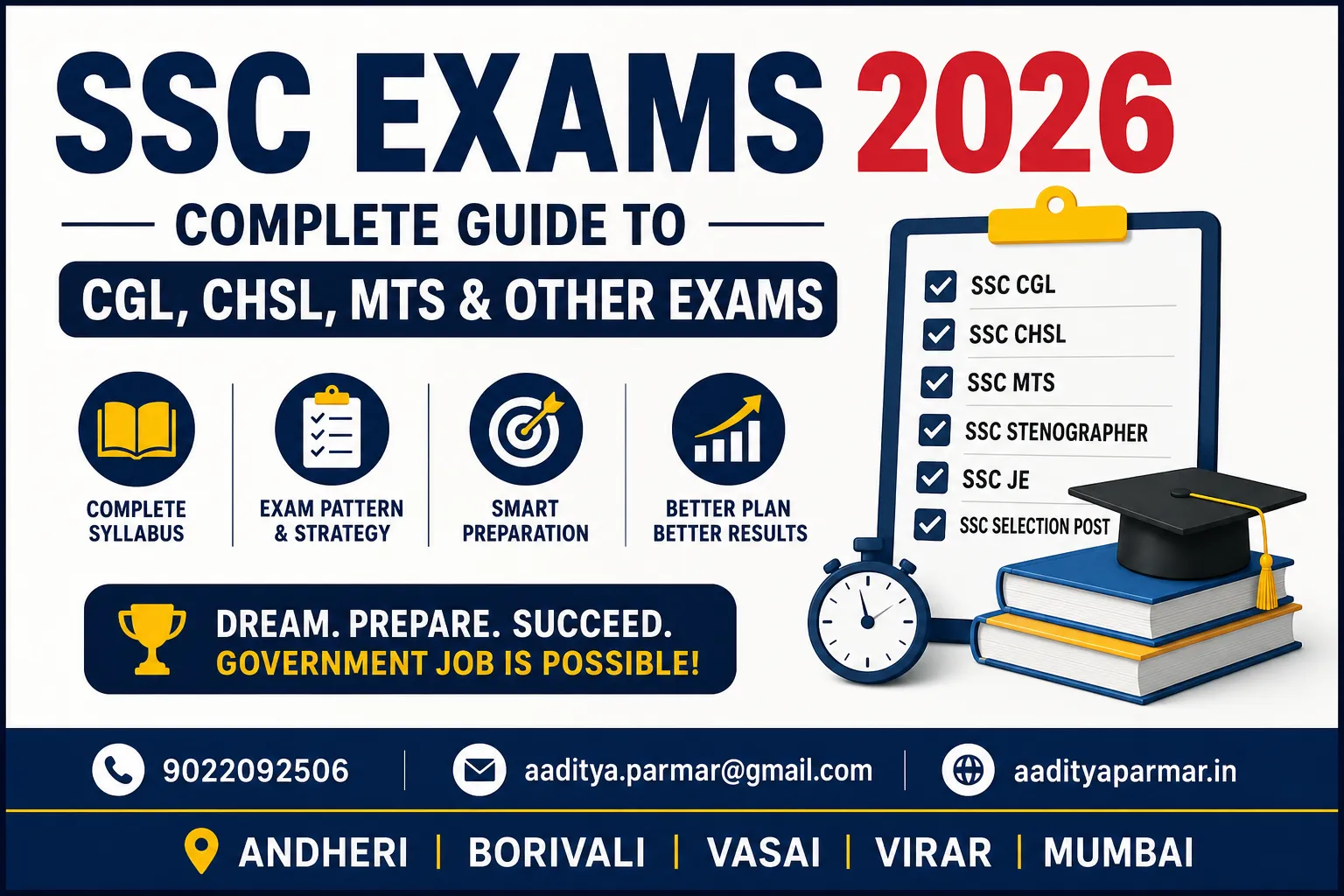
SSC Exams 2026: Complete Guide to SSC CGL, CHSL, MTS & Other Exams
Last updated: Reviewed by our Senior SEO & Government Exam Content Team | Reading time: ~18 minutes

If you have been dreaming of a stable central government job, then SSC Exams 2026: Complete Guide to SSC CGL, CHSL, MTS & Other Exams is exactly the roadmap you have been searching for. Every year, the Staff Selection Commission (SSC) opens doors to thousands of Group B and Group C posts for graduates, 12th-pass candidates and even 10th-pass aspirants — and 2026 is going to be one of the biggest recruitment cycles in recent memory.
In this guide, you will learn exactly what SSC Exams 2026 are, who can apply, what the syllabus and exam pattern look like, how the selection process works, what salary and job growth you can expect, and — most importantly — the step-by-step preparation strategy that toppers actually follow. You will also find a detailed comparison table, common mistakes, expert tips, recommended tools, troubleshooting fixes and a big round of FAQs.
Whether you are a first-time aspirant or someone who has already appeared once and missed the cut-off, this SSC Exams 2026: Complete Guide to SSC CGL, CHSL, MTS & Other Exams will help you plan smarter. You can also explore our related deep dives on SSC CGL 2026 notification details, SSC CHSL 2026 exam guide, and SSC MTS 2026 preparation guide as you go along.
Summary
SSC Exams 2026 are recruitment exams conducted by the Staff Selection Commission for central government posts across ministries, departments and offices in India. The major exams are SSC CGL 2026 (graduate level), SSC CHSL 2026 (12th pass), SSC MTS 2026 (10th pass), SSC CPO 2026, SSC GD Constable 2026, SSC Stenographer 2026 and SSC JE 2026. Most exams follow a computer-based multi-tier pattern with negative marking, followed by skill tests, physical tests or document verification. Preparation requires 8–12 months of consistent study, concept clarity in Quantitative Aptitude, Reasoning, English and General Awareness, plus disciplined mock test analysis.
Key Takeaways
- SSC Exams 2026 cover both graduate-level and non-graduate-level central government jobs in a single recruitment ecosystem.
- SSC CGL 2026 is the highest-paying and most competitive exam, requiring graduation and offering Pay Levels 4 to 8.
- SSC CHSL 2026 needs only Class 12 and is the fastest route to a central government desk job.
- SSC MTS 2026 and SSC GD Constable 2026 are beginner-friendly entry points with a 10th-pass eligibility.
- All major SSC exams share a large portion of common syllabus, so you can prepare for multiple exams simultaneously.
- Negative marking of 0.25 to 0.50 marks makes accuracy more valuable than raw attempt count.
- A structured 3-phase plan — concepts, practice, mock tests — outperforms random daily studying.
- Always confirm eligibility, age limits and dates from the official SSC portal and the SSC Exam Calendar 2026.
Table of Contents
- Summary
- Key Takeaways
- Introduction
- What Is the SSC Exams 2026: Complete Guide to SSC CGL, CHSL, MTS & Other Exams?
- Why SSC Exams 2026 Matter More Than Ever
- Benefits of Cracking SSC Exams 2026
- How SSC Exams 2026 Work: The Complete Selection Process
- Step-by-Step Guide to Prepare for SSC Exams 2026
- Examples: Real Preparation Scenarios for SSC Exams 2026
- SSC Exams 2026 Comparison Table
- Common Mistakes to Avoid in SSC Exams 2026
- Expert Tips to Crack SSC Exams 2026
- Best Practices for SSC Exams 2026 Preparation
- Recommended Tools & Resources for SSC Exams 2026
- Troubleshooting: Common Problems & Fixes
- FAQs on SSC Exams 2026
- Conclusion
- Call to Action
Introduction
Every year, crores of Indian students prepare for government jobs. Among all the recruitment bodies, the Staff Selection Commission is the single largest gateway — it fills posts in almost every central ministry, from the Ministry of External Affairs to the Central Bureau of Investigation, from the Income Tax Department to the Railway Board.
Now imagine this: you are 22, you have just finished graduation, and you are staring at a screen full of exam names — CGL, CHSL, MTS, CPO, GD, Steno, JE, Selection Post. Which one should you pick? What is the syllabus? How many months do you need? What if you fail?
That confusion is exactly what this SSC Exams 2026: Complete Guide to SSC CGL, CHSL, MTS & Other Exams solves. Instead of scattered information, YouTube tabs and WhatsApp forwards, you get one structured, trustable reference that answers your questions in plain English.
By the end of this article, you will have a clear 12-month roadmap, a realistic idea of the competition, and a set of tools and habits that put you ahead of lakhs of other aspirants. Let us begin.
What Is the SSC Exams 2026: Complete Guide to SSC CGL, CHSL, MTS & Other Exams?
The SSC Exams 2026 are a set of competitive recruitment examinations conducted by the Staff Selection Commission, a constitutional body under the Government of India’s Department of Personnel and Training. These exams fill Group B (non-gazetted) and Group C posts in central government departments across the country.
In simple words, if you want a central government job without appearing for UPSC-level exams, SSC is your fastest and most reliable route.
Major SSC Exams 2026 at a Glance
- SSC CGL 2026 (Combined Graduate Level) — Graduate-level posts such as Assistant Section Officer, Inspector, Audit Assistant, Income Tax Inspector, and Excise Inspector. Read the full SSC CGL 2026 notification guide.
- SSC CHSL 2026 (Combined Higher Secondary Level) — 12th-pass posts such as LDC, DEO and Postal Assistant. See our SSC CHSL 2026 complete guide.
- SSC MTS 2026 (Multi Tasking Staff) — 10th-pass Group C posts in ministries and departments. Read the SSC MTS 2026 exam guide.
- SSC CPO 2026 (Central Police Organisation) — Sub-Inspector roles in Delhi Police and CAPFs. Explore the SSC CPO 2026 guide.
- SSC GD Constable 2026 — Constable posts in BSF, CISF, CRPF, SSB, ITBP and Assam Rifles. See the SSC GD Constable 2026 preparation page.
- SSC Stenographer 2026 — Grade C and Grade D stenographer posts requiring steno skills. Check the SSC Stenographer 2026 guide.
- SSC JE 2026 (Junior Engineer) — Engineering posts in Civil, Electrical and Mechanical streams. Read the SSC JE 2026 guide.
- SSC Selection Post 2026 — Region-wise recruitment for state-specific posts. See SSC Selection Post guide.
Eligibility at a Glance for SSC Exams 2026
- Nationality: Indian citizen (with specific relaxations for certain categories in some exams).
- Educational qualification: Varies from Class 10 (MTS, GD) to Graduation (CGL, CPO).
- Age limit: Generally 18–32 years, varying by exam and post. Check our detailed SSC 2026 age limit & eligibility page.
- Number of attempts: No fixed limit; eligibility depends on age and qualification.
- Age relaxation: Available for SC, ST, OBC, PwBD, Ex-servicemen and other reserved categories as per government norms.
Why SSC Exams 2026 Matter More Than Ever
You might wonder: with private tech jobs paying high salaries, why should SSC Exams 2026 still matter? Here is why millions of aspirants still choose this path.
- Job security in an uncertain economy: Central government jobs offer unmatched stability, pensions and protection against layoffs.
- Massive vacancy volumes: SSC consistently recruits in lakhs across CGL, CHSL, MTS and GD Constable.
- Fair, transparent selection: Computer-based tests with published answer keys and result PDFs reduce manipulation.
- Pan-India posting: You can serve in any state or city based on your rank and preference.
- Balanced work-life: Fixed working hours, holidays and medical benefits make SSC jobs sustainable long term.
- Social respect and growth: Posts like Inspector, Assistant Section Officer and Sub-Inspector carry authority and clear promotion ladders.
- Multiple chances in one year: Because the syllabus overlaps, one preparation covers CGL, CHSL, MTS, CPO and more.
If you want to compare SSC with other career tracks, read our comparison: SSC CGL vs Banking Exams — which is better for you?
Benefits of Cracking SSC Exams 2026
1. Attractive Salary and Allowances
- Pay Level 4 (MTS, DEO, LDC equivalent): basic pay around Rs 25,500.
- Pay Level 5 (CHSL LDC, Postal Assistant): basic pay around Rs 29,200.
- Pay Level 6 (Inspector, Sub-Inspector equivalent): basic pay around Rs 35,400.
- Pay Level 7 (Assistant Section Officer, CHSL DEO): basic pay around Rs 44,900.
- Pay Level 8 (CGL ASO in CSS, MEA): basic pay around Rs 47,600.
These are basic pay figures — add DA, HRA, TA, special allowances, NPS contributions and medical benefits, and your actual in-hand salary is significantly higher. Read our full breakdown in SSC CGL 2026 salary & job profile guide.
2. Career Growth and Promotion
Government service offers structured promotions through MACP, departmental exams and internal promotions. You can move from Clerk to Section Officer to Under Secretary over time.
3. Work-Life Balance and Benefits
- Fixed office hours, weekends and gazetted holidays.
- CGHS medical facilities for you and your dependents.
- Home town / state preference opportunities in many departments.
- Study leave, LTC and children’s education allowances in several departments.
4. Personal Growth
Preparing for SSC Exams 2026 builds discipline, quantitative skills, language command, general awareness and measurable confidence — assets that help you even beyond the exam.
How SSC Exams 2026 Work: The Complete Selection Process
The SSC selection process generally follows a multi-stage structure. While the exact number of stages differs by exam, the logic remains the same: screen millions through computer-based tests, then verify skills and documents.
Stage 1: Notification Release
- SSC publishes the official notification with vacancies, eligibility, dates and syllabus.
- Check the SSC Exam Calendar 2026 to plan ahead.
Stage 2: Online Application
- Complete One Time Registration (OTR) on the official SSC portal.
- Fill the application form, upload documents and pay the fee online.
- Follow our SSC 2026 application process step-by-step guide.
Stage 3: Computer-Based Tier 1 / Paper 1
- Objective multiple-choice questions on Quantitative Aptitude, Reasoning, English and General Awareness.
- Duration usually 60 minutes with sectional timing in several exams.
- Negative marking of 0.25 to 0.50 marks per wrong answer.
Stage 4: Tier 2 / Paper 2 (Where Applicable)
- Deeper modules in Mathematics, Reasoning, English, General Awareness and Computer Knowledge.
- SSC CGL Tier 2 includes a Data Entry Speed Test (DEST) for specific posts. See our SSC CGL Tier 2 guide.
- SSC CHSL requires a typing test. Read the typing test preparation tips.
Stage 5: Skill Test / Physical Test
- Typing tests for CHSL, MTS and Stenographer.
- Physical Endurance Test (PET) and Physical Standard Test (PST) for CPO and GD Constable.
- Computer Proficiency Test (CPT) for selected CGL posts. See the SSC CGL skill test guide.
Stage 6: Document Verification
- Original certificates are verified against your application data.
- Read the complete SSC document verification checklist.
Stage 7: Medical Examination and Final Merit
- Medical fitness is checked as per post requirements.
- Final merit list is prepared based on Tier 1 and Tier 2 scores.
Stage 8: Post Allocation and Joining
- You fill post and department preferences; allocation depends on merit and availability.
- Read our SSC CGL post preference strategy guide.
Step-by-Step Guide to Prepare for SSC Exams 2026
This is the heart of this SSC Exams 2026: Complete Guide to SSC CGL, CHSL, MTS & Other Exams. Follow these steps in order and you will never feel lost.
Step 1: Choose Your Target Exam (Week 1)
- If you are a graduate seeking a high-growth desk job, target SSC CGL 2026.
- If you have completed Class 12, target SSC CHSL 2026.
- If you have passed Class 10 or want a quick entry, target SSC MTS 2026 or SSC GD Constable 2026.
- If you are physically fit and want a uniformed role, target SSC CPO 2026 or SSC GD 2026.
- If you are an engineer, target SSC JE 2026.
Step 2: Understand the Syllabus and Exam Pattern (Week 1–2)
- Download the official syllabus PDF for your exam.
- Break the syllabus into high-weight and low-weight topics.
- Read our detailed SSC CGL 2026 syllabus breakdown and exam pattern analysis.
Step 3: Collect the Right Study Material (Week 2)
- One standard book per subject — do not hoard.
- A previous year question bank covering at least the last 8–10 years.
- A reliable mock test series with performance analytics.
- See the best SSC CGL 2026 books list.
Step 4: Build a Realistic Daily Timetable (Week 2)
- 3–4 hours daily for working professionals; 6–8 hours for full-time aspirants.
- Split time as: 40% Quantitative Aptitude, 25% Reasoning, 20% English, 15% General Awareness for CGL aspirants.
- Fix your most productive hours for your weakest subject.
- Follow a ready-made SSC CGL 2026 study plan.
Step 5: Master Concepts Before Speed (Months 1–3)
- Quantitative Aptitude: number system, percentage, ratio, time-speed-distance, geometry, trigonometry, algebra, mensuration, data interpretation. See quantitative aptitude tips.
- Reasoning: series, coding-decoding, syllogism, blood relations, directions, non-verbal reasoning. Read reasoning preparation tips.
- English: grammar rules, error spotting, vocabulary, cloze test, reading comprehension. See English preparation tips.
- General Awareness: static GK, history, geography, polity, economics, science, current affairs. Read general awareness tips.
Step 6: Practice Sectional Tests (Months 4–6)
- Attempt 40–60 questions per section daily.
- Track accuracy, average time per question and repeat mistakes.
- Maintain a mistake notebook — this single habit can add 10–15 marks.
Step 7: Start Full-Length Mocks (Months 7–9)
- Take two full-length mock tests per week.
- Analyse each mock for at least 60 minutes — analysis matters more than the score.
- Use the best mock test strategy for SSC CGL 2026.
Step 8: Revise Relentlessly (Months 9–11)
- Revise formulas, vocabulary lists and static GK weekly.
- Solve previous year question papers under timed conditions.
- Keep a single revision notebook for the last 30 days.
Step 9: Prepare for Skill and Physical Tests in Parallel
- Practice typing at 35–40 words per minute for CHSL and MTS.
- For CPO and GD, run 1.6 km daily and work on stamina.
- Practice basic computer operations for CPT.
Step 10: Manage the Exam Day
- Reach the centre early with your admit card and ID proof.
- Attempt easy questions first; do not get stuck.
- Guess only when you can eliminate two options. Read SSC exam day tips.
Examples: Real Preparation Scenarios for SSC Exams 2026
Example 1: The Final-Year Student
Riya is in her final year of B.Com. She starts preparing in June, studies 4 hours daily, and targets both SSC CGL 2026 and SSC CHSL 2026 because the syllabus overlaps. She completes concepts by December, takes 60 mocks by May, and clears CHSL Tier 1 in her first attempt.
Example 2: The Working Professional
Arjun works in a private company from 9 to 6. He studies 3 hours on weekdays and 6 hours on weekends. He focuses on Reasoning and English first because they need less daily volume, then builds Quant through 20 questions per day. In 10 months, he reaches a CGL Tier 1 score of 148.
Example 3: The Repeater Who Fixes Accuracy
Neha scored 132 in her first CGL attempt but missed the cut-off. On analysis, she realised 18 marks were lost to negative marking. She reduces blind guesses, improves accuracy from 78% to 93%, and adds 22 marks in the next attempt.
Example 4: The 10th-Pass Aspirant
Rohit clears SSC MTS 2026 by focusing only on Maths, Reasoning, English and basic GK, plus a 30 WPM typing speed. Because MTS competition is lower than CGL, his targeted 5-month plan works.
SSC Exams 2026 Comparison Table
Use this table to quickly compare the major SSC Exams 2026 and decide which one fits your profile.
| Exam | Minimum Qualification | Age Limit (General) | Typical Pay Level | Extra Stage | Best For |
|---|---|---|---|---|---|
| SSC CGL 2026 | Graduation | 18–32 years | Level 4 to 8 | CPT / DEST | Graduates targeting high salary and growth |
| SSC CHSL 2026 | Class 12 pass | 18–27 years | Level 2 to 7 | Typing Test | 12th-pass candidates wanting fast entry |
| SSC MTS 2026 | Class 10 pass | 18–25 years | Level 1 | Typing Test | Beginners and quick short-term goals |
| SSC CPO 2026 | Graduation | 20–25 years | Level 4 / 6 | PET + PST + Medical | Fitness-focused candidates |
| SSC GD Constable 2026 | Class 10 pass | 18–23 years | Level 3 | PET + PST + Medical | Uniformed services aspirants |
| SSC Stenographer 2026 | Class 12 pass | 18–30 years | Level 4 / 6 | Steno Skill Test | Candidates with shorthand skills |
| SSC JE 2026 | Engineering Diploma / Degree | 18–32 years | Level 6 | Paper 2 (Technical) | Civil, Electrical, Mechanical engineers |
Note: Age limits, pay levels and stage requirements can change with each notification. Always verify from the official notification and our SSC eligibility criteria 2026 page.
Typical Tier 1 Exam Pattern for SSC Exams 2026
| Section | Questions (CGL/CHSL) | Marks | Focus Area |
|---|---|---|---|
| General Intelligence & Reasoning | 25 | 50 | Logic, patterns, series |
| General Awareness | 25 | 50 | Static GK + current affairs |
| Quantitative Aptitude | 25 | 50 | Arithmetic + advanced maths |
| English Language | 25 | 50 | Grammar + vocabulary |
| Total | 100 | 200 | 60 minutes (no negative rule change) |
Want an exam-by-exam pattern breakdown? Read our SSC CGL 2026 exam pattern and SSC CHSL 2026 guide.
Common Mistakes to Avoid in SSC Exams 2026
- Collecting too many books: Ten half-read books are worse than one completely revised book.
- Skipping mock test analysis: The analysis teaches more than the test itself.
- Ignoring General Awareness: This section is scoring but is usually postponed until the last month.
- Blind guessing: With 0.25–0.50 negative marking, random guesses destroy hard-earned marks.
- Not reading the official notification: Students miss age limits, post-specific requirements and document details.
- Starting typing practice late: CHSL and MTS aspirants often clear Tier 1 but fail the typing test.
- Neglecting health and sleep: Burnout in the last two months is one of the biggest silent killers of SSC dreams.
- Comparing yourself to others online: Social media speed runs create false panic and poor decisions.
- Applying to the wrong exam for your eligibility: Double-check your degree, age and category before paying the fee.
- Missing deadlines: SSC does not reopen applications. Set reminders for every last date and fee payment window.
Expert Tips to Crack SSC Exams 2026
- Build one common syllabus: Prepare Quant, Reasoning, English and GK once, then adapt to CGL, CHSL and MTS patterns.
- Follow the 70/30 rule: Spend 70% of your time on practice and 30% on learning new concepts.
- Prioritise high-weight topics: In Quant, arithmetic and geometry dominate. In English, grammar and vocabulary dominate. In GK, static plus last 8 months of current affairs dominate.
- Create a mistake notebook: Every wrong question gets a one-line reason. Revise it weekly.
- Simulate exam conditions: Take mocks at the same time of day as your actual shift.
- Target accuracy above 90%: Speed without accuracy causes negative marking losses.
- Use spaced revision: Revise a topic after 1 day, 7 days, 30 days and 90 days. Read SSC CGL 2026 preparation strategy.
- Track current affairs monthly: Follow our SSC current affairs 2026 compilation.
- Build a supportive routine: Fixed sleep, light exercise and 10 minutes of mindfulness improve recall during exams.
- Prepare for AI-era study habits: Use AI tools to generate practice questions and to explain concepts, but always verify facts from official sources before memorising them.
- Study your weakest section first: Most aspirants fail in Quant or English, not in their strengths.
- Do not skip the last 30 days: These are for revision, not new topics.
Best Practices for SSC Exams 2026 Preparation
- Set weekly targets, not daily wishes. Convert the syllabus into measurable weekly outcomes.
- Use the official source for everything official. Notifications, corrigendums, answer keys and result PDFs come from ssc.gov.in.
- Maintain one primary resource per subject. Zero duplication of study material.
- Write and solve on paper. Typing answers on a screen hides calculation and grammar weaknesses.
- Track three metrics in every mock: score, accuracy percentage and time per section.
- Keep a one-page formula sheet for Quant and one-page vocabulary sheet for English.
- Join a peer group of serious aspirants. Avoid comparison; use it for doubt-solving only.
- Plan for exam-day logistics — centre location, travel, admit card and ID proof.
- Prepare documents early. Keep your document verification checklist ready months in advance.
- Review your strategy every 30 days and adjust based on mock data, not emotions.
Recommended Tools & Resources for SSC Exams 2026
- Official SSC portal: ssc.gov.in — notifications, admit cards, answer keys and results.
- Mock test platforms: Choose a series with question-level analytics. Read our mock test selection guide.
- Previous year papers: Solve 8–10 years of papers exam-wise. See previous year paper strategy.
- Typing practice tools: Use online typing tutors daily; track WPM and accuracy. Read the typing test guide.
- Current affairs apps and monthly PDFs: Follow our monthly current affairs digest.
- Standard books: One book per subject from the recommended books list.
- Note-taking apps: Use simple digital notes for revision, but keep handwritten formula sheets too.
- AI study assistants: Useful for doubt-solving, generating practice questions and summarising topics — always cross-check facts.
- Timers and habit trackers: Track daily study hours, sleep and revision streaks.
- Coaching (optional): Compare online coaching options in our best online SSC coaching guide.
Troubleshooting: Common Problems & Fixes
Problem 1: “My mock scores are stuck between 110 and 125.”
- Identify your two weakest topics and spend 60% of your next 30 days on them.
- Reduce attempts slightly and improve accuracy above 90%.
- Take sectional mocks daily to fix micro-level speed issues.
Problem 2: “I run out of time in Quantitative Aptitude.”
- Learn shortcut techniques for percentages, ratios and averages.
- Attempt 20 easy questions first; return to difficult ones later.
- Practise 25 questions in 20 minutes, three times a week.
Problem 3: “I forget General Awareness immediately.”
- Use spaced repetition instead of one-time reading.
- Make short one-line notes and revise weekly.
- Prioritise static topics that repeat every year.
Problem 4: “I cannot type 35 WPM.”
- Practise 20 minutes daily with a typing tutor.
- Focus on accuracy first; speed follows automatically.
- Use the correct finger positioning rather than looking at the keyboard.
Problem 5: “I feel burned out and demotivated.”
- Reduce daily hours for one week and rebuild gently.
- Take one full rest day weekly.
- Reconnect with your “why” — read success stories of aspirants who cracked SSC exams in the first attempt.
Problem 6: “My application form shows an error or the fee was deducted twice.”
- Wait 24–48 hours for the payment gateway to reconcile.
- Raise a grievance ticket on the official SSC portal with your registration number.
- Keep screenshots of the transaction and acknowledgment page.
Problem 7: “I got a low score because of negative marking.”
- Adopt a strict rule: guess only when you eliminate two options.
- Track negative marks separately in each mock.
- Target zero to eight wrong answers per section.
FAQs on SSC Exams 2026
1. What are SSC Exams 2026?
SSC Exams 2026 are recruitment examinations conducted by the Staff Selection Commission to fill Group B and Group C posts in central government ministries, departments and offices. Major exams include SSC CGL, CHSL, MTS, CPO, GD Constable, Stenographer, JE and Selection Post 2026.
2. What is the age limit for SSC Exams 2026?
Age limits vary by exam. SSC CGL generally allows 18–32 years, SSC CHSL 18–27 years, SSC MTS 18–25 years, SSC CPO 20–25 years and SSC GD Constable 18–23 years. Reserved categories get relaxation as per government rules. Verify exact dates in the official notification.
3. Is graduation required for SSC CGL 2026?
Yes. A bachelor’s degree in any discipline from a recognised university is required for SSC CGL 2026. There is no minimum percentage requirement.
4. Can I prepare for SSC CGL, CHSL and MTS together in 2026?
Absolutely. These exams share almost identical syllabi for Quant, Reasoning, English and General Awareness. Build one core syllabus, then add exam-specific skills such as typing tests for CHSL and MTS.
5. How many attempts are allowed in SSC Exams 2026?
There is no fixed attempt limit for most SSC Exams 2026. You can appear as many times as you want until you cross the prescribed age limit.
6. What is the salary of an SSC CGL officer in 2026?
Salaries range from approximately Rs 35,000 to Rs 1,00,000+ per month depending on post, pay level and city. Pay Level 8 posts like Assistant Section Officer start at a higher basic pay than Pay Level 4 posts. See our SSC CGL salary guide.
7. Is there negative marking in SSC Exams 2026?
Yes. Most SSC papers apply a penalty of 0.25 marks per wrong answer in Tier 1 and 0.50 marks in Tier 2. Accuracy is therefore more important than maximum attempts.
8. What is the best time to start preparing for SSC Exams 2026?
Ideally 8 to 12 months before your target exam. Beginners should spend 3 months on concepts, 4 months on sectional practice and the final 3–5 months on mock tests and revision.
9. Which SSC exam is easiest for beginners?
SSC MTS and SSC GD Constable are generally considered easier for beginners due to basic syllabus, lower cut-offs and achievable skill or physical requirements. Explore the SSC MTS 2026 guide and SSC GD 2026 guide.
10. How do I apply for SSC Exams 2026?
Apply online via the official SSC portal. Complete One Time Registration (OTR), fill the application form, upload your photo and signature, pay the fee and download the confirmation page. See our application process guide.
11. Does SSC CGL 2026 have an interview?
No traditional interview. However, certain posts such as Assistant Section Officer in CSS, MEA and IB require a Computer Proficiency Test and Document Verification.
12. How many vacancies are expected in SSC Exams 2026?
Lakhs of vacancies are expected across CGL, CHSL, MTS, GD Constable and other exams. Exact numbers are published in each official notification.
13. Can final year students apply for SSC Exams 2026?
Final year graduation students can apply provisionally for SSC CGL 2026 if they complete their degree before the cut-off date in the notification. Class 12 students can apply for CHSL within the allowed window.
14. What documents are needed for document verification?
Matriculation certificate, Class 12 certificates, graduation degree and marksheets, caste or category certificate, PwBD certificate if applicable, photographs, valid ID proof and the printed application form. Check the document verification checklist.
15. How can I score 150+ in SSC CGL Tier 1 2026?
Master high-weight topics, attempt 40–60 sectional questions daily, take two full-length mocks weekly, keep accuracy above 90% and eliminate blind guessing. Follow the SSC CGL 2026 preparation strategy.
16. Do SSC Exams 2026 have sectional timing?
Several SSC Tier 1 exams use section-wise timing, so you cannot shift time between sections. Practise with sectional timers to build discipline.
17. What is the difference between SSC CGL and SSC CHSL?
SSC CGL requires graduation and offers higher pay levels, while SSC CHSL requires only Class 12 and offers clerical and data entry posts. Read the full comparison: SSC CGL vs CHSL — which should you choose?
18. Can I prepare for SSC Exams 2026 without coaching?
Yes. With standard books, previous year papers and a good mock test series, self-study is completely workable. Read how to crack SSC exams without coaching.
19. What is the validity of SSC CGL 2026 results?
SSC results are generally valid for the recruitment cycle or until the next cycle’s results are declared, as specified in the notification. See SSC CGL 2026 result updates.
20. Which SSC exam gives the highest salary?
SSC CGL generally offers the highest salary among SSC exams due to Pay Level 7 and Level 8 posts such as Assistant Section Officer and Inspector.
Conclusion
The path to a central government job in 2026 is not about luck — it is about clarity, consistency and correct information. This SSC Exams 2026: Complete Guide to SSC CGL, CHSL, MTS & Other Exams has given you the full picture: what each exam offers, who is eligible, how the selection process works, what the syllabus demands, how to build a 12-month plan, which mistakes to avoid and which tools to use.
Remember these three truths:
- One syllabus, many exams. Your preparation for CGL also serves CHSL, MTS and CPO.
- Accuracy beats attempts. In an exam with negative marking, discipline wins.
- Consistency beats intensity. Three focused hours daily for 10 months outperforms 12-hour cramming for 30 days.
Start today, even if it is only one hour. One hour today becomes 300 hours in ten months — and 300 disciplined hours can change the entire direction of your career.
Call to Action
Ready to start your SSC Exams 2026 journey?
- 📌 Get the latest SSC CGL 2026 notification updates
- 📌 Download the SSC Exam Calendar 2026
- 📌 Follow the SSC CGL 2026 study plan
- 📌 Start with a free SSC mock test
Join our Telegram community for daily current affairs and free PDFs: Join the SSC 2026 aspirants group.
Save this guide, share it with a friend who is preparing, and comment below with your target SSC exam for 2026. We will reply with a personalised strategy. Your dream government job is closer than you think — take the first step today.