The Doctrine of Separation of Powers: A Primer for Law Aspirants
Summary
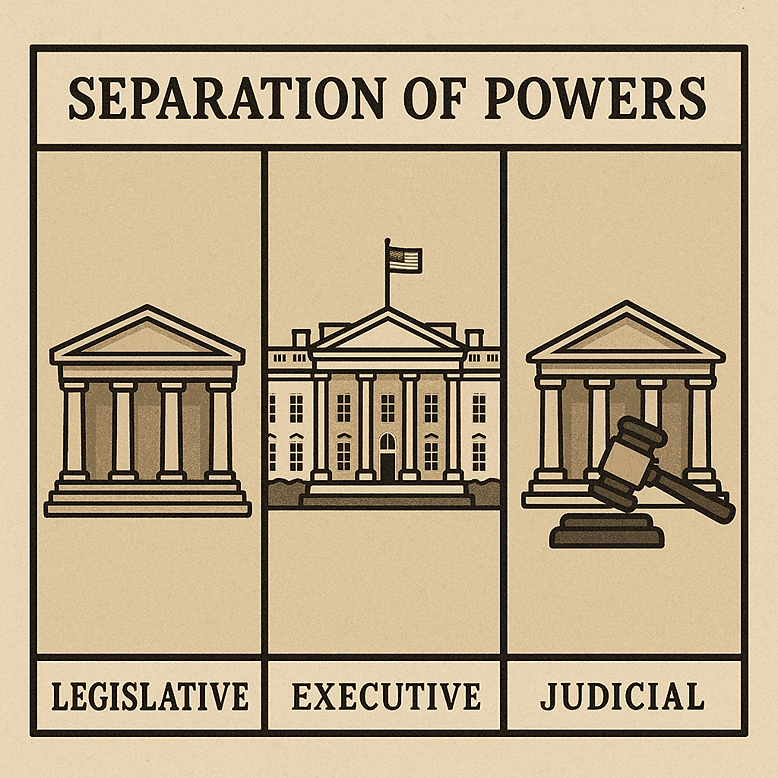
The doctrine of separation of powers divides the State into three organs — the legislature that makes law, the executive that implements law, and the judiciary that interprets law. Montesquieu gave the doctrine its classic form in The Spirit of the Laws (1748), arguing that liberty survives only when power checks power. India does not follow the doctrine rigidly; as the Supreme Court held in Ram Jawaya Kapur v. State of Punjab (1955), the functions of the organs are sufficiently differentiated but not watertight. The doctrine survives in India through Article 50, the basic structure theory, judicial review, and continuing battles over tribunals, judicial appointments, ordinances and judicial overreach.
Key Takeaways
- Three organs, three functions: legislature makes, executive implements, judiciary adjudicates.
- Montesquieu is the modern father of the doctrine; Aristotle and Locke offered earlier versions.
- India follows a flexible model, not an absolute separation — see Ram Jawaya Kapur (1955).
- Article 50 directs separation of the judiciary from the executive in public services.
- Separation of powers is part of the basic structure, per Indira Nehru Gandhi v. Raj Narain (1975).
- Checks and balances are the doctrine’s working partner — not its contradiction.
- Tribunalisation, ordinances, delegated legislation and judicial activism are the four pressure points modern exams love to test.
- Your answer structure: definition → theory → constitutional provisions → case law → criticism → conclusion.
Introduction
Imagine a country where the same body writes the law, enforces the law and then decides whether the law was broken. In that country, you would never get a fair hearing. This is precisely the danger that The Doctrine of Separation of Powers: A Primer for Law Aspirants prepares you to analyse — and it is why the doctrine sits at the very heart of every constitutional law syllabus you will ever study.
The doctrine holds that governmental power should be divided among three distinct organs: the legislature, the executive and the judiciary. Each organ must perform its own function, and each must be able to restrain the others. Montesquieu captured the idea in one famous line: when legislative and executive power are united in the same person, “there can be no liberty.”
If you are preparing for CLAT, UPSC Civil Services, a State Judicial Services Examination, or simply trying to understand how the Constitution of India actually functions, this primer is built for you. You will learn the theory, the constitutional provisions, the landmark judgments, the criticisms, and — most importantly — how to convert all of it into marks.
By the end of this guide, you will be able to define the doctrine, distinguish it from checks and balances, place India correctly on the strict-to-flexible spectrum, and handle the four favourite exam traps: tribunals, ordinances, delegated legislation and judicial overreach.
What Is the Doctrine of Separation of Powers?
The doctrine of separation of powers is the constitutional principle that the three functions of government — legislation, execution and adjudication — should be exercised by three separate organs, each independent of the others within its own sphere.
The Classical Definition
Baron de Montesquieu, in De l’esprit des lois (The Spirit of the Laws, 1748), argued that political liberty is preserved only when power is made to check power. He identified three powers:
- Legislative power — the power to make laws and amend them.
- Executive power — the power to enforce laws and conduct foreign affairs.
- Judicial power — the power to punish crimes and settle disputes between individuals.
His conclusion was uncompromising: where these powers are fused, “everything would be lost.” This three-part framework is often called the Trias Politica.
Earlier Foundations
- Aristotle (Politics) identified three elements in every constitution: the deliberative, the executive and the judicial.
- John Locke (Second Treatise of Government, 1690) distinguished legislative, executive and “federative” power, but placed the legislature supreme.
- Montesquieu transformed these ideas into a prescriptive doctrine of institutional separation.
Separation of Powers Under the Indian Constitution
The Indian Constitution does not use the phrase “separation of powers” anywhere in its text. Yet the structure of the document clearly reflects the doctrine:
- Article 50 — the State shall take steps to separate the judiciary from the executive in the public services.
- Article 53(1) — the executive power of the Union is vested in the President, exercised by him directly or through officers subordinate to him.
- Articles 121 and 211 — no discussion in Parliament or a State legislature on the conduct of Supreme Court or High Court judges, except on a motion for removal.
- Articles 122 and 212 — the validity of the proceedings of Parliament or a State legislature cannot be questioned in any court.
- Articles 245–246 and the Seventh Schedule — distribution of legislative competence between the Union and the States.
- Articles 124 and 214 — establishment of the Supreme Court and High Courts as independent constitutional courts.
- Articles 32 and 226 — writ jurisdiction, the engine of judicial review.
- Article 361 — immunities available to the President and Governors in respect of official acts.
What the Supreme Court Has Said
In Ram Jawaya Kapur v. State of Punjab (AIR 1955 SC 549), Chief Justice Mukherjea observed that the Indian Constitution “has not indeed recognised the doctrine of separation of powers in its absolute rigidity, but the functions of the different parts or organs of the Government have been sufficiently differentiated.” That single sentence is your most reliable exam anchor.
Later, in Indira Nehru Gandhi v. Raj Narain (1975), the Supreme Court treated separation of powers as a component of the basic structure doctrine when it struck down Article 329A, which had removed judicial scrutiny of the election dispute.
In Asif Hameed v. State of Jammu & Kashmir (1989), the Court warned each organ to confine itself to its own sphere and not “encroach” upon another’s.
Why the Doctrine of Separation of Powers Matters
You will encounter the doctrine of separation of powers in almost every constitutional debate in your lifetime — from how judges are appointed to whether a tribunal should decide service disputes. Here is why it matters to you as a law aspirant.
- It protects liberty. Concentration of power is the seed of tyranny; separation is the fence around your fundamental rights.
- It underpins judicial review. Courts can strike down unconstitutional legislation only because they are institutionally distinct from the legislature. See our guide to judicial review in India.
- It explains the basic structure. Without separation of powers, the basic structure doctrine would have no teeth against constitutional amendments.
- It frames tribunalisation. Cases such as Madras Bar Association v. Union of India turn on whether tribunals dilute judicial independence.
- It structures the exam syllabus. Polity, constitutional law, administrative law and constitutional history all rely on this doctrine.
- It sharpens your argument. Any question about ordinances, delegated legislation or contempt becomes easier once you apply the three-function lens.
Consider the counterfactual. If Parliament could also try offences, then a minister facing a corruption charge would be judged by the very body that makes the law and controls the executive. If the executive could interpret its own powers conclusively, then every excess would become lawful by definition. The doctrine exists to prevent both outcomes.
Benefits of the Doctrine of Separation of Powers
When the doctrine of separation of powers functions properly, you feel its benefits as a citizen before you read about them in a textbook.
- Prevents tyranny. No single organ can monopolise State power.
- Preserves individual liberty. Rights are adjudicated by an independent judge, not by the prosecutor.
- Improves efficiency through specialisation. Lawmakers legislate, administrators administer, judges adjudicate.
- Guarantees impartial adjudication. A judiciary structurally insulated from the executive can decide against the government.
- Creates accountability. Each organ can be questioned by another — questions in the legislature, judicial review of executive action, executive implementation of judicial orders.
- Protects the rule of law. See our explainer on the rule of law for how the two ideas interlock.
- Strengthens federalism. Vertical separation between Union and State complements the horizontal separation among organs.
- Builds public trust. Citizens accept decisions more readily when the decision-maker is not judging their own cause.
How the Doctrine of Separation of Powers Works
Think of the doctrine as operating on two levels: vertical allocation (which organ does what) and horizontal control (how each organ restrains the others).
Level 1: Allocation of Functions
- Legislature — enacts law, approves budgets, ratifies emergency proclamations, holds the executive accountable through questions, motions and committees. See parliamentary system of government.
- Executive — implements statutes, formulates policy, conducts foreign affairs, commands the armed forces, issues subordinate legislation.
- Judiciary — interprets the Constitution and statutes, adjudicates disputes, reviews executive and legislative action, issues writs under Articles 32 and 226.
Level 2: Checks and Balances
Pure separation without interaction would produce paralysis. That is why modern constitutions add checks and balances:
- The legislature can impeach judges, alter the jurisdiction of courts, and pass laws overriding executive policy.
- The executive can veto legislation (Article 111), promulgate ordinances (Article 123), and grant pardons (Articles 72 and 161).
- The judiciary can strike down unconstitutional statutes, quash executive orders, and issue directions to the State.
Where the Lines Blur in India
- Ordinances (Articles 123 and 213) — the executive legislates, subject to legislative approval.
- Delegated legislation — the legislature hands rule-making power to the executive, monitored by the Committee on Subordinate Legislation.
- Tribunals (Articles 323A and 323B) — adjudicatory functions shift to bodies under executive control in matters of appointment and administration.
- Advisory jurisdiction (Article 143) — the executive asks the judiciary for an opinion.
- Collegium and NJAC — judicial appointments became a battleground between the judiciary and the executive; the NJAC was struck down in 2015.
- Article 142 — the Supreme Court’s power to do “complete justice” has been used in ways that look legislative.
This is why the correct exam formulation is: India follows a functional, flexible separation of powers moderated by checks and balances, not an absolute or rigid separation.
Step-by-Step Guide: How to Study the Doctrine of Separation of Powers
Use this six-step method to convert a vague topic into a scoring one. You can complete it in a single study week.
-
Step 1 — Lock the definition
Write a 40-word definition in your own hand: the three organs, their three functions, and the purpose (prevention of tyranny and protection of liberty). This becomes the opening line of every answer you write.
-
Step 2 — Learn the theorists in order
Aristotle → Locke → Montesquieu. Attach one line to each. Examiners reward the ability to show the evolution of the idea, not just its final form.
-
Step 3 — Map the constitutional provisions
Create a one-page chart of Articles 50, 53, 121, 122, 124, 211, 212, 214, 245–246, 323A, 323B, 361. Group them under “legislature,” “executive” and “judiciary” so you can retrieve them under pressure.
-
Step 4 — Memorise five judgments, not fifty
Ram Jawaya Kapur (1955), Indira Nehru Gandhi (1975), Asif Hameed (1989), Madras Bar Association (2014/2021), and Rojer Mathew (2019) will cover almost every question.
-
Step 5 — Practise the comparison
Reproduce the India–USA–UK comparison table from memory. Comparative framing is the fastest way to distinguish a top answer.
-
Step 6 — Write one full answer under timed conditions
Give yourself 20 minutes, follow the structure in the Best Practices section, and then self-evaluate against the Common Mistakes list.
Examples of the Doctrine of Separation of Powers in Action
Example 1: Judicial Review of Constitutional Amendments
In Kesavananda Bharati v. State of Kerala (1973), the Supreme Court held that Parliament’s amending power under Article 368 cannot destroy the basic structure. In I.R. Coelho v. State of Tamil Nadu (2007), the Court extended this to laws placed in the Ninth Schedule. Both decisions assert the judiciary’s distinct role as interpreter of the Constitution.
Example 2: Struck-Down Tribunal Rules
In Rojer Mathew v. South Indian Bank Ltd. (2019), the Supreme Court invalidated the Tribunal, Appellate Tribunal and other Authorities (Qualifications, Experience and other Conditions of Service of Members) Rules, 2017, because the executive had gained dominance over judicial appointments to tribunals — a dilution of the separation of powers.
Example 3: Presidential Proclamation and Judicial Scrutiny
In S.R. Bommai v. Union of India (1994), the Court held that a proclamation under Article 356 is subject to judicial review. The executive’s emergency power is therefore not absolute — a textbook illustration of checks and balances. Read more in our guide to emergency provisions of the Constitution.
Example 4: Courts Warned Against Executive Functions
In Divisional Manager, Aravali Golf Club v. Chander Hass (2008), the Supreme Court cautioned judges against assuming executive or legislative roles, noting that judicial restraint is essential to the doctrine.
Example 5: The United States — Marbury v. Madison (1803)
Chief Justice Marshall’s decision established judicial review in the United States: the courts may declare an Act of Congress void if it violates the Constitution. See our case analysis of Marbury v. Madison.
Example 6: The United States — Clinton v. City of New York (1998)
The Supreme Court struck down the Line Item Veto Act, 1996, because it gave the President the power to amend or cancel parts of duly enacted statutes — a legislative function.
Example 7: The United Kingdom — Fusion of Powers
The United Kingdom has no strict separation: the Prime Minister and ministers are members of Parliament, and the Lord Chancellor historically combined judicial, executive and legislative roles. Yet in R (Miller) v. Secretary of State for Exiting the European Union (2017), the Supreme Court affirmed that the executive cannot use prerogative power to displace an Act of Parliament.
Comparison Table: Separation of Powers in India, the USA and the UK
| Parameter | India | United States | United Kingdom |
|---|---|---|---|
| Model followed | Flexible, functional separation | Rigid, institutional separation | Fusion of powers |
| Head of State vs. Head of Government | President (nominal) and Prime Minister (real) | President is both | Monarch (nominal) and Prime Minister (real) |
| Executive accountability to legislature | Collective responsibility under Article 75(3) | Separate elections; no confidence motion unavailable | Strong; government survives on confidence |
| Judicial review of legislation | Yes, including amendments (basic structure) | Yes, since Marbury v. Madison (1803) | Limited, due to parliamentary sovereignty |
| Judges as legislators? | No, but writ and PIL jurisdiction is broad | No | Law Lords historically sat in the upper house |
| Express textual basis | Article 50 and structural provisions | Articles I, II and III of the US Constitution | No written constitution; constitutional conventions |
| Key doctrine | Basic structure + checks and balances | Strict separation + checks and balances | Parliamentary sovereignty + rule of law |
Alt text for accompanying image: “Infographic comparing the doctrine of separation of powers in India, the USA and the UK for law aspirants.”
Common Mistakes Law Aspirants Make
- Claiming India follows strict separation. The correct position, from Ram Jawaya Kapur, is flexible and functional separation.
- Confusing separation of powers with checks and balances. The first divides, the second restrains. Neither cancels the other.
- Ignoring Article 50. It is the only express textual nod to separating the judiciary from the executive.
- Treating the doctrine as a basic structure case only. You must also explain its functional, institutional and comparative dimensions.
- Over-quoting judgments. Five well-explained cases beat twenty name-drops.
- Forgetting the criticisms. A one-sided answer caps your marks at the “average” band.
- Skipping the conclusion. End with a balanced position: flexibility is a strength, but vigilance is necessary.
- Muddling Articles 121 and 122. Article 121 bars discussion on judges’ conduct; Article 122 bars courts from questioning parliamentary proceedings.
- Ignoring delegated legislation. This is where the doctrine is most frequently bent in practice.
- Writing without headings. In a 250-word answer, headings make your structure visible to the examiner.
Expert Tips from the Exam Hall
- Open with Montesquieu, close with India. That arc shows both theory and application.
- Use the “bent but not broken” formula. The doctrine in India is bent by ordinances, tribunals and PILs, but not broken because the basic structure protects it.
- Quote one line verbatim. Ram Jawaya Kapur‘s “not in absolute rigidity” is memorable and precise.
- Add a diagram. A simple triangle of legislature–executive–judiciary with arrows for checks earns presentation marks.
- Link to current affairs. Tribunal vacancies, collegium reforms and the NJAC debate all connect directly.
- Mention the counter-argument yourself. Acknowledging that rigid separation is impractical in a welfare state shows maturity.
- Use the phrase “functional differentiation.” It is the standard scholarly shorthand for India’s model.
- Practise comparative writing. One sentence on the USA or the UK immediately raises the quality of your answer.
Best Practices for a Scoring Answer on Separation of Powers
- Use a four-part structure: introduction and definition → constitutional provisions and case law → criticisms and current challenges → balanced conclusion.
- Use headings and sub-headings even in a short answer; examiners scan before they read.
- Define before you debate. Never criticise a doctrine you have not first explained.
- Integrate provisions and cases in the same paragraph rather than listing them separately.
- Keep case citations short and accurate. Name, year, and the single proposition it establishes.
- Include one normative line. For example: “The doctrine is not an end in itself; it is a means to protect liberty.”
- Revise using active recall. Close the book and reproduce the comparison table weekly.
- Write at least three full-length answers on this topic before your exam — one for a 10-mark, one for a 15-mark and one for a 250-word question.
Recommended Tools and Resources
Legal Research and Primary Sources
- India Code — the bare text of the Constitution and central statutes.
- Supreme Court of India judgments — the primary source for every case cited above.
- Indian Kanoon — free full-text case search.
- PRS Legislative Research — bill and parliamentary committee analysis.
Study and Revision Aids
- Standard textbooks: Introduction to the Constitution of India (Durga Das Basu) and Indian Constitutional Law (M.P. Jain).
- Current affairs trackers: Bar & Bench, LiveLaw and SCC Blog for tribunal and appointment updates.
- Note-taking: Notion or Obsidian for linked case cards.
- Spaced repetition: Anki decks for Articles and case names.
- Answer writing: a plain timer plus a scanned answer sheet to simulate exam conditions.
For Your Own Blog and SEO Work
- Google Keyword Planner and Google Trends to validate search demand.
- Ahrefs, Semrush or Ubersuggest for keyword difficulty and internal-link mapping.
- AnswerThePublic and “People Also Ask” mining for FAQ expansion — the same method used in the FAQ section below.
- Grammarly for clarity and readability scoring.
Troubleshooting the Trickiest Questions
“Is the doctrine of separation of powers part of the basic structure?”
Yes. Indira Nehru Gandhi v. Raj Narain (1975) treated it as part of the basic structure, and subsequent decisions have affirmed that the distribution of powers among the three organs cannot be destroyed by amendment. Pair this with Kesavananda Bharati and I.R. Coelho.
“Are tribunals a violation of separation of powers?”
Not inherently. Articles 323A and 323B expressly permit them. The problem arises when executive control over appointments, tenure and conditions of service compromises independence. That is why the Rules in Rojer Mathew were struck down and why the Madras Bar Association line of cases insists on judicial dominance in selection committees.
“How do ordinances fit in?”
Ordinances are executive legislation permitted by Articles 123 and 213 during a recess of the legislature, subject to mandatory approval within six weeks of reassembly. They are a deliberate, constitutionally sanctioned dilution of strict separation. The Supreme Court’s decision in Krishna Kumar Singh v. State of Bihar (2017) clarified that re-promulgation is a fraud on the Constitution.
“Is judicial activism consistent with the doctrine?”
Judicial activism becomes problematic when courts take over functions belonging to the legislature or executive. Aravali Golf Club and Asif Hameed warn against this. Judicial restraint, not abdication, is the doctrine-compliant middle path.
“Why is India’s model described as flexible?”
Because the executive is drawn from and accountable to the legislature, because the executive can legislate through ordinances, and because the legislature can alter court jurisdiction. The organs are functionally differentiated but institutionally interlinked.
“How is the doctrine applied in administrative law?”
Through the doctrine of ultra vires, the requirement of reasoned orders, the exclusion of bias, and the rules on delegated legislation. Explore this further in our guide to writ petitions and judicial control of administrative action.
FAQs on the Doctrine of Separation of Powers
1. What is the doctrine of separation of powers in simple words?
It means the three organs of government — legislature, executive and judiciary — should each perform only their own function, so that power never concentrates in one body.
2. Who propounded the doctrine of separation of powers?
Baron de Montesquieu in The Spirit of the Laws (1748). Aristotle and John Locke discussed earlier versions of the idea.
3. Does the Indian Constitution strictly follow the separation of powers?
No. In Ram Jawaya Kapur v. State of Punjab (1955), the Supreme Court held that the Constitution does not recognise the doctrine in absolute rigidity, though the functions of the organs are sufficiently differentiated.
4. Which Article of the Indian Constitution deals with separation of the judiciary from the executive?
Article 50, a Directive Principle of State Policy, directs the State to separate the judiciary from the executive in the public services.
5. Is separation of powers part of the basic structure of the Constitution?
Yes. Indira Nehru Gandhi v. Raj Narain (1975) treated it as part of the basic structure, and later decisions have reinforced it.
6. What is the difference between separation of powers and checks and balances?
Separation of powers divides functions among three organs; checks and balances allow each organ to limit the others — for example, judicial review of legislation or legislative approval of ordinances.
7. Which countries follow a strict separation of powers?
The United States comes closest. The United Kingdom follows a fusion of powers, and India follows a flexible, functionally differentiated model.
8. What are the main criticisms of the doctrine of separation of powers?
Critics say rigid separation is impossible in a modern welfare state, produces deadlock, ignores delegated legislation and tribunals, and reflects eighteenth-century political conditions.
9. How is the doctrine relevant for law aspirants preparing for CLAT or UPSC?
It appears in constitutional law papers, polity sections, essay writing, and interview discussions, and it underpins judicial review, the basic structure doctrine and administrative law.
10. What is the best way to memorise separation of powers for exams?
Learn the three organs, attach two or three constitutional provisions to each, pair each with one landmark judgment, and revise the comparison table weekly using active recall.
11. Can the Supreme Court perform legislative functions?
Not formally, but Article 142’s “complete justice” jurisdiction and detailed continuing mandamus orders can resemble legislation. This is often described as a functional dilution rather than a formal breach.
12. What is the role of Article 361 in separation of powers?
Article 361 grants the President and Governors immunity from court proceedings for official acts, protecting the executive from judicial interference during office — a limited, not absolute, insulation.
13. How does delegated legislation affect the doctrine?
Delegated legislation transfers rule-making power to the executive. It is permitted because legislatures cannot draft every detail, but it must remain within the parent statute and is subject to judicial review.
14. Is the doctrine of separation of powers mentioned in the Indian Constitution?
No. The phrase itself does not appear in the text. It is inferred from the structure of the Constitution and expressly reflected in Article 50 and other provisions.
15. Why is separation of powers important for protecting fundamental rights?
Because an independent judiciary is the only organ that can declare a law or executive action unconstitutional and restore your rights under Articles 32 and 226. Without separation, rights would depend on the goodwill of the very authority that violates them.
Conclusion
The doctrine of separation of powers is not a museum piece from eighteenth-century France. It is a living constitutional principle that decides whether a tribunal can hear your case, whether an ordinance survives, whether a constitutional amendment can be struck down, and whether power ultimately answers to law or to itself.
For you as a law aspirant, the doctrine is both a theory and a toolkit. Learn it as a triangle of three organs with three functions. Learn it as a set of articles — 50, 53, 121, 122, 124, 211, 212, 214, 245, 323A, 323B and 361. Learn it through five judgments that carry the whole argument on their shoulders. And finally, learn it as a question of balance: India’s genius lies not in rigid walls but in functional differentiation sustained by checks and balances.
When you can explain why the Indian model is flexible yet resilient, why tribunals and ordinances bend the doctrine without breaking it, and why the basic structure protects the separation of powers even against a determined parliamentary majority, you will have mastered the topic. And more than that — you will have understood how the Constitution keeps its promises to the citizen.
Call to Action
You have the theory. Now build the muscle memory. Download your free one-page Separation of Powers Revision Chart — covering the three organs, all relevant Articles, and five landmark judgments — and test yourself with our 30-question constitutional law quiz.
→ Download the free Separation of Powers Revision Chart
Then keep going:
- Read the next guide in this series: The Basic Structure Doctrine Explained for Law Aspirants.
- Master the enforcement side: Writ Petitions: A Complete Guide.
- Plan your preparation: CLAT Preparation Strategy and Judiciary Exam Guide.
Have a doubt or a question you want answered? Share it in the comments below — we answer every constitutional law query personally. And if this primer helped you, share it with one fellow aspirant who is struggling with the doctrine of separation of powers. Understanding this doctrine once will keep paying you dividends across every paper you write.
Your next step takes two minutes: bookmark this page, download the chart, and write your first timed answer tonight.