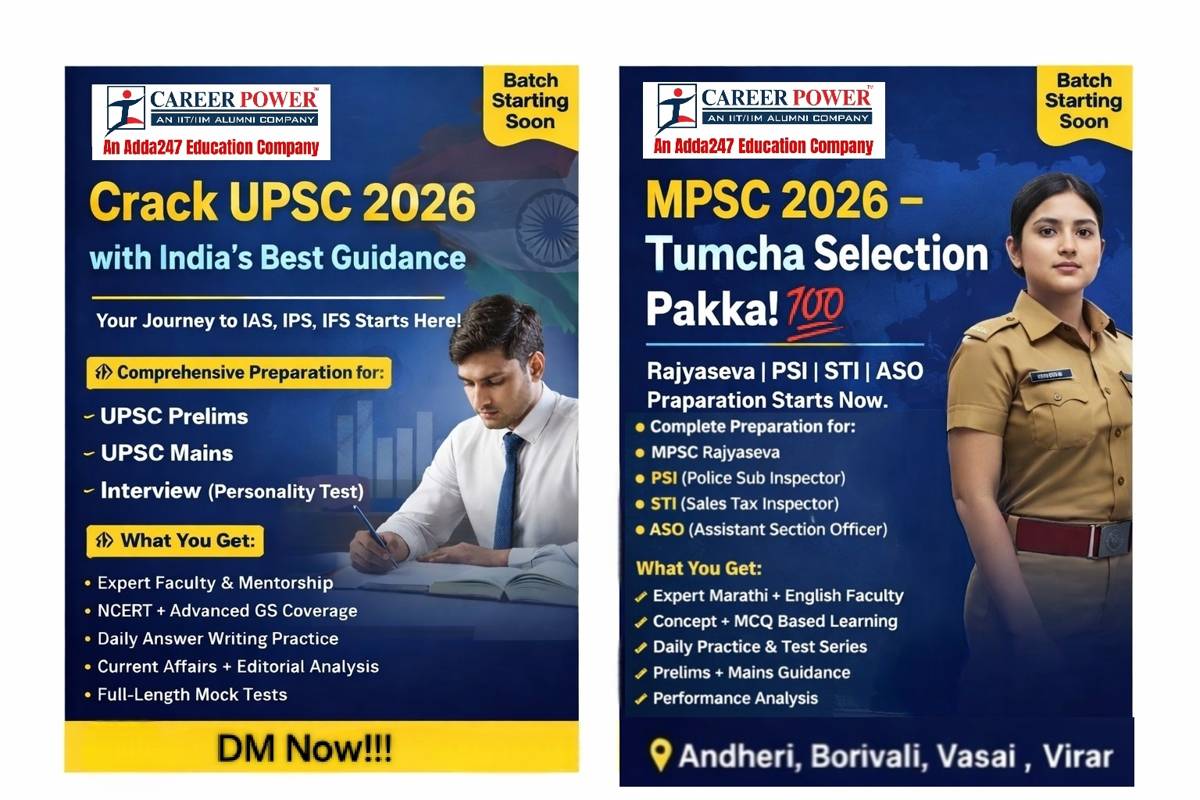
UPSC & MPSC 2026 Coaching in Mumbai: The Complete Guide to Choosing the Right Programme
Summary
UPSC & MPSC 2026 Coaching in Mumbai is a structured, teacher-led programme that prepares you for
the Civil Services Examination (UPSC CSE) and the Maharashtra Public Service Commission (MPSC) exams in the same
preparation cycle. Mumbai’s coaching ecosystem offers offline classrooms in Dadar, Andheri, Thane and Borivali,
live online batches, hybrid schedules for working professionals, and dedicated prelims and mains test series.
This guide explains what these programmes are, why they matter, how they work, what they cost, how to pick the
right one, and the mistakes that quietly ruin thousands of aspirants every year.
Introduction
You have decided to attempt the civil services. That single decision already puts you ahead of thousands of people
who only talk about it. Now comes the harder question: how do you prepare so that 2026 becomes your year,
not just another attempt?
If you live in Mumbai — or plan to move here for preparation — you are sitting in one of India’s strongest
coaching ecosystems. The city gives you Faculty with real exam experience, peer groups that push you harder than
any app, libraries that stay open till midnight, and a transport network that can get you from Thane to Dadar in
under an hour. Used well, that combination is a genuine advantage.
But here is the truth: choosing the wrong UPSC & MPSC 2026 Coaching in Mumbai can cost you
₹1,50,000, twelve precious months, and your confidence. Choosing the right one gives you structure, feedback,
discipline and a mentor who tells you the truth about your performance.
This guide is your decision-making tool. By the end, you will know exactly how to evaluate a coaching institute,
how to build a 2026 study plan, and how to combine Mumbai’s best resources into a system that works for
your life. Let’s begin.
Key Takeaways
- Start early: For UPSC 2026, begin intensive coaching by June 2025 at the latest.
- One core syllabus: UPSC and MPSC overlap by 60–70%, so use UPSC as your base and layer Maharashtra-specific topics on top.
- Fees vary widely: ₹18,000 to ₹1,80,000 depending on format (online, offline, hybrid) and duration.
- Test series matter more than lectures: The feedback loop is what actually raises your score.
- Batch size matters: Prefer batches under 60 students for real doubt-solving and mentorship.
- Verify claims: Ask for result data with roll numbers and interview-stage lists, not just topper photos.
- Mumbai advantage: Local libraries, study rooms, and peer groups in Dadar, Andheri, Thane and Vashi reduce isolation.
- Consistency beats intensity: Six focused hours daily for 400 days beats twelve hours for 20 days.
Table of Contents
- What Is UPSC & MPSC 2026 Coaching in Mumbai?
- Why It Matters
- Benefits of Structured Coaching
- How It Works
- Step-by-Step Guide to Choosing Coaching
- Real Examples from Mumbai Aspirants
- Comparison Table
- Common Mistakes
- Expert Tips
- Best Practices
- Recommended Tools & Resources
- Troubleshooting
- FAQs
- Conclusion
- Call to Action
What Is UPSC & MPSC 2026 Coaching in Mumbai?
UPSC & MPSC 2026 Coaching in Mumbai refers to classroom, online or hybrid training programmes
designed specifically for aspirants targeting the 2026 cycle of two exams:
- UPSC Civil Services Examination (CSE) — conducted by the Union Public Service Commission for
IAS, IPS, IFS and allied services. Stages: Prelims, Mains, Interview. Official details are available on the
UPSC website. - MPSC State Services Examination — conducted by the Maharashtra Public Service Commission for
Deputy Collector, Deputy Superintendent of Police, Block Development Officer and similar posts. See the
MPSC official portal for notifications.
These programmes usually include foundation lectures, NCERT and standard-book coverage, current affairs modules,
answer-writing practice, prelims test series, mains test series, interview guidance, and one-on-one mentorship.
In Mumbai, they are offered in four formats:
- Offline classroom coaching — physical classes in hubs like Dadar, Andheri and Thane.
- Live online coaching — interactive sessions with recordings and digital test series.
- Hybrid coaching — weekday online classes plus weekend classroom sessions.
- Test-series and mentorship-only programmes — for self-study aspirants who need evaluation.
You can also explore our related guides on
UPSC 2026 coaching in Mumbai and
MPSC 2026 coaching in Mumbai for format-specific comparisons.
Why It Matters
The UPSC CSE receives roughly 10 lakh applications for around 1,000 vacancies. The MPSC State Services exam draws
several lakh applicants for a few hundred posts. In both cases, the selection ratio is under 0.2%. That is not
meant to frighten you — it is meant to make one thing clear: random preparation does not work.
Here is why choosing the right UPSC & MPSC 2026 Coaching in Mumbai matters so much:
- Syllabus accuracy: Coaching clarifies what is in scope and, more importantly, what is not.
- Time compression: A good faculty explains in 60 minutes what might take you a week to decode from books.
- Feedback: Without evaluated answer scripts, you cannot know whether your writing is scoring or sinking.
- Peer benchmark: Sitting in a room with 50 serious aspirants shows you your real rank-level preparation.
- Emotional endurance: A two-year exam is as much a psychological test as an academic one.
- Mumbai cost of living: Getting the format right the first time saves you lakhs in rent and opportunity cost.
If you are also weighing self-study, read our breakdown:
Self-Study vs Coaching for UPSC in Mumbai.
Benefits of Joining UPSC & MPSC 2026 Coaching in Mumbai
- Structured roadmap: A week-by-week plan from foundation to revision to test series.
- Expert faculty: Many Mumbai institutes hire former interview-stage candidates and subject specialists.
- Complete study material: Curated notes, maps, current affairs compilations and previous-year analyses.
- Regular testing: Weekly prelims tests and fortnightly mains answer-writing practice.
- Answer evaluation: Personalised feedback on structure, keywords, diagrams and word limits.
- Current affairs integration: Daily or weekly compilations linked to the syllabus.
- Peer learning: Group discussions, mock interviews and study circles.
- Doubt-solving access: Dedicated slots with faculty — the single most underrated benefit.
- Parental confidence: A visible schedule helps families support you instead of questioning you.
- Exam-day readiness: Mock prelims in real time slots and OMR practice.
How It Works
Most reputed UPSC & MPSC 2026 Coaching in Mumbai programmes follow a four-phase cycle:
Phase 1: Foundation (Months 1–5)
- NCERT coverage for History, Geography, Polity, Economics and Science.
- Standard books: Laxmikanth for Polity, Spectrum for Modern History, Shankar IAS for Environment.
- Maharashtra-specific modules for MPSC: state history, geography, economy and social schemes.
- Newspaper reading habit-building with note-making templates.
Phase 2: Advanced & Optional (Months 6–10)
- Deeper coverage of governance, international relations, ethics and internal security.
- Optional subject classes for UPSC Mains.
- Introduction to answer writing: 10-markers, 15-markers, essay structure.
Phase 3: Test Series & Revision (Months 11–15)
- Weekly prelims full-length tests with All India Rank feedback.
- Mains answer-writing practice with evaluated copies returned within 7 days.
- Revision cycles using short notes and flashcards.
Phase 4: Prelims Sprint & Interview Prep
- Daily mock tests, error-log analysis and revision of high-yield topics.
- Personality test preparation through mock interview panels.
- DAF (Detailed Application Form) filling guidance.
For a deeper dive into phase-wise planning, see
2-Year UPSC 2026 Study Plan for Mumbai Aspirants.
Step-by-Step Guide to Choosing the Right Coaching in Mumbai
- Define your goal clearly. Are you targeting UPSC only, MPSC only, or both? If both, decide which
exam is your primary anchor. Most Mumbai aspirants use UPSC as the base and MPSC as a subset. - Map your available time. Full-time aspirants can handle 6–8 hours of daily classwork. Working
professionals should look at weekend or hybrid batches in Andheri, Dadar or Thane. - Shortlist five institutes. Search for best UPSC & MPSC 2026 Coaching in Mumbai,
filter by location, format and fee range, then build a shortlist. - Attend demo lectures. Never enrol without attending at least two live demos. Judge clarity,
pacing and whether the teacher answers questions or dodges them. - Ask for verifiable result data. Request roll numbers, interview-stage lists and Mains-qualified
counts for the last three years. - Check batch size and mentor ratio. Fewer than 60 students per batch and at least one mentor
per 25 aspirants is a healthy benchmark. - Review the test series. Ask how many full-length tests, how many evaluated answer scripts, and
what the turnaround time is. - Read the fee and refund policy carefully. Understand what is included — optional subject,
interview prep, study material, recordings — and what costs extra. - Talk to ex-students. Two or three honest conversations will tell you more than any brochure.
- Enrol and commit. Once you choose, stop comparing. Switching institutes mid-preparation is one
of the most common ways aspirants lose a year.
Real Examples from Mumbai Aspirants
Example 1: The Andheri Working Professional
Rohan worked at a media firm in Andheri East and commuted two hours daily. He joined a hybrid
UPSC & MPSC 2026 Coaching in Mumbai programme with weekday online classes and Sunday
classroom tests. He shifted his newspaper reading to the train commute and used recordings for revision. Result:
he completed his first full prelims test cycle while keeping his job.
Example 2: The Thane First-Time Aspirant
Sneha, a fresh graduate from Thane, chose a two-year offline foundation batch starting June 2025. She combined
classroom lectures with a local study room, wrote 120 mains answers before her first prelims, and used the
institute’s mentor to fix her weakness in Economics. She targeted both UPSC 2026 and MPSC 2026 with one syllabus base.
Example 3: The Dadar Repeater
Amit had already attempted once and failed Prelims by 12 marks. Instead of a full course, he enrolled only in a
test-series-plus-mentorship plan. That single decision — focusing on evaluation rather than lectures — is exactly
what repeaters in Mumbai should consider. See
Best Test Series for UPSC in Mumbai.
Comparison Table: Formats of UPSC & MPSC 2026 Coaching in Mumbai
| Format | Best For | Typical Annual Fee | Pros | Cons |
|---|---|---|---|---|
| Offline Classroom | First-time aspirants, fresh graduates | ₹45,000 – ₹1,80,000 | Discipline, peer group, instant doubt-solving | Travel time, fixed schedule |
| Live Online | Working professionals, remote aspirants | ₹18,000 – ₹75,000 | Recordings, no travel, lower cost | Requires self-discipline, less peer pressure |
| Hybrid | Job holders with weekend availability | ₹35,000 – ₹95,000 | Balance of flexibility and accountability | Slightly fragmented learning rhythm |
| Test Series Only | Repeaters, self-study aspirants | ₹6,000 – ₹30,000 | Cheapest, evaluation-focused, flexible | No teaching support, needs strong basics |
| Mentorship Only | Second- and third-attempt aspirants | ₹10,000 – ₹50,000 | Personalised strategy and accountability | Depends heavily on mentor quality |
UPSC 2026 vs MPSC 2026: Quick Comparison
| Parameter | UPSC CSE 2026 | MPSC State Services 2026 |
|---|---|---|
| Conducting Body | Union Public Service Commission | Maharashtra Public Service Commission |
| Stages | Prelims, Mains, Interview | Prelims, Mains, Interview |
| Syllabus Overlap | Approximately 60–70% common, especially in Prelims GS | |
| Extra Focus Area | National + International, Ethics, Optional Subject | Maharashtra History, Geography, Economy and Schemes |
| Competition Level | Extremely high, pan-India | High, state-level |
Common Mistakes to Avoid
- Joining on topper-photo marketing. One success story does not reflect teaching quality.
- Collecting notes from five institutes. You end up with 3,000 pages and zero clarity.
- Ignoring answer writing until Mains. Writing is a skill; it needs a year of practice.
- Treating test scores as verdicts. Tests are diagnostics, not judgments.
- Skipping revision. Reading new material without revision is the most common failure pattern.
- Comparing yourself to rank-holders daily. Comparison creates anxiety, not accuracy.
- Underestimating MPSC’s Maharashtra component. State-specific questions decide your rank.
- Switching institutes mid-preparation. Momentum matters more than minor syllabus differences.
- Sacrificing sleep for hours. Sleep-deprived retention is dramatically worse.
- Neglecting mental health. Burnout at month eight costs more than any fee.
Expert Tips from Senior SEO & Academics Perspective on Preparation
- Build an error log from day one. Every wrong answer gets a reason: knowledge gap, silly mistake, or guess.
- Use the 3-2-1 revision rule. Revise a topic after 3 days, 2 weeks, then 1 month.
- Read one newspaper, not five. Depth beats breadth in current affairs.
- Attend the demo before paying. Your instinct about a teacher’s clarity is usually right.
- Write answers by hand. Typing does not build the muscle memory of a 3-hour Mains paper.
- Take full-length mocks at the real time slot. 9:30 AM and 2:30 PM, exactly as the exam day runs.
- Use Mumbai’s libraries strategically. Study rooms in Dadar and Andheri give you a distraction-free environment.
- Get one honest mentor. Someone who will tell you “your answers are weak” without softening it.
- Plan your backups. Keep one alternative career plan so exam stress does not become existential fear.
- Track your output, not your input. Measure answers written and tests attempted, not hours “studied”.
Best Practices for UPSC & MPSC 2026 Coaching in Mumbai
- Attend 90% of classes — consistency is the highest-return habit.
- Maintain a single, consolidated notebook set instead of scattered notes.
- Complete each topic with a 50-question self-test before moving on.
- Write one full essay and one ethics case study every week.
- Review every mock test within 48 hours of attempting it.
- Build a study circle of 4–6 serious aspirants, no more.
- Keep Sundays for revision only — no new topics.
- Take one full day off every three weeks, without guilt.
- Follow NCERT textbooks before standard reference books.
- Re-read the official syllabus once every quarter to stay aligned.
Recommended Tools & Resources
Books
- Indian Polity – M. Laxmikanth
- India’s Struggle for Independence – Bipan Chandra
- Certificate Physical and Human Geography – G.C. Leong
- Indian Economy – Ramesh Singh
- Maharashtra State Board textbooks – for MPSC state-specific topics
Digital Tools
- Anki – spaced-repetition flashcards for facts and dates.
- Notion or Evernote – organised digital notes and error logs.
- PIB / PRS India – authentic policy and legislation updates.
- Google Calendar – weekly study blocks and test schedules.
- Timer apps (Forest, Pomodoro) – deep-work sessions.
Mumbai-Specific Resources
- Study rooms and reading halls near Dadar and Andheri stations.
- Public libraries with long evening hours.
- Peer groups formed at coaching centres — extend them into weekend test review sessions.
Compare material quality across institutes in our guide:
Best UPSC & MPSC Study Material in Mumbai.
Troubleshooting: Common Problems & Fixes
| Problem | Likely Cause | Fix |
|---|---|---|
| Scores stuck despite studying | Low question practice, no error analysis | Increase mock frequency; maintain an error log |
| Can’t finish the syllabus | Too many sources, no prioritisation | Limit to one core book per subject |
| Poor answer-writing quality | No structured practice or feedback | Write 5 answers weekly with evaluation |
| Burnout and low motivation | No breaks, no social contact | Schedule rest days; join a study circle |
| Travel time eating into study | Offline location too far | Switch to hybrid or live online format |
| Weak Maharashtra-specific knowledge | UPSC-focused preparation only | Add dedicated MPSC modules and state current affairs |
Frequently Asked Questions (FAQs)
1. When should I start UPSC & MPSC 2026 Coaching in Mumbai?
Ideally 12 to 18 months before Prelims. For UPSC 2026, begin intensive coaching by March–June 2025 to allow a full
revision cycle. For MPSC 2026, 10 to 12 months of structured coaching is usually sufficient if your basics are solid.
2. How much does UPSC & MPSC 2026 Coaching in Mumbai cost?
Offline classroom programmes range from ₹45,000 to ₹1,80,000 per year. Online and hybrid batches cost between
₹18,000 and ₹75,000. Test-series-only plans start at ₹6,000, and mentorship-only plans at around ₹10,000.
3. Can I prepare for both UPSC and MPSC together?
Yes. The Prelims syllabus overlaps by roughly 60–70%. Use UPSC as your core syllabus and add Maharashtra-specific
history, geography, economy and current affairs for MPSC.
4. Is online coaching as effective as offline coaching in Mumbai?
Yes, provided the programme includes live interaction, doubt-solving and evaluated tests. Online formats often save
two to three hours of daily commute in Mumbai, which translates into real study time.
5. Which Mumbai areas have the best coaching hubs?
Dadar, Andheri, Thane, Borivali, Vashi and Churchgate are the main hubs because of strong rail connectivity and a
dense ecosystem of libraries and study rooms.
6. How many hours should I study daily?
Six to eight focused hours daily is a strong benchmark for full-time aspirants. Working professionals should target
three to four hours on weekdays and six to eight on weekends.
7. Do I need an optional subject coaching for UPSC Mains?
It depends on your optional. Subjects like Public Administration, Sociology, History and Geography are well covered
by most Mumbai institutes. Niche subjects may require specialised faculty.
8. How do I verify an institute’s success claims?
Ask for roll numbers, Mains-qualified lists and interview-stage counts for the last three years. Legitimate institutes
share verifiable data, not just topper photographs.
9. How many mock tests should I attempt before Prelims?
Aim for 40 to 60 full-length prelims mocks, and review each one within 48 hours. Quality of review matters more than
raw test count.
10. Is coaching necessary for MPSC if I am already preparing for UPSC?
Not strictly. But a short MPSC-specific module covering Maharashtra history, geography and state schemes is highly
recommended, since those topics decide a significant share of your MPSC score.
11. What if I cannot afford full offline coaching in Mumbai?
Consider live online batches, test-series-only plans, or institute scholarships. Many Mumbai institutes offer
fee concessions based on merit or economic need.
12. Should I move to Delhi instead of preparing in Mumbai?
Not necessarily. Mumbai offers strong faculty, libraries and peer groups. What matters most is your consistency and
the quality of your test-series feedback — not the city.
13. How important is current affairs for UPSC and MPSC 2026?
Extremely important. Current affairs links static subjects to real events and appears in Prelims, Mains and the
Interview. One newspaper plus a monthly compilation is usually enough.
14. Can working professionals manage UPSC & MPSC 2026 Coaching in Mumbai?
Yes. Hybrid and weekend batches in Andheri, Thane and Dadar are designed for working professionals. The key is
consistent early-morning or late-night study blocks.
15. What is the ideal batch size?
Under 60 students per batch. Above that, doubt-solving and personal mentorship tend to disappear.
16. How do I handle a failed attempt?
Treat it as data. Analyse your Prelims cutoff gap and Mains answer quality, then adjust your strategy. Many successful
candidates cleared in their third or fourth attempt.
17. Do coaching institutes help with the UPSC interview?
Reputed institutes run mock interview panels with retired officers and subject experts. Two or three serious mocks
with detailed feedback are usually enough.
18. What should I look for in a demo lecture?
Clarity of explanation, syllabus relevance, willingness to take questions, and whether the teacher connects topics
to previous-year questions.
19. How do I avoid information overload?
Fix one source per subject, one newspaper, and one current affairs compilation. Add nothing new after month ten
except revision material.
20. Is it okay to change my optional subject mid-preparation?
Only if you are genuinely failing to score in mocks. Changing optionals after a full year is rarely a good idea —
it resets your momentum.
Conclusion
Preparing for the civil services in Mumbai is a serious commitment — of money, time, and mental energy. The good news
is that you do not have to figure it out alone. A well-chosen UPSC & MPSC 2026 Coaching in Mumbai
programme gives you structure, expert guidance, honest feedback and a peer group that keeps you accountable on the
days motivation disappears.
Remember the fundamentals: start early, keep one core syllabus, write answers every week, revise relentlessly, and
review every mock test. Choose your institute based on demo lectures and verifiable results — not marketing. And once
you choose, commit fully.
2026 is not far away, but it is far enough. Used well, these next eighteen months can genuinely change the direction
of your life. Start today.
Call to Action
Ready to start? Explore our detailed guides and take the next step today:
- Compare UPSC 2026 Coaching in Mumbai
- Compare MPSC 2026 Coaching in Mumbai
- Download the 2-Year UPSC 2026 Study Plan
- Browse the Best Test Series in Mumbai
- Book a Free Counselling Session
Bookmark this page — we update it whenever UPSC or MPSC announces changes to the 2026 cycle.
Share this guide with a friend who is preparing for UPSC or MPSC 2026 in Mumbai. Sometimes one
shared link is all the push someone needs.