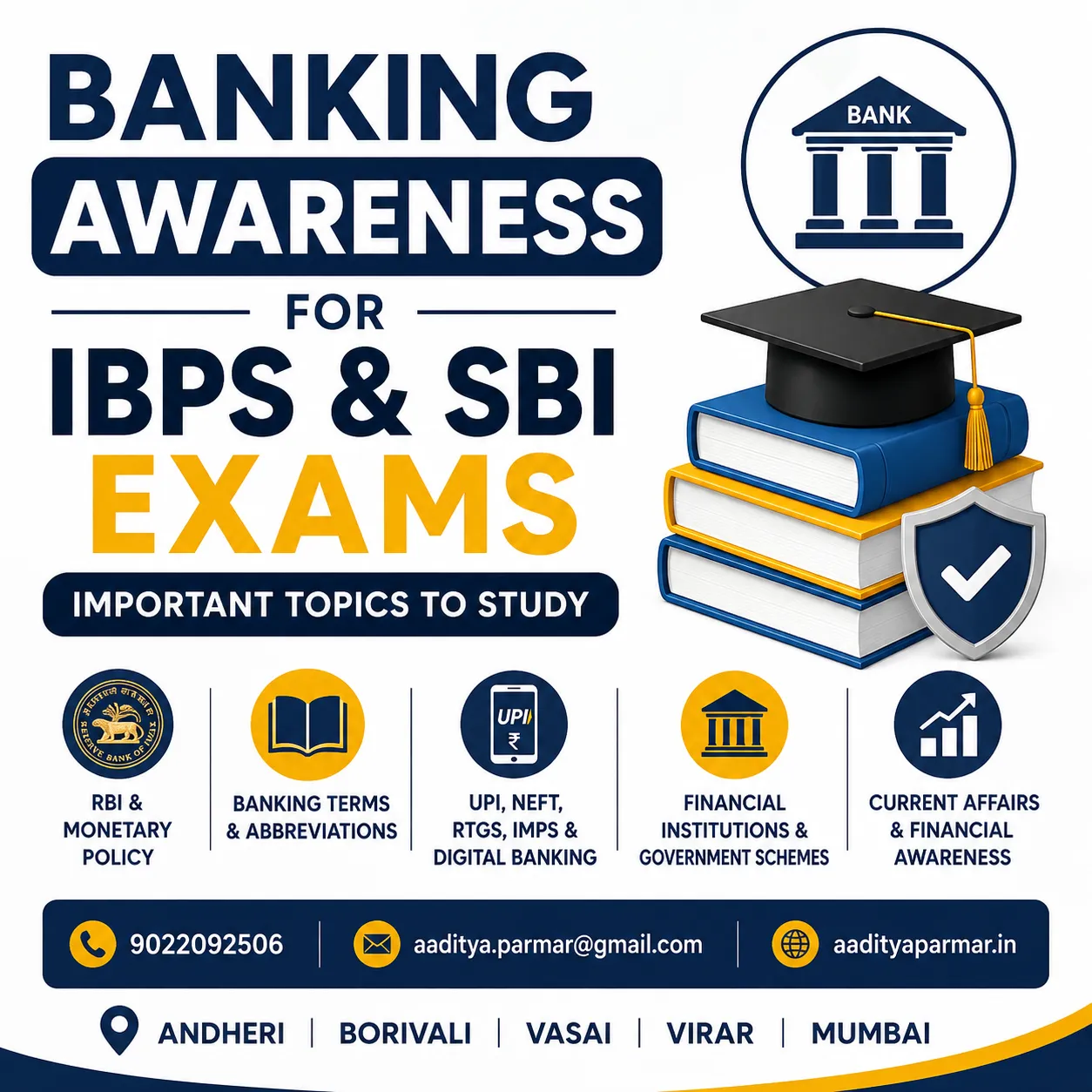
Banking Awareness for IBPS & SBI Exams: Important Topics to Study
Banking Awareness for IBPS & SBI Exams: Important Topics to Study
Summary
Banking Awareness for IBPS & SBI Exams is one of the most important areas for candidates preparing for banking and competitive examinations. It covers the fundamentals of the Indian banking system, Reserve Bank of India (RBI), monetary policy, financial institutions, banking terms, digital payments, financial markets, government schemes, banking reforms and recent developments in the financial sector.
For many aspirants, Banking Awareness can initially appear difficult because the subject contains a large number of terms, abbreviations, institutions and current-affairs topics. However, the preparation becomes much easier when candidates divide the syllabus into logical categories and study static banking concepts together with current banking and financial developments.
The official RBI material covers areas such as monetary policy, regulation and supervision of banks, payment and settlement systems, foreign exchange, currency management and the RBI's role as banker to banks and governments. SBI's own examination material has also included questions under General Awareness/Economy/Banking Knowledge, demonstrating the relevance of banking and economic awareness in its recruitment examinations.
This detailed guide explains the Banking Awareness syllabus, important topics, RBI concepts, banking terminology, monetary policy, digital banking, financial institutions, government schemes, preparation strategy, current-affairs preparation, revision methods and frequently asked questions for IBPS and SBI aspirants.
Students preparing for banking examinations in Mumbai can also explore coaching and preparation support in Andheri, Borivali, Vasai and Virar.
Introduction
Banking Awareness is different from Quantitative Aptitude, Reasoning or English.
You are not expected to solve lengthy mathematical problems in every Banking Awareness question. Instead, the section tests whether you understand the banking and financial system and important economic developments.
A question may ask about:
- RBI functions
- Monetary policy
- Repo Rate
- CRR
- SLR
- Banking abbreviations
- Types of banks
- Financial institutions
- Digital payment systems
- Banking regulations
- Financial inclusion
- Government schemes
- Capital markets
- Insurance
- Budget and economy
- Recent banking developments
The challenge is that Banking Awareness contains both static knowledge and current affairs.
For example, knowing what the RBI does is a static concept. But knowing a recent RBI policy decision, regulatory change or payment-system development requires current-affairs preparation.
Therefore, a successful preparation strategy should combine:
Static Banking Knowledge + Financial Awareness + Current Affairs + Regular Revision
This is particularly important for candidates preparing for IBPS and SBI examinations, where General Awareness, Economy and Banking Knowledge can form part of the assessment at relevant stages. SBI's official material, for example, has used the category "General Awareness/Economy/Banking Knowledge."
What Is Banking Awareness?
Banking Awareness refers to knowledge of the banking and financial system, including the institutions, terminology, regulations, products, services and developments associated with banking.
It broadly covers:
- Indian Banking System
- RBI
- Monetary Policy
- Banking Terminology
- Types of Banks
- Financial Institutions
- Banking Regulations
- Digital Banking
- Payment Systems
- Financial Inclusion
- Government Schemes
- Financial Markets
- Insurance
- Capital Markets
- Banking Reforms
- Current Banking Affairs
- Economic Awareness
The RBI itself identifies major areas of its work including monetary policy, financial-system regulation and supervision, payment and settlement systems, foreign exchange, currency management and its role as banker to banks and governments.
Why Is Banking Awareness Important for IBPS & SBI Exams?
1. It Can Be a Scoring Area
Many Banking Awareness questions are direct if you have studied the relevant concept.
Unlike lengthy numerical questions, a factual banking question may require only a few seconds.
2. It Covers Multiple Banking Exams
Banking awareness is useful across preparation for several examinations, including:
- IBPS PO
- IBPS Clerk/Customer Service Associate
- SBI PO
- SBI Clerk
- IBPS RRB
- Other banking recruitment examinations
The exact pattern can vary between examinations and recruitment cycles, so candidates should always refer to the latest official notification.
The current IBPS recruitment cycle continues to publish official examination information and notices through the IBPS portal, making the latest notification the appropriate source for the exact examination structure.
3. It Supports Interview and Professional Knowledge
Banking knowledge is also useful beyond objective examinations because it helps candidates understand the financial sector and the role of banks.
Banking Awareness Syllabus for IBPS & SBI Exams
A comprehensive preparation list should include the following areas:
Banking Basics
- Meaning of banking
- Functions of banks
- Types of deposits
- Loans and advances
- Banking products
- Cheques
- Negotiable instruments
- Interest rates
- Basic banking terminology
RBI
- History of RBI
- Functions
- Monetary policy
- Currency management
- Banking regulation
- Payment systems
- Foreign exchange
- Financial stability
Monetary Policy
- Repo Rate
- Reverse Repo Rate
- CRR
- SLR
- Bank Rate
- MSF
- Open Market Operations
- Liquidity management
- Monetary Policy Committee
Financial Institutions
- RBI
- NABARD
- SIDBI
- EXIM Bank
- NHB
- NHB-related concepts
- SEBI
- IRDAI
- PFRDA
- NPCI
- Other important institutions
Digital Banking
- UPI
- NEFT
- RTGS
- IMPS
- Digital wallets
- Cards
- Internet banking
- Mobile banking
- QR payments
- Tokenisation
- Digital Rupee
Financial Awareness
- Inflation
- GDP
- Fiscal deficit
- Monetary policy
- Fiscal policy
- Budget
- Taxation
- Financial markets
- Balance of payments
- Foreign exchange
1. Indian Banking System
The first step in Banking Awareness preparation is understanding the structure of India's banking system.
Candidates should know the difference between:
- Commercial banks
- Public sector banks
- Private sector banks
- Foreign banks
- Regional Rural Banks
- Cooperative banks
- Small Finance Banks
- Payments Banks
You should also understand what each category generally does and how it fits into India's financial system.
2. Reserve Bank of India
The Reserve Bank of India (RBI) is one of the most important topics for banking examinations.
Candidates should study:
- Establishment of RBI
- RBI Act
- Functions of RBI
- Monetary policy
- Currency issuance
- Banking regulation
- Foreign exchange management
- Payment systems
- Financial stability
- Banker to banks
- Banker to government
- Lender of last resort
The RBI's official description identifies functions including monetary-policy formulation and implementation, regulation and supervision of the financial system, regulation of payment and settlement systems, foreign-exchange management, currency issuance, management of reserves and banking services for banks and governments.
Why RBI Is Important
Questions about RBI can be direct:
- What is the role of RBI?
- What is monetary policy?
- Who regulates banking?
- What is the role of RBI in currency management?
- What is the purpose of CRR?
- What is the Monetary Policy Committee?
Therefore, RBI should be one of the first topics you study.
3. Monetary Policy
Monetary Policy is another extremely important Banking Awareness topic.
It broadly concerns how monetary conditions and liquidity are managed to influence inflation, growth and financial conditions.
The RBI's stated monetary-policy framework focuses primarily on maintaining price stability while keeping growth in mind.
Candidates should understand:
- Repo Rate
- Reverse Repo Rate
- Bank Rate
- CRR
- SLR
- MSF
- Open Market Operations
- Liquidity Adjustment Facility
- Monetary Policy Committee
Do not simply memorise abbreviations.
Understand what happens when a particular policy instrument is increased or decreased.
4. Repo Rate
The Repo Rate is a commonly tested banking concept.
Candidates should understand its relationship with:
- Bank borrowing
- Liquidity
- Interest rates
- Credit availability
- Inflation
You should also distinguish Repo Rate from Reverse Repo Rate and other policy rates.
Because monetary-policy decisions can change over time, candidates should revise the latest official RBI announcements rather than memorising an old rate permanently.
5. Cash Reserve Ratio
CRR stands for Cash Reserve Ratio.
It refers to the prescribed portion of certain bank liabilities that banks are required to maintain as cash reserves with the RBI.
Students should understand:
- Meaning of CRR
- Purpose
- Effect on liquidity
- Difference between CRR and SLR
6. Statutory Liquidity Ratio
SLR stands for Statutory Liquidity Ratio.
Candidates should understand the broad concept and how it differs from CRR.
A common examination question may ask students to identify:
- What CRR means
- What SLR means
- Where reserves are maintained
- How they affect bank liquidity
7. Monetary Policy Committee
The Monetary Policy Committee (MPC) is another important topic.
Students should understand:
- Purpose of MPC
- Role in monetary policy
- Inflation targeting framework
- Policy-rate decisions
- Composition and appointment framework
Candidates should also follow important MPC meetings and decisions as part of current banking awareness.
8. Types of Banks in India
Understanding different types of banks is essential.
Public Sector Banks
These are banks in which the government has a controlling ownership position.
Candidates should know major public-sector banking institutions and important developments involving them.
Private Sector Banks
These are privately controlled banking institutions operating under RBI regulation.
Foreign Banks
Foreign banks operate in India subject to applicable Indian laws and regulatory requirements.
Regional Rural Banks
RRBs focus primarily on banking and financial services in rural and semi-urban areas.
Cooperative Banks
Cooperative banking institutions operate under the applicable cooperative and banking regulatory framework.
Small Finance Banks
Small Finance Banks were created with a focus on financial inclusion and serving underserved sections.
Payments Banks
Payments Banks operate under a specialised banking model with restrictions that distinguish them from full-service commercial banks.
9. Important Banking Terms
Banking terminology is one of the easiest areas to improve with systematic revision.
Prepare terms such as:
- NPA
- KYC
- AML
- CASA
- CRR
- SLR
- IFSC
- MICR
- CTS
- EMI
- LTV
- MCLR
- EBLR
- NIM
- ROA
- ROE
- Basel Norms
- Priority Sector Lending
- Financial Inclusion
Maintain a dedicated abbreviation notebook.
10. Non-Performing Assets
NPA, or Non-Performing Asset, is a very important banking concept.
Candidates should understand:
- Meaning of NPA
- Why NPAs matter
- Gross NPA
- Net NPA
- Bad loans
- Provisioning
- Recovery mechanisms
NPA-related questions frequently connect banking with financial stability and bank profitability.
11. KYC and AML
KYC
KYC means Know Your Customer.
It is associated with customer identification and verification requirements.
AML
AML means Anti-Money Laundering.
Candidates should understand the relationship between customer due diligence, suspicious transactions and prevention of money laundering.
These concepts are particularly important because banking regulations and compliance are common areas of banking awareness.
12. Basel Norms
Basel norms are important for understanding banking capital and risk management.
Candidates should study:
- Basel Committee
- Capital adequacy
- Risk-weighted assets
- Tier 1 capital
- Tier 2 capital
- Capital ratios
- Basel I
- Basel II
- Basel III
Don't attempt to memorise every technical detail initially.
First understand why capital requirements exist.
13. Priority Sector Lending
Priority Sector Lending is an important topic for banking examinations.
Candidates should understand the concept of lending to identified sectors that are considered important for broader economic and social objectives.
Important areas can include:
- Agriculture
- MSMEs
- Education
- Housing
- Weaker sections
- Other specified sectors
Always verify the latest regulatory classification when studying current rules.
14. Digital Banking
Digital banking has become an increasingly important part of Banking Awareness.
Prepare:
- Internet banking
- Mobile banking
- UPI
- QR payments
- Digital wallets
- Debit cards
- Credit cards
- Contactless payments
- Tokenisation
- Digital financial services
The RBI's payment-system framework covers electronic and paper-based payment arrangements, including major systems such as RTGS and NEFT.
15. UPI
UPI stands for Unified Payments Interface.
Candidates should know:
- Full form
- Purpose
- Role of NPCI
- UPI-based payments
- QR-code payments
- UPI-linked developments
- International linkages and related current affairs
Because digital payments continue to evolve, UPI should be included in both static and current-affairs preparation.
16. NEFT
NEFT stands for National Electronic Funds Transfer.
Students should understand:
- Purpose
- Electronic fund transfers
- RBI's role
- How NEFT differs from RTGS
- How NEFT differs from IMPS
The RBI maintains official information and FAQs on NEFT and other payment systems.
17. RTGS
RTGS stands for Real Time Gross Settlement.
RTGS is an important large-value payment system operated by the RBI. RBI material describes RTGS as a large-value payment system in which transactions settle on a real-time gross basis.
Students should compare:
| System | Key Concept |
|---|---|
| NEFT | Electronic fund transfer |
| RTGS | Real-time gross settlement |
| IMPS | Immediate interbank electronic transfer |
| UPI | Instant account-to-account payment interface |
18. IMPS
IMPS stands for Immediate Payment Service.
Prepare:
- Full form
- Purpose
- Instant electronic transfers
- Difference between IMPS, NEFT and RTGS
- Related current developments
19. Digital Rupee
The Digital Rupee (e₹) is another important topic for modern banking awareness.
Candidates should study:
- Meaning of CBDC
- Digital Rupee
- RBI's role
- Retail CBDC
- Wholesale CBDC
- Difference between CBDC and cryptocurrency
The RBI maintains official FAQs and information relating to the Digital Rupee, making its own resources useful for current preparation.
20. NPCI
NPCI stands for National Payments Corporation of India.
It is a major institution in India's retail-payment infrastructure.
Candidates should associate NPCI with important payment products and systems and follow its current developments.
21. Important Financial Institutions
Banking Awareness preparation should not stop at commercial banks.
Study the functions and purposes of:
- NABARD
- SIDBI
- EXIM Bank
- NHB
- SEBI
- IRDAI
- PFRDA
- NPCI
- RBI
Create a simple table containing:
Institution → Full Form → Established/Relevant Year → Main Function → Headquarters
This is an efficient revision method.
22. NABARD
NABARD stands for National Bank for Agriculture and Rural Development.
Important areas include:
- Rural development
- Agriculture finance
- Rural credit
- Developmental functions
- Supervision-related roles
23. SIDBI
SIDBI stands for Small Industries Development Bank of India.
It is associated with the development and financing ecosystem for micro, small and medium enterprises.
Students should understand its broad role and important initiatives.
24. SEBI
SEBI stands for Securities and Exchange Board of India.
It is associated with regulation and development of India's securities market.
Prepare:
- SEBI
- Stock exchanges
- Securities
- Investors
- Capital markets
- Market intermediaries
25. IRDAI
IRDAI stands for Insurance Regulatory and Development Authority of India.
Students should know its role in India's insurance sector.
26. PFRDA
PFRDA stands for Pension Fund Regulatory and Development Authority.
It is associated with regulation and development of India's pension sector.
27. Financial Inclusion
Financial Inclusion is a major topic connecting banking with economic development.
It refers broadly to improving access to useful and affordable financial services.
Study:
- Basic bank accounts
- Banking access
- Rural banking
- Digital payments
- Financial literacy
- Direct Benefit Transfer
- Government financial-inclusion programmes
28. Government Schemes
Government schemes are an important component of banking and economic awareness.
Candidates should study major schemes associated with:
- Financial inclusion
- Insurance
- Pension
- Agriculture
- MSMEs
- Entrepreneurship
- Social security
- Rural development
- Digital payments
For every scheme, prepare:
Name → Ministry → Objective → Target Group → Key Benefit → Recent Update
This format makes revision much easier.
29. Financial Markets
Banking Awareness overlaps with financial-market awareness.
Study the basics of:
Money Market
Short-term financial instruments and liquidity.
Capital Market
Long-term financing through securities and related instruments.
Government Securities
Understand basic concepts surrounding government borrowing and securities.
Foreign Exchange Market
Understand currencies, exchange rates and forex-related concepts.
30. Inflation
Inflation is an essential economy topic.
Candidates should understand:
- Meaning of inflation
- Consumer prices
- Wholesale prices
- Causes
- Effects
- Monetary-policy relationship
A common conceptual question may ask how inflation affects purchasing power or why monetary policy responds to inflationary pressure.
31. GDP and Economic Growth
Candidates should understand:
- GDP
- Real GDP
- Nominal GDP
- Economic growth
- Per-capita income
- Major sectors of the economy
You do not need to memorise every economic statistic.
Instead, understand what the indicators mean and follow major current data releases.
32. Fiscal Policy and Monetary Policy
This is a common conceptual comparison.
Monetary Policy
Primarily associated with the central bank and monetary conditions.
Fiscal Policy
Associated with government taxation, spending and borrowing.
Remember the distinction clearly.
33. Union Budget and Economic Survey
Candidates should follow major points from:
- Union Budget
- Economic Survey
- Fiscal deficit
- Government expenditure
- Tax changes
- Major financial announcements
- Economic growth projections
- Sector-specific allocations
Don't attempt to memorise the entire Budget.
Focus on banking, finance, taxation, economy and major schemes.
34. Banking Current Affairs
Static knowledge alone is not enough.
Candidates should regularly follow:
- RBI notifications
- Monetary policy decisions
- Bank mergers or restructuring
- New banking products
- Digital-payment developments
- Important appointments
- Banking regulations
- Financial-sector reforms
- Major government schemes
- Important reports
- Economic indicators
The RBI's official FAQ and publication resources are particularly useful for verifying payment-system and regulatory concepts.
How to Prepare Banking Awareness for IBPS & SBI Exams
Step 1: Build Static Banking Knowledge
Begin with:
- RBI
- Banking system
- Banking terms
- Monetary policy
- Financial institutions
- Payment systems
Do not begin with random current-affairs PDFs.
Step 2: Create Short Notes
Make one-page notes for each major topic.
For example:
RBI
- Establishment
- Functions
- Monetary policy
- Currency
- Regulation
- Payment systems
Payment Systems
- UPI
- NEFT
- RTGS
- IMPS
- Digital Rupee
This makes revision significantly easier.
Step 3: Follow Current Affairs Daily
Spend around 20–30 minutes regularly on banking and financial current affairs.
Focus on quality rather than reading every news story.
Step 4: Use Monthly Revision
At the end of every month, revise:
- RBI updates
- Banking appointments
- New schemes
- Financial institutions
- Digital-payment developments
- Monetary-policy decisions
- Important economic data
Step 5: Practise MCQs
After studying a topic, immediately solve questions.
For example:
RBI → 30 questions
Monetary Policy → 30 questions
Banking Terms → 50 questions
This reveals whether you actually remember the information.
Step 6: Use Previous-Year Questions
Previous-year questions help identify frequently tested concepts.
Create topic-wise collections for:
- RBI
- Banking terms
- Monetary policy
- Digital banking
- Financial institutions
- Economy
- Government schemes
Best Revision Strategy for Banking Awareness
Use a three-stage revision cycle.
First Revision
Within 24–48 hours.
Second Revision
After approximately one week.
Third Revision
At the end of the month.
This is more effective than studying everything once.
Common Mistakes in Banking Awareness Preparation
1. Memorising Without Understanding
Don't simply memorise abbreviations.
Understand what they mean.
2. Ignoring Static Banking
Current affairs cannot replace basic banking knowledge.
3. Reading Too Many Sources
Using too many PDFs and websites can create confusion.
Choose a small number of reliable sources.
4. Not Revising
Banking Awareness contains a lot of information.
Revision is essential.
5. Ignoring RBI
RBI is one of the most important institutions for banking examinations.
6. Ignoring Digital Banking
UPI, NEFT, RTGS, IMPS and digital banking should be part of your preparation.
7. Studying Only Before the Exam
Banking current affairs are much easier when prepared consistently.
30-Day Banking Awareness Study Plan
Days 1–5
Indian Banking System + RBI
Days 6–8
Monetary Policy + Banking Rates
Days 9–12
Banking Terms + Abbreviations
Days 13–16
Financial Institutions
Days 17–20
Digital Banking + Payment Systems
Days 21–23
Government Schemes + Financial Inclusion
Days 24–26
Economy + Financial Markets
Days 27–28
Banking Current Affairs
Day 29
Previous-Year Questions
Day 30
Full Revision + Mock Test
Repeat and adapt the cycle based on your examination schedule.
How Coaching Can Help With Banking Awareness
Students often struggle with Banking Awareness because they don't know:
- What to study
- What to skip
- Which topics are important
- How much current affairs to cover
- How to revise
- Which questions to practise
A structured banking coaching programme can provide:
- Topic-wise classes
- Study material
- Current-affairs coverage
- Practice questions
- Mock tests
- Doubt-solving
- Revision sessions
- Exam-oriented guidance
Students looking for banking classes in Mumbai can explore options based on their location.
Preparation centres serving students around Andheri, Borivali, Vasai and Virar can be particularly convenient for candidates living in Mumbai's western suburbs.
However, location should not be your only selection criterion. Evaluate:
- Faculty experience
- Banking syllabus coverage
- Current-affairs support
- Study material
- Mock-test quality
- Doubt-solving
- Batch size
- Class schedule
- Student feedback
- Overall academic support
Banking Awareness Preparation in Mumbai
Candidates searching for banking classes in Andheri, banking classes in Borivali, banking classes in Vasai or banking classes in Virar should consider both accessibility and academic quality.
A nearby centre can reduce travel time, which can be useful during intensive preparation.
At the same time, students should ensure that the coaching programme provides comprehensive preparation for:
- IBPS
- SBI
- RRB
- Banking Awareness
- General Awareness
- Economy
- Current Affairs
Frequently Asked Questions
1. What is Banking Awareness for IBPS and SBI exams?
Banking Awareness is the study of India's banking and financial system, including RBI, banking terms, monetary policy, financial institutions, digital payments, banking regulations, government schemes, financial markets and current banking developments.
2. What are the most important Banking Awareness topics?
Important topics include RBI, monetary policy, banking terms, types of banks, financial institutions, NPA, KYC, Basel norms, digital banking, UPI, NEFT, RTGS, IMPS, financial inclusion, government schemes and banking current affairs.
3. Is Banking Awareness difficult?
It can seem difficult because the syllabus contains many terms and facts. However, dividing the syllabus into static banking, financial awareness and current affairs makes preparation much easier.
4. How should beginners start Banking Awareness preparation?
Beginners should start with the Indian banking system, RBI, basic banking terminology, monetary policy and types of banks before moving to current affairs.
5. Is RBI important for IBPS and SBI exams?
Yes. RBI is one of the most important institutions to study for banking awareness. Candidates should understand its functions, monetary-policy role, regulatory responsibilities and payment-system role.
6. Is current affairs important for Banking Awareness?
Yes. Candidates should combine static banking knowledge with recent banking, financial and economic developments.
7. How many months of current affairs should I study?
The ideal period depends on the examination and its notification. Candidates should follow the latest examination guidance and cover a sufficient recent period, with particular emphasis on banking, finance and economy-related developments.
8. What is the difference between NEFT and RTGS?
NEFT is an electronic fund-transfer system, while RTGS is a real-time gross-settlement system. RBI provides official information on both payment systems.
9. What is UPI?
UPI stands for Unified Payments Interface. It enables users to make digital payments and account-to-account transfers through supported payment applications and banking channels.
10. What is CRR?
CRR stands for Cash Reserve Ratio. It represents the prescribed cash-reserve requirement that banks maintain with the RBI under applicable regulations.
11. What is SLR?
SLR stands for Statutory Liquidity Ratio. It relates to the proportion of specified liabilities that banks are required to maintain in specified liquid assets under the applicable regulatory framework.
12. How can I remember banking abbreviations?
Create a dedicated abbreviation notebook and revise it regularly. Group similar terms together, such as payment systems, regulatory institutions and monetary-policy terms.
13. Are government schemes important for banking exams?
Yes. Candidates should understand major schemes related to financial inclusion, insurance, pension, agriculture, MSMEs and social security.
14. Can I prepare Banking Awareness without coaching?
Yes. Self-study can be effective if you use reliable sources, maintain structured notes, practise MCQs and revise regularly. Coaching can provide additional structure and guidance.
15. How much time should I spend on Banking Awareness daily?
There is no universal number. A focused 30–60 minutes of daily study, combined with regular revision and MCQ practice, can be a useful component of an overall bank-exam preparation schedule.
16. Which is more important: static banking or current affairs?
Both are important. Static concepts help you understand banking, while current affairs help you answer questions about recent developments.
17. Is Digital Rupee important for Banking Awareness?
Yes. The RBI's Digital Rupee is a relevant modern banking and financial-awareness topic, and candidates should understand basic CBDC concepts and follow official updates.
18. Where can I find banking classes in Mumbai?
Aspirants can explore banking coaching options in areas including Andheri, Borivali, Vasai and Virar. Compare faculty, study material, test series, current-affairs coverage, fees and academic support before enrolling.
Final Banking Awareness Checklist
Before your IBPS or SBI examination, make sure you have revised:
- RBI
- Monetary Policy
- Repo Rate
- Reverse Repo Rate
- CRR
- SLR
- MSF
- Bank Rate
- MPC
- Types of Banks
- Banking Terms
- NPA
- KYC
- AML
- Basel Norms
- Priority Sector Lending
- Financial Inclusion
- NABARD
- SIDBI
- SEBI
- IRDAI
- PFRDA
- NPCI
- UPI
- NEFT
- RTGS
- IMPS
- Digital Rupee
- Government Schemes
- Financial Markets
- Inflation
- GDP
- Fiscal Policy
- Monetary Policy
- Union Budget
- Economic Survey
- Banking Current Affairs
- Previous-Year Questions
Conclusion
Banking Awareness for IBPS & SBI Exams becomes manageable when you stop treating it as a collection of random facts and start understanding it as a connected subject.
Begin with the Indian banking system and RBI. Then move to monetary policy, banking terminology, financial institutions, digital payments and financial inclusion. Once the static foundation is strong, add current banking and economic affairs.
Your preparation should follow a simple cycle:
Learn → Make Notes → Practise MCQs → Revise → Follow Current Affairs → Take Tests → Analyse Mistakes
Do not try to memorise everything in one sitting. Banking Awareness is a subject where repeated revision can make a major difference.
For students preparing for IBPS, SBI and other banking examinations, structured guidance can also help organise the syllabus, current affairs, mock tests and revision. Aspirants in Mumbai can explore preparation options in Andheri, Borivali, Vasai and Virar according to their location and learning requirements.
With consistent preparation, Banking Awareness can become one of the most efficient areas to improve your overall performance in banking examinations.
Contact Details
Banking Exam Preparation
Phone: 9022092506
Email: aaditya.parmar@gmail.com
Website: https://aadityaparmar.in
Locations: Andheri | Borivali | Vasai | Virar | Mumbai