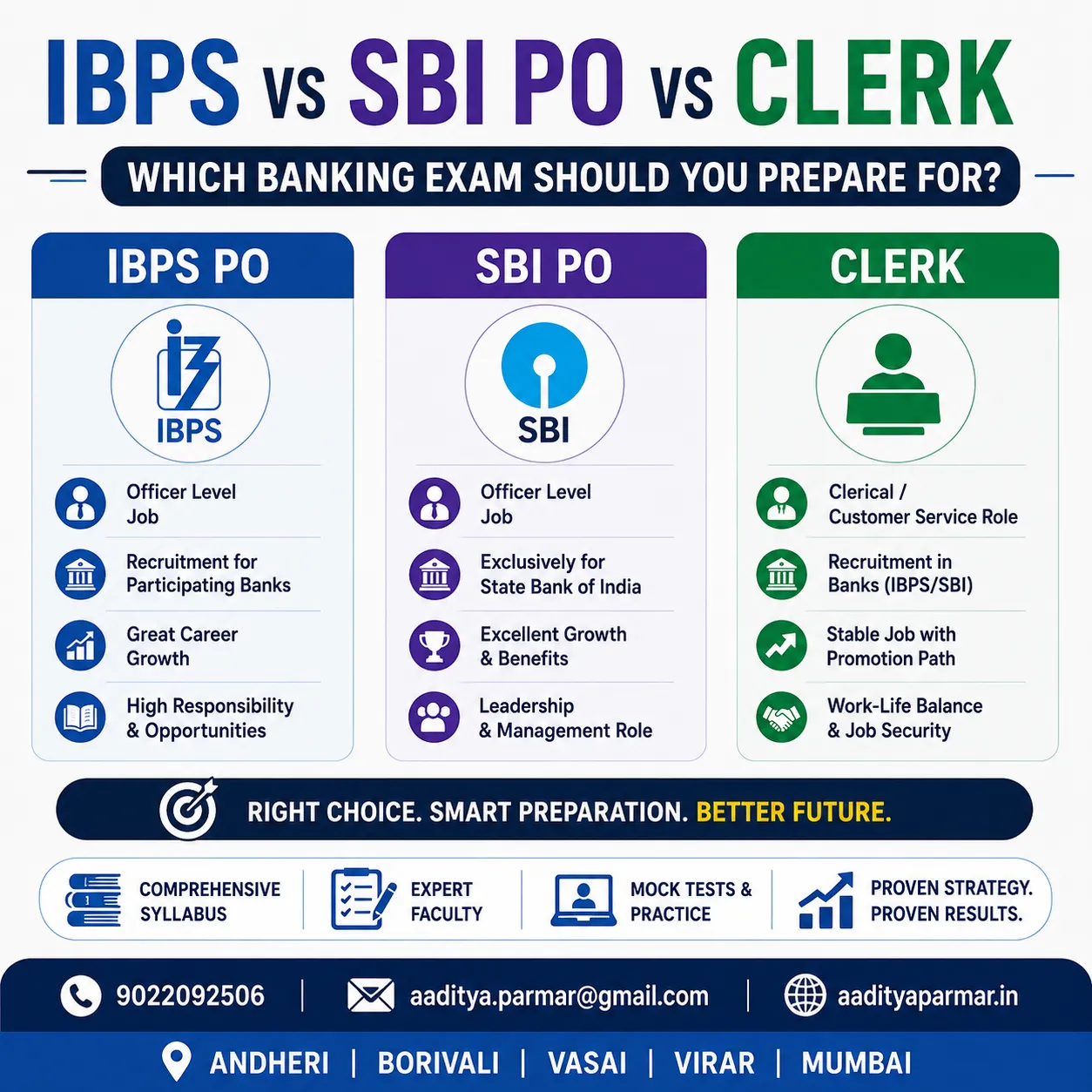
IBPS vs SBI PO vs Clerk: Which Banking Exam Should You Prepare For?
IBPS vs SBI PO vs Clerk: Which Banking Exam Should You Prepare For?
Target Audience: Banking exam aspirants in Mumbai, Andheri, Borivali, Vasai and Virar
Primary Keyword: IBPS vs SBI PO vs Clerk
Secondary Keywords: IBPS PO vs SBI PO, SBI PO vs Clerk, IBPS Clerk vs SBI Clerk, best banking exam, bank PO vs clerk, IBPS PO eligibility, SBI PO eligibility, banking exams after graduation, bank exam preparation in Mumbai
Summary
Choosing the right banking examination is one of the most important decisions for an aspirant preparing for a career in the banking sector. Among the most popular options are IBPS PO, SBI PO and bank clerk examinations such as IBPS Customer Service Associate (CSA) and SBI Junior Associate (Clerk).
Although these examinations share several subjects—including Quantitative Aptitude, Reasoning, English Language, General Awareness and Banking Awareness—their selection processes, difficulty levels, job responsibilities, career growth, competition and exam structures can differ significantly.
For candidates who want an officer-level career, IBPS PO and SBI PO are generally more suitable. Candidates who want to enter banking through a clerical or customer-service role may consider IBPS CSA or SBI Junior Associate. SBI PO is particularly attractive to aspirants targeting the State Bank of India, while IBPS PO provides an opportunity to be recruited into participating public-sector banks through the IBPS common recruitment process.
The best choice ultimately depends on your educational background, preparation level, career goals, willingness to handle responsibility, preferred job role and target bank.
Important: Examination patterns, eligibility requirements, vacancies and selection procedures can change from one recruitment cycle to another. Candidates should always verify the latest notification issued by the respective recruiting organization. For example, IBPS has released the CRP-PO/MT-XVI notification for vacancies of 2027–28, while its 2026 updates also include the CSA-XVI recruitment cycle.
Introduction
A career in banking continues to attract thousands of graduates because public-sector bank jobs offer structured career progression, professional work environments, competitive compensation and opportunities to work in different areas of banking.
However, many aspirants face a common question:
Should I prepare for IBPS PO, SBI PO or a Clerk examination?
The answer is not the same for everyone.
A candidate who wants to become a bank officer may find PO examinations more appropriate, while another candidate may prefer a clerical/customer-service position because of the nature of the work or because they want to enter the banking sector through a different route.
The situation becomes even more confusing because the preparation for these examinations overlaps considerably. A candidate preparing for IBPS PO can simultaneously build a strong foundation for SBI PO and several clerk-level examinations.
This makes it possible to create a combined banking exam preparation strategy instead of preparing separately for every examination.
In this guide, we will compare:
- IBPS PO
- SBI PO
- IBPS Clerk/Customer Service Associate
- SBI Clerk/Junior Associate
- Exam patterns
- Eligibility
- Difficulty level
- Job responsibilities
- Salary and career growth
- Transfer and work profile
- Selection process
- Syllabus
- Preparation strategy
- Which examination is better for different types of aspirants
- Frequently asked questions
What Are IBPS PO, SBI PO and Clerk Exams?
Before comparing the examinations, it is important to understand what each one means.
What is IBPS PO?
IBPS PO refers to the Probationary Officer/Management Trainee recruitment conducted through the Institute of Banking Personnel Selection.
The recruitment process is designed for participating public-sector banks. IBPS conducts a common recruitment process, and successful candidates are provisionally allotted to participating banks according to the applicable recruitment rules, vacancies and merit/preferences.
The current IBPS PO/MT-XVI recruitment cycle is for vacancies of 2027–28.
The PO role is an officer-level position and generally involves greater responsibility than a clerical position.
What is SBI PO?
SBI PO is the Probationary Officer recruitment examination conducted by State Bank of India.
Unlike IBPS PO, where recruitment is conducted for participating public-sector banks through the IBPS process, SBI PO is specifically for the State Bank of India.
SBI's official careers portal lists recruitment for Probationary Officers separately from its Junior Associate recruitment.
SBI PO is considered a highly competitive banking examination and is suitable for candidates who want an officer-level career specifically with SBI.
What is IBPS Clerk?
The IBPS clerical recruitment process is currently referred to as Customer Service Associate (CSA) recruitment.
IBPS describes the CRP-CSA process as recruitment for clerical-cadre positions in participating public-sector banks. The process includes an online preliminary examination followed by an online main examination.
An important feature is that clerical recruitment is conducted on a State/UT-wise basis, and candidates apply for vacancies in one State/UT according to the applicable notification.
What is SBI Clerk?
SBI Clerk is commonly used to describe recruitment for Junior Associates (Customer Support & Sales) in SBI.
SBI's recruitment information describes Junior Associates as positions in the clerical cadre. SBI also states that Junior Associates can become eligible for promotion to the officer cadre after completing the applicable service requirement.
Therefore, a clerk-level position does not necessarily mean that your entire career will remain within the clerical cadre.
IBPS PO vs SBI PO vs Clerk: Quick Comparison
| Factor | IBPS PO | SBI PO | Clerk |
|---|---|---|---|
| Level | Officer | Officer | Clerical/Customer Service |
| Recruiting body | IBPS | SBI | IBPS/SBI depending on exam |
| Bank | Participating PSBs | SBI | Participating PSBs/SBI |
| Career level | Officer | Officer | Clerical with promotion opportunities |
| Competition | High | Very High | High |
| Preparation | Advanced | Advanced | Moderate to Advanced |
| Reasoning | Important | Very Important | Important |
| Quantitative Aptitude | Important | Very Important | Important |
| English | Important | Important | Important |
| General/Banking Awareness | Very Important in mains | Very Important | Important |
| Interview/Personality stages | Depends on current notification | Depends on current notification | Generally different from PO route |
| Best suited for | Officer aspirants | SBI officer aspirants | Candidates targeting clerical/customer service roles |
Always refer to the current official notification before relying on any particular pattern.
IBPS PO vs SBI PO vs Clerk: Which Is More Difficult?
There is no single objective answer because difficulty can vary by year and by candidate.
However, in terms of the overall selection process and officer-level competition, aspirants commonly perceive the order as:
SBI PO → IBPS PO → Clerk-level exams
This should not be interpreted as an official difficulty ranking.
SBI PO
SBI PO generally demands strong performance in:
- Reasoning
- Quantitative Aptitude/Data Analysis
- English
- General Awareness
- Banking Awareness
- Descriptive/communication skills where prescribed
- Personality/interview-related stages where applicable
The competition for SBI's officer position is substantial.
IBPS PO
IBPS PO also requires a strong combination of:
- Speed
- Accuracy
- Reasoning
- Quantitative Aptitude
- English
- Banking Awareness
- Current Affairs
- Mains-level problem solving
Clerk Examinations
Clerk-level exams can be comparatively accessible for beginners, but that does not mean they are easy.
Because of the large number of applicants, cut-offs can be competitive.
The biggest challenge is often:
High speed + high accuracy + limited time.
IBPS PO vs SBI PO: Major Differences
If you are specifically confused between IBPS PO and SBI PO, consider the following factors.
1. Recruiting Organization
IBPS PO is conducted through IBPS for participating public-sector banks.
SBI PO is conducted directly by SBI.
2. Bank Choice
With IBPS PO, recruitment is associated with participating banks under the IBPS process.
With SBI PO, your target organization is specifically SBI.
3. Competition
Both examinations are competitive.
SBI PO can be particularly attractive because SBI is India's largest public-sector bank and has a massive branch and business network.
4. Career Opportunities
Both offer officer-level banking careers.
The exact career progression, postings, transfers, responsibilities and promotional opportunities depend on the bank's rules and policies.
5. Preparation Overlap
The good news is that preparation overlaps heavily.
A candidate preparing properly for IBPS PO can also prepare for SBI PO simultaneously.
SBI PO vs Clerk: Which Is Better?
This is another common question.
The answer depends on your career objective.
Choose SBI PO if:
- You want an officer-level role.
- You are comfortable with greater responsibility.
- You want a management-oriented career.
- You are ready for a tougher selection process.
- You are comfortable preparing for advanced-level reasoning and quantitative sections.
- You want to specifically target SBI.
Consider SBI Clerk if:
- You prefer a clerical/customer-service entry position.
- You want to enter SBI through the Junior Associate route.
- You prefer a different level of responsibility.
- You want to build a banking career and potentially pursue promotion later.
SBI itself states that Junior Associates are eligible for promotion into the officer cadre after the applicable service period.
IBPS PO vs Clerk: Which Should You Choose?
If you are a graduate and have sufficient preparation time, it can be beneficial to prepare for PO-level examinations while also applying for eligible clerk-level opportunities.
Why?
Because the fundamental preparation areas overlap:
- Quantitative Aptitude
- Reasoning
- English
- General Awareness
- Banking Awareness
- Current Affairs
A candidate who prepares only for clerk-level questions may need additional preparation to reach PO mains-level difficulty.
On the other hand, a candidate preparing at PO level can often attempt clerk-level exams with appropriate speed and practice.
Eligibility for Banking Exams
Eligibility varies according to the latest recruitment notification.
Generally, PO examinations require a graduation degree, subject to the precise eligibility conditions and cut-off dates specified in the notification.
Clerk/CSA/Junior Associate recruitment also has its own age, educational qualification, nationality and language-related requirements.
Candidates should never rely solely on information from coaching websites because eligibility can change.
For example, IBPS's current recruitment pages explicitly instruct candidates to read the notification carefully and confirm that they meet the prescribed criteria.
Always check the latest notification before applying.
Exam Pattern: What Should You Prepare?
Although patterns vary between recruitment cycles, banking aspirants generally need to develop five major skill areas.
1. Quantitative Aptitude
Important topics include:
- Simplification
- Approximation
- Number System
- Percentage
- Ratio and Proportion
- Average
- Profit and Loss
- Simple Interest
- Compound Interest
- Time and Work
- Time, Speed and Distance
- Partnership
- Mixture and Allegation
- Probability
- Permutation and Combination
- Data Interpretation
- Data Sufficiency
- Quadratic Equations
- Number Series
PO-level preparation generally requires more advanced problem-solving and data-analysis ability.
2. Reasoning Ability
Important topics include:
- Puzzles
- Seating Arrangement
- Syllogism
- Inequality
- Coding-Decoding
- Blood Relations
- Direction Sense
- Ranking
- Alphanumeric Series
- Input-Output
- Logical Reasoning
- Data Sufficiency
- Statement and Assumption
- Statement and Conclusion
For PO examinations, puzzles and logical reasoning can become particularly important.
3. English Language
English preparation should cover:
- Reading Comprehension
- Cloze Test
- Error Detection
- Sentence Improvement
- Fill in the Blanks
- Para Jumbles
- Vocabulary
- Synonyms
- Antonyms
- Grammar
- Phrase Replacement
- Sentence Rearrangement
Do not prepare English only by memorizing vocabulary.
You need to improve:
Reading speed + comprehension + grammar + contextual vocabulary.
4. General Awareness and Banking Awareness
This section becomes especially important in mains-level preparation.
Study:
- RBI
- Monetary Policy
- Banking terminology
- Financial institutions
- Banking regulations
- Digital banking
- UPI
- NEFT
- RTGS
- IMPS
- Financial inclusion
- Government schemes
- Capital markets
- Insurance
- Budget
- Economic developments
- Banking appointments
- Important reports and indexes
- Recent banking developments
5. Current Affairs
Current affairs preparation should focus particularly on:
- Banking
- Economy
- RBI
- Government schemes
- Financial institutions
- Appointments
- Awards
- Important reports
- National events
- International events
- Business and finance
- Sports and awards where relevant to the examination
Avoid trying to memorize every news story.
Focus on exam-relevant information.
Selection Process: PO vs Clerk
The exact selection process can change.
However, a typical structure involves:
PO examinations
Preliminary Examination → Main Examination → further selection stages as prescribed
For SBI PO and IBPS PO, candidates should prepare for the possibility of additional stages such as personality/interview-related assessment according to the current recruitment notification.
IBPS's recent PO recruitment process has included personality-test and interview stages.
Clerk examinations
The clerk route generally focuses more heavily on:
Preliminary Examination → Main Examination → applicable language/other requirements
For IBPS CSA, the official notification describes the process as a two-tier online examination consisting of Preliminary and Main examinations.
Salary and Career Growth
Salary is an important factor, but aspirants should not choose an examination only based on the starting salary.
PO Career
PO positions are officer-level jobs.
Career progression can lead toward positions with increasing managerial responsibility.
The exact designation structure and promotional timelines vary by bank.
Clerk Career
Clerical positions focus heavily on customer service, branch operations and administrative banking work.
However, clerical recruitment does not necessarily mean that your career will remain clerical forever.
For example, SBI states that Junior Associates can become eligible for promotion to the officer cadre after three years of service, subject to the applicable rules.
Therefore, both routes can provide long-term career opportunities.
Job Responsibilities: PO vs Clerk
Understanding the actual nature of work can help you make a better decision.
Bank PO Responsibilities
A PO may be involved in:
- Customer relationship management
- Loan-related work
- Account-related operations
- Branch administration
- Business development
- Documentation
- Financial products
- Compliance
- Supervision
- Team coordination
- Credit-related activities
The responsibilities can vary depending on the bank, posting and department.
Clerk Responsibilities
Clerical/customer-service roles may involve:
- Customer support
- Account opening assistance
- Cash-related operations
- Deposits and withdrawals
- Documentation
- Banking transactions
- Customer queries
- Digital banking assistance
- Administrative branch activities
Transfer and Posting Considerations
Posting and transfer policies can vary significantly between banks and recruitment processes.
This is particularly important for candidates who have strong location preferences.
IBPS clerical recruitment, for example, is conducted on a State/UT-wise basis under the applicable recruitment framework.
Candidates should carefully read the current notification to understand:
- State/UT eligibility
- Local-language requirements
- Transfer provisions
- Posting conditions
- Bank allocation
- Circle/state restrictions
Do not assume that clearing a bank exam guarantees a posting in your preferred city.
Which Banking Exam Is Best for Beginners?
If you are completely new to competitive exams, starting with a clerk-level target can help you understand:
- Exam pressure
- Time management
- Online examination interface
- Reasoning questions
- Quantitative aptitude
- English
- Current affairs
However, if you are a graduate with sufficient preparation time, there is no need to limit yourself to clerk-level preparation.
A better approach can be:
Prepare at PO level and simultaneously target eligible clerk examinations.
This gives you more opportunities without requiring completely separate preparation.
Which Exam Should You Prepare For Based on Your Goal?
Goal 1: I want to become a bank officer
Primary target: IBPS PO + SBI PO
Also consider other eligible officer-level banking examinations.
Goal 2: I specifically want SBI
Primary target: SBI PO
Additional target: SBI Junior Associate
This gives you two possible career-entry routes, subject to eligibility.
Goal 3: I want a banking job as soon as possible
Consider preparing for:
- IBPS CSA
- SBI Junior Associate
- IBPS PO
- SBI PO
- Other eligible banking recruitments
Don't restrict yourself to one examination.
Goal 4: I am weak in Quantitative Aptitude
Start with clerk-level fundamentals but gradually move toward PO-level questions.
Focus on:
- Arithmetic basics
- Calculation speed
- Simplification
- Percentage
- Ratio
- Average
- Profit and Loss
- Time and Work
- Data Interpretation
Goal 5: I am strong in Reasoning and Quant
You may be able to target PO examinations directly.
Spend additional time on:
- Advanced puzzles
- Data Interpretation
- Logical Reasoning
- Mains-level questions
- Banking Awareness
- Current Affairs
- Descriptive/communication preparation where required
Can You Prepare for IBPS PO and SBI PO Together?
Yes.
This is one of the biggest advantages of banking exam preparation.
There is substantial overlap between the examinations.
Instead of maintaining separate preparation plans, create a common syllabus.
Common Preparation
Quantitative Aptitude
↓
Reasoning
↓
English
↓
Banking Awareness
↓
Current Affairs
↓
Mock Tests
Then add examination-specific preparation based on the latest notifications.
How to Prepare for IBPS PO, SBI PO and Clerk Exams
Step 1: Understand the Latest Notification
Never start preparation based only on an old syllabus.
Check:
- Eligibility
- Age limit
- Exam dates
- Number of stages
- Sectional requirements
- Marking scheme
- Language requirements
- Vacancies
- Selection procedure
IBPS's official website currently publishes recruitment updates and notifications for its different CRP cycles.
SBI also maintains a dedicated current-openings page for recruitment notifications.
Step 2: Take a Diagnostic Mock Test
Before beginning preparation, attempt one mock test.
Don't worry about your score.
Use it to identify:
- Weak subjects
- Slow topics
- Calculation problems
- English weaknesses
- Reasoning weaknesses
- Time-management problems
Step 3: Build Your Fundamentals
For the first phase, don't focus entirely on speed.
Focus on:
Concept → Practice → Accuracy → Speed
For example:
If you are weak in percentages:
Learn the concept.
↓
Solve 20 basic questions.
↓
Solve 20 moderate questions.
↓
Solve previous-exam questions.
↓
Solve timed questions.
↓
Add the topic to mock-test practice.
Step 4: Create a Daily Study Schedule
A sample schedule could look like this:
| Subject | Time |
|---|---|
| Quantitative Aptitude | 90 minutes |
| Reasoning | 90 minutes |
| English | 60 minutes |
| Banking Awareness | 45 minutes |
| Current Affairs | 30 minutes |
| Mock/Practice | 45 minutes |
This is only a sample.
Working professionals and college students can modify the schedule according to their availability.
Step 5: Practice Previous-Year Questions
Previous-year questions are extremely useful because they show you:
- Actual question style
- Difficulty level
- Repeated concepts
- Time pressure
- Common traps
Don't just solve them.
Analyse them.
Ask:
- Why did I get this wrong?
- Was it a conceptual mistake?
- Did I calculate incorrectly?
- Did I spend too much time?
- Was there a shorter method?
Step 6: Take Mock Tests Regularly
Mock tests should become more frequent as your examination approaches.
Track:
- Score
- Accuracy
- Attempted questions
- Time per section
- Wrong answers
- Unattempted easy questions
- Weak topics
Your mock-test score is not just a number.
It is a diagnostic tool.
Step 7: Maintain a Mistake Notebook
Create separate sections for:
Quant Mistakes
Reasoning Mistakes
English Mistakes
Banking Awareness
Current Affairs
Review this notebook every week.
This can be more useful than repeatedly solving questions you already know.
Should You Join Banking Coaching?
You can prepare through self-study, online courses or classroom coaching.
Coaching can be useful if you:
- Need structured preparation
- Struggle with discipline
- Need faculty guidance
- Have difficulty understanding concepts
- Want regular mock tests
- Need doubt-solving support
- Want a competitive classroom environment
Self-study can work well if you have:
- Strong discipline
- Good study material
- A structured timetable
- Regular mock tests
- Reliable current-affairs resources
The best option depends on your learning style.
How to Choose the Best Banking Classes in Mumbai
If you are looking for banking classes in Mumbai, don't choose an institute only because of advertisements or the number of students enrolled.
Compare the following factors.
1. Faculty Quality
Check whether teachers can explain difficult concepts clearly.
2. Updated Study Material
Banking exams evolve.
Your material should be updated according to recent examination patterns.
3. Mock Test Quality
A good test series should provide:
- Prelims mocks
- Mains mocks
- Detailed solutions
- Performance analysis
- Difficulty variation
4. Current Affairs Coverage
This is particularly important for mains-level preparation.
5. Doubt Support
Ask whether students can get individual doubt clarification.
6. Batch Size
Smaller batches may allow more interaction with teachers, although the ideal batch size depends on the institute.
7. Classroom + Online Options
Hybrid learning can be useful for students and working professionals.
8. Results and Transparency
Don't rely only on promotional claims.
Look for verifiable results and student experiences.
Banking Exam Preparation in Andheri, Borivali, Vasai and Virar
Aspirants looking for banking classes in Mumbai may prefer an institute that is convenient to reach and fits their daily schedule.
For students and working professionals in the western Mumbai region, locations such as:
- Andheri
- Borivali
- Vasai
- Virar
can be considered when selecting a suitable preparation centre.
However, location should not be your only criterion.
A coaching centre that is close to your home but lacks proper faculty, study material or mock-test support may not be as useful as an institute that provides a stronger overall preparation system.
The ideal combination is:
Good Faculty + Structured Course + Regular Tests + Current Affairs + Doubt Support + Convenient Location
Common Mistakes Banking Aspirants Should Avoid
1. Preparing for Only One Exam
Don't unnecessarily restrict yourself to a single examination.
2. Ignoring Current Affairs
Current affairs can become crucial for mains preparation.
3. Avoiding Mock Tests
You cannot develop exam temperament through theory alone.
4. Focusing Only on Speed
Speed without accuracy can reduce your score.
5. Ignoring English
English can become a deciding factor for many aspirants.
6. Using Too Many Resources
Five books don't automatically mean five times better preparation.
Choose limited, reliable resources.
7. Not Analysing Mocks
Taking 50 mocks without analysing mistakes is less useful than taking fewer mocks and learning from every mistake.
IBPS PO vs SBI PO vs Clerk: Final Verdict
So, which banking exam should you prepare for?
There is no universal winner.
Choose IBPS PO if:
You want an officer-level position and are comfortable with recruitment into participating public-sector banks through the IBPS process.
Choose SBI PO if:
Your primary goal is to become an officer specifically in SBI and you are prepared for a highly competitive selection process.
Choose IBPS CSA/Clerk if:
You want a clerical/customer-service role in participating public-sector banks and want to build your banking career through that route.
Choose SBI Clerk/Junior Associate if:
You specifically want to join SBI through its Junior Associate route and are comfortable with the responsibilities of a clerical/customer-service position.
Best strategy for many aspirants:
Prepare for PO-level examinations while simultaneously applying for eligible clerk-level examinations.
This approach allows you to keep multiple opportunities open.
Frequently Asked Questions
1. Is IBPS PO better than SBI PO?
Neither is universally better. Both are officer-level career opportunities. SBI PO is specifically for SBI, whereas IBPS PO recruits for participating public-sector banks through the IBPS process.
2. Is SBI PO harder than IBPS PO?
Many aspirants consider SBI PO highly competitive, but actual difficulty varies from year to year. Preparation should be based on the latest examination pattern rather than assumed difficulty.
3. Is Clerk easier than PO?
Clerk examinations generally have a different level and selection structure, but competition remains high. Candidates still need excellent speed and accuracy.
4. Can I prepare for IBPS PO and SBI PO simultaneously?
Yes. There is substantial syllabus overlap between the two examinations.
5. Can I prepare for PO and Clerk exams together?
Yes. Preparing at PO level can help you cover much of the syllabus required for clerk-level exams, although you should separately practise the speed and pattern requirements of each examination.
6. Which is better for a beginner: PO or Clerk?
A beginner can prepare for either. If your long-term goal is an officer-level position and you meet the eligibility requirements, you can begin PO preparation from the start.
7. Is graduation compulsory for IBPS PO?
The exact educational qualification must be checked in the latest IBPS notification. Current recruitment notifications specify the eligibility conditions and cut-off dates candidates must satisfy.
8. Is SBI PO only for SBI?
Yes. SBI PO recruitment is specifically conducted by SBI for Probationary Officer positions in SBI.
9. Can a Clerk become a PO?
A clerical employee may have opportunities for internal promotion into the officer cadre, subject to the bank's applicable rules and eligibility requirements. SBI, for example, states that Junior Associates are eligible for promotion to the officer cadre after the applicable service period.
10. Which subjects are common in IBPS PO and SBI PO?
The major preparation areas include Quantitative Aptitude, Reasoning, English, General Awareness, Banking Awareness and Current Affairs, although the exact examination structure varies.
11. How many hours should I study for bank exams?
There is no fixed number that guarantees success. Quality matters more than simply counting hours. A consistent 4–6 hours of focused preparation can be effective for many full-time aspirants, while working candidates can adapt their schedule.
12. Is coaching necessary for IBPS PO?
No. Coaching is not mandatory. Many candidates use self-study, online resources and mock tests. Coaching can nevertheless provide structure, faculty guidance and accountability.
13. Should I prepare Banking Awareness separately?
Yes. Banking Awareness deserves dedicated preparation, especially for mains-level examinations.
14. Which is better: online or offline banking coaching?
Both can work. Choose offline coaching if you learn better through classroom interaction; choose online learning if you need flexibility and can maintain discipline.
15. Which banking exam should I prepare for after graduation?
Graduates can explore eligible examinations such as IBPS PO, SBI PO, IBPS CSA, SBI Junior Associate and other relevant banking recruitments. Always check the latest notification before applying.
16. Where can I find banking exam preparation in Mumbai?
Aspirants can explore banking exam preparation options across Mumbai, including areas such as Andheri, Borivali, Vasai and Virar. Compare faculty, fees, study material, test series, batch size and academic support before joining.
Conclusion
The choice between IBPS PO, SBI PO and Clerk examinations should be based on your career objective rather than simply choosing the examination that appears easiest.
If you want an officer-level banking career, IBPS PO and SBI PO should be your primary targets. If your specific goal is SBI, SBI PO can be an obvious target. If you prefer a clerical/customer-service entry route, IBPS CSA or SBI Junior Associate may be more appropriate.
The smartest strategy for many aspirants is not to prepare for each examination independently. Instead, build a strong common foundation in:
Quantitative Aptitude + Reasoning + English + Banking Awareness + Current Affairs
Then adapt your preparation according to the latest notification and exam pattern.
Most importantly, remember that clearing a banking examination requires more than completing the syllabus. Speed, accuracy, revision, mock-test performance, current-affairs preparation and consistency all matter.
If you are preparing in Mumbai, including Andheri, Borivali, Vasai or Virar, choose your coaching or preparation method based on the quality of teaching and support rather than location alone.
With a structured strategy and consistent practice, you can prepare for multiple banking examinations simultaneously and increase your chances of securing a position that matches your career goals.
Contact Details
Phone: 9022092506
Email: aaditya.parmar@gmail.com
Website: aadityaparmar.in
Locations: Andheri | Borivali | Vasai | Virar | Mumbai