
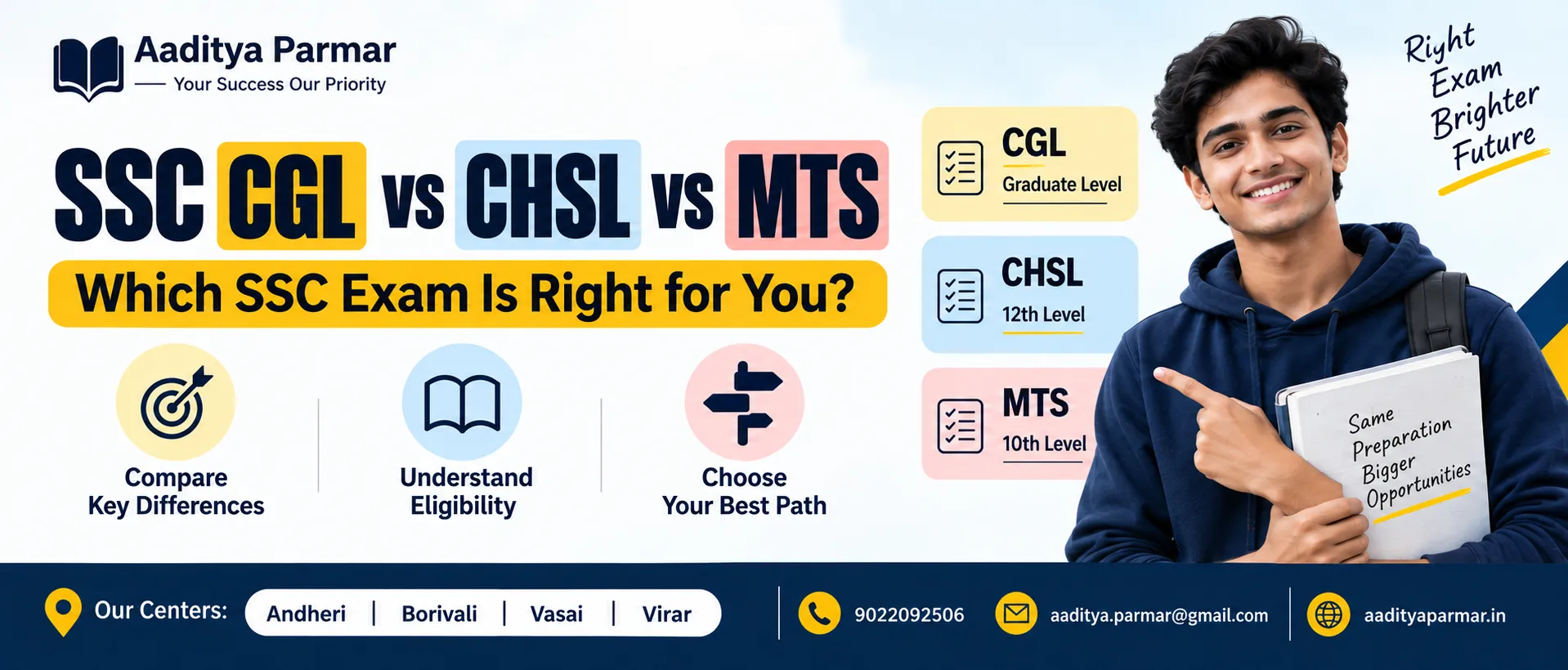
The SSC CGL, SSC CHSL and SSC MTS examinations are three major recruitment examinations conducted by the Staff Selection Commission, but they are designed for candidates with different educational qualifications and lead to different categories of government posts.
The biggest distinction is straightforward:
That does not mean one examination is automatically better than another. The appropriate examination depends on your education, age eligibility, career goals, preferred type of government work, preparation level and the posts available in the relevant recruitment cycle.
SSC CGL has a broad range of Group B and Group C posts. The current CGL examination structure includes Tier-I and Tier-II stages, with Tier-II containing Mathematical Abilities, Reasoning and General Intelligence, English Language and Comprehension, General Awareness and computer-related/skill components depending on the applicable stage and post.
SSC CHSL is aimed at recruitment to 10+2-level positions such as Lower Division Clerk/Junior Secretariat Assistant and Data Entry Operator categories, subject to the posts and requirements in the relevant notification. The 2025 CHSL notification specified Tier-I followed by Tier-II, including qualifying computer knowledge and typing/skill components where applicable.
SSC MTS is designed for Multi-Tasking Staff recruitment. The current MTS structure uses a Computer Based Examination with two sessions, while candidates applying for Havaldar positions have additional PET/PST requirements.
This guide explains the differences so you can identify which examination fits your current qualification and preparation objective.
Choosing the right SSC examination is one of the first decisions an aspirant should make.
Many students begin SSC preparation without deciding whether they want to target SSC CGL, SSC CHSL or SSC MTS. Although there is significant overlap between their subjects, the eligibility requirements, examination stages, post categories and career opportunities can differ.
This creates an important question:
SSC CGL vs CHSL vs MTS — which examination should you prepare for?
The answer depends on your individual circumstances.
For example, a student who has completed Class 12 may consider CHSL, while a graduate may be eligible for CGL depending on the specific post and notification requirements. A candidate meeting the applicable matriculation qualification may consider MTS.
Instead of asking which examination is universally “best,” it is more useful to ask:
Which SSC examination matches my qualification, career goals and preparation level?
This article provides a detailed comparison of the three examinations.
SSC CGL stands for Staff Selection Commission Combined Graduate Level Examination.
It is conducted for recruitment to various Group B and Group C posts in different ministries, departments and organizations of the Government of India.
Because it is a graduate-level examination, candidates generally need a bachelor’s degree or the specific qualification prescribed for the relevant post.
The CGL examination covers several subjects, including:
The exact requirements vary by post and recruitment cycle.
The current CGL scheme includes Tier-I and Tier-II. The official SSC CGL examination scheme specifies four sections in Tier-I: General Intelligence and Reasoning, General Awareness, Quantitative Aptitude and English Comprehension.
SSC CHSL stands for Staff Selection Commission Combined Higher Secondary (10+2) Level Examination.
It is intended primarily for candidates who have completed the required 10+2-level education.
CHSL provides recruitment opportunities for various Group C positions, depending on the applicable recruitment cycle.
Posts can include categories such as:
Specific educational requirements can vary by post.
The CHSL examination has multiple stages. The 2025 recruitment scheme included Tier-I and Tier-II, with Tier-II incorporating computer knowledge and skill/typing components depending on the post.
SSC MTS stands for Staff Selection Commission Multi-Tasking (Non-Technical) Staff Examination.
It is a recruitment examination for Multi-Tasking Staff positions in various central government ministries, departments and offices.
The qualification level is generally lower than that of CGL and CHSL.
The current MTS structure uses a Computer Based Examination with:
The latest available MTS scheme also distinguishes MTS recruitment from Havaldar recruitment, for which PET/PST requirements apply.
| Feature | SSC CGL | SSC CHSL | SSC MTS |
|---|---|---|---|
| Full Form | Combined Graduate Level | Combined Higher Secondary Level | Multi-Tasking Staff |
| Broad Qualification | Graduation | 10+2 | Matriculation |
| Main Level | Graduate | 12th | 10th |
| Major Recruitment Area | Group B & Group C posts | Group C posts | Multi-Tasking Staff |
| Exam Structure | Tier-I + Tier-II | Tier-I + Tier-II | Computer Based Examination |
| Main Subjects | Reasoning, GA, Quant, English | English, Reasoning, Quant, GA | Maths, Reasoning, GA, English |
| Skill Test | Depends on post | Typing/Skill requirements for applicable posts | Not generally for MTS; Havaldar has PET/PST |
| Preparation Level | Broadest of the three | Moderate | Comparatively foundational |
| Suitable For | Graduates | 12th-pass candidates | Eligible matriculation-level candidates |
Important: This table is a broad comparison. Candidates must check the latest SSC notification for exact post-wise qualifications, age limits, vacancies, examination stages and skill requirements.
SSC CGL is primarily intended for graduates.
Candidates generally need to possess a bachelor’s degree from a recognized university or institution, although certain posts can have additional or specific educational requirements.
Therefore, students who are currently in Class 12 should generally consider CHSL or another appropriate examination rather than assuming they can immediately apply for every CGL post.
The exact cut-off date for possessing the required qualification is specified in the relevant SSC notification.
SSC CHSL is primarily intended for candidates who have passed Class 12 or an equivalent qualification.
The applicable notification specifies the exact qualification requirements and any post-specific conditions.
For example, certain Data Entry Operator posts can have additional educational requirements depending on the department/post.
Therefore, candidates should not assume that simply passing Class 12 automatically qualifies them for every CHSL post.
Always check the individual post requirements.
SSC MTS is generally targeted at candidates who have passed the required matriculation-level qualification.
Candidates should verify the precise qualification and age requirements in the latest MTS notification.
For candidates who have completed Class 10 and want to enter central government service, MTS can therefore represent a different entry route from graduate-level CGL and 10+2-level CHSL.
This is one of the easiest ways to understand the difference.
Depending on the applicable notification and eligibility conditions, MTS may be one examination to consider.
CHSL may be an appropriate examination to consider.
CGL becomes an important examination to consider, subject to post-specific eligibility.
However, educational qualification should never be the only deciding factor.
Your career preference and preparation ability also matter.
The current SSC CGL structure contains multiple stages.
The official CGL scheme specifies Tier-I with:
The total is 100 questions for 200 marks, with a 60-minute duration under the standard timing arrangement. The official scheme also specifies negative marking in Tier-I.
Tier-II is more extensive and includes Mathematical Abilities, Reasoning and General Intelligence, English Language and Comprehension, General Awareness and qualifying computer/skill components, with additional papers for specific posts.
Therefore, CGL preparation needs to go beyond basic subject familiarity.
The CHSL examination uses multiple stages.
The 2025 official notification specified Tier-I as a Computer Based Examination covering:
Each section contains 25 questions for 50 marks, for a total of 100 questions and 200 marks.
Tier-II includes additional components such as computer knowledge and skill/typing requirements depending on the relevant post.
Because the Commission can revise examination structures, candidates should check the latest notification before finalising their preparation strategy.
The MTS examination uses a Computer Based Examination divided into two sessions.
| Subject | Questions | Marks |
|---|---|---|
| Numerical and Mathematical Ability | 20 | 60 |
| Reasoning Ability and Problem Solving | 20 | 60 |
| Subject | Questions | Marks |
|---|---|---|
| General Awareness | 25 | 75 |
| English Language and Comprehension | 25 | 75 |
The latest available MTS scheme specifies 45 minutes for each session under standard conditions.
For Havaldar recruitment, PET/PST requirements apply in addition to the Computer Based Examination.
There is considerable overlap among the three examinations.
Major subjects include:
Major subjects include:
Major subjects include:
This overlap is useful.
A candidate preparing for one SSC examination can often build a foundation useful for another examination, although the exact syllabus and depth must still be checked.
Rather than saying that one examination is simply “easy” or “hard,” it is better to understand what makes each preparation different.
CGL generally requires broader and deeper preparation because candidates compete for multiple graduate-level posts and the examination has a substantial Tier-II stage.
Candidates should develop:
CHSL is designed around the 10+2 level, but that does not mean preparation should be taken lightly.
Candidates still need:
MTS focuses more on foundational aptitude and general awareness.
Candidates should still prepare seriously because competition can be substantial.
The most important principle is:
Difficulty is relative to your current academic level and preparation.
The nature of work is another major difference.
Depending on the recruitment cycle and post allocation, CGL can lead to roles involving:
The exact post list changes according to vacancies and departments.
CHSL recruitment can include positions such as:
These roles can involve:
MTS positions involve support functions within central government offices.
Depending on the department, duties can include:
The exact responsibilities depend on the department and post.
A graduate has more than one possible SSC pathway.
CGL is the major graduate-level examination among these three.
However, a graduate may also be eligible for CHSL or MTS if the relevant notification permits candidates meeting the lower qualification.
The practical question is not simply:
“I am a graduate, so which exam should I take?”
Instead consider:
For students who have completed Class 12, CHSL is particularly relevant because it is a 10+2-level recruitment examination.
Students should still check:
A student may also begin preparing foundational subjects that are useful across several SSC examinations.
Candidates who have completed Class 10 can consider examinations for which they meet the applicable eligibility conditions.
MTS is one important SSC examination to examine because its qualification level is generally matriculation-based.
However, candidates should always check the latest official notification before applying.
Salary should not be the only factor when choosing an SSC examination.
Candidates should compare:
CGL includes several posts across different pay levels, while CHSL and MTS recruitment cover different categories of positions.
The exact salary and allowances can depend on the post, department, location and applicable government rules.
Career progression varies according to the post and department.
Because CGL recruits for a broad range of Group B and Group C roles, career paths can differ significantly from one post to another.
CHSL positions can provide opportunities for departmental experience and promotion under applicable service rules.
MTS employees can also progress through departmental processes and applicable service rules.
Therefore, candidates should research the specific post, not just the examination name.
All three examinations can attract a large number of candidates.
However, comparing competition simply by registration numbers does not tell you whether one examination is appropriate for you.
Instead, focus on:
Competition also changes from one recruitment cycle to another.
Use this simple decision framework.
Yes, to an extent.
There is considerable overlap in:
However, preparing for all three simultaneously without a clear priority can become confusing.
A better strategy is:
Choose one primary examination.
Build common subjects.
Add examination-specific preparation.
For example, a CGL candidate can develop a strong foundation in Maths, Reasoning, English and General Awareness and then add CGL-specific Tier-II preparation.
Several subjects can be studied together.
Focus on:
Study:
Study:
Cover:
If you are confused between CGL, CHSL and MTS, do not immediately start collecting study materials for all three.
First determine your eligibility.
Then:
Build common fundamentals.
Start previous-year questions.
Begin examination-specific mock tests.
Focus on your primary examination.
This approach reduces duplication and improves preparation efficiency.
Students looking for SSC coaching in Mumbai can compare institutes based on faculty, course structure, study material, mock tests, previous-year questions and doubt-solving support.
Preparation support is available across four locations:
Andheri | Borivali | Vasai | Virar
Students should choose the location that fits their daily routine and allows them to attend consistently.
A nearby coaching centre can also reduce commuting time and leave more time for self-study and revision.
Students searching for SSC classes in Andheri can compare coaching options based on:
A demo class can help students understand the teaching methodology before enrolling.
For students looking for SSC classes in Borivali, factors such as faculty quality, batch schedule, test series and study material should be evaluated.
Students should also consider travel time because consistent attendance is important during long-term SSC preparation.
Students looking for SSC classes in Vasai can consider a local coaching option to reduce daily travel.
Before joining, ask about:
Candidates searching for SSC classes in Virar should evaluate institutes based on:
The best option for an individual student is the one that fits their preparation requirements and routine.
Before enrolling, ask:
Salary matters, but job responsibilities and eligibility also matter.
Your educational qualification and career goals may be different.
Trying to prepare equally for three examinations can dilute your focus.
SSC rules can change.
CHSL and CGL can have skill/computer-related components depending on the post and stage.
The same examination can recruit for very different roles.
| Your Situation | Examination to Consider |
|---|---|
| Class 10 qualified | MTS, where eligible |
| Class 12 qualified | CHSL, where eligible |
| Graduate | CGL, where eligible |
| Want graduate-level posts | CGL |
| Want clerical/DEO-type roles | CHSL |
| Interested in MTS positions | MTS |
| Want broader graduate-level options | CGL |
| Want 10+2-level recruitment | CHSL |
| Want a matriculation-level SSC route | MTS |
This is a qualification-and-goal guide, not a ranking. The right choice depends on the latest notification and the candidate’s individual circumstances.
CGL is primarily a graduate-level recruitment examination, CHSL is a 10+2-level examination, and MTS is primarily a matriculation-level recruitment examination for Multi-Tasking Staff positions.
SSC CGL is the principal graduate-level examination among these three. Candidates must still verify the specific educational and post requirements in the applicable notification.
SSC CHSL is primarily designed for candidates who have completed the required 10+2 qualification.
SSC MTS is an important examination to consider for candidates meeting the applicable matriculation-level eligibility requirements.
The examinations have different structures and preparation requirements. CGL has a broader graduate-level recruitment scope and a substantial Tier-II stage, while CHSL is designed around 10+2-level eligibility. Difficulty also depends on the candidate’s preparation.
MTS generally tests more foundational subjects than CGL, but candidates should not assume that selection is easy. Competition and cut-offs vary by recruitment cycle.
A graduate may meet CHSL’s educational requirement because it is based on 10+2-level qualification, but candidates must satisfy all conditions in the relevant notification.
CGL is primarily a graduate-level examination, so a candidate generally needs the prescribed bachelor’s degree for the relevant post by the applicable qualification cut-off date.
Salary varies by post, pay level, department and applicable allowances. CGL includes several higher-level posts, but candidates should compare the specific post rather than judging only by the examination name.
Yes. There is significant overlap in Mathematics, Reasoning, English and General Awareness. However, you should choose a primary examination and add the examination-specific topics separately.
Yes. Their foundational subjects overlap considerably. A common preparation plan can cover Mathematics, Reasoning, English and General Awareness, followed by examination-specific practice.
There is no universally best examination. Graduates can evaluate CGL and other SSC examinations according to their preferred posts, eligibility, career goals and preparation level.
The three examinations have significant overlap in Mathematics or numerical ability, reasoning, English and General Awareness, although the depth and exact syllabus vary.
SSC preparation support is available across Andheri, Borivali, Vasai and Virar. Candidates can contact Aaditya Parmar for information about available classes and preparation options.
You can contact Aaditya Parmar at 9022092506, email aaditya.parmar@gmail.com, or visit https://aadityaparmar.in.
The choice between SSC CGL vs CHSL vs MTS should begin with one simple question:
What are you eligible for, and what type of government career are you targeting?
SSC CGL is primarily a graduate-level pathway covering a broad range of Group B and Group C positions.
SSC CHSL is designed around 10+2-level eligibility and includes roles such as LDC/JSA and DEO categories depending on the recruitment cycle.
SSC MTS provides a matriculation-level route to Multi-Tasking Staff positions.
None of these examinations should be treated as universally “best.”
Instead, evaluate:
If you are a graduate and want to target graduate-level SSC opportunities, CGL may be an important examination to consider.
If you have completed Class 12 and are looking for 10+2-level recruitment, CHSL may be relevant.
If you meet the matriculation-level requirements and are interested in Multi-Tasking Staff recruitment, MTS may be relevant.
The best strategy is to choose a primary target and prepare systematically rather than dividing your attention equally among multiple examinations.
For candidates preparing in Mumbai, SSC preparation support is available across:
Andheri | Borivali | Vasai | Virar
Phone: 9022092506
Email: aaditya.parmar@gmail.com
Website: https://aadityaparmar.in
Always verify the latest examination notification, eligibility requirements, vacancies, syllabus, examination dates and selection process on the official SSC website before applying. SSC maintains examination schemes and candidate resources through its official portal.